

In many Javanese families, the conversation about marriage becomes more serious when someone asks for the couple’s weton. The question is not only about a birth date. It often opens a wider family discussion about pasaran, neptu, compatibility, wedding timing, blessings, and readiness.
This is why Weton for marriage needs to be read with care. It can help families begin a thoughtful conversation before marriage, but it should not become pressure. Weton is not a judge’s hammer that decides whether two people will certainly match, fail, or live happily.
In JavaSense, weton before marriage is safer as cultural reflection. It may help a couple and family move with more awareness, but the decision to marry still needs communication, family blessing, emotional readiness, responsibility, and real-life conditions.
Quick Answer: What Is Weton for Marriage?
Weton for marriage is the Javanese cultural reading of a couple’s birth weekday, pasaran, neptu, compatibility, and possible wedding timing before marriage. It is often used by families as one consideration when preparing for engagement or a wedding.
But weton should not be treated as a final verdict. A supportive result does not guarantee a happy marriage, and a heavy result does not mean a couple must separate or cancel the wedding. Weton is best used as a starting point for family dialogue, not as fear.
- Weton comes from a birth weekday and Javanese pasaran.
- Neptu is calculated from weekday value plus pasaran value.
- Weton compatibility can be read as relationship reflection, not as a marriage verdict.
- A Javanese wedding date should also consider family readiness, calendar context, and real conditions.
- To begin, calculate weton from a birth date for each partner.
What Families Read from a Couple’s Weton
When families discuss weton before marriage, they usually look at several layers. The first layer is the birth weekday and Javanese pasaran. The second is neptu, the numerical value formed from both. The third is compatibility, which may be read through certain traditional patterns.
In some families, the discussion may also connect with a good wedding date, family remembrance days, and wuku in the Pawukon cycle. This shows that marriage in Javanese culture is not only seen as the union of two people, but also as the meeting of families, time, tradition, and responsibility.
Still, one boundary must be kept clear: weton is not the judge of a relationship. It is one cultural language for opening conversation.
Why Weton for Marriage Is Still Searched Today
Weton for marriage is still searched because many Javanese families see marriage as a major life step. Marriage is not only about affection between two people. It also brings together two family histories, two ways of living, and two directions for the future.
Because of that, some families want to read weton before deciding the next step. Some want to understand compatibility. Some want to calculate neptu. Some want to choose a wedding date. Others simply want to honor the memory of elders and inherited tradition.
JavaSense places this search in a careful position. Tradition may be respected, but it should not turn into pressure. A good cultural reading should help the couple and family feel clearer, not more afraid.
Weton for Marriage and Javanese Primbon
Weton for marriage is often connected with Primbon, a traditional Javanese body of knowledge used to read patterns, timing, conduct, and life events through cultural signs.
In wedding discussions, Primbon may be used to consider weton, neptu, compatibility, good days, and other family-related concerns. But JavaSense does not read Primbon as fixed fortune-telling. It is better understood as cultural reflection.
A Primbon-based reading can become one consideration, but it should not be the only foundation for deciding marriage. The couple still needs emotional readiness, family support, financial responsibility, communication, health, and a real commitment to build a life together.
Seven Ways to Read Weton Before Marriage
To avoid fear or misunderstanding, weton before marriage should be read in a clear, safe, and family-sensitive way. These seven steps can help.
1. Know Each Partner’s Weton
The first step is to know each partner’s weton. Weton comes from the combination of a birth weekday and Javanese pasaran.
For example, someone born on Friday with the pasaran Kliwon has the weton Friday Kliwon. Someone born on Monday with the pasaran Legi has the weton Monday Legi.
If the couple does not know their weton yet, use the JavaSense weton calculator to find each partner’s weton, pasaran, and neptu from a birth date.
2. Understand Javanese Pasaran
Javanese pasaran consists of Legi, Pahing, Pon, Wage, and Kliwon. Pasaran joins with the ordinary weekday to form weton.
Pasaran matters because each pasaran has a neptu value. That value is added to the weekday value when someone calculates neptu weton.
To learn the five-day cycle more clearly, read Javanese pasaran.
3. Calculate Neptu Weton
Neptu is the numerical value of a weekday and pasaran. In weton reading, weekday neptu is added to pasaran neptu.
For example, Friday Kliwon has a neptu of 14 because Friday has a value of 6 and Kliwon has a value of 8. Monday Legi has a neptu of 9 because Monday has a value of 4 and Legi has a value of 5.
To understand the values more deeply, read neptu weton values.
4. Read Compatibility as Reflection
After each partner’s weton and neptu are known, the family may read the couple’s compatibility through Javanese relationship patterns. This is often called weton jodoh or weton compatibility.
But the result should not be read as a final verdict. If the result feels supportive, the relationship still needs care. If the result feels heavy, do not panic. Use it as a starting point for dialogue about communication, family blessing, emotional readiness, and responsibility.
For practical reflection, use the JavaSense weton compatibility tool. To understand the method, read how to calculate weton compatibility.
5. Connect It with a Javanese Wedding Date
A couple’s weton may become one consideration when a family looks for a Javanese wedding date. But a wedding date should not be chosen from weton alone.
A good date also needs the Javanese calendar, family availability, venue readiness, health, budget, travel distance, and the practical needs of both families.
To read dates in a wider cultural context, check the Javanese calendar and see how date, pasaran, weton, and wuku appear together.
6. Respect Geblak and Family Tradition Carefully
In some Javanese families, wedding timing may also consider geblak, a family remembrance-related timing concern connected with the death day of a respected family member or ancestor.
This practice differs from one family to another. Because of that, geblak should not be applied rigidly to everyone. It is better discussed calmly with each family so tradition can be honored without becoming a source of pressure.
For global readers, the important point is simple: some families consider family memory when choosing a major event date, but the practice is not the same in every household.
7. Keep Family Blessing and Dialogue at the Center
Weton may be calculated, but family blessing and dialogue still matter. In Javanese culture, marriage is often discussed in the family space, not only decided by two individuals.
If there is disagreement about weton, speak calmly. Do not use weton to pressure a partner. At the same time, do not dismiss family members who still hold the tradition. The healthier path is respectful dialogue.
Weekday Neptu Values
The table below shows the weekday neptu values commonly used in Javanese weton reading.
| Weekday | Javanese / Indonesian Name | Neptu Value |
|---|---|---|
| Sunday | Minggu | 5 |
| Monday | Senin | 4 |
| Tuesday | Selasa | 3 |
| Wednesday | Rabu | 7 |
| Thursday | Kamis | 8 |
| Friday | Jumat | 6 |
| Saturday | Sabtu | 9 |
Javanese Pasaran Neptu Values
Javanese pasaran also has neptu values. These values are added to weekday values to calculate neptu weton.
| Javanese Pasaran | Neptu Value |
|---|---|
| Legi | 5 |
| Pahing | 9 |
| Pon | 7 |
| Wage | 4 |
| Kliwon | 8 |
These numbers help readers understand the calculation. But neptu should still be read as a cultural symbol, not as a measure of someone’s value.
Example: Monday Legi and Friday Kliwon Before Marriage
For example, one partner has the weton Monday Legi. Monday has a value of 4 and Legi has a value of 5, so the neptu is 9.
Monday Legi = Monday 4 + Legi 5 = 9.
The other partner has the weton Friday Kliwon. Friday has a value of 6 and Kliwon has a value of 8, so the neptu is 14.
Friday Kliwon = Friday 6 + Kliwon 8 = 14.
In Javanese cultural reading, these numbers may become material for reading compatibility and considering wedding timing. But numbers should not become the judge of the relationship.
What matters more is how two people build communication, guard family blessing, and prepare themselves to live together with responsibility.
Weton Compatibility Results Before Marriage
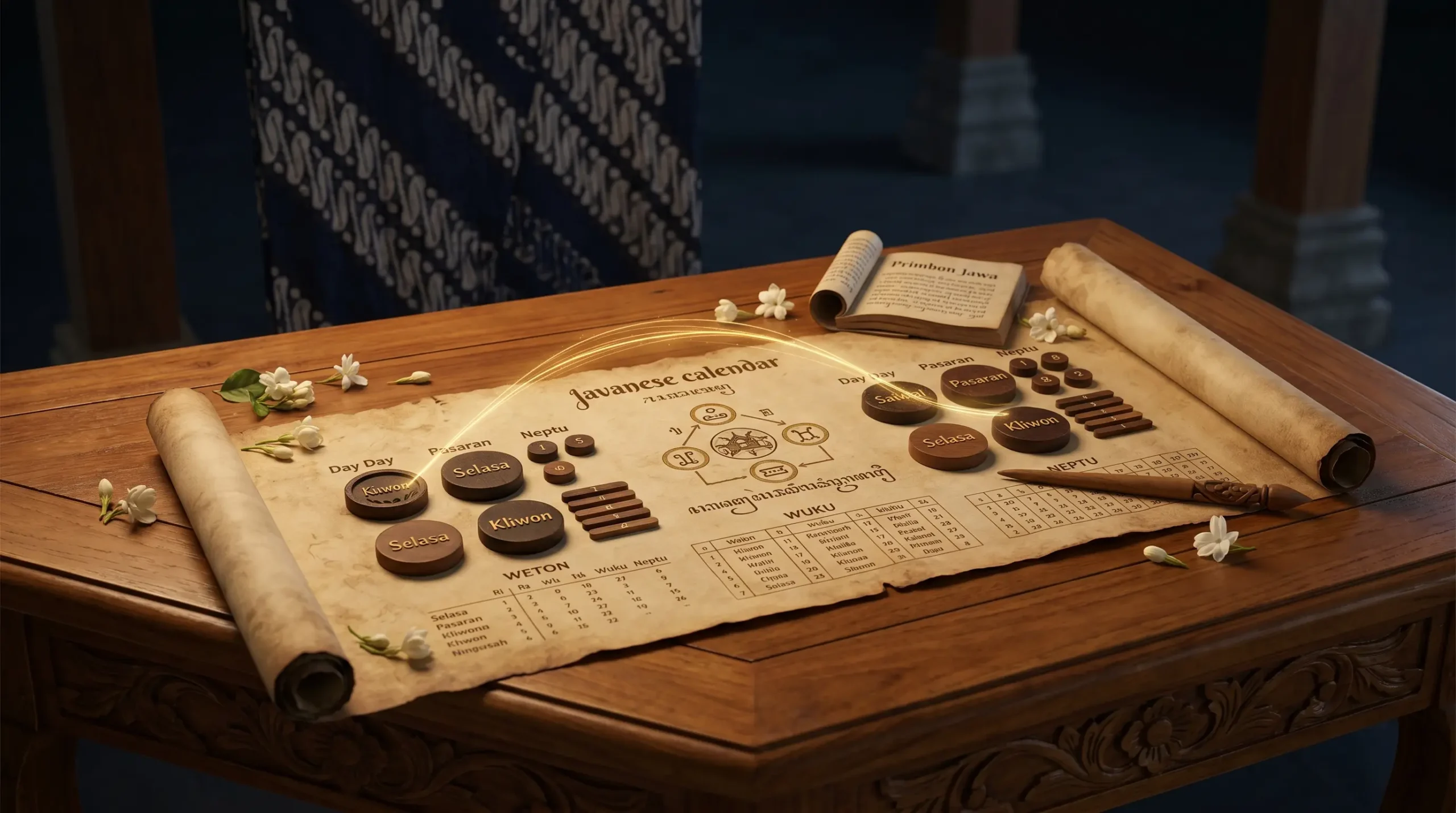
In Javanese marriage discussions, weton is often used to read weton compatibility. Usually, the neptu of both partners is calculated and then read through certain cultural patterns.
Some common result names include Pegat, Ratu, Jodoh, Topo, Tinari, Padu, Sujanan, and Pesthi. These terms can make people anxious when they are read too harshly.
| Weton Compatibility Result | Common Cultural Meaning | JavaSense Reading |
|---|---|---|
| Pegat | Often seen as a result that needs caution. | A reminder to guard communication, not a verdict of separation. |
| Ratu | Often read as a respected or harmonious relationship. | A reminder to protect dignity and mutual respect. |
| Jodoh | Often understood as good suitability. | A reminder that compatibility still needs care. |
| Topo | Often connected with tests or patient effort. | A reminder to stay steady, patient, and supportive. |
| Tinari | Often connected with sufficiency and calmness. | A reminder to keep working, stay grateful, and avoid carelessness. |
| Padu | Often connected with sharp words or conflict. | A reminder to care for speech, emotion, and dialogue. |
| Sujanan | Often connected with tests of trust. | A reminder to guard honesty, openness, and trust. |
| Pesthi | Often read as peace or stability. | A reminder that peace still needs responsibility. |
To understand these result names in detail, read Weton compatibility results. To keep the reading safe, also read weton compatibility is not a verdict.
If the Weton Result Does Not Match, Can the Couple Still Marry?
A weton result that feels not matching does not automatically mean a couple should not marry. In Javanese tradition, a heavy result is better understood as a point of reflection and caution, not an absolute ban.
The decision to marry still needs many considerations: emotional readiness, family blessing, communication, responsibility, shared values, economic condition, health, and the couple’s way of solving problems.
If the weton result feels heavy, use it as a reminder to be more careful. Do not panic immediately, but also do not ignore real problems. For a focused reading, open when weton compatibility does not match.
Weton for Marriage and Choosing a Javanese Wedding Date
Weton for marriage is often read together with the search for a good wedding date. After the couple’s weton is known, the family may look at several possible dates through the Javanese calendar.
From those dates, the family may consider weekday, pasaran, daily weton, neptu, wuku, and family tradition. But all of this still needs to be balanced with real readiness: venue, cost, travel, health, family schedule, and the emotional readiness of the couple.
For a practical calendar view, use the JavaSense Javanese calendar. To understand how date, pasaran, weton, neptu, and wuku appear together, read Javanese weton calendar.
Geblak and Family Tradition in Javanese Marriage
In some Javanese families, wedding timing may also be connected with geblak. This usually relates to family remembrance around the death day of a respected family member or ancestor.
Some families choose to avoid certain days for major events. Other families may not use this practice at all. Because of that, geblak should be discussed in a calm family setting, not forced as a universal rule.
Family tradition deserves respect, but it should not be used to pressure the couple. The healthiest reading is one that keeps memory, family feeling, and practical readiness in balance.
Weton, Wuku, and Pawukon Before Marriage
Besides weton, some Javanese cultural readings may also consider wuku. Wuku comes from the Pawukon cycle, which consists of 30 wuku.
Wuku is different from weton. Weton comes from weekday and pasaran, while wuku belongs to the Pawukon cycle. They can become complementary cultural layers, but they should not be treated as the same thing.
To understand this clearly, read the difference between weton and wuku, Weton, Wuku, and Pawukon, and Pawukon and the 30 wuku cycle.
Is There a Best Weton for Marriage?
This question appears often. But JavaSense does not recommend reading weton through an absolute “best” or “worst” label.
Every weton has its own cultural language. What matters is not only someone’s weton, but also readiness, communication, responsibility, family blessing, and the way two people live their relationship.
Because of that, weton is better read as reflection. It should not become a final label used to decide that someone is completely suitable or unsuitable for marriage.
Myths and Safer Facts About Weton for Marriage
Many people search for weton before marriage because they want a quick answer. But quick answers still need to be read carefully.
| Myth | Safer Fact |
|---|---|
| Weton decides whether a marriage will be happy or fail. | No. Weton is a cultural consideration, not an absolute decision about married life. |
| A higher neptu is always better for marriage. | No. Neptu is a cultural symbol, not a measure of human value or relationship quality. |
| If weton does not match, the couple may not marry. | Not automatically. A heavy result is better used as material for dialogue and caution. |
| A good wedding date can be chosen from weton alone. | No. The date also needs calendar context, family readiness, practical conditions, and each family’s tradition. |
| There is one best weton for marriage. | No. Weton should be read with context, not as a universal ranking of good and bad. |
A Family Case: When Weton Creates Worry Before Marriage
Imagine a couple preparing to move toward engagement. They feel ready, but when the family begins calculating weton, the result is considered heavy. The warm atmosphere suddenly becomes full of questions.
In a situation like this, JavaSense does not invite readers to reject tradition. But weton should not become the only judge. What needs to be read is also the real condition: can the couple speak honestly, can the families discuss calmly, is marriage readiness already clear, and is the decision being carried with responsibility?
Weton can become a starting point for family dialogue. It may open conversation about caution, blessing, readiness, and shared hope. But it should not become a reason to frighten a couple without seeing the reality of their relationship.
Common Mistakes When Reading Weton for Marriage
Several mistakes often happen when someone reads weton before marriage. These mistakes should be avoided so tradition does not become pressure.
- Making weton the only decision. Marriage cannot be understood from one calculation alone.
- Using weton to frighten a partner. Tradition should become dialogue, not a threat.
- Treating a supportive result as a guarantee. Good results still need communication and responsibility.
- Treating a heavy result as an absolute ban. Heavy results are better read as signs of caution.
- Forgetting real readiness. Marriage needs family, place, budget, health, communication, and readiness to live together.
Ky Tutur’s reflection: Weton before marriage is not a judge over love. It is closer to a small lamp: it may help a family walk with more awareness, but the path of marriage still needs heart, dialogue, and responsibility.
Use JavaSense to Read Weton, Compatibility, and Calendar
JavaSense provides several doorways for reading Javanese culture more practically. To know the couple’s weton, use the JavaSense weton calculator. To read a possible wedding date through the Javanese calendar, open the JavaSense Javanese calendar.
To reflect on compatibility, use the JavaSense weton compatibility tool. To understand the result, read Weton compatibility results, weton compatibility is not a verdict, and when weton compatibility does not match.
For wider learning, continue with Javanese weton, Javanese pasaran, neptu weton values, weton is not fortune telling, and Javanese weton myths.
To explore weton, the Javanese calendar, Primbon reflection, wuku, Pawukon, and Javanese script in one place, JavaSense can also be read as a Javanese cultural platform.
Cultural References on Weton, Primbon, and the Javanese Calendar
In Javanese tradition, weton for marriage is connected with Primbon, petungan, the Javanese calendar, pasaran, and the way families arrange caution before a major ceremony.
For library references, readers may explore Kitab Primbon Jawa Serbaguna in BintangPusnas. The Primbon catalog entry at the National Library of Indonesia also shows Primbon as part of the written cultural heritage around good days, character reflection, and Javanese tradition.
External references help give general cultural context. JavaSense presents the same cultural space in a more practical, reflective, and safe way for modern readers.
Closing: Marriage Needs a Clear Heart
Weton for marriage is one way Javanese culture reads the meeting of two people. Inside it, there are birth days, pasaran, neptu, compatibility, wedding timing, and family blessing.
But marriage does not end in calculation. Marriage is a long practice: learning to listen, learning to care, learning to hold back ego, and learning to grow together through easy and difficult seasons.
So read weton calmly. Respect the tradition, understand its limits, and use it as a cultural mirror for preparing marriage with more awareness.
To learn weton, relationship reflection, pasaran, neptu, the Javanese calendar, and script in a lighter way, you can also open JavaSense on Google Play.
FAQ About Weton for Marriage
What is weton for marriage?
Weton for marriage is the reading of a couple’s weton as one Javanese cultural consideration before marriage, including compatibility, neptu, pasaran, and possible wedding timing.
Does weton decide whether a couple should marry?
No. Weton should not decide marriage by itself. It is safer to read it as cultural reflection and family dialogue, not as a final verdict.
How can I find each partner’s weton before marriage?
The practical way is to use the JavaSense weton calculator. It can help find each partner’s weekday, Javanese pasaran, weton name, and neptu from a birth date.
How is weton related to a Javanese wedding date?
Weton may become one consideration when families discuss a Javanese wedding date, but the date should also consider the Javanese calendar, family readiness, health, budget, and practical conditions.
Is there a best weton for marriage?
JavaSense does not read weton as absolutely best or worst for marriage. Every weton needs to be understood with context, communication, readiness, and responsibility.
Is a higher neptu better for marriage?
No. A higher neptu is not automatically better, and a lower neptu is not bad. Neptu is a cultural symbol, not a measure of human value or relationship quality.
Can a couple still marry if the weton result feels heavy?
Yes, if the decision is taken with maturity. A heavy weton result should become a starting point for dialogue and caution, not an automatic marriage ban.
Where can I check weton compatibility for marriage?
You can use the JavaSense weton compatibility tool to read weton-based relationship reflection from two birth dates in a practical and careful way.