

Many people begin searching for Primbon Weton after hearing a simple family question: “What is your weton?” From that small question, the conversation can quickly widen into pasaran, neptu, character reading, relationships, good days, and the Javanese calendar.
Weton feels close because it begins with a person’s birth day. Yet it can also make people uneasy when it is read too rigidly. Some worry that their calculation is “bad.” Others fear that weton may be used to judge relationships, fortune, or the future as if everything has already been decided.
JavaSense reads Primbon Weton in a calmer way. Weton is part of Javanese Primbon heritage: a cultural language for understanding birth time, not a tool for judging human life.
Quick Answer: What Is Primbon Weton?
Primbon Weton is the reading of weton within the Javanese Primbon tradition. Weton comes from the combination of a birth weekday and the five-day Javanese pasaran cycle, such as Senin Legi, Jumat Kliwon, Rabu Pon, or Sabtu Pahing. From that combination, a person can find neptu, the numerical value of the weekday and pasaran.
In Javanese culture, Primbon Weton is often used to reflect on cultural tendencies, relationship compatibility, good days, and a person’s connection with the Javanese calendar. But weton is safest when read as a cultural mirror and a space for reflection, not as a verdict on fate or a measure of someone’s worth.
Primbon Jawa and Primbon Weton: What Is the Difference?
Javanese Primbon is the larger body of traditional Javanese knowledge. It includes discussions of weton, pasaran, neptu, good days, relationships, natural signs, ilmu titen, the Javanese calendar, and personal conduct.
Primbon Weton is more specific. It focuses on reading birth day, Javanese pasaran, neptu, and the cultural meanings that arise from the weekday-pasaran combination.
So Primbon Weton does not replace Javanese Primbon as a whole. It is one doorway into how Javanese communities read birth time and place it within a wider cultural conversation.
The Basic Elements of Primbon Weton
To understand Primbon Weton, readers need four basic elements: weekday, pasaran, weton, and neptu. They are connected, but they should not be mixed carelessly.
| Element | Basic Meaning | Example |
|---|---|---|
| Weekday | The ordinary seven-day calendar day. | Sunday, Monday, Tuesday, Wednesday, Thursday, Friday, Saturday. |
| Pasaran | The five-day Javanese market-day cycle. | Legi, Pahing, Pon, Wage, Kliwon. |
| Weton | The combination of a weekday and Javanese pasaran. | Jumat Kliwon, Senin Legi, Rabu Pon. |
| Neptu | The total numerical value of the weekday and pasaran. | Jumat Kliwon = 6 + 8 = 14. |
Neptu Values for Javanese Weekdays
These are the weekday neptu values commonly used in Javanese weton readings:
| Javanese / Indonesian Day | English Day | Neptu |
|---|---|---|
| Minggu | Sunday | 5 |
| Senin | Monday | 4 |
| Selasa | Tuesday | 3 |
| Rabu | Wednesday | 7 |
| Kamis | Thursday | 8 |
| Jumat | Friday | 6 |
| Sabtu | Saturday | 9 |
Neptu Values for the Javanese Pasaran Cycle
These are the pasaran neptu values commonly used in weton calculation:
| Javanese Pasaran | Neptu |
|---|---|
| Legi | 5 |
| Pahing | 9 |
| Pon | 7 |
| Wage | 4 |
| Kliwon | 8 |
How to Read Primbon Weton Wisely
To avoid fear or misunderstanding, Primbon Weton should be read step by step. The goal is not to trap a person inside a number, but to understand how Javanese culture reads birth time.
1. Start from the Birth Date
The first step is knowing the birth date. From that date, a person can find the weekday and the Javanese pasaran that applied on that day.
For a practical method, use the JavaSense tool to calculate weton from a birth date. This helps readers find the weekday, pasaran, and neptu without doing the calculation manually.
2. Find the Weekday
The ordinary weekday comes from the seven-day cycle: Sunday, Monday, Tuesday, Wednesday, Thursday, Friday, and Saturday. This is one part of weton.
But the weekday alone is not enough. To find weton, it must be combined with the Javanese pasaran.
3. Find the Javanese Pasaran
The Javanese pasaran consists of Legi, Pahing, Pon, Wage, and Kliwon. It moves in a five-day cycle and is one of the most important elements in weton reading.
If someone was born on Friday and the pasaran was Kliwon, the weton is Jumat Kliwon. If someone was born on Monday and the pasaran was Legi, the weton is Senin Legi.
4. Combine Weekday and Pasaran into Weton
Weton is formed from the meeting of the ordinary weekday and the Javanese pasaran. Because there are seven weekdays and five pasaran days, there are 35 weton combinations.
Examples include Senin Legi, Selasa Pahing, Rabu Pon, Kamis Wage, Jumat Kliwon, Sabtu Pahing, Minggu Wage, and other combinations in the 35-day cycle.
5. Calculate the Neptu Weton
Javanese neptu is the numerical value used in weton calculation. The neptu of the weekday is added to the neptu of the pasaran.
For example, Jumat Kliwon has neptu 14 because Jumat is valued at 6 and Kliwon is valued at 8. Senin Legi has neptu 9 because Senin is valued at 4 and Legi is valued at 5.
6. Read Cultural Meaning, Not a Verdict
After finding weton and neptu, readers may explore the cultural meaning. But that meaning should never become a verdict on life.
Weton can be a mirror for understanding tendencies, but a human being is always wider than weton. Character is shaped by family, education, environment, experience, choices, and self-awareness.
7. Connect Weton with the Javanese Calendar
Weton does not stand alone. It is connected to the Javanese calendar, pasaran, neptu, and the wider Primbon tradition. Readers should see weton as one part of a larger cultural system.
With this approach, Primbon Weton does not stop at calculation. It becomes a doorway into how Javanese culture reads the relationship between time, birth, family, and personal conduct.
Examples of Primbon Weton Calculation
Here is the first example. Someone is born on Jumat Kliwon. Jumat has neptu 6, while Kliwon has neptu 8. The total is:
Jumat Kliwon = Jumat 6 + Kliwon 8 = 14
In cultural reading, Jumat Kliwon is often associated with depth of feeling, inner steadiness, and a certain sensitivity. But this does not mean that all people born on Jumat Kliwon are the same. Each person is still shaped by experience, family, education, environment, and personal choices.
Here is the second example. Someone is born on Senin Legi. Senin has neptu 4, while Legi has neptu 5. The total is:
Senin Legi = Senin 4 + Legi 5 = 9
Neptu 9 can be read as part of a cultural symbol. But the number should not become a measure of human value. This is how JavaSense reads Primbon Weton: slowly, reflectively, and without judgment.
A Practical Case: When Weton Is Discussed for a Relationship
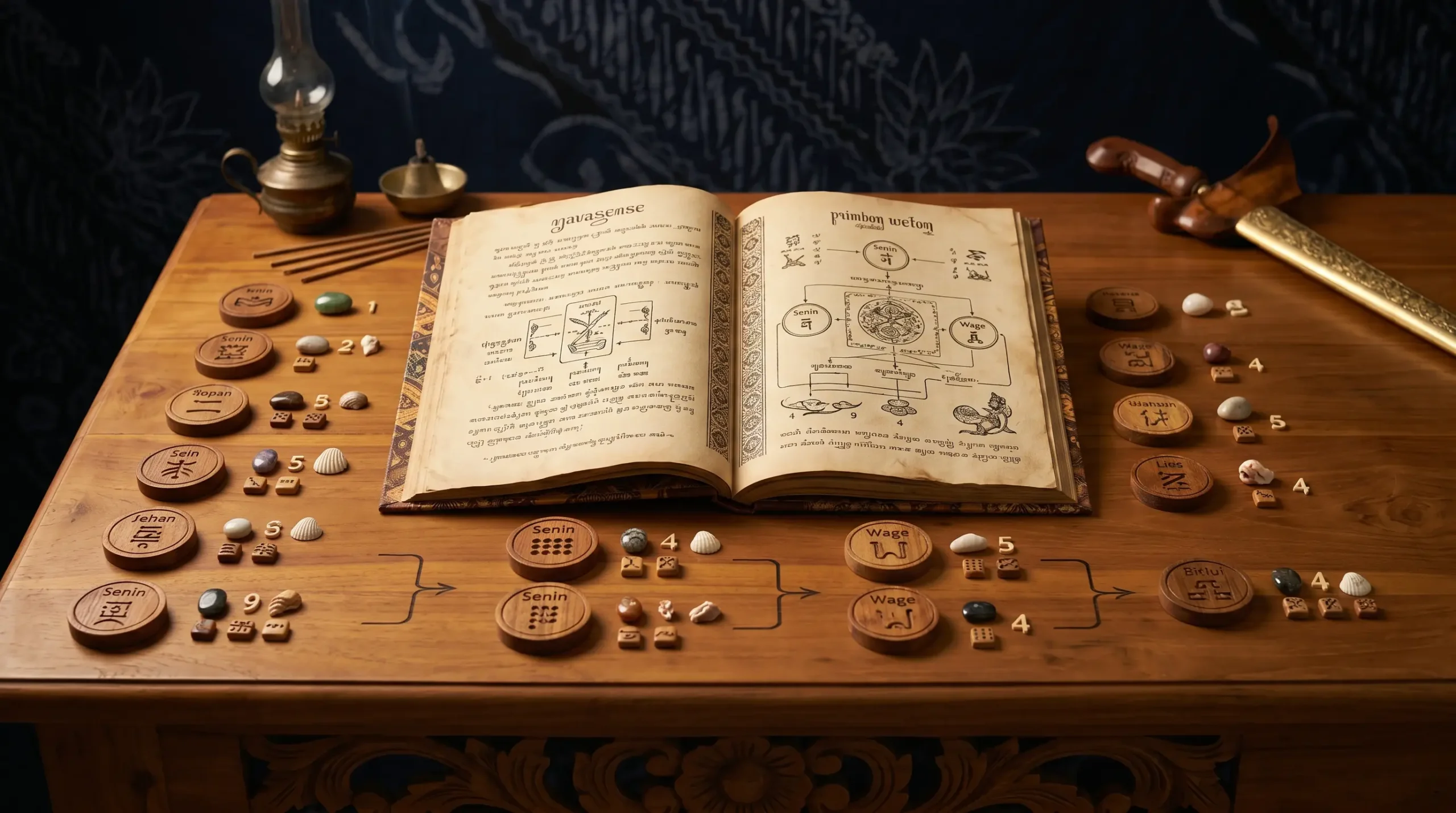
Imagine someone preparing for a more serious relationship. The family begins asking for each person’s weton. After the calculation, the result feels heavy, and a previously calm situation begins to feel uncertain.
In this kind of moment, Primbon Weton does not need to become a judge. Neptu can become a topic of conversation, but the relationship still needs to be seen through real matters: communication, family blessing, responsibility, emotional readiness, and how two people handle problems together.
If a weton result feels difficult, it can be read as a reminder to be more careful. It should not become an automatic reason to fear, blame, or end a relationship without dialogue.
Primbon Weton and Cultural Character Reading
In Javanese tradition, weton is often connected with cultural character reading. A person may be described as patient, strong, open, reserved, gentle, firm, sensitive, or steady based on weton and neptu symbolism.
But character reading should never become a rigid label. A person should not be treated as “certainly this” or “certainly that” only because of weton.
Readers who feel worried by harsh weton labels can read why “bad weton” should be read carefully. This helps keep weton in its proper place: a cultural mirror, not a sentence.
Ky Tutur’s reflection: Weton may become a small mirror for looking at the self. But do not let the mirror replace your steps, your choices, and your responsibility.
Primbon Weton and Relationship Compatibility
In relationship discussions, Primbon Weton is often used to read compatibility based on the weton and neptu of two people. From this practice, Javanese tradition knows several symbolic relationship patterns.
But weton compatibility should not be read as a verdict. Human relationships are not completed by numbers alone. Communication, family blessing, responsibility, shared values, and emotional maturity remain essential.
To explore this carefully, readers can read weton compatibility with care using the JavaSense tool. The result should be treated as cultural reflection, not as a command about whether a relationship must continue or end.
Primbon Weton and Good Days
Primbon Weton is also often connected with the search for good days. In Javanese culture, weton and neptu may become one consideration when families discuss important events.
But a good day should not be read as a guarantee of success. A day considered favorable still needs real preparation. A day that feels heavy does not mean someone must be afraid to move forward.
For family events, marriage, moving house, or other important plans, weton can be one cultural consideration beside readiness, health, budget, location, timing, and communication.
Primbon Weton, the Javanese Calendar, Wuku, and Pawukon
Weton is always connected to the Javanese calendar because weton is born from the meeting of weekday and pasaran. Without the Javanese calendar, it is difficult to know the pasaran of a specific date accurately.
Weton is also different from wuku. Weton comes from weekday and pasaran, while wuku belongs to the Pawukon cycle, which consists of 30 wuku across a 210-day cycle.
In Javanese cultural reading, weton and wuku may complement each other, but they should not be treated as the same thing. To understand this layer of time, explore Pawukon and the 30 wuku cycle.
Common Mistakes When Reading Primbon Weton
The first mistake is treating weton as a verdict on life. Weton is safer when read as cultural knowledge and reflection.
The second mistake is judging other people by their weton. No weton makes someone more noble or less worthy than another person.
The third mistake is focusing too much on neptu while forgetting real life. Neptu is a cultural symbol, not a measure of human quality.
The fourth mistake is using weton as the only basis for major decisions. For relationships, work, family, or health, cultural reading may become a space for reflection, but it should not replace reason, communication, and practical consideration.
Safe Principles for Reading Primbon Weton
Several principles can help readers approach Primbon Weton with care:
- Read it as a cultural mirror, not as a verdict on fate.
- Do not frighten yourself with weton results.
- Do not judge other people by their birth day.
- Use it as reflection, not as an absolute decision.
- Combine it with reason, communication, and real conditions.
With this approach, weton does not become a burden. It returns to being a cultural space for understanding the self more gently.
Use JavaSense to Check Weton
To find weton from a birth date, use the JavaSense weton calculator. It helps readers see weekday, pasaran, and neptu more practically.
To read daily Javanese time, use the JavaSense Javanese calendar. To understand the wider Primbon frame, read Javanese Primbon as cultural reflection. To reflect on relationship patterns, use the JavaSense weton compatibility tool.
To explore weton, the Javanese calendar, Primbon, wuku, Pawukon, and Javanese script in one place, visit JavaSense as a Javanese cultural platform.
For a more practical mobile experience, readers can download the JavaSense Android app through Google Play.
Cultural References for Primbon Weton
For general background, readers may also see external references on Primbon and the Javanese calendar.
External references help give basic context. JavaSense, meanwhile, presents weton in a practical, reflective, and safer language for modern readers.
Closing Reflection: Reading Weton with More Awareness
Weton is one doorway into Javanese culture. Inside it are birth day, pasaran, neptu, and the trace of how Javanese communities read time.
But weton does not need to make people afraid. When read clearly, weton can help a person become more aware: aware of the self, aware of conduct, and aware that life still needs to be lived with wisdom.
So read Primbon Weton calmly. Honor the tradition, understand its limits, and use it as a cultural mirror for living with more care.
FAQ About Primbon Weton
What is Primbon Weton?
Primbon Weton is the reading of weton within the Javanese Primbon tradition. It is based on the combination of a birth weekday and Javanese pasaran, often connected with neptu and cultural meaning.
What is the difference between Javanese Primbon and Primbon Weton?
Javanese Primbon is the larger body of traditional Javanese knowledge, while Primbon Weton is the part that focuses on weton, pasaran, neptu, and birth-day reading.
How do I find weton from a birth date?
The practical way is to use the JavaSense weton calculator. A reader enters a birth date to find the weekday, pasaran, and neptu.
What is neptu weton?
Neptu weton is the total value of the weekday and pasaran. For example, Jumat Kliwon has neptu 14 because Jumat is 6 and Kliwon is 8.
Does Primbon Weton determine fate?
No. Primbon Weton is best read as a cultural mirror and a space for reflection, not as a fixed decision about fate.
Can weton be used for relationship reading?
In Javanese culture, weton is often used as one way to reflect on relationships. However, the result should not be treated as a final verdict on a relationship.
Where can I check weton online?
Readers can use the JavaSense weton calculator to find weton, pasaran, and neptu from a birth date more practically.