
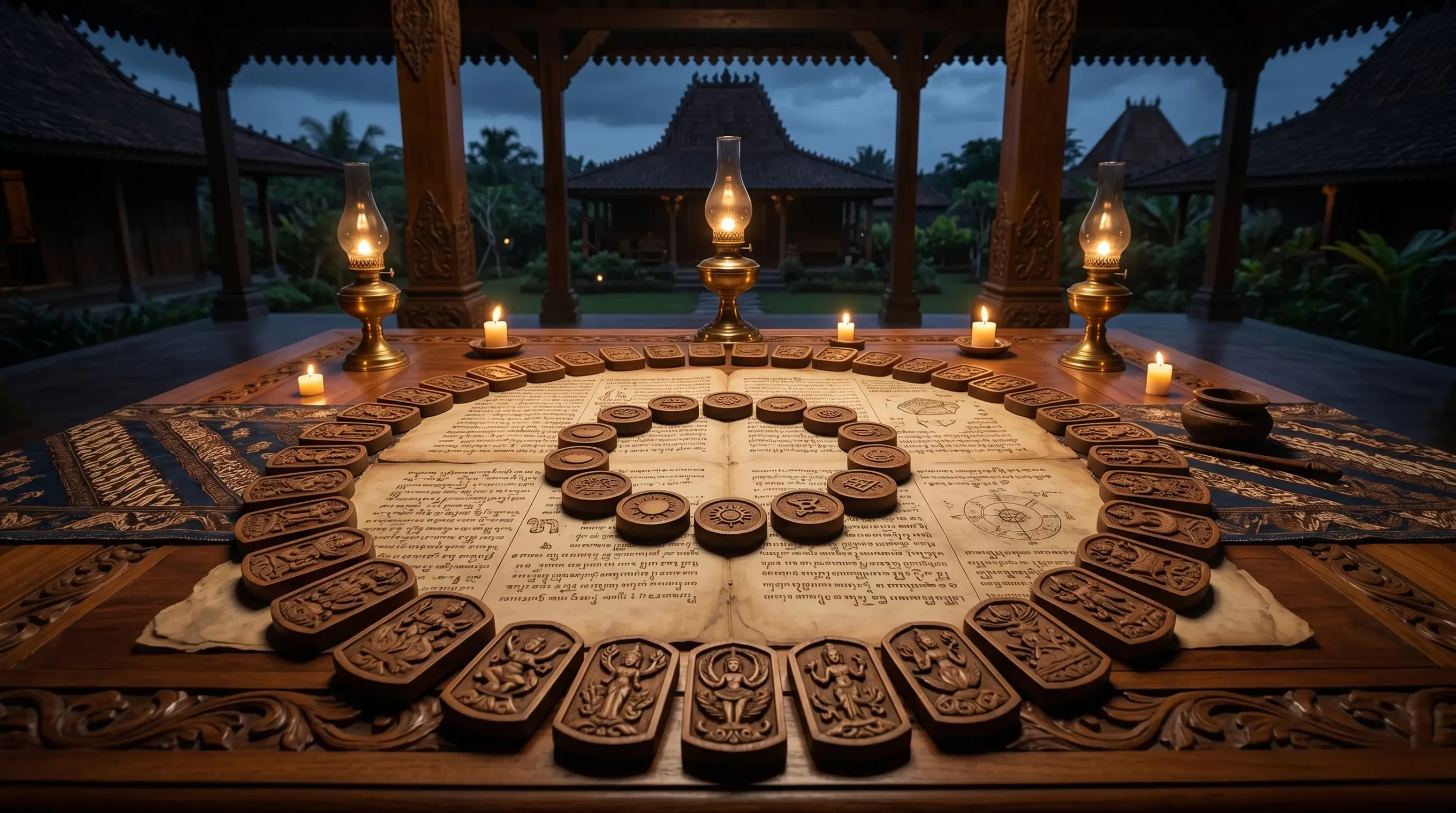
Many readers first come looking for weton. They want to know their birth weekday, pasaran, and neptu. Then another word appears in the Javanese calendar: wuku. Behind both of them stands Pawukon, the wider cycle that helps explain how Javanese time is layered.
This is why Weton Wuku Pawukon should be read as a relationship between three layers of time, not as three identical terms. Weton reads the meeting of weekday and Javanese pasaran. Wuku reads position within the Pawukon cycle. Pawukon is the larger 30-wuku system that keeps the wuku sequence moving.
In JavaSense, these layers are not used to frighten readers or decide fate. They are better understood as cultural knowledge: a way to see how Javanese tradition arranges time, rhythm, birth, and conduct with care.
Quick Answer: How Are Weton Wuku Pawukon Connected?
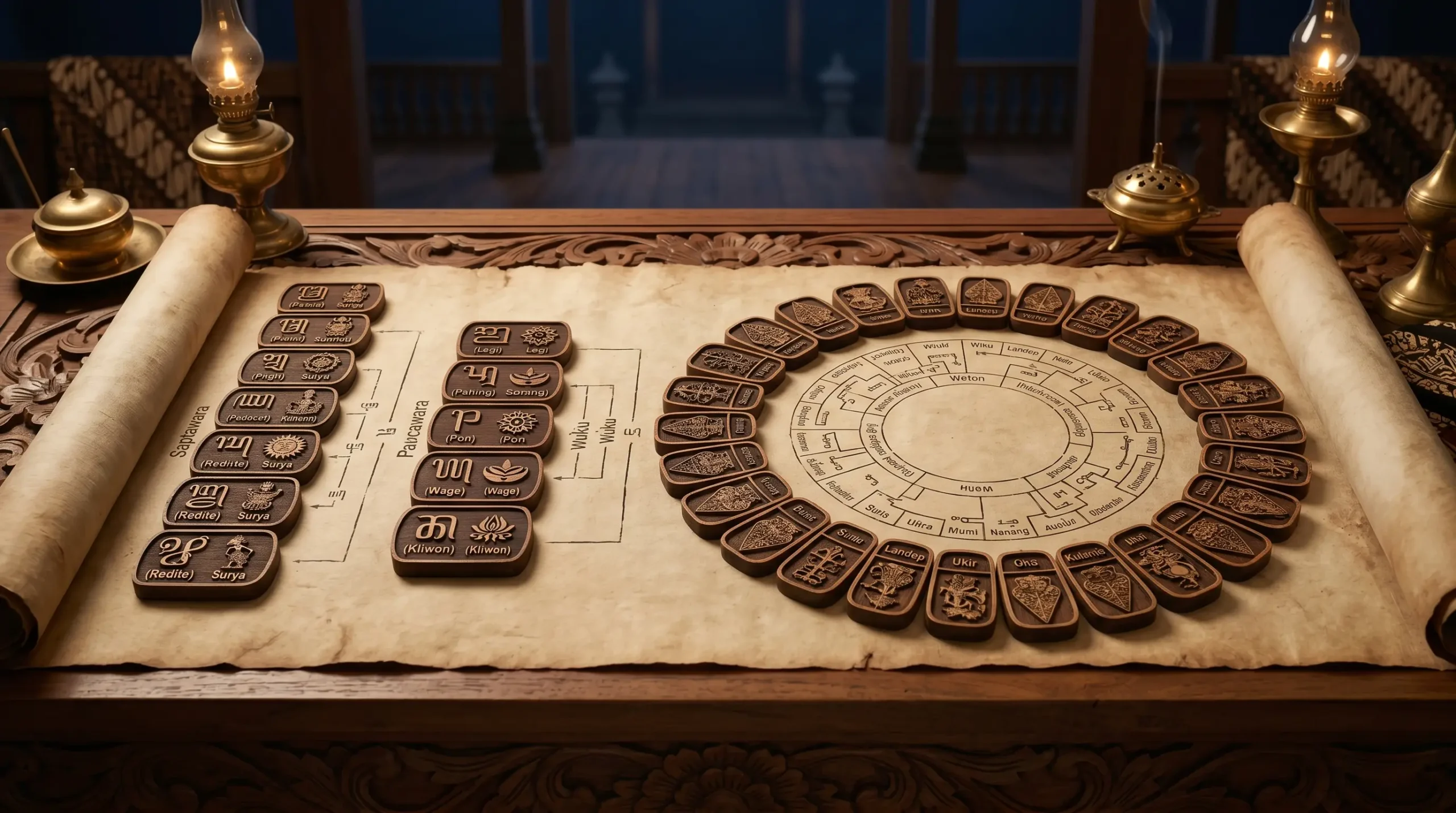
Weton, Wuku, and Pawukon are three connected layers of Javanese time. Weton reads the meeting of weekday and Javanese pasaran and uses neptu values. Wuku is one unit in the Pawukon cycle. Pawukon is the larger 30-wuku system, with each wuku lasting 7 days, making one full cycle 210 days.
The easiest way to understand them is this: weton is the birth-day layer, wuku is the cycle-position layer, and Pawukon is the wider system that holds the 30 wuku sequence.
- Weton is formed from weekday and Javanese pasaran.
- Wuku is one part of the Pawukon cycle.
- Pawukon is the 30-wuku system of Javanese time.
- Neptu belongs to weton because it is calculated from weekday and pasaran values.
- The Javanese calendar connects date, weekday, pasaran, weton, wuku, and Pawukon in one practical view.
Quick Table: Weton, Wuku, and Pawukon
The table below gives a simple map of how these three elements differ and connect.
| Element | Basis | Cycle | Cultural Role |
|---|---|---|---|
| Weton | Weekday + Javanese pasaran. | 35 combinations. | Reads birth weekday, pasaran, and neptu. |
| Wuku | One unit inside Pawukon. | 30 wuku. | Reads position within the Pawukon cycle. |
| Pawukon | The 30-wuku system. | 210 days. | Gives the larger time framework for wuku. |
| Javanese calendar | Javanese time reckoning. | Daily and yearly reading. | Connects date, pasaran, weton, wuku, and other time elements. |
To find your weton from a birth date, use the JavaSense weton calculator. To see daily pasaran, weton, and wuku together, use the JavaSense Javanese calendar. To understand the full wuku cycle, read Pawukon and the 30 wuku cycle.
What Is Weton?
Weton is the meeting of a weekday and a Javanese pasaran. The seven weekdays are Sunday, Monday, Tuesday, Wednesday, Thursday, Friday, and Saturday. The five Javanese pasaran are Legi, Pahing, Pon, Wage, and Kliwon.
From the meeting of 7 weekdays and 5 pasaran, there are 35 weton combinations. This is why Javanese culture knows weton such as Monday Legi, Tuesday Pahing, Wednesday Pon, Friday Kliwon, Saturday Pahing, Sunday Wage, and many others.
Weton is closely connected with neptu. Neptu is the numerical value of weekday and pasaran. For example, Monday Legi has a neptu of 9 because Monday is 4 and Legi is 5.
To understand this foundation more fully, read Javanese weton. For all combinations, open the complete list of 35 Javanese weton.
What Is Wuku?
Wuku is a unit of time inside the Javanese Pawukon cycle. There are 30 wuku, beginning with Sinta and ending with Watugunung. After Watugunung, the cycle returns to Sinta.
Wuku is different from weton. Weton comes from weekday and pasaran. Wuku comes from the Pawukon cycle. Because of that, a person can have a certain weton and also belong to a certain wuku based on the birth date.
Wuku is not calculated with neptu the way weton is. Wuku is read from its position within the Pawukon sequence. This is why someone cannot know wuku only from the weekday or pasaran name.
For a focused comparison, read the difference between weton and wuku.
What Is Pawukon?
Pawukon is the larger Javanese time system that contains the 30 wuku. Each wuku lasts 7 days, so one complete Pawukon cycle lasts 210 days.
If wuku is a single unit in the cycle, Pawukon is the framework that holds the whole sequence. Without Pawukon, wuku would only look like a list of names. With Pawukon, wuku becomes part of a repeating rhythm of time.
In JavaSense, Pawukon is read as cultural inheritance that needs clarity and reason. It is not a tool for frightening people. It is a way to understand how Javanese society has read time through cycles, symbols, and conduct.
Three Layers of Javanese Time
Weton, Wuku, and Pawukon can be imagined as three layers of Javanese time. Weton is the birth-day layer. Wuku is the cycle-position layer. Pawukon is the wider cycle that lets the wuku sequence move repeatedly.
Understanding these three layers helps readers avoid confusion. Weton is not the same as wuku. Wuku is not the same as Pawukon. Neptu belongs to weton, not to wuku in the same way.
This is why a bridge article is useful. Readers can begin with weton, enter the idea of wuku, and then understand Pawukon as the wider cultural time system behind the 30 wuku.
The 30 Wuku in the Pawukon Cycle
The table below shows the 30 wuku in Pawukon order. This is a reference list, not a full interpretation of each wuku.
| Order | Wuku | Cycle Position |
|---|---|---|
| 1 | Sinta | Opening of the cycle. |
| 2 | Landep | Opening of the cycle. |
| 3 | Wukir | Opening of the cycle. |
| 4 | Kurantil | Opening of the cycle. |
| 5 | Tolu | Moving from opening toward the middle. |
| 6 | Gumbreg | Moving from opening toward the middle. |
| 7 | Warigalit | Moving from opening toward the middle. |
| 8 | Wariagung | Moving from opening toward the middle. |
| 9 | Julungwangi | Moving from opening toward the middle. |
| 10 | Sungsang | Early third of the cycle. |
| 11 | Galungan | Early third of the cycle. |
| 12 | Kuningan | Early third of the cycle. |
| 13 | Langkir | Approaching the middle of the cycle. |
| 14 | Mandhasiya | Approaching the middle of the cycle. |
| 15 | Julungpujud | Middle of the cycle. |
| 16 | Pahang | Middle of the cycle. |
| 17 | Kuruwelut | Moving from the middle toward the end. |
| 18 | Marakeh | Moving from the middle toward the end. |
| 19 | Tambir | Moving from the middle toward the end. |
| 20 | Medangkungan | Moving from the middle toward the end. |
| 21 | Maktal | Approaching the end of the cycle. |
| 22 | Wuye | Approaching the end of the cycle. |
| 23 | Manahil | Approaching the end of the cycle. |
| 24 | Prangbakat | Approaching the end of the cycle. |
| 25 | Bala | Late part of the cycle. |
| 26 | Wugu | Late part of the cycle. |
| 27 | Wayang | Late part of the cycle. |
| 28 | Kulawu | Late part of the cycle. |
| 29 | Dukut | Near the closing of the cycle. |
| 30 | Watugunung | Closing of the Pawukon cycle. |
For a more complete explanation of the cycle itself, continue to Pawukon and the 30 wuku cycle.
Seven Key Connections Between Weton, Wuku, and Pawukon
Weton, Wuku, and Pawukon are often discussed together because all three belong to Javanese ways of reading time. They follow different paths, but they meet inside the wider space of the Javanese calendar.
1. Weton Reads Weekday and Pasaran
Weton gives information about weekday and Javanese pasaran. From here, names such as Monday Legi, Friday Kliwon, or Saturday Pahing appear. Weton also becomes the basis for neptu calculation.
2. Wuku Reads Position in the Pawukon Cycle
Wuku gives information about position within the Pawukon cycle. It is not calculated from weekday and pasaran neptu values. It follows the order of 30 wuku that repeats over time.
3. Pawukon Holds the 30 Wuku Framework
Pawukon gives the larger structure for the 30 wuku. Without understanding Pawukon, wuku may be mistaken as just a name, when it is actually part of a cycle.
4. Weton and Wuku Can Be Read Together
If a reader only knows weton, the reading stays in the layer of weekday and pasaran. If the reader also knows wuku, the reading becomes wider because it enters the Pawukon layer.
5. Neptu Belongs to Weton, Not Wuku
Neptu is connected with weton because it is calculated from weekday and pasaran values. Wuku does not use neptu in the same way. Wuku is read from the Pawukon sequence.
6. The Javanese Calendar Connects All Layers
The Javanese calendar helps readers see the relationship between Gregorian date, weekday, pasaran, weton, and wuku. This makes the calendar an important doorway for understanding Weton, Wuku, and Pawukon together.
7. All Three Should Be Read as Cultural Mirrors
Weton, Wuku, and Pawukon are safest when read as cultural mirrors, not verdicts on fate. Tradition can help people understand time, but life decisions still need reason, communication, and responsibility.
How Weton Connects with Neptu
Weton is closely connected with neptu. In Javanese tradition, every weekday has a value, and every pasaran also has a value. When both values are added, the result is called neptu weton.
For example, Friday Kliwon has a neptu of 14 because Friday is 6 and Kliwon is 8. Saturday Pahing has a neptu of 18 because Saturday is 9 and Pahing is 9.
Neptu often appears in relationship reflection, traditional timing, or other cultural considerations. But neptu should never be used as a measure of human worth.
For a clearer explanation, read neptu weton values and how to calculate weton.
How Wuku Connects with Pawukon
Wuku cannot be separated from Pawukon. If wuku is the name of a part in the cycle, Pawukon is the larger system that contains all 30 wuku and keeps them moving in order.
One wuku lasts 7 days. Because there are 30 wuku, one Pawukon cycle lasts 210 days. After Watugunung ends, the cycle returns to Sinta.
In this way, Pawukon becomes the map of the time cycle, while wuku becomes the marker of position within that cycle.
How to Find Wuku from a Birth Date
To find wuku from a birth date, the date needs to be matched with its position in the Pawukon cycle. Wuku cannot be guessed only from the weekday or pasaran.
For example, someone may know they were born on Monday Legi. That is enough to know the weton and neptu, but it is not enough to know the wuku. To know the wuku, the date must be connected with the Javanese calendar or a tool that includes the Pawukon cycle.
For practical reading, use the JavaSense Javanese calendar or the JavaSense weton calculator when you want to find your weton, pasaran, neptu, and wuku from a birth date.
Can Weton and Wuku Be Read Together?
Yes. Weton and Wuku can be read together as two different cultural layers. Weton gives the foundation of weekday, pasaran, and neptu. Wuku gives the layer of the Pawukon cycle.
For example, someone may have the weton Monday Legi and belong to Wuku Sinta. From weton, readers can understand weekday, pasaran, and neptu. From wuku, readers can understand position within the Pawukon cycle.
Still, a combined reading is not certainty about life. It only gives a wider cultural angle. The more layers are read, the more important humility becomes. People should not rush to label a person from one name, one number, or one cycle.
How the Javanese Calendar Connects All Three
The Javanese calendar helps readers see the relationship between Gregorian date, weekday, pasaran, weton, and wuku. This makes the calendar the practical bridge between Weton, Wuku, and Pawukon.
If readers want to see daily Javanese time elements in one place, they can check the Javanese calendar. The calendar helps show how dates, pasaran, weton, and wuku meet in a more orderly way.
For many readers, the calendar becomes the easiest entry point. It prevents guessing and helps the tradition be read with more care.
How Weton, Wuku, and Pawukon Connect with JavaSense Tools
The JavaSense weton calculator helps readers find weekday, pasaran, and neptu from a birth date. This is the first doorway before entering wider discussion about wuku and Pawukon.
The JavaSense Javanese calendar helps readers see date, pasaran, weton, and wuku in daily context. It is useful when readers want to understand how the different layers of time appear together.
For relationship reflection, readers may use weton compatibility with care. In JavaSense, compatibility results should be read as cultural reflection, not as a final decision about love or marriage.
Common Mistakes When Reading Weton, Wuku, and Pawukon
Several mistakes often make these three terms feel confusing or frightening.
First, treating weton and wuku as the same thing. Weton comes from weekday and pasaran. Wuku comes from Pawukon.
Second, assuming all readings use neptu. Neptu belongs to weton because it comes from weekday and pasaran values. Wuku is read from the Pawukon sequence, not from the same neptu formula.
Third, reading everything as fixed prediction. JavaSense does not use Weton, Wuku, or Pawukon to say someone will certainly succeed, fail, match, separate, or suffer misfortune.
Fourth, making a large conclusion from one element alone. Cultural knowledge needs context. It should not be used to place narrow labels on a human life.
Cultural Reference on the Javanese Calendar and Pawukon
Weton, Wuku, and Pawukon are connected with how Javanese society has read time through several layers of calculation. For readers who want to see one modern discussion of the structure behind Javanese calendar calculation, a supporting reference is the study on ethnoarithmetic in the Javanese calendar.
A reference like this does not replace family memory or lived cultural practice. It only helps modern readers see that Javanese time reckoning has structure, while meaning still needs to be read with feeling, reason, and conduct.
How to Read Weton, Wuku, and Pawukon Wisely
To read these three layers wisely, readers need to understand their limits. Weton, Wuku, and Pawukon belong to Javanese culture, but they should not replace reason.
- Read them as cultural mirrors, not verdicts on fate.
- Do not frighten yourself with traditional terms.
- Do not judge other people from their weton or wuku.
- Use them as reflection, not absolute decisions.
- Combine cultural reading with reason, communication, and real-life conditions.
Ky Tutur’s reflection: Weton, Wuku, and Pawukon are not three cages. Weton is the doorway of birth day, Wuku is the trace of the cycle, and Pawukon is the wider rhythm where Javanese time is read with feeling, reason, and responsibility.
With this approach, culture does not become a burden. It becomes a space to know the self, family, and Javanese inheritance more gently.
Why This Guide Matters
This guide matters because many readers still mix up Weton, Wuku, and Pawukon. When the foundation is unclear, cultural reading can easily become blurred or frightening.
By understanding how Weton, Wuku, and Pawukon are connected, readers can see that Javanese tradition does not stand on only one number or one name. There are layers: weekday, pasaran, neptu, wuku, Pawukon, and the Javanese calendar.
This is the direction of JavaSense: helping readers understand Javanese culture in a modern, clear, and non-frightening way.
Learn Javanese Time with JavaSense
To begin with weton, use the JavaSense weton calculator. To see daily Javanese time, open the Javanese calendar.
To understand wuku, read Pawukon and the 30 wuku cycle. To compare the two terms more directly, open the difference between weton and wuku.
For wider learning, continue with Javanese weton, Javanese pasaran, neptu weton values, and Javanese astrology.
To explore related resources in one place, open JavaSense cultural tools. For a broader cultural map, JavaSense can also be read as a Javanese cultural platform for weton, calendar, Primbon reflection, Pawukon, wuku, and Javanese script.
Closing: Reading Javanese Time Clearly
Weton, Wuku, and Pawukon are three doorways into Javanese time. Weton brings readers to weekday and pasaran. Wuku brings readers into the Pawukon sequence. Pawukon gives a wider room for reading the movement of time.
None of this needs to make people afraid. A tradition read clearly does not imprison life. It helps people become more aware: aware of time, aware of conduct, and aware that choices still remain in human hands.
So read these three layers as cultural inheritance. Respect the symbols, understand the limits, and use them as a mirror for arranging life more wisely.
To learn weton, wuku, the Javanese calendar, pasaran, neptu, and Javanese cultural wisdom in a lighter way, you can also open JavaSense on Google Play.
FAQ About Weton, Wuku, and Pawukon
What is the relationship between Weton, Wuku, and Pawukon?
Weton, Wuku, and Pawukon are three connected layers of Javanese time. Weton reads weekday and pasaran, Wuku reads position within the cycle, and Pawukon is the larger 30-wuku system.
What is Weton?
Weton is the meeting of a birth weekday and Javanese pasaran, such as Monday Legi, Friday Kliwon, Saturday Pahing, or Sunday Wage.
What is Wuku?
Wuku is one unit in the Javanese Pawukon cycle. There are 30 wuku, beginning with Sinta and ending with Watugunung.
What is Pawukon?
Pawukon is the Javanese time cycle that contains 30 wuku. Each wuku lasts 7 days, so one full Pawukon cycle lasts 210 days.
What is the difference between Weton and Wuku?
Weton is connected with weekday, pasaran, and neptu. Wuku is connected with position in the Pawukon cycle. They are different, but they can be read together as layers of Javanese time.
Does Wuku use neptu like Weton?
No. Neptu belongs to weton because it is calculated from weekday and pasaran values. Wuku is read through its order in the Pawukon cycle.
How does the Javanese calendar connect Weton, Wuku, and Pawukon?
The Javanese calendar connects Gregorian date, weekday, pasaran, weton, wuku, and Pawukon so readers can see several layers of time in one organized view.
Do Weton, Wuku, and Pawukon determine fate?
No. Weton, Wuku, and Pawukon should be read as cultural reflection, not as fixed fate or absolute predictions about life.