
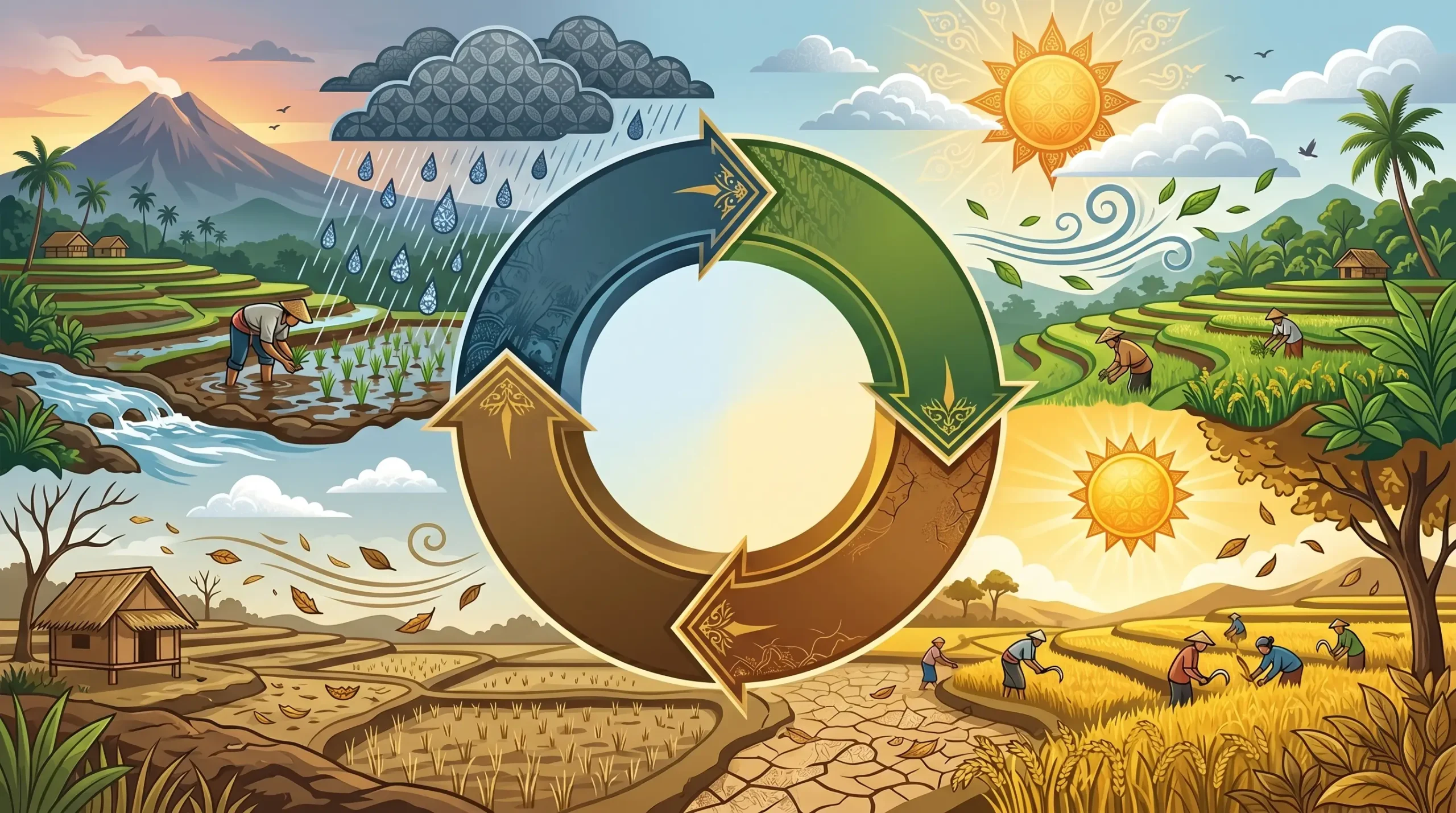
Before weather apps, some Javanese farmers read the season from soil, wind, falling leaves, insects, well water, and the changing color of rice fields. They watched the sky, touched the ground, listened to small signs, and learned to place human work inside the rhythm of nature.
From that patient way of observing the world came one of the important time systems in Javanese culture: Pranata Mangsa.
Some readers may find it written as pranatamangsa, pranoto mongso, or even mistyped as pranta mangsa. The meaning points to the same cultural knowledge: a traditional Javanese seasonal calendar, especially close to farming life and careful observation of nature.
Quick Answer: What Is Pranata Mangsa?
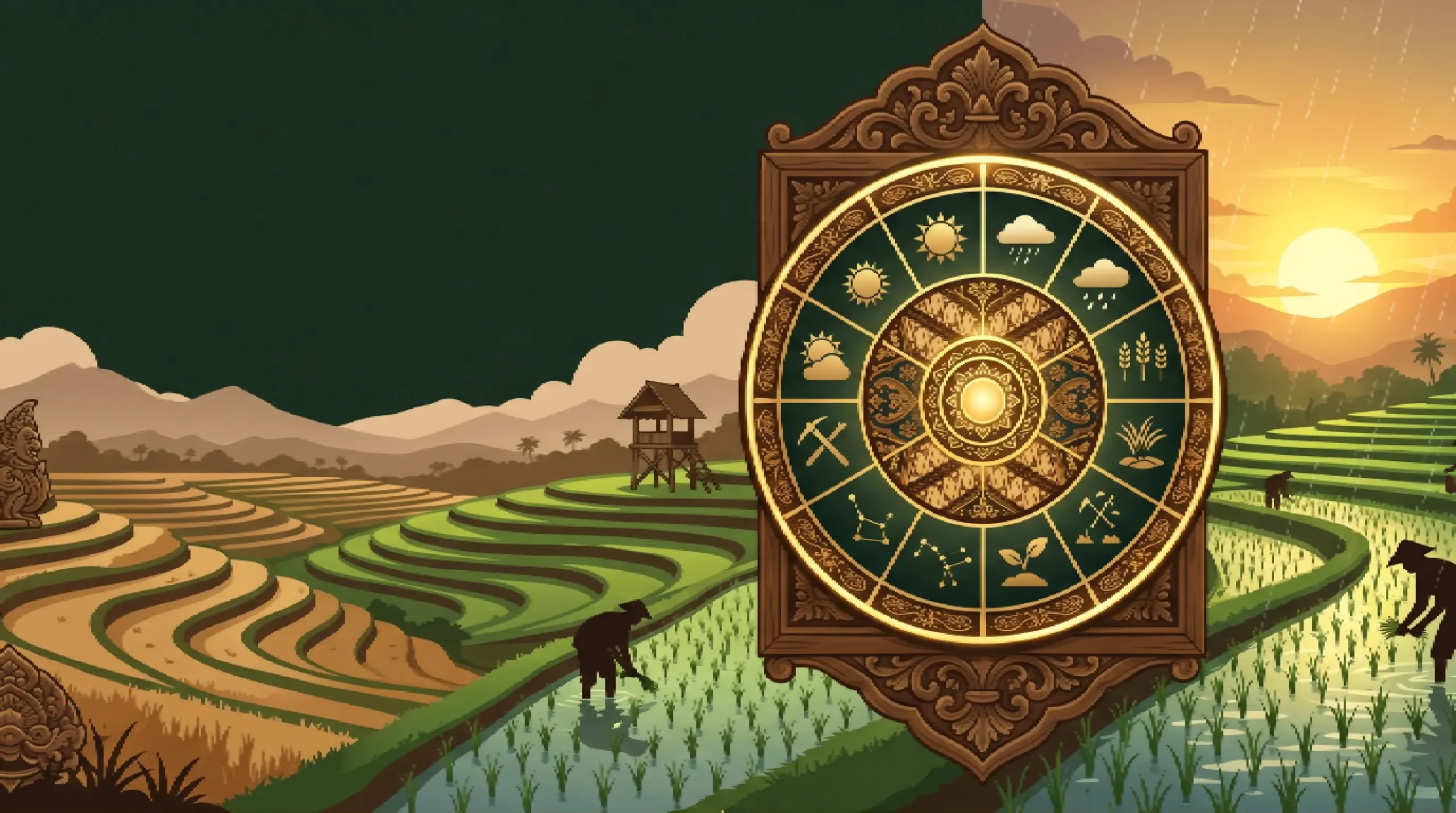
Pranata Mangsa is a traditional Javanese seasonal calendar used to read changes in nature, especially for farming. It divides the year into 12 mangsa, such as Kasa, Karo, Katiga, Kapitu, Kawolu, and Saddha.
In JavaSense, Pranata Mangsa is best understood as ilmu titen, the practice of careful observation of repeated natural signs. It is not a fixed weather prediction. For modern decisions, it should be read together with current weather and climate data.
- Pranata can be understood as order, arrangement, or system.
- Mangsa means season or seasonal time.
- Pranata Mangsa reads seasonal rhythm through soil, water, wind, plants, animals, and farming work.
- It is different from the Javanese calendar, which focuses on dates, pasaran, weton, months, years, and wuku.
- To read Javanese dates, pasaran, and wuku, use the JavaSense Javanese calendar.
Why Pranata Mangsa Grew from Javanese Farming Life
Pranata Mangsa grew from communities that lived close to the land. For older Javanese farmers, season was not only a name on a calendar. Season decided when land could be prepared, when seeds might be sown, when rice needed care, when water had to be saved, and when harvest could be expected.
In this sense, Pranata Mangsa is not only about counting time. It is a way of arranging human work within the changing rhythm of nature.
Its strength lies in observation. Rain and heat were not the only signs. In many discussions of Pranata Mangsa, the season could also be read through plants, animal behavior, water levels, wind direction, soil condition, and even the appearance of certain stars in the sky.
This shows something important about older Javanese ecological thinking. Nature was not treated as a silent background. It was treated as a conversation partner. It gave signs quietly, and humans needed patience to niteni, to observe carefully and remember the pattern.
Is Pranata Mangsa the Same as the Javanese Calendar?
Pranata Mangsa belongs to Javanese ways of reading time, but it is not the same as the Javanese calendar used to read dates, weekdays, pasaran, Javanese months, years, weton, and wuku.
The Javanese calendar helps readers see the structure of dates. It includes the seven-day weekday cycle, the five-day Javanese pasaran, Javanese months, years, weton, and other time markers. Pranata Mangsa is closer to a seasonal calendar. It reads changes in nature within a yearly cycle.
| Aspect | Javanese Calendar | Pranata Mangsa |
|---|---|---|
| Main focus | Dates, weekdays, pasaran, months, years, weton, wuku | Seasons, nature, farming, traditional weather signs |
| Main function | Reading the structure of Javanese time | Reading seasonal rhythm and farming work |
| Examples | Monday Legi, Friday Kliwon, Sura, Mulud, a certain wuku | Kasa, Karo, Katiga, Kapitu, Kawolu, and other mangsa |
| Modern value | Understanding Javanese dates and cultural time | Understanding ecological wisdom and ilmu titen |
Because of that, Pranata Mangsa should not be confused with Javanese weton. Weton reads the meeting of weekday and pasaran. Pranata Mangsa reads seasons, natural signs, and farming rhythm. Both belong to Javanese time knowledge, but they enter through different doors.
The 12 Mangsa in Pranata Mangsa
In one year, Pranata Mangsa is divided into 12 mangsa. These divisions are not equal in length. Some last 23 days, others 41 days, and some 43 days.
In different references, the spelling of some mangsa names may vary. For example, the twelfth mangsa may appear as Sadha, Saddha, or Shada. This article uses forms that are easier for modern readers to recognize. The dates and descriptions below should be read as traditional seasonal patterns, not as a guarantee that today’s weather will be exactly the same in every region.
| No. | Mangsa Name | Common Period | Traditional Description |
|---|---|---|---|
| 1 | Mangsa Kasa | June 22 – August 1 | The beginning of the dry season. Leaves begin to fall, soil becomes dry, and fields may be prepared for secondary crops. |
| 2 | Mangsa Karo | August 2 – August 24 | The dry season feels stronger. Water becomes more difficult, soil may crack, and farmers look for water sources for crops. |
| 3 | Mangsa Katiga | August 25 – September 17 | The dry season reaches a harsh point. Wells may dry, dusty winds appear, and some secondary crops may begin to be harvested. |
| 4 | Mangsa Kapat | September 18 – October 12 | A transition toward the rainy season. Signs of life begin to move again, but rice fields are not always ready for planting. |
| 5 | Mangsa Kalima | October 13 – November 8 | Early rains begin to arrive. Farmers may start working the fields, repairing embankments, and managing water flow. |
| 6 | Mangsa Kanem | November 9 – December 21 | The early rainy season. Rice fields may be plowed, rice seeds may be sown, and certain fruits begin to ripen. |
| 7 | Mangsa Kapitu | December 22 – February 2 | The height of the rainy season. Rainfall can be heavy, rivers may overflow, and farmers begin planting rice seedlings. |
| 8 | Mangsa Kawolu | February 3 – February 28 | Rain begins to decrease. Rice grows taller, some plants begin to flower, and farmers focus on crop care. |
| 9 | Mangsa Kasanga | March 1 – March 25 | The end of the rainy season. Rice begins to fill or turn yellow, and farmers protect fields from birds. |
| 10 | Mangsa Kadasa | March 26 – April 18 | A transition toward the dry season. Rice in the fields turns yellow, upland rice may be ready to harvest, and the air begins to change. |
| 11 | Mangsa Dhesta | April 19 – May 11 | A further transition toward the dry season. Days begin to feel hotter, rice is ready to harvest, and farmers are busy gathering the yield. |
| 12 | Mangsa Saddha | May 12 – June 21 | The end of the transition toward the dry season. Rain becomes rarer, mornings may feel cool, and harvested grain begins to be stored. |
The names and descriptions above show that Pranata Mangsa is more than a list of dates. It stores knowledge about water, soil, crops, animals, and human work. To read Pranata Mangsa is to read the relationship between time and life.
Pranata Mangsa and the Life of Javanese Farmers
Imagine a farming family in a village after harvest. Straw remains in the field, water begins to recede, and the wind carries a dry feeling. Their first question is not always, “What date is it?” A more practical question may be: is the soil ready yet?
In that kind of setting, Pranata Mangsa gives a frame. In one mangsa, farmers may read whether water needs to be searched for. In another, they may consider whether the land should rest, whether secondary crops are more suitable, or whether signs of rain are strong enough to begin sowing rice seeds.
This does not mean every farmer made decisions only from Pranata Mangsa. In many places, family experience, local soil condition, water sources, crop type, and village habits also mattered. Pranata Mangsa worked more like an early map, not the only road.
This is why Pranata Mangsa feels close to ilmu titen. People watched repeated patterns, remembered them, and used them as guidance. Not because nature could be controlled completely, but because humans needed to live in a more orderly relationship with nature.
Common Mistakes When Reading Pranata Mangsa
Several mistakes often appear when modern readers approach Pranata Mangsa.
First, treating Pranata Mangsa as a fixed weather prediction. This is not safe. Pranata Mangsa grew from long observation, but daily weather still needs current meteorological data.
Second, assuming every region follows the same pattern. Seasonal patterns in highlands, coastal areas, cities, and rural fields are not always the same. Even within Java, land-use change, irrigation, population density, and climate change can shape different seasonal experiences.
Third, cutting Pranata Mangsa away from farming life. If it is read only as a list of 12 seasons, it becomes dry. Its strength lies in its relationship with soil, plants, water, animals, and human work.
Fourth, dismissing the tradition as useless. That is also too quick. Pranata Mangsa should not replace modern weather forecasts, but it still matters as ecological heritage and a way of remembering human closeness with nature.
Is Pranata Mangsa Still Relevant Today?
Pranata Mangsa is still relevant, but it needs to be used clearly. It should not be treated as a single technical tool for deciding exactly when rain will fall or when every farmer should plant. The natural world today is more complex than in times when seasonal patterns were more stable.
Climate change, land conversion, changing planting patterns, modern irrigation systems, and extreme weather make seasonal reading more complicated. Because of that, Pranata Mangsa is safer as a bridge: it connects local ecological wisdom with modern weather and climate data.
This approach is close to the idea of bringing ilmu titen together with weather-forecasting technology. Farmers may still read natural signs, but important decisions need wider data support.
For JavaSense readers, the deepest value of Pranata Mangsa is not only whether the dates still match perfectly. Its deeper value is the invitation to become attentive again: to remember that human life is never truly separate from soil, water, wind, and season.
How to Read Pranata Mangsa Wisely
There are three simple ways to read Pranata Mangsa today.
First, read it as cultural knowledge. Pranata Mangsa helps us understand how older Javanese communities arranged life with nature. Inside it are farming history, ecological thinking, and a close inner relationship with the environment.
Second, read it as a reminder to become more attentive. Many modern people know temperature from numbers, but no longer notice soil in the yard, wind direction, or changes in nearby trees. Pranata Mangsa invites us to pause and look again at small signs around us.
Third, do not separate it from modern data. For planting, harvest, disaster mitigation, travel, or other important decisions, use updated weather and climate information from official sources. Tradition gives feeling and context; modern data helps read today’s risk.
Read this way, Pranata Mangsa does not need to be worshiped, and it does not need to be thrown away. It can become a meeting place between ancestral knowledge and modern ecological awareness.
Pranata Mangsa, Weton, Pasaran, Wuku, and Primbon
In Javanese culture, time has many layers. There are the seven weekdays, Javanese pasaran, weton, wuku, Javanese months, and also mangsa. Each reads a different side of time.
If someone uses a tool to calculate weton from a birth date, the reading focuses on the meeting of the birth weekday and pasaran. If someone reads Pranata Mangsa, the focus is season, nature, and agricultural signs. These two should not be forced into the same meaning.
In some Javanese traditions, this kind of knowledge also stands near Primbon. But in JavaSense, readings like this remain cultural reflection. Tradition may become a mirror, but it should not become a verdict.
This is why it is important to distinguish knowledge, symbol, habit, and practical decision. For sensitive topics, the principle is close to reading weton is not fortune telling: tradition helps people look more deeply, not surrender their judgment.
How Pranata Mangsa Connects with Other JavaSense Tools
Pranata Mangsa is not a tool for finding someone’s weton or today’s pasaran. It belongs to seasonal reading. Still, it can sit beside other JavaSense resources as part of a wider cultural map.
To read Javanese dates, pasaran, and wuku, use the JavaSense Javanese calendar. To find weton from a birth date, use the JavaSense weton calculator. To understand the Pawukon layer, read Pawukon and the 30 wuku cycle and Weton, Wuku, and Pawukon.
To understand the month side of Javanese time, continue with Javanese calendar months. To explore several resources in one place, open JavaSense cultural tools.
Cultural and Academic References on Pranata Mangsa
To read Pranata Mangsa responsibly, academic and official references still matter. Several useful starting points include studies on Pranata Mangsa as environmental wisdom, the Javanese agricultural calendar, ethnoscience discussions, and official examples of combining ilmu titen with modern weather forecasting.
- Pranata Mangsa dan Budaya Kearifan Lingkungan, Jurnal Budaya Nusantara.
- Pranatamangsa, the Javanese Agricultural Calendar, N. Daldjoeni, The Environmentalist.
- Sistem Pranata Mangsa: Tinjauan Etnosains dan Uji Keakuratan, Lembaran Antropologi UGM.
- Kolaborasi Ilmu Titen dan Teknologi Prakiraan Cuaca, BMKG.
These references help keep the reading grounded. JavaSense presents Pranata Mangsa as cultural and ecological knowledge, not as a replacement for weather agencies, climate science, or local risk assessment.
Closing: Time Read with Patience
Pranata Mangsa reminds us that time does not always arrive as a number on a calendar. Sometimes it appears as cracked soil, falling leaves, yellowing rice, cool morning air, or the first rain that makes a village breathe more easily.
In a fast modern life, this kind of heritage helps us slow down. Not to leave modern science behind, but to remember that people once learned to read nature with patient eyes.
Ky Tutur’s reflection: Nature is not always silent. Sometimes it speaks through small signs: the wind, the water, the soil, and the season. Pranata Mangsa teaches us to notice before deciding.
Perhaps that is the meaning of Pranata Mangsa today: not only knowing the names of 12 Javanese seasons, but learning again that nature is never completely mute. It keeps giving signs. We only need enough awareness to pay attention.
To explore weton, the Javanese calendar, pasaran, wuku, Pawukon, Primbon reflection, and Javanese script in one place, JavaSense can also be read as a Javanese cultural platform.
FAQ About Pranata Mangsa
What is Pranata Mangsa?
Pranata Mangsa is a traditional Javanese seasonal calendar used to read changes in nature, especially in farming life. It divides one year into 12 mangsa or seasonal periods.
Is Pranata Mangsa the same as the Javanese calendar?
No. The Javanese calendar is more closely related to dates, weekdays, pasaran, months, years, weton, and wuku. Pranata Mangsa focuses on seasons, nature, and agricultural activities.
How many mangsa are there in Pranata Mangsa?
Pranata Mangsa generally has 12 mangsa: Kasa, Karo, Katiga, Kapat, Kalima, Kanem, Kapitu, Kawolu, Kasanga, Kadasa, Dhesta, and Saddha.
What was Pranata Mangsa used for?
Traditionally, Pranata Mangsa was used as a seasonal guide for farming activities such as preparing fields, sowing seeds, caring for crops, managing water, and preparing for harvest.
Is Pranata Mangsa still accurate today?
Pranata Mangsa still has cultural and ecological value, but it should not be used as the only basis for reading today’s weather. Climate change, land-use change, and extreme weather mean it should be combined with modern weather and climate data.
How is Pranata Mangsa connected with Javanese farming?
Pranata Mangsa is closely connected with Javanese farming because it grew from observation of seasons, soil, water, plants, animals, and the rhythm of agricultural work.
Is Pranata Mangsa a form of prediction?
Pranata Mangsa is better understood as ilmu titen, or careful observation based on repeated natural patterns, not as a fixed prediction that guarantees the same weather in every place and time.
How should Pranata Mangsa be read today?
Pranata Mangsa should be read as cultural heritage and ecological knowledge. For practical decisions such as planting, harvesting, travel, or disaster mitigation, it should be used together with updated weather and climate information from official sources.