

Angger, my child…
Javanese coastal culture is not only a story of the sea, harbors, markets, and boats. It is a living meeting space: where trade opens paths, language absorbs new sounds, religion dialogues with local custom, food carries traces of travel, and people learn to stay flexible without losing their roots.
Ky Tutur Summary
- Javanese coastal culture grows in the coastal and harbor regions of Java through trade, language, religion, food, art, maritime life, and social networks.
- The coast should not be seen as a culture that is less pure. It shows how Javanese communities absorbed outside influences with rasa, choice, and local adjustment.
- Important features of coastal culture include openness, flexibility, trading courage, more direct language, rich food, layered identity, and strong communal networks.
- In JavaSense, Javanese coastal culture is read as a mirror of conduct: open without being uprooted, flexible without losing principle, and communal in the middle of encounters.
Ky Tutur Note: This article discusses Javanese coastal culture as cultural heritage and reflection. It is not a single final claim about every coastal region. Cirebon, Demak, Jepara, Lasem, Kudus, Semarang, Tuban, Gresik, Surabaya, and other coastal areas each have their own character. Read this as a doorway to understanding, not as a label that flattens every place into one.
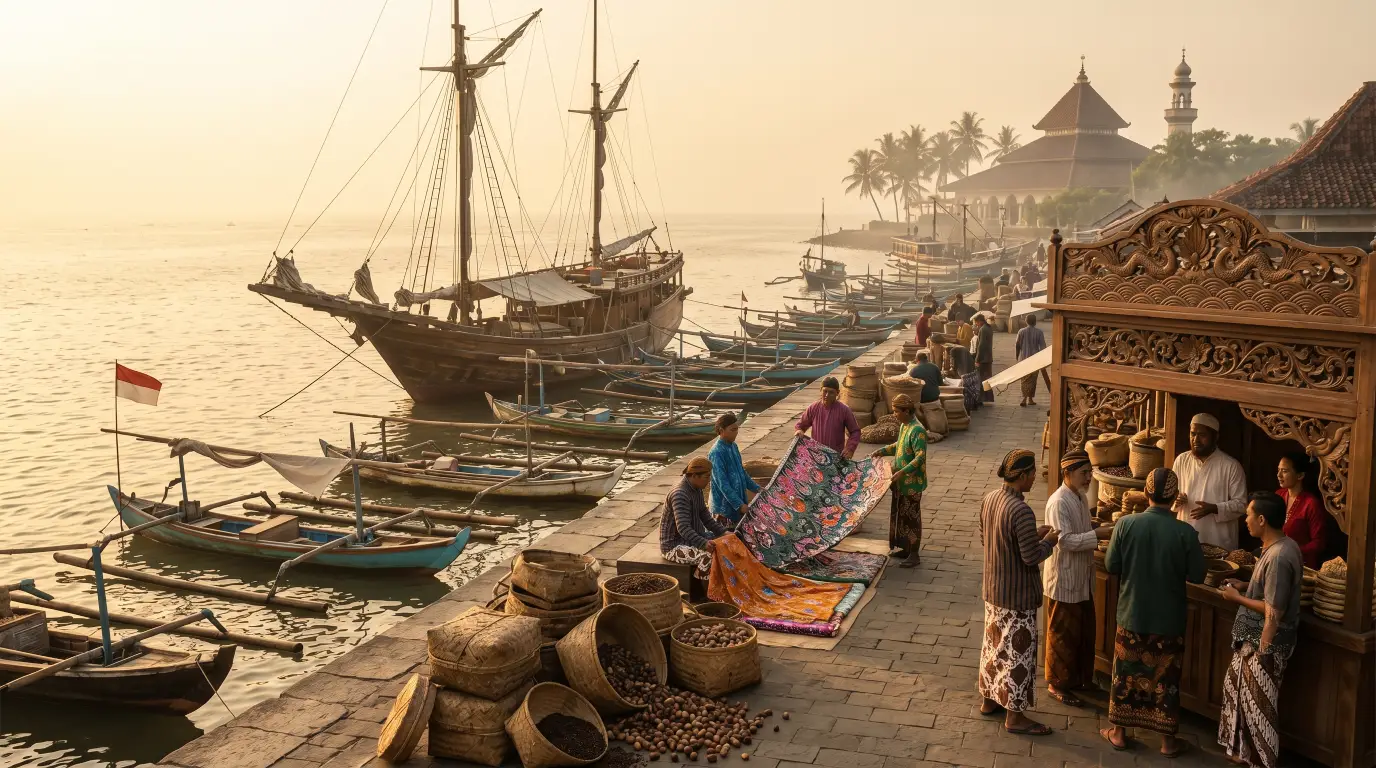
Javanese coastal culture was born from a long meeting between land and sea. On the coast, ships arrive and leave. Goods are exchanged. Languages absorb one another. People from different backgrounds meet, negotiate, trade, pray, eat together, and slowly form new habits.
For that reason, the coast should not be read only as a line between land and water. It is a social space. There are harbors, markets, fishing villages, traders, artisans, religious teachers, artists, newcomers, and families who live by learning how to face change.
A common misunderstanding says that coastal culture is merely mixed, less refined, or less authentic than inland culture. This reading is too narrow. The coast is indeed open to outside influence, but openness does not mean losing roots. Its strength lies precisely there: the ability to absorb, choose, arrange, and turn encounters into a living identity.
What Is Javanese Coastal Culture?
Javanese coastal culture is the cultural character of Javanese communities that developed in coastal and harbor regions. It is shaped by maritime life, trade, human movement, language encounters, religious development, and daily habits that are more open to change.
In coastal culture, the sea is not merely a background view. The sea is a road. It connects one place to another. It carries goods, news, prayers, spices, cloth, ideas, stories, and people. Because of this, coastal communities are used to living in the flow of encounters.
This kind of culture is often more flexible. Language tends to be more direct. Trade networks are stronger. Food is bolder in flavor. Art more easily absorbs new forms. Social relationships are often shaped by the need to help one another in changing conditions.
Yet flexibility does not mean living without principle. Coastal communities still have custom, respect, family values, belief, and communal bonds. They simply learn that life beside the sea requires the ability to read the wind: when to hold firm, when to adjust the sail, and when to depart.
Javanese Coastal Culture as a Meeting Space
The coast is best understood as an early space of encounter. Ships come, languages meet, goods are exchanged, and new values are processed. These encounters are not always easy. There are differences in interest, language, belief, and habit. Yet from those differences, coastal communities learn how to arrange a livable social order.
In Javanese history, many coastal regions became gateways for major cultural change. Trade grew through harbor towns. Religion spread through networks of teachers, traders, and local communities. Language absorbed outside terms. Food used spices and cooking methods that moved through maritime routes.
But encounter does not mean accepting everything. Coastal communities did not simply swallow every outside influence. There was selection. Some things were accepted because they fit. Some were changed to suit local rasa. Some were left behind because they did not align with local values.
This is where coastal tata rasa becomes visible. It does not reject change, but it does not surrender to every current either. It shapes encounter into something that can enrich life.
Harbors, Trade, and Cultural Routes
Harbors are the heart of Javanese coastal culture. In a harbor, people learn that life does not move in only one direction. Ships arrive carrying goods. Ships depart carrying local produce. Foreigners become trading neighbors. New words enter daily speech.
For a long time, the coastal regions of Java have played an important role in trade, religious transmission, and cultural exchange across the archipelago. Their traces can be seen in many northern coastal towns of Java, with long histories of trading, Islamic learning, craft, food, and social networks.
Trade shapes a particular character. A trader must be brave enough to take risks, but must also understand trust. A fisherman must be brave enough to face the sea, but must also know when the weather cannot be forced. An artisan must maintain quality, while remaining sensitive to the needs of the market.
For that reason, Javanese coastal culture has a strong practical intelligence. It is not shallow practicality, but a life skill for reading conditions. Life on the coast teaches that good intention needs skill, and courage needs calculation.
Coastal Language: Direct, Flexible, and Open
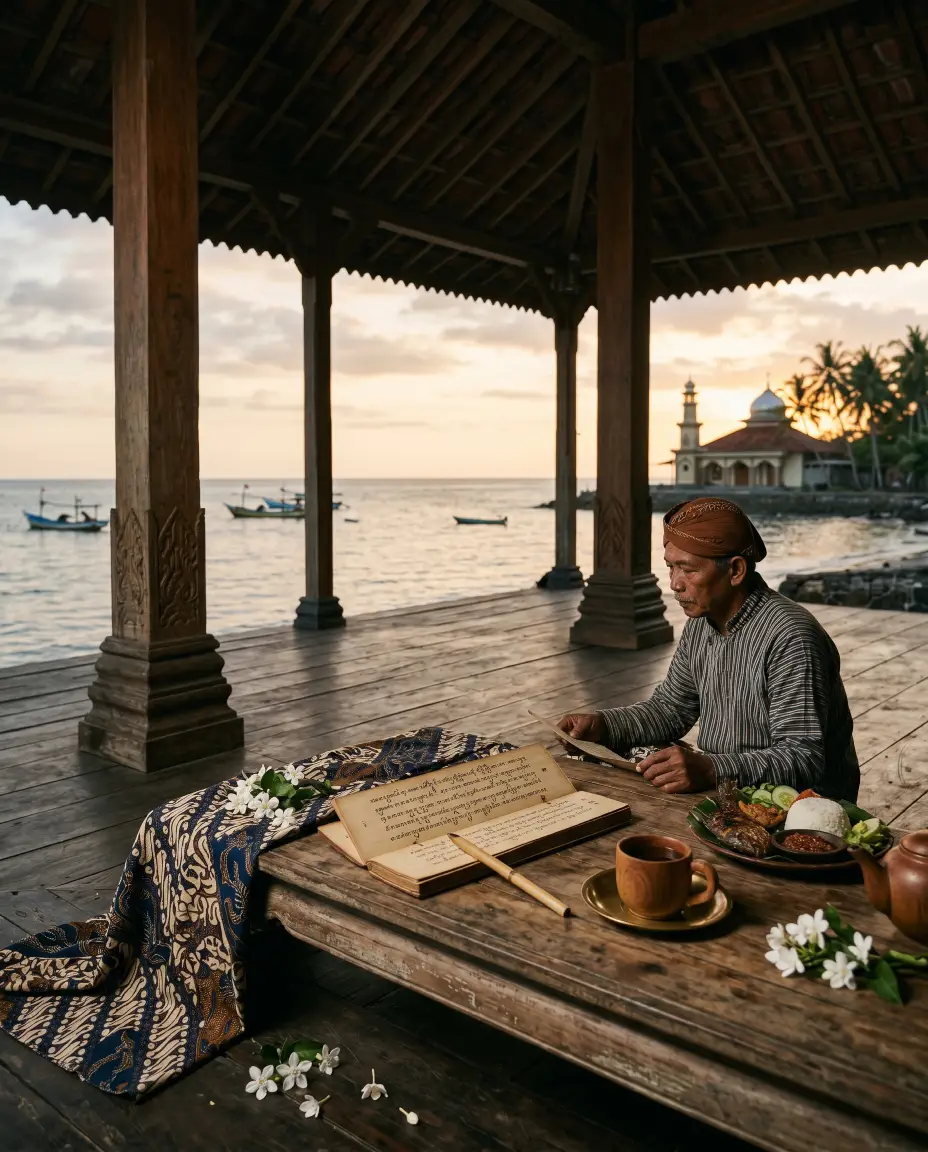
Language is one of the clearest doors into Javanese coastal culture. In many coastal regions, Javanese speech may sound more direct, quicker, and more open. Word choices can differ from inland regions. The tone may also feel more straightforward.
Direct does not mean rude. In coastal culture, directness often grows from the need for quick and clear communication. In markets, harbors, boats, and trading spaces, people need to understand one another without too many layers of speech. Clarity becomes part of practical politeness.
Coastal language also absorbs easily. Terms from trade, religion, food, and daily life enter through encounters. This kind of absorption is not a sign of cultural decline. It is proof that language is alive. A living language receives, adjusts, and still keeps its local rasa.
This teaches us that Javanese language is not one fixed form. It moves with relationship, space, work, social need, and historical encounter.
Religion and Teaching that Dialogues with Local Culture
The coastal regions of Java are also important in the history of religious development, especially Islam. In many coastal areas, Islam grew through teaching that dialogued with local culture, art, language, community tradition, and trade networks.
Teaching that lasts rarely comes by cutting every old root at once. It listens, chooses a language that people can understand, and slowly arranges new values in forms that feel familiar. Art, story, tradition, and social space become bridges for transmitting meaning.
Because of this, Javanese coastal culture often has a strong religious character while remaining culturally layered. Old mosques, wali tombs, pilgrimage traditions, art, food, and social habits often stand close to one another. They show that religion in community life does not only live inside worship spaces, but also inside daily social order.
Still, this must be read carefully. Not every coastal practice is the same. Each place has its own history, figures, and habits. Reading religion on the coast should be done with respect, without flattening every region into one example.
Coastal Food as a Record of Encounters
Javanese coastal food is an archive of rasa. In a single dish, one may find traces of trade, spices, the sea, family habit, and cultural encounter. Stronger, spicier, savory, sour, or richly seasoned flavors often become part of the coastal character.
Bandeng, garang asem, nasi jamblang, seafood dishes, coastal soto, pindang, petis, terasi, and many local dishes show how local ingredients met spices and cooking techniques moving through trade routes. Food becomes proof that culture is not only written in manuscripts. It is also cooked in the kitchen.
Coastal food also shows adaptive intelligence. Communities use fish, salt, seafood, spices, and available ingredients. They process them so they can last, travel, taste good, and fit the rhythm of daily life.
In Javanese rasa, food is not only about being full. It is also about family, guests, markets, gatherings, and memory. Coastal food can therefore be read as a way of caring for relationships: feeding, welcoming, trading, and preserving family stories.
Art, Architecture, and Layered Identity
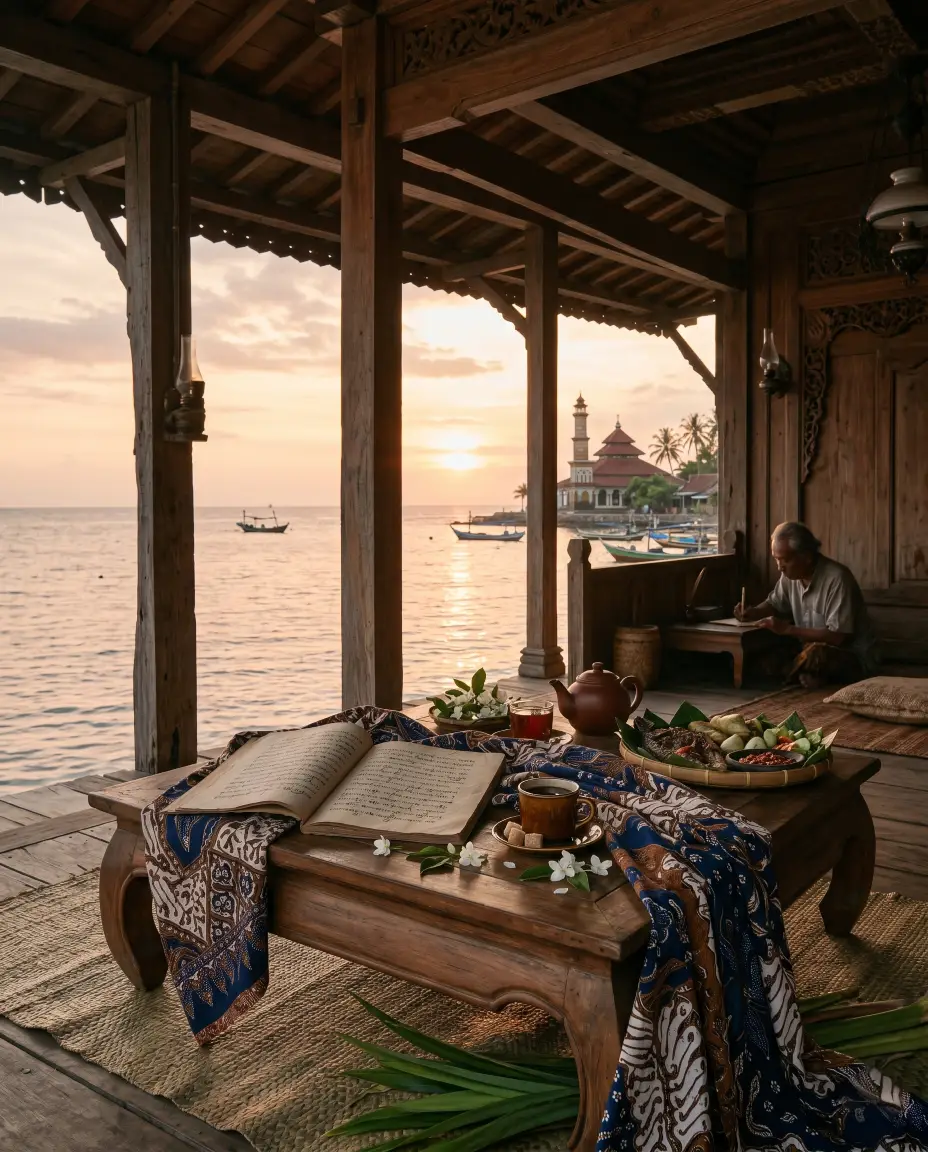
Javanese coastal culture can also be seen in art and architecture. Old mosques, traditional houses, ornaments, coastal batik, performing arts, music, and local traditions often show layered identity. Javanese, Islamic, Chinese, Malay, Arab, European, and other influences may be present, arranged according to local context.
Coastal batik, for example, is often known for bolder colors and motifs. This differs from inland batik, which is often more tied to courtly conventions. This difference is not about higher or lower culture. Each has its own aesthetic language.
Coastal architecture also shows encounter. Mosques, pendopo spaces, merchants’ houses, gates, and tombs may carry a combination of local forms and outside elements. These encounters are not always neat like straight lines. Sometimes they look like layers of memory living together.
Coastal art teaches that identity does not have to be stiff. Roots can remain strong even when branches grow in many directions. What matters is not rejecting every outside influence, but making sure that influence is shaped with rasa and does not erase local dignity.
The Coastal Laku: Open, Resilient, and Communal
Life on the coast forms its own laku. The sea teaches uncertainty. Trade teaches courage. The harbor teaches encounter. Fishing communities teach interdependence. All of this shapes an inner attitude that is open, resilient, and communal.
Open means willing to meet what is different. Resilient means not easily broken when conditions change. Communal means remembering that human beings do not live alone. In storms, celebrations, grief, or hard seasons, social networks become an important strength.
Yet openness also needs boundaries. Not every influence should be accepted. Not every change brings goodness. Not every opportunity deserves to be taken. This is where eling lan waspada becomes important: open, but still aware; flexible, but still able to read risk.
The coastal way reminds us that encounters become healthy only when people still know how to care for one another’s rasa.
Common Misunderstandings about Javanese Coastal Culture
There are several misunderstandings about Javanese coastal culture that need to be clarified.
First, coastal culture is sometimes seen as less refined than inland culture. This is too simple. The coast has its own tata rasa: more direct, open, and practical, but not without refinement.
Second, coastal culture is sometimes seen as impure. Yet living culture always moves. The ability to absorb and shape outside influence is one of the major strengths of coastal history.
Third, the coast is sometimes reduced to trade. Trade is indeed important, but coastal culture also speaks about language, religion, art, food, family, social networks, and ways of living.
Fourth, coastal culture is sometimes romanticized. It is imagined as all harmony without conflict. In truth, encounter always carries the possibility of friction. What matters is how communities process friction into a way of life that can still be shared.
Fifth, coastal culture is often generalized. Cirebon, Demak, Jepara, Kudus, Lasem, Semarang, Tuban, Gresik, Surabaya, and other regions each have their own character.
Javanese Coastal Culture in Modern Life
In modern life, many of us live like coastal communities. Every day, information arrives. Foreign cultures enter through screens. Language mixes. Tastes change. The way people work, trade, learn, and relate to one another keeps moving.
Javanese coastal culture offers an important lesson: do not fear encounter, but do not lose your roots. Receive what is good, shape it with rasa, and leave behind what makes life lose dignity.
In the digital world, coastal values can become a form of guidance. We need flexibility in facing technology. We need openness to new knowledge. We need courage to trade, create, and build networks. But we also need to preserve speech, adab, identity, and a sense of enough.
The coast also teaches that life does not always wait for perfect conditions. Fishermen still mend their nets. Traders still open their stalls. Families still keep the kitchen alive. Communities still help one another in difficult times. There is resilience born from living with the rhythm of tide and change.
A Brief Javanese Glossary
- Budaya pesisir: coastal culture shaped by maritime life, trade, encounter, and adaptation.
- Rasa: inner feeling, sensitivity, and refined awareness.
- Laku: conduct, inner practice, or a way of living with awareness.
- Guyub: warm togetherness, neighborly care, and communal closeness.
- Eling lan waspada: remembering one’s grounding while staying alert to risk and change.
- Tata rasa: the arrangement of feeling, conduct, and social sensitivity.
JavaSense and a Clearer Way to Read Coastal Culture
JavaSense reads Javanese coastal culture as heritage that deserves to be cared for with rasa and clear understanding. It is not merely nostalgia, nor is it an empty slogan of cultural mixture. It is a mirror of how Javanese communities learned to meet, trade, speak, pray, cook, make art, and live together through change.
Coastal culture is most useful when it helps us ask better questions. How do we welcome new things without losing roots? How do we speak directly without lowering others? How do we trade without losing honesty? How do we live with difference without being easily divided?
As a general cultural reference, you may explore the Spice Route archive by Kemdikbud, the Indonesian Ministry of Culture archive, and the National Library of Indonesia. References like these help cultural reflection remain connected to learning.
To learn Javanese culture in a lighter and more modern way, open the JavaSense app on Google Play: download JavaSense on Google Play.
Closing Reflection: Flexible Without Losing Roots
In the end, Javanese coastal culture teaches one important lesson: a healthy life needs flexibility. But flexibility is not the same as losing direction. Being open does not mean accepting everything. Changing does not mean uprooting the self.
Angger, my child, the coast teaches people to read the wind. If the wind changes, the sail must be adjusted. If the waves rise, the step must be more careful. If a ship comes carrying new goods and new ideas, a community must consider what enriches life and what should be kept at a distance.
Javanese coastal culture is a lesson about encounters shaped with rasa. It teaches people to trade without losing honesty, to speak directly without humiliating others, to receive outside influence without feeling inferior, and to live with difference without being easily torn apart.
FAQ about Javanese Coastal Culture
What is Javanese coastal culture?
Javanese coastal culture is the cultural character of Javanese communities in coastal and harbor regions, shaped by trade, maritime life, language encounters, religion, food, art, and social networks.
What are the main features of Javanese coastal culture?
Its main features include openness, flexibility, more direct language, courage in trade, rich food, strong social networks, layered identity, and the ability to absorb outside influences.
Why are harbors important in Javanese coastal culture?
Harbors are important because they became meeting spaces for goods, people, languages, religions, and ideas. From harbors, many new habits entered and were shaped by local communities.
How did trade shape Javanese coastal culture?
Trade shaped courage, trust-building, practical intelligence, social networks, and openness to goods and ideas from outside regions.
How did coastal life influence the Javanese language?
Coastal Javanese speech is often more direct, open, and adaptive. It may absorb terms from trade, religion, food, and harbor life while keeping local rasa.
How did religion develop in Javanese coastal regions?
In many coastal regions, religion developed through trade networks, local teachers, art, language, and traditions that dialogued with community life.
Why is Javanese coastal food often rich in flavor?
Javanese coastal food is often rich in flavor because it is shaped by seafood, salt, spices, trade routes, and local kitchen traditions.
How should Javanese coastal culture be understood safely?
It should be understood as diverse and layered heritage, not as a culture that is less pure, not as one single uniform identity, and not as a romantic image without complexity.
Learning Javanese Coastal Culture More Clearly
Javanese coastal culture is a mirror of encounter: trade, language, religion, food, art, resilience, and rasa. To explore Javanese wisdom, script, weton, calendar, and cultural heritage more easily, open JavaSense on Google Play.