

Some people first meet weton through worry: “If my weton is like this, does it mean my life must be like that?” A small cultural question can quickly become fear when weton is spoken as if it were a final sentence about fate.
This is where the reading needs to be clarified. Weton is not fortune telling in the sense of a fixed prediction that decides someone’s life absolutely. In Javanese culture, weton is better understood as a cultural language: a way to read birth weekday, pasaran, neptu, personal tendencies, and conduct without losing reason.
Weton does not need to be rejected harshly, but it also should not be believed blindly. Tradition can be respected while common sense remains awake. That is how JavaSense reads weton: as a mirror for self-understanding, not as a hammer that closes the future.
Quick Answer: Is Weton Fortune Telling?
Weton is not fortune telling when it is read properly. Javanese weton is the meeting of a birth weekday and the five-day Javanese pasaran cycle. In tradition, it may be used to read neptu, personal tendencies, relationships, and cultural timing.
But human life is not shaped by weton alone. Effort, prayer, education, family, environment, experience, communication, choices, and maturity all matter. For that reason, weton is safer when read as cultural reflection, not as a fixed prediction of the future.
- Weton can help identify birth weekday, pasaran, and neptu.
- Weton can become a mirror for noticing personal tendencies.
- Weton should not be used to judge human worth.
- Weton should not be the only reason for deciding love, fortune, work, or the future.
- Weton is not fortune telling; it is part of Javanese cultural heritage that needs both feeling and reason.
What “Weton Is Not Fortune Telling” Really Means
Saying that weton is not fortune telling does not mean rejecting Javanese culture. It means weton should not be treated as a tool that guarantees someone’s destiny. Weton may be respected as tradition, but it should not be used to frighten people or judge others.
At its basic level, weton is the meeting between a birth weekday and a Javanese pasaran. Examples include Monday Legi, Wednesday Pon, Friday Kliwon, and Sunday Wage. From this meeting, Javanese tradition recognizes neptu and many symbolic readings connected with family, calendar, ceremonies, and social life.
The boundary matters. Weton can help someone reflect on tendencies, but it should not be used to conclude that a person will certainly fail, certainly struggle financially, certainly be incompatible, or certainly have bad fate.
For the foundation, read the broader guide to Javanese weton.
Why Weton Is Often Mistaken for Prediction
Weton is often mistaken for prediction because many people receive it in the form of short conclusions: “this weton is heavy,” “that neptu is not compatible,” or “this couple is not good according to the calculation.” These sentences are easy to remember, but they often lose context.
In Javanese tradition, weton should not stand on one short sentence. There are weekday, pasaran, neptu, the Javanese calendar, wuku, family situation, intention, and the way a person lives daily life. When all of that is reduced to one verdict, wisdom turns into fear.
Often, what feels frightening is not weton itself, but the way weton is read too quickly. Weton becomes heavy when numbers are used without care. It becomes narrow when a human being is seen only through one calculation.
JavaSense chooses a slower reading. Weton may become a starting point for reflection, but life decisions still need real conditions, communication, responsibility, and reason.
Weton as a Mirror, Not a Verdict
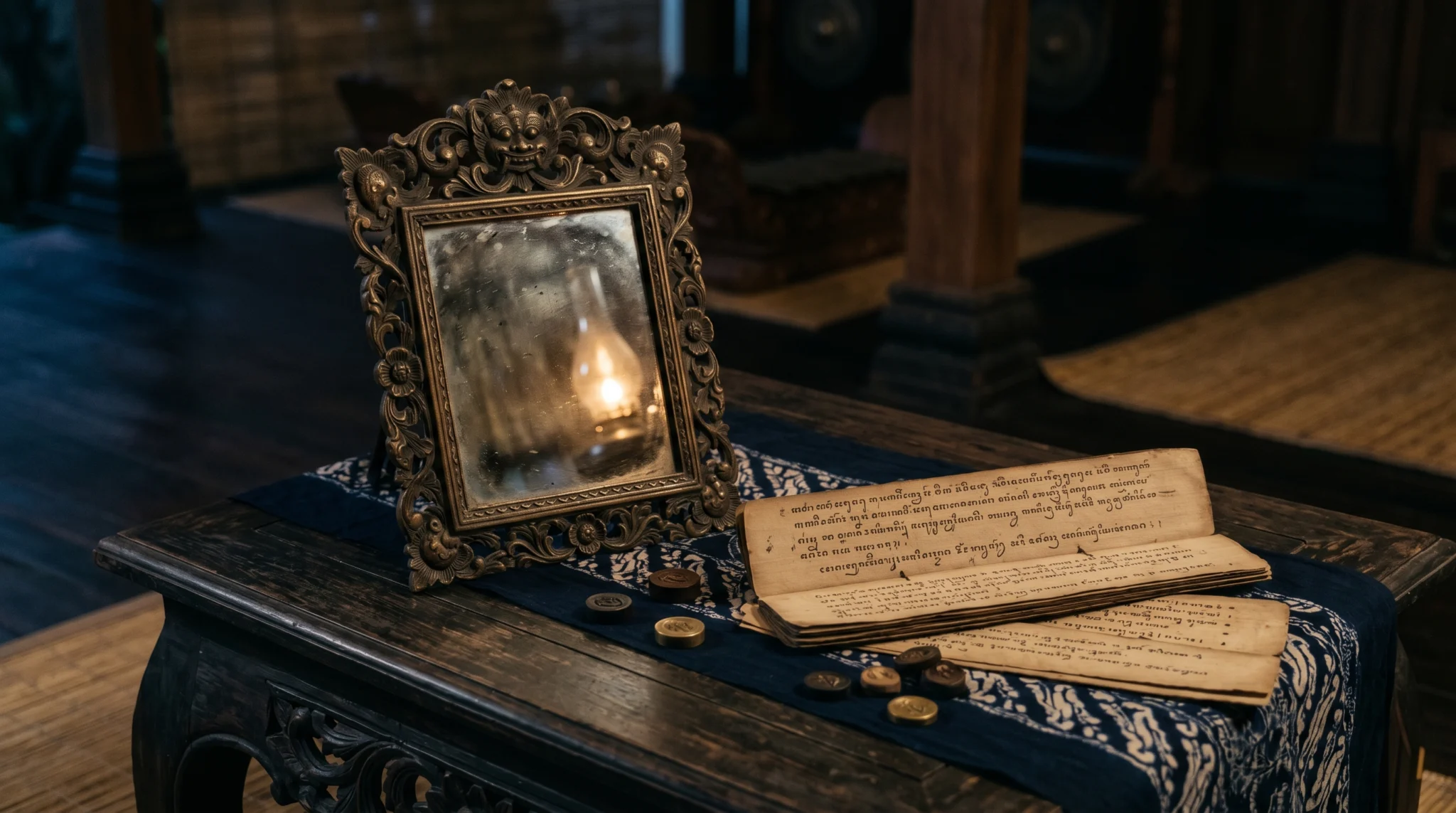
A mirror does not create a face. It only reflects what is there. Weton works best in a similar way. It does not create someone’s fate, but it can help a person notice patterns, habits, and tendencies.
A person reading weton may ask: am I often too hurried? Do I hold my opinions too tightly? Do I keep feelings inside too long? Do I need to become more patient in communication? These questions are healthier than believing that life has already been decided by a calculation.
When read as a mirror, weton becomes a learning space. It helps a person pay attention to character, habit, speech, and decisions. When read as a verdict, weton becomes a burden.
In JavaSense language, weton is safer as a reflective cultural mirror: a place to look at oneself more clearly, not a place to search for a final sentence about fate.
What Weton Can Help You Reflect On
In Javanese tradition, weton can become an entry point for several symbolic readings. The most basic reading is birth weekday, pasaran, and neptu. From there, some Javanese readings discuss tendencies, relationships, and conduct.
The word “tendency” is important. A tendency is not a certainty. If someone is described as strong, it does not mean they must be stubborn. If someone is described as sensitive, it does not mean they must be weak. Everything depends on how a person shapes themselves.
Weton can help someone notice potential and points of caution, but it should not be used to label a human being too narrowly. A person is always wider than one calculation.
If you want to find your birth weekday, pasaran, and neptu, you can calculate your weton from a birth date with JavaSense.
What Weton Should Never Be Used to Decide
There are limits that need to be protected when reading weton. Weton should never be used to decide that someone will certainly become rich, certainly become poor, certainly suffer misfortune, certainly fail in marriage, certainly be incompatible, or certainly have bad fate.
Weton should also never be used to lower someone’s dignity. No person becomes less valuable because their neptu is small. No person becomes automatically superior because their neptu is large.
In relationships, weton should not be the only reason to decide a couple’s future. In work, weton should not replace skill, discipline, opportunity, and effort. In health, weton should never replace medical examination or professional advice. In money or legal matters, weton should never replace careful, qualified guidance.
This boundary helps culture remain a source of wisdom, not a source of fear.
Weton, Pasaran, Neptu, and Wuku Explained
To avoid misunderstanding weton, readers need to understand several basic terms.
| Term | Simple Meaning | Safer Way to Read |
|---|---|---|
| Weton | The meeting of a birth weekday and Javanese pasaran, such as Monday Legi or Friday Kliwon. | Read it as a doorway into birth timing and cultural reflection. |
| Pasaran | The five-day Javanese cycle: Legi, Pahing, Pon, Wage, and Kliwon. | Read it as part of the Javanese calendar, not as a fixed label. |
| Neptu | The numerical value of weekday and pasaran used in weton calculation. | Read it as a symbolic number, not as a measure of human worth. |
| Wuku | A layer of the Pawukon cycle, which consists of 30 wuku. | Read it as a cultural layer of time, not as a fixed personality verdict. |
To go deeper, read about neptu in the Javanese calendar, use the Javanese calendar, and explore Pawukon and the 30 wuku cycle.
A Real-Life Case: When Weton Makes a Family Anxious
Imagine someone preparing to take a relationship more seriously. The family begins to ask about weton, then someone calculates the couple’s neptu. The result is considered heavy. A warm conversation suddenly becomes uncertain.
In this situation, JavaSense does not ask readers to reject tradition. But a number should not become the only judge. What needs to be read is not only the calculation, but also real life: can the couple speak honestly, can both families talk calmly, can conflict be handled, and has the decision been prepared with maturity?
Weton can become part of family conversation. It may open space for more care, patience, and honesty. But it should not become a hammer that decides the future of two people without seeing the real life they are building.
Common Weton Myths That Create Fear
Some fear around weton comes from myths passed down through conversation. Some people believe certain weton must be heavy, certain neptu must be bad, or certain couples must bring problems.
These myths need to be reread carefully. Not everything inherited as a story should be accepted as a verdict. Some stories may have begun as advice for caution, but later turned into fear because they were repeated without context.
Several myths need special care:
- Certain weton will certainly bring bad fate.
- Small neptu is always bad.
- Large neptu is always superior.
- A heavy weton compatibility result means a relationship must fail.
- A person cannot change because their weton has already decided everything.
For a focused discussion, read JavaSense’s guide on why “bad weton” should be read carefully.
How to Read Weton Wisely
Reading weton wisely means not rejecting it harshly, but also not believing it blindly. Tradition deserves respect, but it still needs common sense.
Ky Tutur’s reflection: Weton is not a fence that imprisons life. It is closer to a small mirror: it helps people notice their tendencies, but each step still needs reason, feeling, and responsibility.
Use these simple principles:
- Read weton as cultural heritage, not as fixed fate.
- Use weton to know yourself, not to justify harmful behavior.
- Do not use weton to judge a partner, family member, or anyone else.
- Do not fear neptu, because a number is not a measure of human dignity.
- Use a reading as the beginning of conversation, not the end of decision-making.
- Keep communication, real conditions, responsibility, and proper advice in view.
With this approach, weton does not make people feel defeated before trying. It becomes a reminder to become more aware of habits, speech, relationships, and life decisions.
JavaSense Principles for Reading Weton
JavaSense reads weton with two feet: feeling and reason. Feeling helps preserve respect for tradition. Reason keeps tradition from becoming fear, absolute claims, or careless decisions.
The principle is simple. First, weton is cultural heritage worth understanding. Second, weton should not become a verdict on life. Third, weton should help people know themselves, not make them feel low or afraid.
Fourth, weton should never be used to frighten readers. Fifth, weton reading should always leave room for laku: improving habits, caring for communication, managing emotion, and taking responsibility for choices.
With this approach, JavaSense protects the Javanese rasa without asking readers to abandon common sense.
Learn Weton Without Fear
If you want to begin from the foundation, read Javanese weton to understand weton, pasaran, neptu, and the 35 weton combinations. If you want to know your own weton, use the JavaSense weton calculator.
After that, you can explore neptu in the Javanese calendar and the Javanese calendar. For relationships, use weton compatibility with care as cultural reflection, not as a fixed decision.
To explore related cultural resources in one place, open JavaSense cultural tools. For a broader cultural map, JavaSense can also be read as a Javanese cultural platform for weton, calendar, Primbon reflection, Pawukon, wuku, and Javanese script.
Closing: Weton Reminds, It Does Not Bind
The most important part of reading weton is not searching for certainty about fate. The deeper value is learning to know oneself more gently. Weton does not come to bind a person. It reminds people that life needs awareness.
If part of the self is too hard, soften it. If a habit is not healthy, improve it. If a potential has not been cared for, nurture it with patience. Weton becomes meaningful when it helps people improve conduct, not when it makes them afraid of life.
So read weton without fear. Respect the culture, understand its limits, and use it as a mirror for better steps. Hold this core idea carefully: weton is not fortune telling that binds the future, but a reminder to live with more awareness.
To learn weton, pasaran, neptu, compatibility, and the Javanese calendar in a lighter way, you can also open JavaSense on Google Play.
FAQ About Weton and Fortune Telling
Is weton fortune telling?
No. In the JavaSense reading, weton is not fortune telling in the sense of a fixed prediction. Weton is better understood as cultural reflection, not as a final decision about someone’s fate.
Does weton determine someone’s fate?
No. Weton does not determine fate absolutely. A person’s life is still shaped by effort, choices, environment, education, communication, family, and maturity.
What does weton as a cultural mirror mean?
Weton as a cultural mirror means weton can help a person reflect on tendencies, habits, relationships, and conduct. It should not be used as a fixed label.
Does neptu weton determine luck?
Neptu weton should not be read as a fixed measure of luck. Neptu is part of traditional calculation, but a person’s life is still shaped by conduct, responsibility, effort, and real conditions.
Should weton compatibility be fully trusted?
Weton compatibility can be read as cultural reflection, but it should not become the only basis for a relationship decision. Communication, commitment, family dialogue, shared values, and maturity still matter.
What should weton never be used to decide?
Weton should never be used to decide that someone will certainly become rich, poor, unlucky, incompatible, unable to marry, or doomed to fail.
How can weton be read wisely?
Read weton as cultural heritage, not as a verdict. Use it to know yourself, care for your conduct, and open conversation without frightening yourself or judging others.
Where can I check my weton from a birth date?
You can use the JavaSense weton calculator to find your Javanese birth weekday, pasaran, neptu, and related cultural information from a birth date.