

Angger, my child…
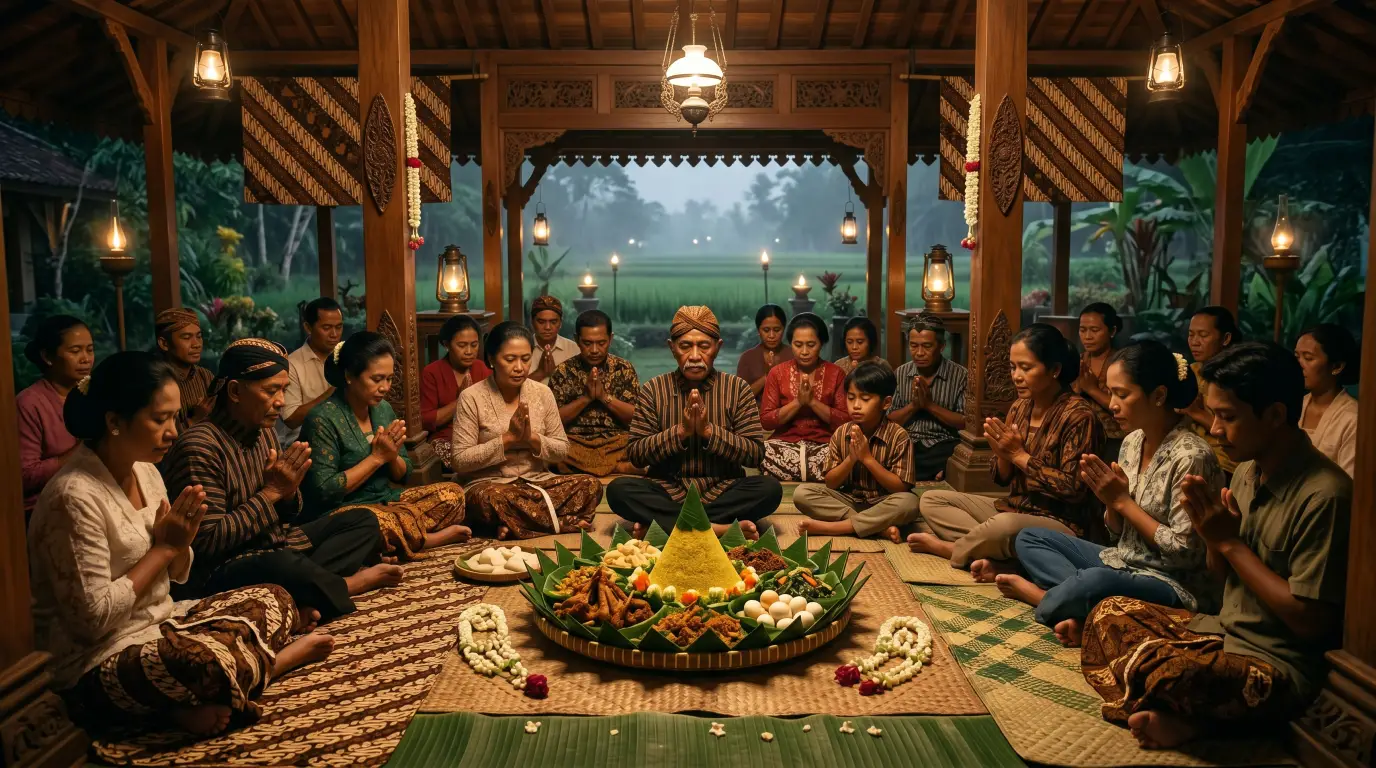
There is a Javanese tradition that may look simple from the outside, yet carries a deep layer of meaning: slametan. It gathers prayer, food, gratitude, and togetherness into one quiet practice. Slametan is not merely a communal meal, nor is it an empty custom repeated without thought. At its heart, it is a way of caring for inner safety and social harmony together.
Ky Tutur Summary
- Slametan is a Javanese tradition centered on prayer, shared food, gratitude, and communal togetherness.
- The word slamet means more than being safe from danger. It also points to calm, balance, harmony, and a life that feels inwardly settled.
- Food in slametan is not only served to be eaten. It becomes a language of care, shared with family, neighbors, and the surrounding community.
- In JavaSense, slametan is read as a cultural mirror: praying with humility, sharing with sincerity, and living together without losing rasa.
Ky Tutur Note: This article discusses slametan as a Javanese cultural tradition and a reflective practice. The form of slametan may differ across regions, families, and religious communities. This reading is not meant to standardize every practice, judge anyone’s tradition, or replace religious guidance. It is a doorway to understanding the cultural meaning with care.
Slametan appears in many moments of Javanese life. It may accompany birth, moving into a new house, harvest, marriage, circumcision, death, village cleansing, starting a new effort, or simply giving thanks for safety already received. Sometimes it is simple. Sometimes it is more complete, depending on the family, region, and ability.
Yet the meaning of slametan should not stop at the outer scene. From the outside, it may look like people gathering, praying, and sharing food. But inside that simple form lives a way of caring for relationships: the relationship with God, with family, with neighbors, with ancestors, with the environment, and with one’s own inner life.
Slametan reminds people that life is not carried alone. When someone has a life event, neighbors may come to pray. When a family receives a blessing, food may be shared. When grief comes, people sit together. When hope is still uncertain, prayer is spoken in community. In this way, slametan becomes both a social practice and an inner practice.
What Is Slametan?
Slametan is a Javanese communal tradition usually centered on prayer, food, and the presence of family or neighbors. Its purpose is to ask for safety, express gratitude, arrange inner feeling, and strengthen togetherness.
The root word is slamet, often understood as safe or saved. In Javanese rasa, however, slamet is broader than physical safety. It can also mean calm, whole, balanced, socially harmonious, and inwardly at peace.
For that reason, slametan can be understood as a practice of caring for slamet. People pray because they know life is not fully in human hands. People share food because blessings are not meant to be kept only for oneself. People invite others because life needs relationship.
Slametan is not merely an outer ceremony. It is a refined way of processing feeling: gratitude when blessings arrive, humility when facing uncertainty, and togetherness when people need to strengthen one another.
Slametan as Prayer, Food, and Togetherness
There are three elements that often stand at the center of slametan: prayer, food, and togetherness. Each carries a different role, yet all three support one another.
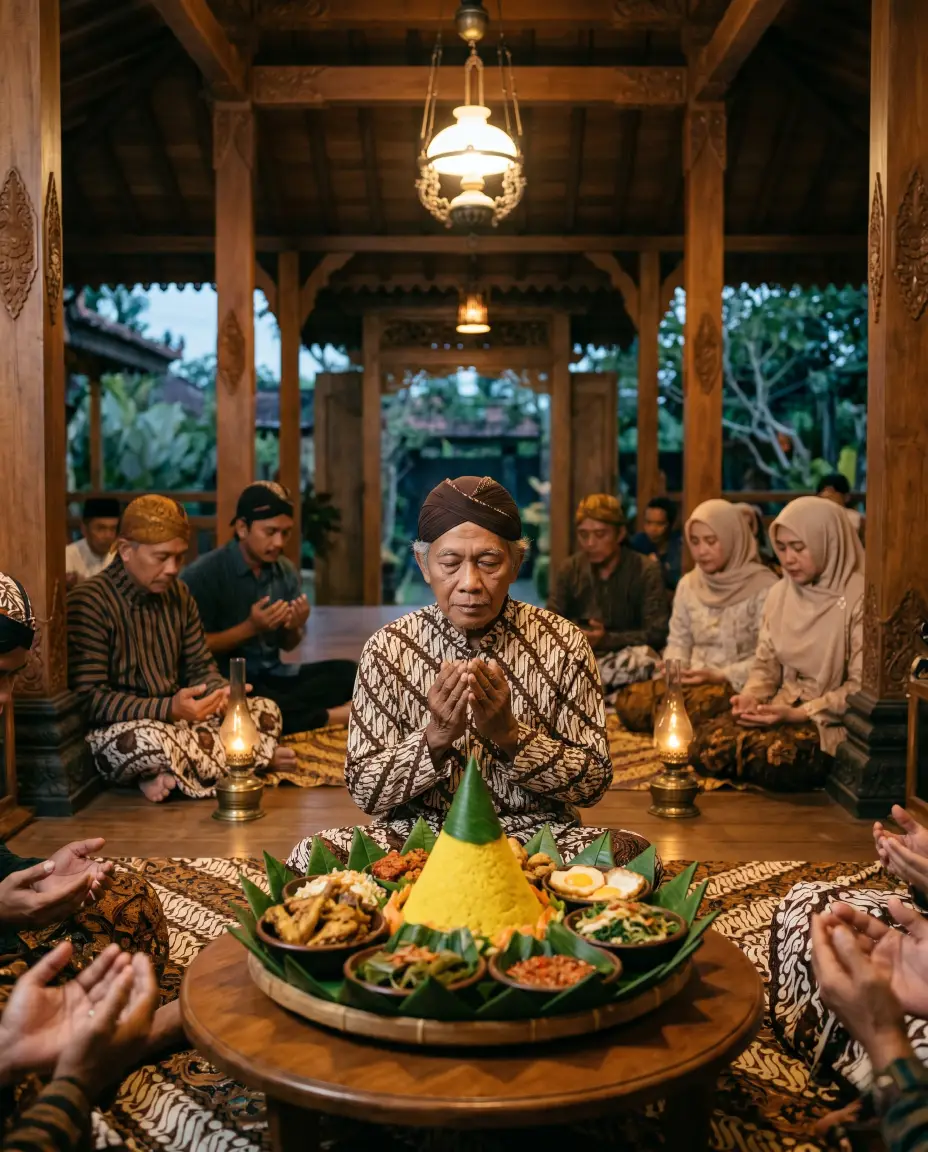
Prayer is the inner center. Through prayer, people admit that life cannot be controlled entirely by personal will. There is hope being expressed. There is gratitude being spoken. There is a request for safety, steadiness, and a calmer path ahead.
Food is the visible form of sharing. Rice, side dishes, tumpeng, snacks, or simple meals are not only matters of the stomach. Food becomes a language of care. It allows prayer to become action: giving, sharing, and maintaining social bonds.
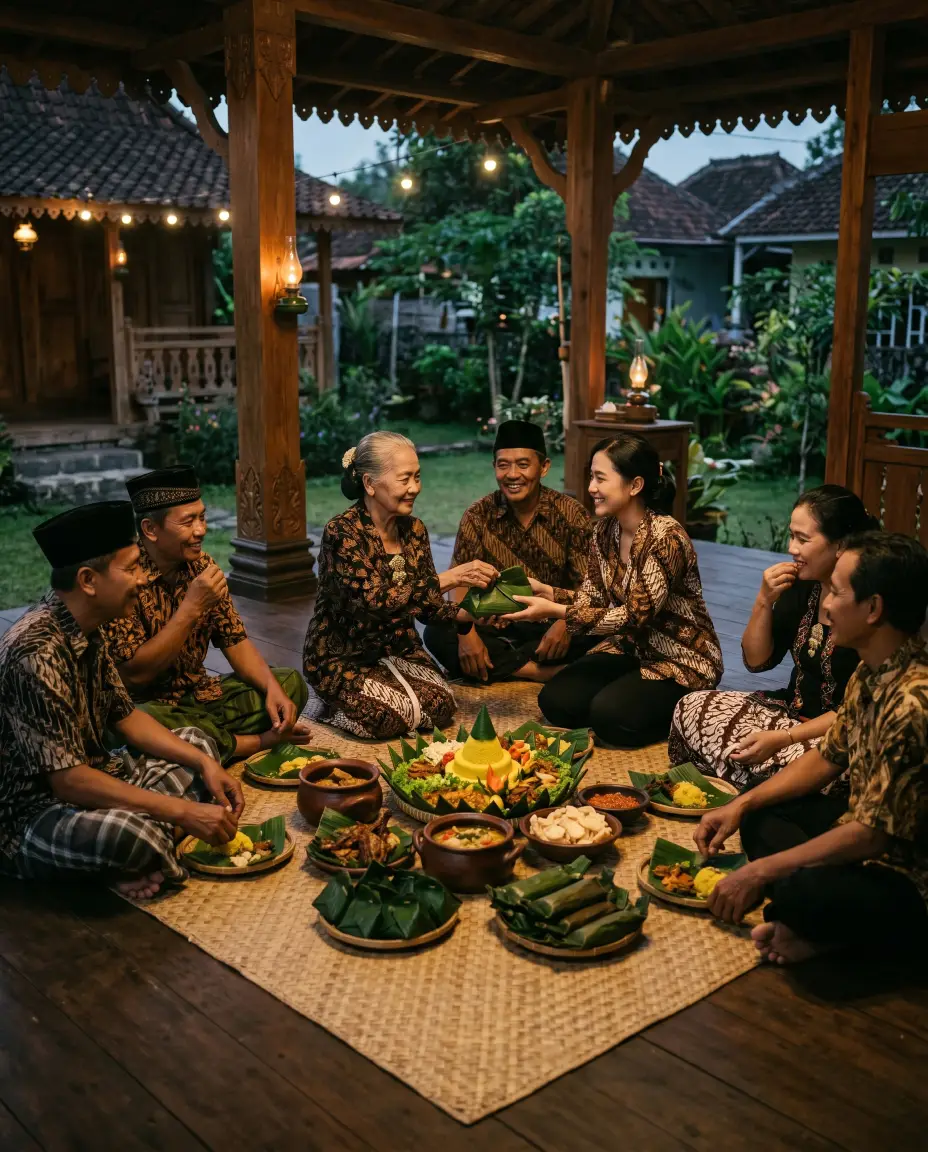
Togetherness is the social space. In slametan, people come, sit, listen, pray, greet one another, and bring goodwill. Their presence matters. Sometimes people do not say much, yet their arrival already says: this family is not being left alone.
When prayer, food, and togetherness meet, slametan becomes more than a cultural event. It becomes a way of caring for shared rasa.
The Meaning of Slamet in Javanese Culture
The meaning of slamet in Javanese culture is wide. It does not only mean being free from accidents or disaster. Slamet also touches inner life, social relationships, and the feeling that life is more settled.
A person may live without obvious danger, yet still feel not truly slamet because the heart is filled with envy, anxiety, anger, or isolation. Another person may live simply, yet feel more slamet because the heart is calmer, relationships are more harmonious, and life is not constantly ruled by restlessness.
In slametan, the hope for safety is not only personal. The prayer is often not just for one individual, but also for the family, the home, the neighbors, the work, and the wider environment.
This is why slametan has a communal spirit. Safety is not imagined as private property. A person’s sense of safety is tied to the condition of the house, the family, the neighborhood, and the surrounding community.
Prayer in Slametan: Hope, Gratitude, and Humility
Prayer in slametan is not merely a sequence of words. It is a way of shaping hope and gratitude with humility. It may be spoken in Arabic, Javanese, Indonesian, or according to the habit of a particular community. The form may differ, but the center is the intention.
Through prayer, people learn that not everything can be forced. They continue to make effort, yet also learn to surrender the result. They hope for safety, but are also invited to improve their conduct so life becomes more worthy of goodness.
Prayer in slametan also reminds people not to forget gratitude. Many things in life seem ordinary, yet they are deeply valuable: health, enough food, family still able to gather, neighbors who still care, work that still continues, and a heart still able to hope.
In this way, slametan becomes a pause. In the middle of a busy life, people stop for a moment, lower the heart, and remember that life is not only about chasing the next thing. It is also about giving thanks for what is already present.
Food as a Language of Care
Food in slametan has a gentle meaning. It is not only served to be eaten together. Food becomes a visible form of gratitude. What is cooked, wrapped, shared, or brought home becomes a sign that blessing should not stop within one house.
In many slametan gatherings, food is prepared with intention. Someone cooks from morning. Someone helps wrap the portions. Someone delivers them to neighbors. Someone receives them with a good prayer. These small acts form a quiet network of social care.
Food also teaches humility. Slametan does not have to be luxurious. A simple meal prepared with sincerity can still carry deep meaning. What matters most is not the number of dishes, but the intention to share and the togetherness that surrounds it.
Here, food becomes a language of care. It says what is sometimes not spoken directly: “I am grateful, and I want this goodness to be shared with those around me.”
Guyub: The Social Heart of Slametan
Guyub is one of the deepest values inside slametan. Without guyub, slametan can become a dry formality. Guyub allows people to feel recognized, accompanied, and connected.
In slametan, neighbors do not come only as guests. They come as part of a network of rasa. Their presence strengthens the family holding the event. Their prayers become a sign of support. Their small conversations after the prayer often renew social ties.
In a fast-moving world, this value of guyub becomes even more important. Many people now live close in distance but far in feeling. One neighborhood may be full of houses, yet the people inside may hardly know one another. Slametan reminds us that living near each other is not only about address, but also about care.
Guyub is not noise. It is not merely a crowd. It is the quiet knowledge that people are willing to show up for one another.
Slametan, Ikhlas, and Nrimo
Behind prayer, food, and togetherness, slametan also carries inner values: ikhlas and nrimo. These values help slametan remain more than an outer event.
Ikhlas means sincerity. If slametan is held only to impress others, to seek praise, or to avoid gossip, its inner weight becomes heavy. But when it is held as gratitude, prayer, and a wish to share, the practice becomes clearer.
Nrimo means accepting reality with awareness. In slametan, people may hope that a life event goes smoothly, that a family stays safe, or that a path becomes easier. Yet the result is never fully in human control. Nrimo teaches people to remain calm, keep making effort, and not lose gratitude.
This does not mean giving up. It means accepting that human beings have limits, while still carrying responsibility. Slametan becomes a reminder that one can pray, act, share, and still leave room for life to unfold beyond personal control.
Common Misunderstandings about Slametan
There are several misunderstandings about slametan that need to be made clear.
First, slametan is often seen as merely eating together. This is too shallow. Food is visible, but behind it are prayer, gratitude, intention, social care, and the hope for safety.
Second, slametan is sometimes seen only as a cultural obligation. A healthy slametan should come from awareness, not pressure. If it is held only out of fear of gossip, its meaning can become heavy.
Third, slametan is assumed to be the same everywhere. This is not accurate. Its form may differ by region, family, religious community, and economic ability. Those differences should be respected.
Fourth, slametan is sometimes treated as something irrelevant to modern life. Yet its basic values remain deeply relevant: prayer, gratitude, sharing, and caring for social bonds.
Fifth, slametan is sometimes judged by the size of the meal. This is also misleading. The dignity of slametan does not lie in luxury, but in intention, rasa, and the social good it carries.
Slametan in Modern Life
In modern life, slametan can become a valuable pause. Life moves quickly. People chase work, notifications, targets, and achievements. Many relationships become thin because everyone is busy with their own world.
Slametan invites people to stop for a while. To sit together. To pray. To eat simply. To greet neighbors. To remember that life is not only about the self. There is family to care for. There is community to maintain. There is gratitude to be spoken.
The form of slametan may adapt to the times. It does not always have to be large. It does not have to be complicated. What matters is that the core value remains: humble prayer, shared food, and togetherness that keeps relationships warm.
In modern families, slametan can also become a way to introduce children to cultural roots. Children learn that food does not simply appear. Behind it are intention, prayer, kitchen work, neighborly help, and gratitude. In that way, culture is not only read. It is experienced.
A Practical Way to Read Slametan Clearly
There are several simple ways to read slametan more clearly.
First, look at the intention. A meaningful slametan begins with a clean intention: gratitude, prayer, sharing, and caring for relationships.
Second, do not measure it by luxury. A simple meal shared sincerely can be more meaningful than a large event that burdens the heart.
Third, respect different forms. Slametan in one area may differ from slametan in another. Do not quickly judge only because the form is not the same.
Fourth, keep adab in togetherness. Coming to a slametan is not only about eating. It is also about praying, greeting, and bringing goodwill.
Fifth, carry the value home. After the gathering ends, do not let the meaning stop on the plate. Let it become conduct: more gratitude, more care, more harmony, and more awareness of others.
A Brief Javanese Glossary
- Slametan: a Javanese communal gathering centered on prayer, shared food, and the hope for safety.
- Slamet: a state of safety, calm, balance, and social harmony.
- Guyub: warm togetherness, neighborly care, and communal closeness.
- Rasa: inner feeling, sensitivity, and refined awareness.
- Ikhlas: sincerity, especially in giving, praying, and acting without seeking praise.
- Nrimo: accepting reality with a spacious heart, without giving up responsibility.
JavaSense and the Care of Javanese Tradition
JavaSense reads slametan as a Javanese tradition that deserves to be cared for with rasa and clear understanding. Tradition does not need to be frozen like an object in a museum. It also does not need to be abandoned simply because the world has changed. What matters is understanding the root meaning, then bringing its values into present life.
Slametan teaches that culture lives through small acts: sitting together, praying together, sharing food, greeting neighbors, and remembering that human beings need one another.
If you want to explore Javanese cultural heritage more deeply, you can also visit the National Library of Indonesia and the Indonesian Ministry of Culture archive. References like these help cultural reflection stay connected to learning, not only memory.
Closing Reflection: Caring for Safety Together
In the end, slametan teaches that safety is not only requested alone. It is cared for together. There is prayer being spoken. There is food being shared. There are neighbors who come. There is gratitude made visible. There are social ties quietly warmed again.
Angger, my child, slametan is not just an old tradition. It is a gentle way for Javanese culture to remind people not to become isolated from rasa. In a world that easily makes everyone busy with themselves, slametan reminds us to sit together, pray for one another, and share what we can.
Slametan teaches: do not wait for life to be perfect before giving thanks. Do not wait to have excess before sharing. Do not wait for loss before realizing the value of togetherness. Inner safety often grows from simple acts done with a clear heart.
To learn Javanese culture in a lighter and more modern way, open the JavaSense app on Google Play: download JavaSense on Google Play.
FAQ about Slametan in Javanese Culture
What is slametan in Javanese culture?
Slametan is a Javanese communal tradition centered on prayer, shared food, gratitude, and togetherness. It is often held to ask for safety, express thanks, and maintain social harmony.
What does slamet mean in slametan?
Slamet means safe, calm, balanced, and socially harmonious. In slametan, slamet is not only physical safety, but also inner calm and communal well-being.
Is slametan only a communal meal?
No. The meal is only the visible part. Slametan also includes prayer, intention, gratitude, social care, and the hope for a more settled life.
Why is food important in slametan?
Food is important because it turns gratitude into a visible act of sharing. It connects family, neighbors, and community through care.
What does guyub mean in slametan?
Guyub means warm togetherness and communal closeness. In slametan, guyub is expressed when people gather, pray, greet one another, and share food.
Is slametan still relevant today?
Yes. Slametan remains relevant when understood as a practice of prayer, gratitude, sharing, and caring for social relationships. Its form may adapt, but its values remain meaningful.
How should slametan be understood safely?
Slametan should be understood as a diverse cultural tradition, not as a burden, not as mere eating, and not as a practice that must look the same for every family or community.
Can slametan be adapted for modern life?
Yes. Slametan can be simple and adapted to modern life as long as its core values remain: sincere prayer, shared food, gratitude, and togetherness.
Learning Slametan More Clearly
Slametan is not merely a meal or a gathering. It is a Javanese practice of prayer, food, togetherness, gratitude, and shared inner safety. To explore Javanese wisdom, script, weton, calendar, and cultural heritage more easily, open JavaSense on Google Play.