

Online Weton Calculator by Birth Date
Use this online weton calculator to find your birth weton from a Gregorian birth date. Enter a date, and JavaSense shows the weekday, Javanese pasaran, total neptu, birth wuku, and calendar elements as cultural reflection, not fortune-telling.
This calculation is presented as a Javanese cultural reference for education and reflection. It is not fortune-telling, not a fixed compatibility verdict, and not a final decision-maker for the future.
Cultural note: In Javanese tradition, the day changes after Maghrib (sunset prayer), not at 00:00. Birth time before or after Maghrib may affect the Javanese day reading in some family traditions.
Online Weton Calculator Summary
- Check weton: find a birth weton from a birth date.
- Calculate weton: shows weekday, Javanese pasaran, total neptu, and birth wuku.
- Javanese weton calculator: helps read saptawara, pancawara, pranata mangsa, and supporting wariga elements.
- Today's weton: this page also shows today's weekday, pasaran, neptu, and wuku.
- Cultural note: results are for education and reflection, not fixed fortune-telling.

How to Use the Weton Calculator
- Select your birth date from the date field.
- Click Check now.
- View the full result: weekday, pasaran, total neptu, wuku/pawukon, and supporting wariga elements.
Privacy: your birth date is used only for calculation on this page; JavaSense does not store it without your consent.
What the Calculator Shows
- Birth weekday or Saptawara, such as Sunday, Monday, Tuesday, Wednesday, Thursday, Friday, and Saturday.
- Javanese pasaran or Pancawara, namely Legi, Pahing, Pon, Wage, and Kliwon.
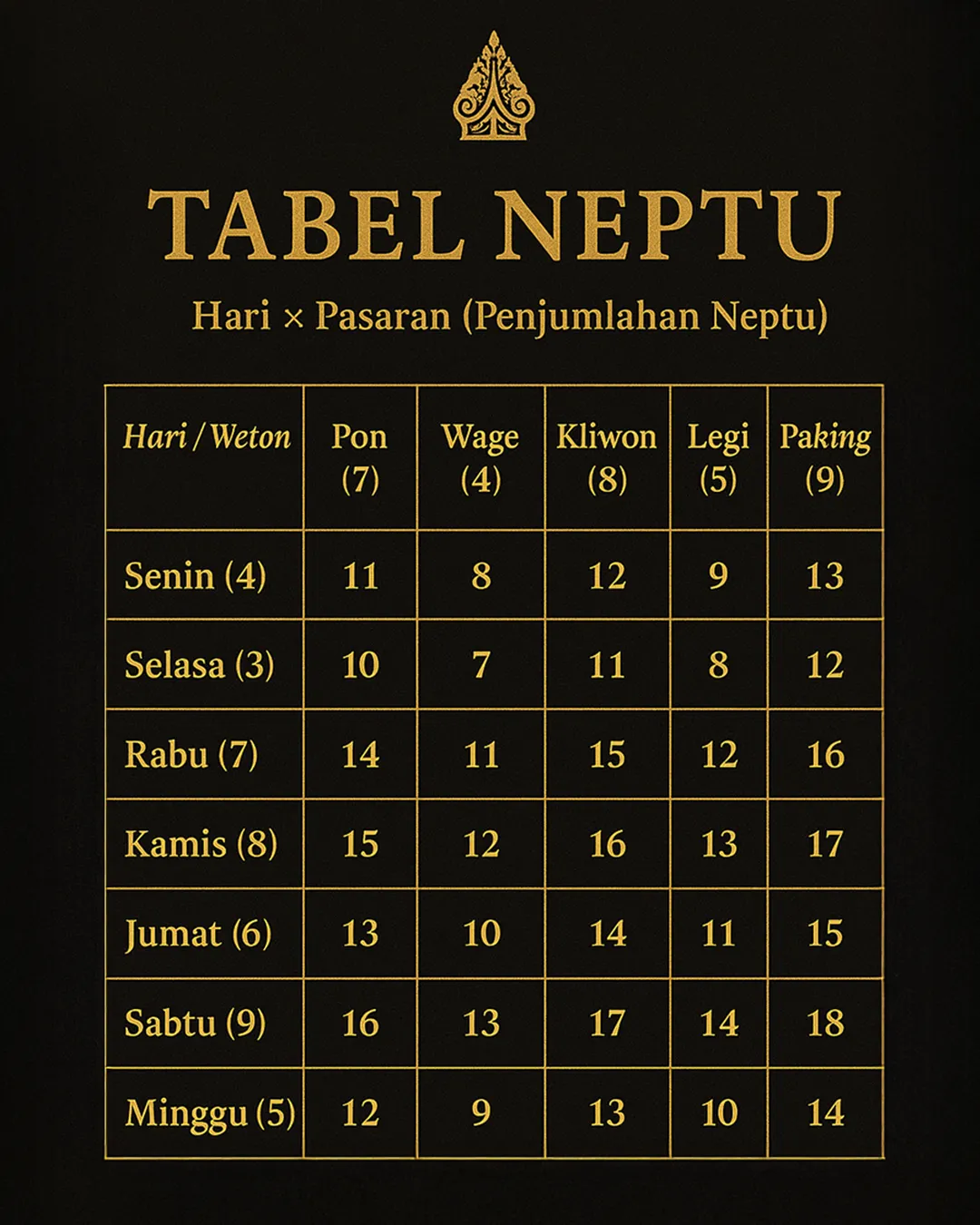
- Total neptu, which is the weekday value plus the pasaran value.
- Birth wuku in the 30-wuku Pawukon cycle.
- Pranata mangsa as a traditional Javanese seasonal system. General reference: Pranata mangsa.
- Hastawara, sadwara, sangawara, and saptawara as supporting wariga elements.
- Rakam and Paarasan as traditional cultural reading elements.
- Javanese date, Hijri date, and warsa when available in the system.
Wuku and Pawukon as Cultural Layers
Besides weekday and pasaran, the JavaSense weton result also shows wuku in the Pawukon cycle. Weton and wuku are not the same. Weton comes from weekday and pasaran, while wuku comes from the 30-cycle Pawukon tradition.
By showing wuku, the reading becomes richer because it does not stop at neptu only. Wuku adds another cultural layer for understanding symbols, tendencies, and traditional context around a birth date.
How to Calculate Weton Neptu
In Javanese weton calculation, neptu is determined by adding the weekday value and the Javanese pasaran value.
Weton Neptu = Weekday Value + Pasaran Value
Weekday Neptu Values
- Sunday: 5
- Monday: 4
- Tuesday: 3
- Wednesday: 7
- Thursday: 8
- Friday: 6
- Saturday: 9
Javanese Pasaran Neptu Values
- Legi: 5
- Pahing: 9
- Pon: 7
- Wage: 4
- Kliwon: 8
Example: Sunday Pahing = 5 + 9 = 14. Values may vary across sources; JavaSense follows common neptu values used in many Javanese cultural references.
What Can the Weton Result Be Used For?
The weton result can be used as an early cultural reference. It should be read wisely and not treated as an absolute decision.
- Understanding weton, weekday, pasaran, and neptu through this calculator.
- Checking dates, pasaran, and calendar elements through the Javanese Calendar.
- Reading relationship compatibility as cultural reflection through Weton Compatibility.
- Use the JavaSense app on Google Play to access Javanese cultural tools from your phone.
- Using work, fortune, or life-direction notes as cultural reflection, not certainty.
Read the Result Wisely
Weton can be a doorway into Javanese culture, but it should not be used to frighten yourself or judge another person. A small neptu is not bad, and a large neptu is not automatically better.
In JavaSense, weton is read as a cultural mirror. The result may help with reflection, but real decisions still need clear thinking, communication, effort, and responsibility.
Calculation Method (Short & Transparent)
- Convert the Gregorian date into Javanese calendar elements: saptawara or weekday, pancawara or pasaran, wuku/pawukon, and optionally Javanese/Hijri date plus warsa.
- Total neptu is calculated from weekday value plus pasaran value.
- Wuku is taken from the 30-cycle Pawukon system and used as a cultural reading layer.
- Day change follows Javanese tradition after Maghrib, and calculations use local time with Asia/Jakarta as default.
FAQ - Weton Calculator
Does this online weton calculator predict fate?
What is weton?
How do I find my weton?
Which weton is the strongest?
Which weton are considered special?
When does the day change in the Javanese calendar?
What is neptu and how is it calculated?
What is the difference between weton and wuku or pawukon?
Can the weton result be used to choose an auspicious day?
Can it be used for compatibility?
What about work, fortune, or life direction?
Why can results differ across websites?
Does it show Javanese and Hijri dates?
Is my birth date stored?
Last updated: Thursday, September 17, 2026