

In many Javanese families, one simple question can open a long cultural doorway: “What day and pasaran were you born on?” The question may sound small, but it often leads to Javanese weton: birth day, pasaran, neptu, relationship reflection, good days, and an older way of reading time.
Some people search for weton out of curiosity. Others search because family begins to talk about marriage, ceremonies, compatibility, or important days. Some arrive with worry because they have heard that certain neptu values are considered heavy.
This is where the reading needs to be clarified. Javanese weton is not a tool for locking a person’s life. It is better understood as a cultural language: a way Javanese tradition reads the meeting of weekday and pasaran, then turns that reading into reflection for conduct, not a verdict on fate.
Quick Answer: What Is Javanese Weton?
Javanese weton is the meeting of a person’s birth weekday and the five-day Javanese pasaran cycle. The weekday comes from the seven-day cycle, while pasaran comes from the five Javanese market days: Legi, Pahing, Pon, Wage, and Kliwon.
From the meeting of 7 weekdays and 5 pasaran, there are 35 Javanese weton combinations. In Javanese tradition, weton is often used to understand neptu, character reflection, relationships, good days, the Javanese calendar, and cultural timing. A healthy reading does not treat weton as fixed fate.
- Weton is the meeting of birth weekday and Javanese pasaran.
- Pasaran is the five-day Javanese cycle: Legi, Pahing, Pon, Wage, and Kliwon.
- Neptu weton is the numerical value formed by adding the weekday value and pasaran value.
- There are 35 Javanese weton combinations from 7 weekdays and 5 pasaran.
- Weton is safer when read as cultural reflection, not as absolute prediction.
Why Weton Matters in Javanese Families
Weton often appears in family conversations before it appears in books. An elder may ask about someone’s weekday and pasaran before a wedding discussion, a family ceremony, or a conversation about timing.
For many Javanese families, this question is not only about a date. It is a way of entering a cultural memory. Weton can become a bridge between a person’s birth, family expectation, Javanese calendar rhythm, and the idea that important decisions should be made with care.
This is why weton should be read with balance. It deserves respect as culture, but it should not be used to frighten people or reduce human life to one calculation.
What Is Javanese Weton?
Javanese weton is a cultural calendar system that reads a person’s birth through two cycles of time: the seven-day weekday cycle and the five-day Javanese pasaran cycle.
The weekdays are Monday, Tuesday, Wednesday, Thursday, Friday, Saturday, and Sunday. The five pasaran are Legi, Pahing, Pon, Wage, and Kliwon.
If someone is born on Monday Legi, their weton is Monday Legi. If someone is born on Friday Kliwon, their weton is Friday Kliwon. From this meeting of seven weekdays and five pasaran, Javanese tradition recognizes 35 weton combinations.
In daily life, weton often appears in discussions about family, marriage, ceremonies, good days, compatibility, and the Javanese calendar. But weton should not be used to judge a person. A human life is also shaped by family, experience, education, environment, choices, and the willingness to grow.
If you want to find your own weton, you can calculate your weton from a birth date with JavaSense. The tool helps show your weekday, pasaran, neptu, wuku, and related Javanese calendar information.
Weekday, Pasaran, and Neptu in Weton
There are three basic terms to understand before reading weton more deeply: weekday, pasaran, and neptu.
Weekday refers to the seven-day cycle. Pasaran refers to the five-day Javanese cycle. Neptu is the numerical value assigned to each weekday and pasaran.
When the weekday value and pasaran value are added together, the result is called neptu weton. This number is often used as an entry point in readings about weton, relationship reflection, good days, or certain cultural needs.
Still, neptu should never be treated as a measure of human worth. A smaller neptu does not mean someone is bad. A larger neptu is not automatically better. The number is a sign; conduct still needs awareness, effort, communication, and responsibility.
Javanese Weekday Neptu Values
The table below shows the weekday neptu values commonly used in Javanese weton calculation.
| Weekday | Javanese / Indonesian Name | Neptu Value |
|---|---|---|
| Sunday | Minggu | 5 |
| Monday | Senin | 4 |
| Tuesday | Selasa | 3 |
| Wednesday | Rabu | 7 |
| Thursday | Kamis | 8 |
| Friday | Jumat | 6 |
| Saturday | Sabtu | 9 |
Javanese Pasaran Neptu Values
The table below shows the pasaran neptu values commonly used in Javanese weton calculation.
| Pasaran | Neptu Value |
|---|---|
| Legi | 5 |
| Pahing | 9 |
| Pon | 7 |
| Wage | 4 |
| Kliwon | 8 |
For a more focused explanation, read neptu in the Javanese calendar. That guide explains how weekday values and pasaran values work together in weton calculation.
How to Calculate Weton from a Birth Date
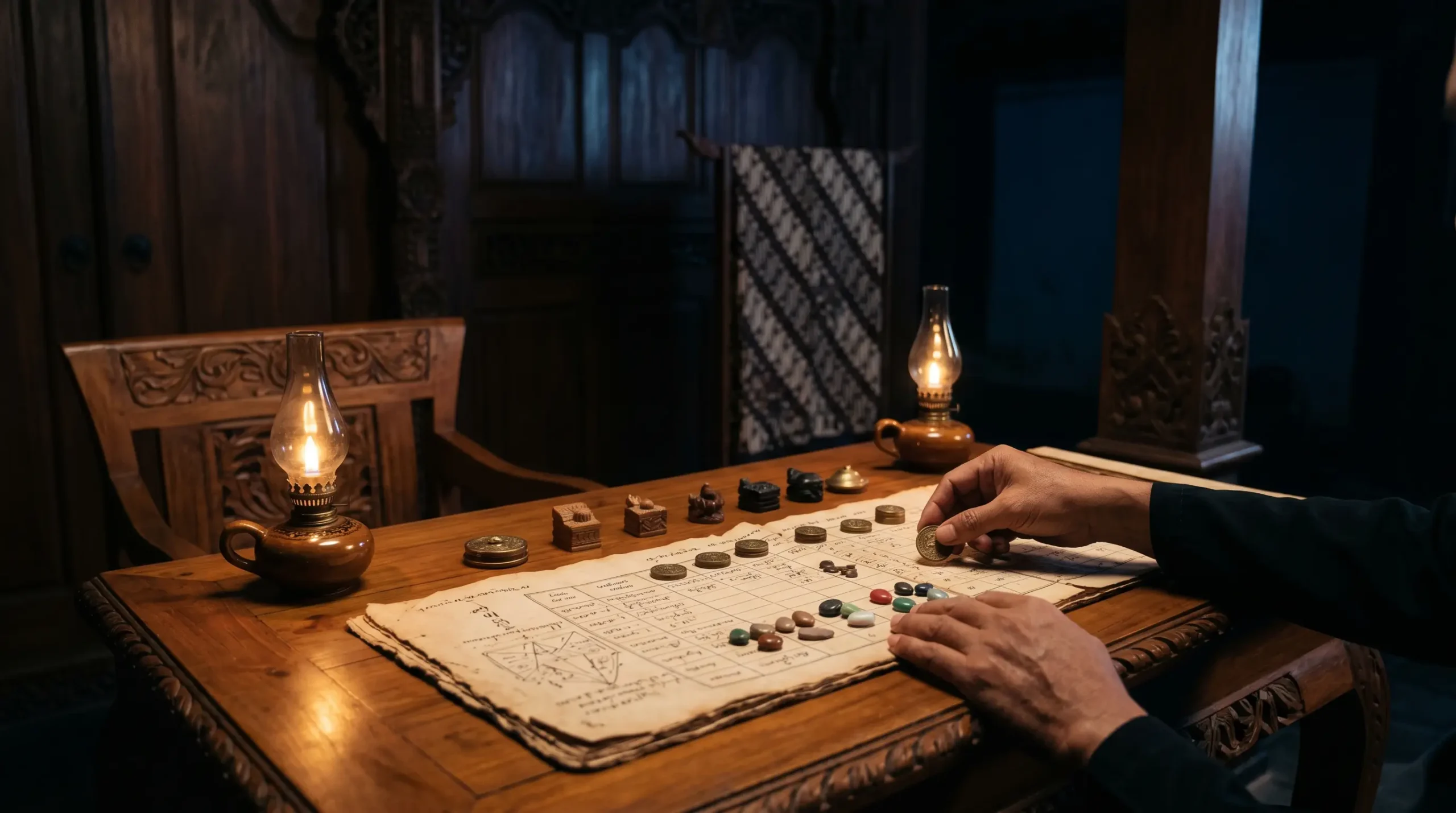
To calculate weton, you first need to know the birth weekday and the Javanese pasaran for that date. After that, add the weekday neptu value and the pasaran neptu value.
Neptu weton = weekday value + pasaran value.
For example, if someone is born on Monday Legi, Monday has a value of 4 and Legi has a value of 5. The neptu of Monday Legi is 9.
Monday Legi = 4 + 5 = 9.
Another example: if someone is born on Friday Kliwon, Friday has a value of 6 and Kliwon has a value of 8. The neptu of Friday Kliwon is 14.
Friday Kliwon = 6 + 8 = 14.
The calculation looks simple, but finding the pasaran from a modern birth date can be difficult if done manually. For a practical result, use the JavaSense weton calculator.
The 35 Javanese Weton Combinations
Because weton comes from 7 weekdays and 5 pasaran, there are 35 Javanese weton combinations. The table below gives a quick map of each weton and its neptu value.
| Weekday | Legi | Pahing | Pon | Wage | Kliwon |
|---|---|---|---|---|---|
| Monday | Monday Legi Neptu 9 |
Monday Pahing Neptu 13 |
Monday Pon Neptu 11 |
Monday Wage Neptu 8 |
Monday Kliwon Neptu 12 |
| Tuesday | Tuesday Legi Neptu 8 |
Tuesday Pahing Neptu 12 |
Tuesday Pon Neptu 10 |
Tuesday Wage Neptu 7 |
Tuesday Kliwon Neptu 11 |
| Wednesday | Wednesday Legi Neptu 12 |
Wednesday Pahing Neptu 16 |
Wednesday Pon Neptu 14 |
Wednesday Wage Neptu 11 |
Wednesday Kliwon Neptu 15 |
| Thursday | Thursday Legi Neptu 13 |
Thursday Pahing Neptu 17 |
Thursday Pon Neptu 15 |
Thursday Wage Neptu 12 |
Thursday Kliwon Neptu 16 |
| Friday | Friday Legi Neptu 11 |
Friday Pahing Neptu 15 |
Friday Pon Neptu 13 |
Friday Wage Neptu 10 |
Friday Kliwon Neptu 14 |
| Saturday | Saturday Legi Neptu 14 |
Saturday Pahing Neptu 18 |
Saturday Pon Neptu 16 |
Saturday Wage Neptu 13 |
Saturday Kliwon Neptu 17 |
| Sunday | Sunday Legi Neptu 10 |
Sunday Pahing Neptu 14 |
Sunday Pon Neptu 12 |
Sunday Wage Neptu 9 |
Sunday Kliwon Neptu 13 |
This table is meant as a simple map, not as a final judgment. The meaning of weton should be read with context, conduct, and care.
A Family Example: When Someone Asks About Weton
Imagine someone preparing for a family meeting before an engagement. Everything seems calm, then someone asks, “What is your weton? What is your partner’s weton?” The question can change the atmosphere. Some people become curious, some begin calculating, and others become anxious.
In a situation like this, JavaSense does not ask readers to reject tradition. But weton should not become the only judge. What needs to be read is not only the neptu number, but also real life: whether both families can speak openly, whether the couple can handle conflict, whether the decision has been prepared maturely, and whether communication is honest.
In this way, weton becomes part of a family conversation, not a hammer of judgment. Tradition remains respected, while reason and responsibility remain present.
How Weton Connects with the Javanese Calendar
Weton cannot be separated from the Javanese calendar. In the Javanese calendar, time is not only read as a Gregorian date. It also includes pasaran, weton, neptu, wuku, Javanese months, and other cultural cycles.
This is why people often search for today’s weton, today’s pasaran, today’s Javanese date, or good days in the Javanese calendar. These searches come from the relationship between time and culture.
If weton helps read the meeting of weekday and pasaran, the Javanese calendar gives a wider map. It helps show how date, pasaran, wuku, and cultural cycles meet.
Weton, Relationships, and Compatibility
One of the most searched weton topics is relationship compatibility. In Javanese tradition, the neptu values of two people are sometimes added to reflect compatibility, possible tension, or advice for care in a relationship.
This part needs to be read calmly. Weton compatibility is not an absolute decision. A calculation should not be used to declare that a relationship will certainly succeed or fail.
Human relationships are wider than numbers. They include communication, shared values, family blessing, loyalty, emotional maturity, economic realities, and the ability of two people to learn from each other. Weton can become a cultural reflection, but it should not become the only basis for decision-making.
For a more focused relationship reading, use JavaSense weton compatibility. Read the result as a cultural reflection and conversation starter, not as a verdict on love or marriage.
Weton and Choosing a Good Day
In Javanese culture, weton is also discussed when families look for a good day. This may happen before marriage, moving house, starting a business, or holding a family ceremony.
A good day should be understood as a cultural effort, not a guarantee that everything will happen without difficulty. Family readiness, timing, cost, place, communication, and real conditions still need to be considered.
When you need to see pasaran, weton, wuku, and Javanese date together, check the Javanese calendar as a clearer starting point.
Weton, Wuku, and Pawukon
Besides weton, Javanese tradition also knows wuku. Weton comes from the meeting of weekday and pasaran, while wuku comes from the Pawukon cycle, which consists of 30 wuku.
They are not the same, but they can complement each other. Weton gives an entry point for reading birth day and pasaran. Wuku gives another layer of time within the Pawukon cycle.
This is why Javanese cultural reading often feels layered. It does not stop at one number, one weton name, or one day. To understand this wider layer, read about Pawukon and the 30 wuku cycle.
Common Myths About Weton
Because weton is often discussed from person to person, many myths grow around it. Some people say a certain weton must bring financial difficulty. Others believe a small neptu is automatically bad. Some become afraid of marriage because a compatibility result sounds heavy.
This way of reading needs correction. No weton makes someone certainly unlucky. No number should be used to lower human dignity. No calculation should be used to close every possibility in life.
Weton should be used to notice tendencies, not to judge. It can remind people to become more aware of habits, emotions, speech, and decisions.
For a safer reading, JavaSense also explains why “bad weton” should be read carefully.
How to Read Weton Safely
Reading weton safely means not rejecting it harshly, but also not believing it blindly. Tradition deserves respect, but it still needs common sense.
Ky Tutur’s reflection: Weton is not a fence that imprisons life. It is closer to a small mirror: it helps people notice their tendencies, but each step still needs reason, feeling, and responsibility.
Use these simple principles:
- Read weton as reflection, not as fixed fate.
- Do not use weton to judge other people.
- Do not fear neptu, because a number is not a measure of human worth.
- Use weton as a doorway into Javanese culture, not as a reason to stop trying.
- Combine traditional reading with communication, experience, and real-life consideration.
With this approach, weton does not become a burden. It becomes a learning space. It helps a person ask: what should I understand, what should I guard, and what should I improve in the way I carry life?
Learn Weton with JavaSense
This page is a main doorway for understanding Javanese weton. After learning the basics, you can continue through related JavaSense pages and tools.
-
- To find your birth weton, use the JavaSense weton calculator.
- To understand weekday and pasaran numbers, read neptu in the Javanese calendar.
- To read relationship reflection, use weton compatibility with care.
- To follow daily pasaran, weton, and wuku, open the Javanese calendar.
- To understand Pawukon, read Pawukon and the 30 wuku cycle.
-
- To explore related categories, open Javanese weton and neptu meanings.
For a broader cultural map, JavaSense can also be read as a Javanese cultural platform for weton, calendar, Primbon reflection, Pawukon, wuku, and Javanese script.
Closing: Weton as a Mirror for Conduct
Javanese weton is one way Javanese people read time. Inside it are weekday, pasaran, neptu, and a long cultural feeling. But none of this should make people afraid.
What matters is not only knowing weton, but understanding how that knowledge is used. If used to judge, weton becomes narrow. If used to reflect, weton becomes a learning space.
Read weton calmly. Respect the tradition, understand its limits, and use it as a reminder to improve conduct.
To learn weton, relationship reflection, wuku, pasaran, and the Javanese calendar in a lighter way, you can also open JavaSense on Google Play.
FAQ About Javanese Weton
What is Javanese weton?
Javanese weton is the meeting of a person’s birth weekday and Javanese pasaran. Examples include Monday Legi, Friday Kliwon, and Sunday Wage. In Javanese culture, weton is often connected with neptu, character reflection, relationships, good days, and the Javanese calendar.
How many Javanese weton combinations are there?
There are 35 Javanese weton combinations. This number comes from combining 7 weekdays with 5 Javanese pasaran: Legi, Pahing, Pon, Wage, and Kliwon.
What is the difference between weton and pasaran?
Weton is the combination of weekday and pasaran, while pasaran is the five-day Javanese cycle: Legi, Pahing, Pon, Wage, and Kliwon.
What is neptu weton?
Neptu weton is the numerical value formed by adding the weekday value and pasaran value. For example, Monday has a value of 4 and Legi has a value of 5, so Monday Legi has a neptu of 9.
How do you calculate weton?
To calculate weton, find the birth weekday and Javanese pasaran, then add their neptu values. If you do not know the pasaran, the JavaSense weton calculator can help find it from a birth date.
Does weton determine fate?
No. Weton is better understood as cultural reflection, not fixed fate. Choices, effort, environment, communication, and maturity still play a major role in a person’s life.
What is the relationship between weton and compatibility?
In Javanese tradition, neptu weton is sometimes used to reflect on relationship compatibility. The result should be treated as a conversation starter, not as an absolute decision about love or marriage.
How is weton related to the Javanese calendar?
Weton is part of the Javanese calendar because it comes from the meeting of weekday and pasaran. The Javanese calendar helps read dates, pasaran, weton, neptu, wuku, and other cultural cycles.