
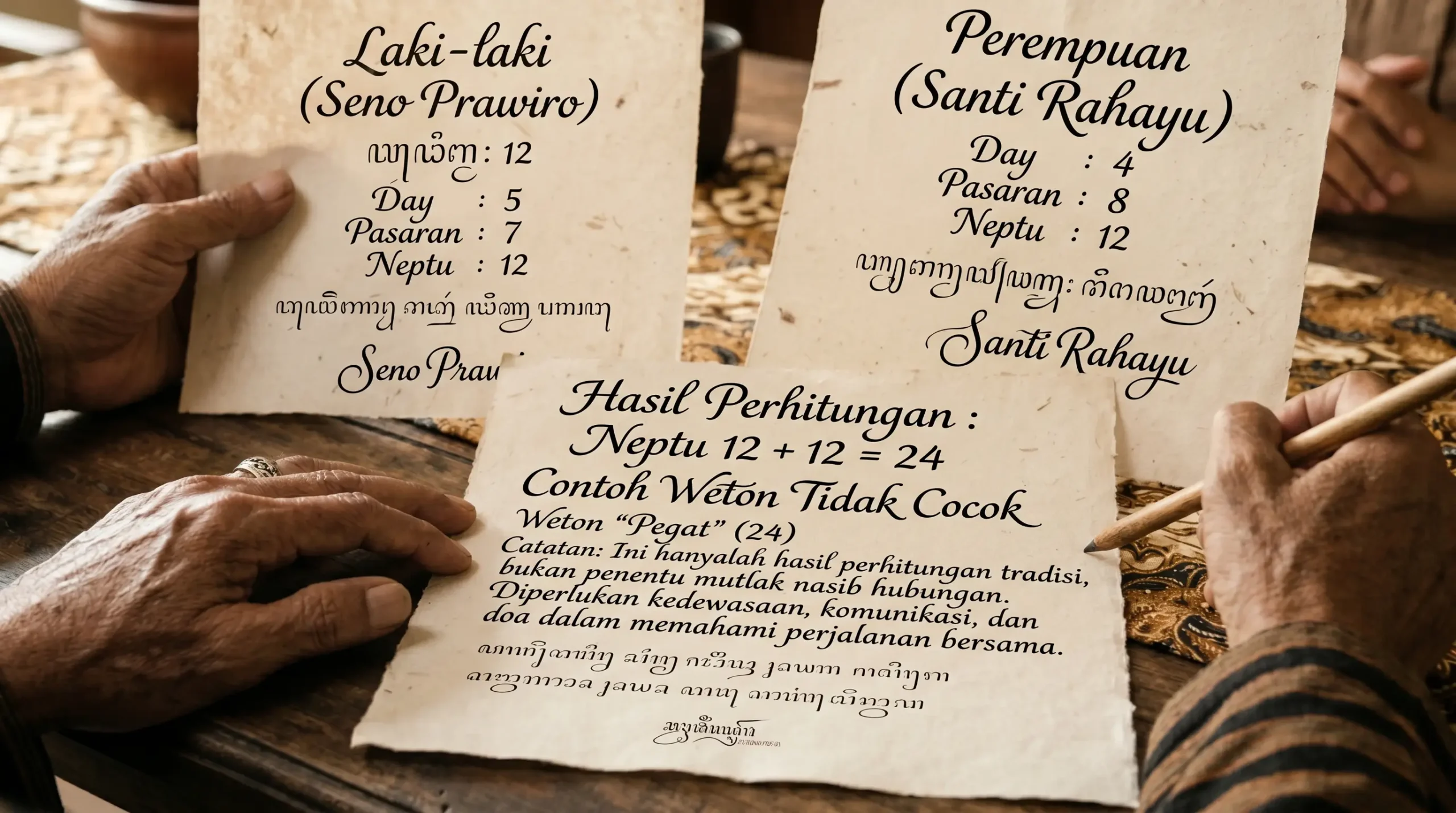
In Javanese tradition, certain results such as Pegat, Topo, Padu, and Sujanan are often considered heavier than others. But “difficult” should not be read as “doomed.” A weton result should not be used to frighten a couple, pressure a family, or close the door on a relationship too quickly.
This guide uses examples to explain how difficult weton compatibility results may appear in calculation, and how JavaSense reads them as cultural reflection rather than final verdicts.
Quick Answer: What Are Weton Compatibility Examples Often Seen as Difficult?
Weton compatibility examples often seen as difficult are pairings whose combined neptu values fall into results such as Pegat, Topo, Padu, or Sujanan. These results are commonly treated with caution in Javanese weton jodoh reading.
In JavaSense’s approach, difficult weton results should not be read as proof that a relationship must fail, that a couple must separate, or that marriage is forbidden. They are better understood as symbolic reminders: communication may need care, patience may need strengthening, words may need softening, or trust may need protection.
The examples below are not a list of couples to avoid. They are learning examples for reading Javanese weton compatibility with more calm, reason, and responsibility.
What Does “Not Compatible” Mean in Weton Reading?
In everyday conversation, people sometimes call certain weton results “not compatible.” This phrase can sound final, but it needs to be handled carefully.
In Javanese weton compatibility, “not compatible” often means the result is considered heavier, more sensitive, or in need of more awareness. It does not automatically mean two people cannot build a good relationship.
A real relationship is shaped by communication, honesty, family blessing, emotional maturity, responsibility, values, and how two people treat each other in ordinary life. Weton may open a reflective conversation, but it should not replace that conversation.
The Basic Calculation Before Reading Examples
Before looking at examples, it helps to understand the basic calculation. In one popular Javanese weton compatibility method, the neptu value of the first person’s weton is added to the neptu value of the second person’s weton.
The total is then read through an eight-result cycle. The result is based on the remainder when the total is divided by eight.
| Remainder After Dividing by 8 | Result | JavaSense Reading |
|---|---|---|
| 1 | Pegat | A reminder to protect communication, commitment, and shared decisions. |
| 2 | Ratu | A favorable sign that still needs mutual respect and responsibility. |
| 3 | Jodoh | A sense of compatibility that still needs to be cared for in daily conduct. |
| 4 | Topo | A reminder to build patience, endurance, and mutual support. |
| 5 | Tinari | A favorable sign about enoughness that still needs effort and wise management. |
| 6 | Padu | A reminder to care for words, emotions, and the way conflict is handled. |
| 7 | Sujanan | A reminder to protect honesty, openness, and mutual trust. |
| 0 or fully divisible by 8 | Pesthi | A sign of peace that still needs to be maintained. |
To understand the number behind weton more clearly, you can first read about neptu in the Javanese calendar. If you want to compare two weton values directly, use JavaSense to read weton compatibility with care.
Weton Compatibility Examples Often Considered Difficult
The examples below are often described as difficult because they fall into results that call for caution. Still, caution does not mean fear. These examples are meant for learning the pattern, not for judging a relationship.
| Example Pairing | Neptu | Total | Result | Safer Reading |
|---|---|---|---|---|
| Senin Legi + Senin Wage | 9 + 8 | 17 | Pegat | Read as a reminder to protect communication and commitment, not as a verdict of separation. |
| Jumat Kliwon + Sabtu Legi | 14 + 14 | 28 | Topo | Read as a reminder of patience, resilience, and mutual support. |
| Jumat Kliwon + Senin Wage | 14 + 8 | 22 | Padu | Read as a reminder to care for speech, emotion, and conflict resolution. |
| Jumat Kliwon + Senin Legi | 14 + 9 | 23 | Sujanan | Read as a reminder to protect honesty, openness, and trust. |
These four examples are often called “not compatible” because their results feel heavier. But a heavy result does not close the road. It invites the couple to look more honestly at the parts of the relationship that need care.
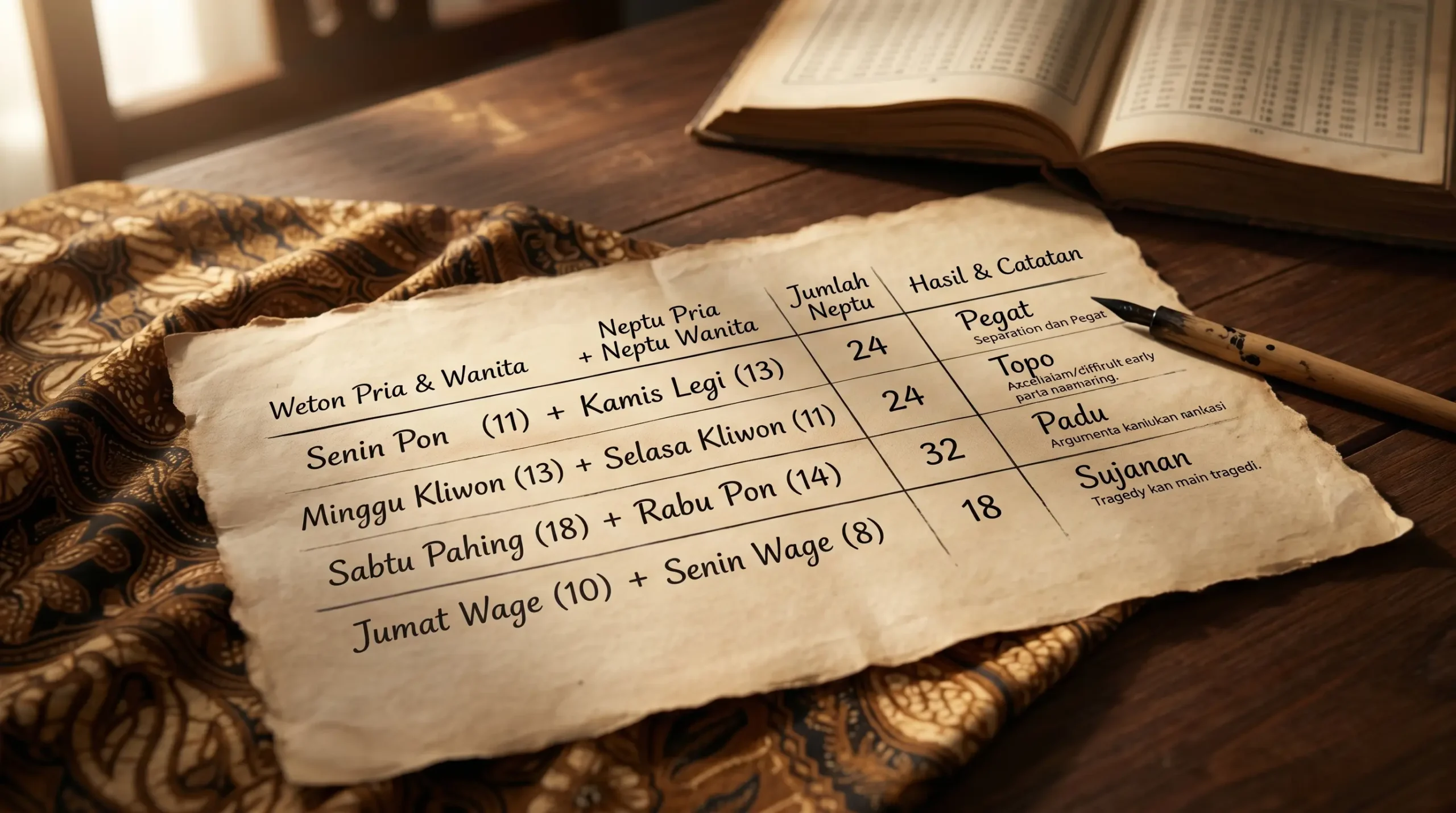
Example 1: Senin Legi and Senin Wage Result in Pegat
Senin Legi has a neptu value of 9, while Senin Wage has a neptu value of 8. Added together, the total is 17. In the eight-result cycle, 17 leaves a remainder of 1, so it is often read as Pegat.
In older popular readings, Pegat is often considered a heavy result. But Pegat should not be understood as certainty that a couple will separate. JavaSense reads Pegat as a reminder to care for communication, commitment, and shared decisions.
A healthier question is not, “Should we break up?” A better question is, “Do we have a way to solve problems without slowly moving away from each other?”
Example 2: Jumat Kliwon and Sabtu Legi Result in Topo
Jumat Kliwon has a neptu value of 14, and Sabtu Legi also has a neptu value of 14. Added together, the total is 28. In the eight-result cycle, 28 leaves a remainder of 4, so it is often read as Topo.
Topo is often associated with patience, hardship, restraint, or a relationship process that needs endurance. But Topo does not mean the relationship must be full of suffering.
In JavaSense’s approach, Topo invites a couple to ask: are we ready to face difficult seasons together? Can we speak kindly when we are tired? Can we strengthen each other when life does not move as planned?
Example 3: Jumat Kliwon and Senin Wage Result in Padu
Jumat Kliwon has a neptu value of 14, while Senin Wage has a neptu value of 8. Added together, the total is 22. In the eight-result cycle, 22 leaves a remainder of 6, so it is often read as Padu.
Padu is often linked with sharp words, disagreement, or conflict. But Padu does not mean a couple will always fight or cannot live harmoniously.
JavaSense reads Padu as a reminder about speech and emotional control. A couple is invited to pause when emotions rise, choose words that do not wound, and solve differences without humiliating each other.
Example 4: Jumat Kliwon and Senin Legi Result in Sujanan
Jumat Kliwon has a neptu value of 14, while Senin Legi has a neptu value of 9. Added together, the total is 23. In the eight-result cycle, 23 leaves a remainder of 7, so it is often read as Sujanan.
Sujanan is often associated with trust, openness, suspicion, or emotional safety. But Sujanan is not proof that a partner will be unfaithful.
In JavaSense’s approach, Sujanan invites a couple to protect honesty, avoid letting suspicion grow silently, and build clearer communication before doubt becomes distance.
Seven Safer Ways to Read Difficult Weton Examples
To keep weton compatibility examples from becoming fear, they should be read as learning tools rather than relationship verdicts.
- Do not turn examples into verdicts. A calculation example helps explain a pattern; it does not decide a couple’s future.
- Read the results as symbolic language. Pegat, Topo, Padu, and Sujanan each carry cultural messages that need careful interpretation.
- Separate numbers from real relationship conduct. Real compatibility is seen in communication, responsibility, honesty, and mutual care.
- Use the result to open dialogue. A difficult result can become a door to talk about things that have been avoided.
- Do not frighten a partner or family. Weton should become a mirror, not a weapon.
- Look at marriage readiness as a whole. Family blessing, emotional maturity, livelihood, values, and conflict resolution still matter.
- Care for the relationship through daily conduct. A relationship is not only calculated; it is protected through words, promises, patience, and responsibility.
Ky Tutur’s reflection: A calculation example is a path for learning, not a tool for fear. When a result looks heavy, do not look only at the number. Look also at the heart, conduct, and responsibility of two people who want to walk together.
Myths and Safer Ways to Understand Weton Compatibility
Many people search for difficult weton examples because they want a quick answer. But quick answers need care, especially when they touch relationships and family decisions.
| Myth | Safer Reading |
|---|---|
| Difficult weton compatibility examples mean couples like that must fail. | No. Examples show a calculation pattern, not certainty about a relationship’s future. |
| If the result is Pegat, the couple must separate. | No. Pegat is better read as a reminder to protect communication and commitment. |
| If the result is Padu, the couple will always fight. | No. Padu reminds a couple to care for words, emotions, and how differences are resolved. |
| If the result is Sujanan, a partner must be unfaithful. | No. Sujanan is a reminder to protect trust, not a reason to accuse. |
Does a Difficult Weton Result Mean a Couple Should Not Marry?
Not automatically. A weton result often considered difficult should not become an absolute prohibition. A marriage decision still needs to consider readiness, family blessing, communication, responsibility, values, and the real condition of the couple.
In Javanese culture, a difficult result may become material for rembug, or calm dialogue. If a family takes weton seriously, discuss it with respect. Do not use weton to force a decision, but do not dismiss family feelings carelessly either.
A safer reading asks: what part of this relationship needs more preparation before moving forward?
How This Article Differs from General Weton Compatibility Guidance
This article focuses on examples and calculation patterns. Its purpose is to help readers understand why certain weton pairings can result in Pegat, Topo, Padu, or Sujanan.
General weton compatibility guidance is broader. It may discuss how to respond to a difficult result in family dialogue, relationship planning, and marriage preparation. This page is more practical: it shows examples, totals, remainders, and safer ways to read them.
For wider relationship reflection, use this page as a starting point, then continue with tools and related JavaSense readings rather than treating one example as the whole answer.
Use JavaSense Tools to Check Your Own Result
If you want to understand your own pairing, you can compare two weton values with the JavaSense weton compatibility tool. Enter both birth dates, then read the result calmly.
If you do not know your own weton yet, you can calculate your weton from a birth date. To understand timing, pasaran, neptu, and wuku more broadly, you can also check the Javanese calendar.
A digital tool can calculate faster, but wisdom still depends on how humans read and respond. For a broader cultural path, explore JavaSense as a Javanese cultural platform, where weton, calendar, Primbon reflection, and Javanese script are presented as heritage and reflective guidance.
Cultural Notes on Primbon and Petungan Jawa
In Javanese tradition, weton compatibility belongs to a wider world of Primbon, petungan, pasaran, neptu, and the careful reading of timing before important decisions. Because of this, difficult weton examples are best understood as part of cultural literacy.
For Indonesian readers who want to see library references, the National Library of Indonesia provides records related to Primbon, including Kitab Primbon Jawa Serbaguna and an OPAC record on Primbon.
JavaSense does not treat Primbon as a rigid book of fate. In this article, difficult weton compatibility examples are read as cultural language that still needs reason, care, family dialogue, and the real condition of the couple.
FAQ: Weton Compatibility Examples
What are weton compatibility examples often considered difficult?
Weton compatibility examples often considered difficult are pairings whose combined neptu values result in categories such as Pegat, Topo, Padu, or Sujanan. In JavaSense’s approach, these examples should be read as reflection, not as final verdicts.
Does a difficult weton result mean a couple should break up?
No. A difficult weton result should not become an immediate reason to separate. It is safer to read it as material for reflection, calm dialogue, and better preparation.
Which weton results are often considered difficult?
Results often considered difficult include Pegat, Topo, Padu, and Sujanan. Each one carries a different reminder: communication, patience, speech, or trust.
Does Pegat always mean separation?
No. Pegat is often considered heavy, but it is safer to read it as a reminder to protect communication, commitment, and shared decisions.
Does Padu always mean conflict?
No. Padu does not mean a couple will always fight. It reminds a couple to care for words, emotions, and how they resolve differences.
Does Sujanan mean betrayal?
No. Sujanan should not be read as proof of betrayal. It is better understood as a reminder to protect honesty, openness, and mutual trust.
Where can I check weton compatibility online?
You can use the JavaSense weton compatibility tool to compare two weton values from birth dates. The result should be read with care and reflection.
Is weton compatibility the same as fortune-telling?
No. In JavaSense’s approach, weton compatibility is read as Javanese cultural reflection, not as absolute fortune-telling or a fixed prediction about a relationship.
Closing Reflection: Examples Are for Learning, Not Fear
Weton compatibility examples are useful when they help people understand a traditional pattern. They become harmful when they are used to frighten, accuse, or close a relationship without dialogue.
A good relationship is not born only from a light calculation. It grows from people who listen, apologize, keep promises, speak carefully, and take responsibility for their choices.
Read these examples with a clear heart. Do not turn culture into a burden. Let it become a mirror, so a relationship can be walked with more awareness, care, and responsibility.