

Some people know their zodiac sign long before they know their weton. They may remember being a Leo, Scorpio, or Pisces from school, social media, or horoscope posts. Then one family question opens another doorway: what day and pasaran were you born on?
This is where Javanese astrology becomes interesting to read carefully. The term can help global readers understand how Javanese culture reads birth, time, character tendency, relationships, and conduct through its own cultural system. But it needs a clear boundary: Javanese astrology should be read as a cultural map, not as fixed fortune-telling.
JavaSense reads this tradition with two feet: feeling and reason. Feeling keeps the cultural soul alive. Reason keeps weton, wuku, neptu, and Pawukon from becoming frightening verdicts over human life.
Quick Answer: What Is Javanese Astrology?
Javanese astrology is a modern term for reading time and birth through Javanese cultural systems such as weton, pasaran, neptu, wuku, Pawukon, and laku. In a healthier reading, it is not treated as fixed fortune-telling. It is read as a cultural map for reflection, conduct, timing, and self-awareness.
Weton helps read the meeting of birth weekday and Javanese pasaran. Neptu gives numerical values to weekday and pasaran. Wuku and Pawukon add a wider cycle of time. Laku reminds people that cultural reading should become guidance for conduct, not a sentence that locks the future.
- Weton is the meeting of the seven-day weekday cycle and the five-day Javanese pasaran cycle.
- Javanese pasaran consists of Legi, Pahing, Pon, Wage, and Kliwon.
- Neptu is the numerical value of weekday and pasaran.
- Wuku is a weekly unit in the Pawukon cycle.
- Pawukon consists of 30 wuku, each lasting 7 days, making one full cycle of 210 days.
- Laku is the way a person turns cultural reflection into mindful conduct.
Why Javanese Astrology Is Not Just Horoscope
The word astrology may make some readers think of horoscopes, star signs, or personality predictions. That is understandable, but Javanese astrology should not be reduced to the same frame.
In JavaSense, the phrase is used as a bridge for English readers. It points to a Javanese way of reading birth, time, relationship, and conduct through weton, pasaran, neptu, wuku, and Pawukon. It is close to cultural timing and self-reflection, not a machine that predicts destiny.
Western horoscopes often ask, “What kind of person am I?” Javanese astrology asks a further question: “If I carry this tendency, what conduct should I guard?”
The Main Elements of Javanese Astrology
Javanese astrology is not built from one element alone. It is formed by several layers of time that work together. The table below gives a simple map.
| Element | Cycle or Number | Role in Javanese Reading |
|---|---|---|
| Seven-day week | 7 days | The ordinary weekday foundation: Sunday, Monday, Tuesday, Wednesday, Thursday, Friday, and Saturday. |
| Javanese pasaran | 5 pasaran | The cycle of Legi, Pahing, Pon, Wage, and Kliwon that forms weton together with the weekday. |
| Weton | 35 combinations | The meeting of weekday and pasaran, often used as a birth-time foundation. |
| Neptu | Numerical values | The value of weekday and pasaran used in several forms of Javanese calculation. |
| Wuku | 30 wuku | A weekly cycle in Pawukon that gives another layer of time to a birth or a day. |
| Pawukon | 210 days | A full cycle of 30 wuku, with each wuku lasting 7 days. |
| Laku | Lifelong practice | The way a person uses cultural reading as a reminder to shape conduct. |
From this map, Javanese astrology is not only one calculation. It is a layered rhythm of time. Because of that, it needs to be read carefully so it does not become a narrow label.
Weton as the Birth-Time Foundation
Weton is the meeting of a weekday and a Javanese pasaran. The seven weekdays are Sunday, Monday, Tuesday, Wednesday, Thursday, Friday, and Saturday. The five pasaran are Legi, Pahing, Pon, Wage, and Kliwon.
From the meeting of these two cycles, there are 35 weton combinations, such as Monday Legi, Tuesday Pahing, Wednesday Pon, Friday Kliwon, Saturday Wage, and others.
In Javanese culture, weton is often used as a foundation for reading birth, character tendency, relationship dynamics, and certain family considerations. But weton should not be used to judge a person rigidly. It is safer to read weton as an opening ground: a place to notice tendencies, not a place to decide the whole future.
To understand the foundation more clearly, read Javanese weton. To find your own weton, use the JavaSense weton calculator.
Pasaran and Neptu in Javanese Astrology
Javanese pasaran is the five-day cycle of Legi, Pahing, Pon, Wage, and Kliwon. Each pasaran has a neptu value. This pasaran value is added to the weekday value to get neptu weton.
For example, Monday has a neptu value of 4 and Legi has a value of 5. Monday Legi has a neptu of 9. Friday has a value of 6 and Kliwon has a value of 8. Friday Kliwon has a neptu of 14.
Neptu often becomes the first doorway into weton reading. But neptu is not a measure of human dignity. Small neptu does not mean bad, and large neptu is not automatically better. It is part of cultural calculation, not a rank of human worth.
To go deeper, read Javanese pasaran, neptu weton values, and how to calculate weton.

Wuku and Pawukon as Javanese Time Cycles
Besides weton, Javanese astrology also knows wuku. Wuku is a weekly unit in the Pawukon cycle. There are 30 wuku, and each wuku lasts 7 days. This makes one full Pawukon cycle 210 days.
If weton can be imagined as a birth-time foundation, wuku gives another layer of time. Two people may have the same weton but be born under different wuku. This is one reason Javanese cultural reading can feel layered rather than one-dimensional.
JavaSense does not read wuku as a fixed character sentence. Wuku is better understood as a cultural season: a mood of time that can offer a sign of caution, a reflective tone, or an invitation to certain conduct.
To understand the wider cycle, read Pawukon and the 30 wuku cycle. To see daily cycles in context, use the Javanese calendar.
Javanese Astrology and Primbon
Javanese astrology is close to Primbon, but the two should not be treated as exactly the same thing. Primbon is a wider traditional Javanese body of knowledge used to read patterns, signs, timing, conduct, family considerations, and life reflection.
Javanese astrology, in this article, focuses more specifically on reading time and birth through weton, pasaran, neptu, wuku, and Pawukon. It can be understood as one doorway into a wider Javanese tradition of reflection.
The way of reading matters. Primbon and Javanese astrology should not be used to frighten people. They are healthier when treated as titen, cultural observation, and reflective knowledge, not as books of absolute decisions.
For now, JavaSense groups this wider discussion under Primbon as cultural reflection.
Javanese Astrology vs Western Zodiac
Javanese astrology and the Western zodiac can both be used as languages of self-reflection, but they come from different cultural roots. The Western zodiac is widely known through 12 star signs. Javanese astrology is closer to birth weekday, pasaran, weton, wuku, Pawukon, neptu, and laku.
| Aspect | Western Zodiac | Javanese Astrology |
|---|---|---|
| Basis of reading | 12 zodiac signs in Western astrological tradition. | Birth weekday, pasaran, weton, neptu, wuku, and Pawukon. |
| Main language | Stars, elements, sky symbols, and horoscopes. | Days, pasaran, felt rhythm of time, Javanese calendar, and conduct. |
| Popular focus | Personality, emotion, relationships, and social style. | Character tendency, relationships, family timing, good days, time, and responsibility. |
| Healthier way to read | As a light mirror for emotion and character, not as an absolute label. | As a cultural map for knowing the self without locking fate. |
The zodiac does not need to be dismissed. Many people feel helped because it gives them a simple language for emotion and relationships. But for Javanese readers, weton and wuku give another layer that is closer to family memory, birth day, pasaran, ceremonies, and the Javanese calendar.
For a focused comparison, read Javanese weton vs Western zodiac.
A Simple Case: Knowing Zodiac Before Weton
Imagine someone who has known their zodiac since school. They know their sign, read horoscope posts, and sometimes feel that a few descriptions match. Then, when the family begins discussing an engagement, someone asks, “What is your weton?”
The question makes them realize that they do not know their birth pasaran. They know the birth date, but not whether it was Legi, Pahing, Pon, Wage, or Kliwon. From there, they begin searching for weton, neptu, and eventually meet the words wuku and Pawukon.
In this situation, learning Javanese astrology does not mean leaving the zodiac behind. It is closer to returning to one’s own cultural language. A person may know the stars and still begin to know birth weekday, pasaran, weton, wuku, and laku living in Javanese tradition.
Why Javanese Astrology Is Not Fixed Fortune-Telling
The biggest mistake in reading Javanese astrology is turning it into a tool for fear. It can sound as if the result of weton, wuku, or neptu is a final decision that cannot be changed. But in the Javanese sense, cultural reading is always tied to laku.
If a reading describes someone as easily heated, the task is not to say, “I am just like this.” The task is to learn how to turn heat into energy, not anger. If a reading suggests that a relationship may face tension, the task is not to panic, but to soften communication and learn how to listen.
Javanese astrology should not make people passive. It invites better questions: if I carry this tendency, what attitude should I train? If life often feels tense, which part should be repaired? If my relationships become heated easily, how can I learn to listen more deeply?
Ky Tutur’s reflection: A birth day is not a fence that imprisons life. It is closer to a small doorway: from there, a person can learn to recognize feeling, read direction, and choose clearer conduct.
To understand this boundary more deeply, read weton is not fortune telling and why bad weton should be read carefully.
How to Read Javanese Astrology Wisely
A map is not the same as the journey. Knowing weton, neptu, wuku, or Pawukon is only an opening step. After the map is read, a person still needs to walk: choosing, improving habits, guarding speech, caring for relationships, and taking responsibility for life.
This is the difference between label and laku. A label stops at the sentence, “I am like this.” Laku moves further: “Because I carry this tendency, what should I train?”
- Use weton to notice tendencies, not to justify harmful behavior.
- Use neptu as part of cultural calculation, not as a measure of human value.
- Use wuku as a layer of time, not as a fixed character verdict.
- Use weton compatibility as dialogue material, not as a final judgment.
- Use the Javanese calendar as a map of time, not as a rigid order.
For relationship reflection, use weton compatibility with care. The result is healthier when it helps improve communication, recognize patterns, and guard conduct.
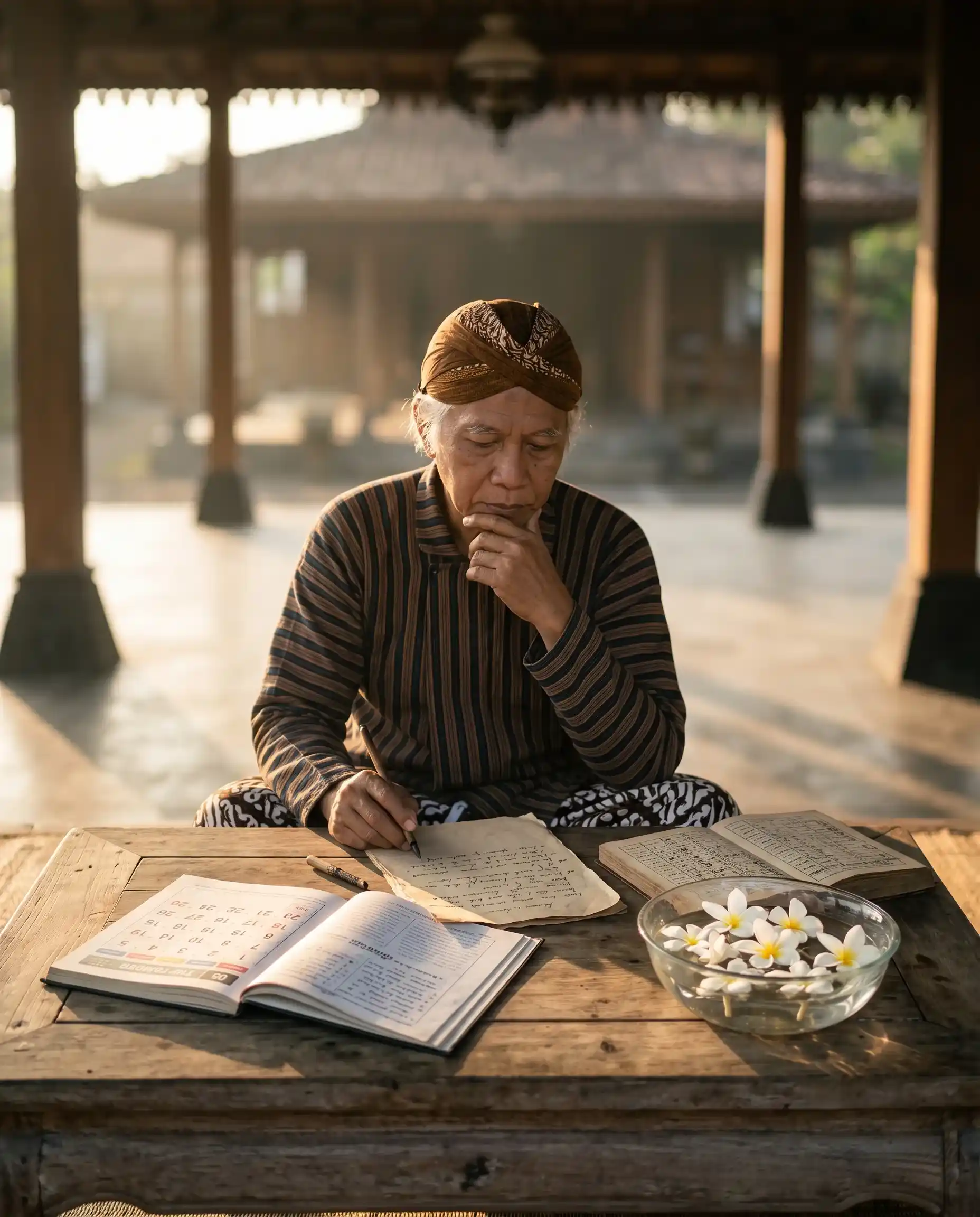
Reading Javanese Wisdom in a Modern Way
Some local wisdom has been dismissed as old-fashioned, superstitious, or irrelevant. Because of that, many people feel more comfortable saying their zodiac sign than their own weton. Many know popular symbols from other cultures but do not know their birth pasaran.
The task of modern readers is not to swallow every inheritance blindly. The task is to reread, sort carefully, clean the frightening ways of using it, and take the laku values that still help life.
Javanese astrology does not need to be treated like a dusty museum. It can be reread in a healthier language: not to punish, not to separate couples carelessly, not to make people afraid of their birth day, but to know the self and shape life more consciously.
For readers interested in the calculation side of Javanese calendar patterns, one supporting reference discusses ethnoarithmetic in the Javanese calendar.
Learn Javanese Astrology with JavaSense
JavaSense reads Javanese astrology as a cultural map that can be approached in a modern way. You do not need to memorize all the calculations at once. Begin from the simplest doorway: birth date, weekday, pasaran, and weton.
First, use the JavaSense weton calculator to find your birth weekday, pasaran, weton, neptu, and wuku. Second, understand the foundation through Javanese weton. Third, read the layer of time through Pawukon and the 30 wuku cycle. Fourth, follow daily rhythm through the Javanese calendar.
If you want to understand the numerical side, open neptu weton values. If you want to know the five-day cycle, read Javanese pasaran. If you want to compare it with a more familiar language, read Javanese weton vs Western zodiac.
To explore related resources in one place, open JavaSense cultural tools. For a broader cultural map, JavaSense can also be read as a Javanese cultural platform for weton, calendar, Primbon reflection, Pawukon, wuku, and Javanese script.
Closing: Reading the Self Without Losing the Roots
In the end, Javanese astrology is not about becoming superior to zodiac, Chinese zodiac, or any other way of reading the self. It is a return path. It reminds us that, in Javanese culture, people once read time with great subtlety.
Weton teaches people to recognize the foundation of a birth day. Wuku teaches people to read another layer of time. Pawukon reminds us that life moves in cycles: beginning, growth, test, closing, and beginning again.
So do not turn Javanese astrology into a tool for frightening yourself. Let it become a mirror, a map, and a language for caring for life more consciously.
Knowing the self does not always require looking far into someone else’s sky. Sometimes, the return path begins from the birth day that once seemed ordinary.
To learn weton, wuku, pasaran, neptu, compatibility, the Javanese calendar, and script in a lighter way, you can also open JavaSense on Google Play.
FAQ About Javanese Astrology
What is Javanese astrology?
Javanese astrology is a modern term for reading time and birth through weton, pasaran, neptu, wuku, Pawukon, and laku in Javanese tradition. In a healthy reading, it is understood as a cultural map, not fixed fortune-telling.
Is Javanese astrology the same as Western astrology?
No. Western astrology is commonly known through 12 zodiac signs, while Javanese astrology reads birth through weekday, pasaran, weton, neptu, wuku, Pawukon, and conduct.
What is the role of weton in Javanese astrology?
Weton is one of the main foundations of Javanese astrology. It is formed by the meeting of the seven-day weekday cycle and the five-day pasaran cycle, such as Monday Legi, Friday Kliwon, or Sunday Wage.
What is neptu in Javanese astrology?
Neptu is the numerical value assigned to weekdays and pasaran. It is used in several forms of Javanese calculation, but it should not be treated as a measure of human worth or fixed fate.
What are wuku and Pawukon?
Wuku is a weekly unit in the Pawukon cycle. There are 30 wuku, each lasting 7 days, so one full Pawukon cycle lasts 210 days.
Is Javanese astrology related to Primbon?
Yes. Javanese astrology is close to Primbon because both deal with traditional Javanese reflection, timing, patterns, and conduct. Primbon is wider, while Javanese astrology in this guide focuses on weton, pasaran, neptu, wuku, and Pawukon.
Does Javanese astrology determine fate?
No. Javanese astrology should not be read as a fixed decision about fate. It is safer to read it as cultural reflection for understanding the self, relationships, timing, and conduct.
How can I find my weton and wuku?
The easiest way is to use the JavaSense weton calculator. Enter a birth date, then read the weekday, pasaran, weton, neptu, and wuku shown by the tool.