

Some people discover their weton and return home with a heavy heart. Not because they understand themselves more deeply, but because they feel as if their birth day has placed a bad label on their life.
This is why Bad Weton Myth Explained needs a calmer reading. A weton called heavy, hot, difficult, or less compatible should not immediately be treated as bad fate. In a healthier Javanese reading, weton is closer to a cultural mirror: a way to notice tendencies, vulnerable points, and the space to improve conduct.
There is no value in reading weton if the result only makes someone afraid of their own birth day. Tradition should help people become clearer, not make them give up before they take a step.
Quick Answer: Is There Really a Bad Weton?
No weton should be read as absolutely bad. In Javanese tradition, some weton may be described as heavy, hot, or vulnerable, but those words are safer when understood as signs for caution, not as negative labels on a person’s life.
The bad weton myth usually appears when weton is read as a verdict on fate. In fact, weton is the meeting of a birth weekday and Javanese pasaran. It can be used as cultural reflection, but it should not be used to frighten people, lower someone’s dignity, or reject others unfairly.
- The bad weton myth is the belief that certain weton bring misfortune, bad fate, or life failure.
- A weton called heavy is safer when read as a point of awareness, not as a curse.
- Small neptu does not mean bad, and large neptu is not automatically better.
- A difficult weton compatibility result should not become the only reason to end a relationship.
- Weton is healthier when read with reason, communication, responsibility, prayer, effort, and maturity.
What Does the Bad Weton Myth Mean?
The bad weton myth is the belief that certain weton are born with bad luck, permanent difficulty, blocked relationships, weak fortune, or a failed future. This belief often comes from fragments of family stories, short interpretations, social media posts, or traditional readings repeated without context.
The important point is this: the word “bad” in traditional reading does not always mean absolutely negative. Sometimes it points to a tendency that needs direction. A strong character can become a problem if it is not managed, but it can also become firmness when guided by awareness. A restless nature may feel tiring, but it can also become sensitivity when trained through the right conduct.
So when a weton is called heavy, do not immediately assume that life has been closed. It may be a cultural signal to read yourself more carefully: what needs to be guarded, what needs to be trained, and what can become strength when directed well.
For the foundation, read the broader guide to Javanese weton.
Why People Become Afraid of Weton
Fear of weton usually comes from three things. First, people read the result without context. They see short phrases such as “less good,” “many obstacles,” “not compatible,” or “heavy,” then treat them as final decisions.
Second, some readings are delivered in a frightening way. Some people use weton, neptu, or Primbon language to make others submit, feel anxious, or believe they have no choice. This is not healthy. Cultural heritage should help people become clearer, not make the heart feel paralyzed.
Third, human beings are more vulnerable to labels when they are already fragile. When someone is failing, disappointed, heartbroken, or facing many problems, they may easily feel that everything has already been decided by fate. But life is shaped by many things: choices, environment, habits, education, relationships, effort, opportunity, and the way a person responds to circumstances.
Weton as a Mirror, Not a Bad Label
Weton is healthier when read as a mirror. A mirror does not decide a face. It only helps someone see what may not have been noticed before. If a mirror shows tiredness, a person does not need to hate the mirror. They can rest, wash their face, and care for themselves.
Weton can work in a similar way. If a reading points to a tendency toward anger, it does not mean someone is destined to remain angry forever. It can become a reminder to practice awareness and self-control. If a reading suggests wastefulness, it can become an invitation to manage money more carefully. If someone is described as hard-hearted, it can become a call to practice empathy.
This is the difference between reading weton and fearing weton. Reading weton creates awareness. Fearing weton creates surrender. Reading weton opens the possibility of improvement. Fearing weton closes the road before the journey begins.
7 Bad Weton Myths That Need Correction
To read more clearly, here are seven bad weton myths that often make people afraid.
1. Myth: Some Weton Definitely Bring Bad Luck
No weton needs to be read as an absolute source of bad luck. In Javanese culture, terms such as heavy or vulnerable are safer when understood as reminders to become more aware, not as decisions that life must be difficult.
If a weton is said to bring challenges, the healthier question is not “Am I unlucky?” but “Which part of myself needs more care?” In this way, weton becomes a space for practice, not a source of fear.
2. Myth: Small Neptu Is Always Bad
Small neptu does not mean bad. Large neptu is not automatically better. Neptu is the numerical value of weekday and pasaran used in several traditional readings, but the number is not a measure of human dignity.
A person with small neptu can still live with clarity when they have good conduct, healthy communication, and responsibility. A person with large neptu can still stumble if they are careless, arrogant, or unwilling to improve.
3. Myth: Heavy Weton Means Life Will Surely Be Difficult
A weton called heavy should not be immediately read as a life that must be difficult. Heavy may mean there are tendencies that need more awareness: rising emotion, firm stubbornness, family burden, or decision patterns that need to be improved.
When read clearly, the word heavy can become a reminder not to walk carelessly. Heavy is not a closed road. It can be a sign that the next steps need to be more ordered.
4. Myth: Bad Weton Is Not Suitable for Marriage
Weton often creates anxiety in relationship matters. Some couples become afraid because their neptu result is considered less suitable. Some families immediately hesitate when they hear terms that sound difficult.
But human relationships are not decided by numbers alone. They are built through honesty, responsibility, maturity, family blessing, communication, and the ability of two people to solve problems together. To read relationships more carefully, use weton compatibility with care as cultural reflection, not as a hammer of judgment.
5. Myth: Character from Weton Cannot Change
Character in weton reading is safer when understood as tendency, not as a wall that cannot be crossed. If someone is described as hard, they can learn gentleness. If someone is described as hesitant, they can learn decision-making. If someone is described as easily provoked, they can learn to hold their words.
A person does not stop at their weton. A person grows through education, experience, environment, awareness, and daily conduct.
6. Myth: Primbon Always Means Absolute Prediction
Primbon is part of traditional Javanese knowledge. It contains notes, symbols, calculations, advice, and older ways of reading the relationship between people and time. But Primbon should not become the only basis for deciding life.
Culture can become a mirror. Life decisions still need real conditions, responsibility, conversation, and clear judgment. This is why JavaSense also explains that weton is not fortune telling.
7. Myth: Birth Day Determines the Whole Future
A birth day is the beginning of a journey, not the end of a conclusion. Weton can offer symbolic language about tendencies, but the future is still shaped by how someone thinks, chooses, works, prays, improves themselves, and cares for relationships.
If someone begins to hate their own birth day, they lose inner ground. It is better to read weton as a reminder: what needs to be guarded, what needs to be improved, and what can be cared for so life becomes more ordered.
A Real Case: When Family Calls a Weton Heavy
Imagine someone preparing to move a relationship into a more serious stage. The couple knows each other, families begin to talk, then someone calculates weton. The result is called heavy. A warm atmosphere suddenly becomes anxious.
In a situation like this, JavaSense does not ask readers to reject tradition. But a number should not become the only judge. What needs to be read is not only the calculation, but also real life: can the couple speak honestly, can both families talk kindly, can conflict be resolved, and has the decision been prepared maturely?
Weton can become part of family conversation. It can open space for more care, patience, and honesty. But it should not become a bad label that closes the future of two people without seeing the reality of their lives.
7 Wise Ways to Read Weton
After recognizing the myths, readers also need a healthier way to read weton. Here are seven simple principles.
1. Do Not Read Weton as a Curse
The first step is to let go of overly dark interpretations. There is no value in reading weton if the result only makes a person feel cursed. Weton should not become a closing sentence over someone’s life.
If a result feels heavy, read it as a reminder. Not “I will certainly suffer,” but “this part needs my attention.” Not “my life will surely be difficult,” but “I need to be more careful in shaping my choices.”
2. Understand Weton as a Map of Reflection
A map does not force someone to fail. A map only shows the terrain. If the road climbs, a wise person prepares energy. If the road is slippery, they step more carefully. If there is a sharp turn, they slow down.
It is the same when using a Javanese weton calculator. Use the result to understand yourself. Do not turn one result into a reason to stop trying or to feel lower than others.
3. Separate Primbon, Advice, and Life Decisions
Primbon, traditional advice, and calculation can help people read cultural signs. But major decisions such as marriage, work, moving house, or building a business still need common sense, readiness, communication, real conditions, and responsibility.
Culture gives a mirror. Life still needs to be lived with awareness.
4. Do Not Cancel a Relationship Only Because of a Number
Relationship is one of the most common places where fear appears. If a calculation shows possible tension, it can become a conversation: how do we communicate, how do we manage ego, how do we build patience, and how can two families understand each other?
A relationship is not determined by a number alone. It is built by honesty, responsibility, maturity, commitment, and the willingness of two people to keep learning from each other.
5. Use the Javanese Calendar as Cultural Knowledge
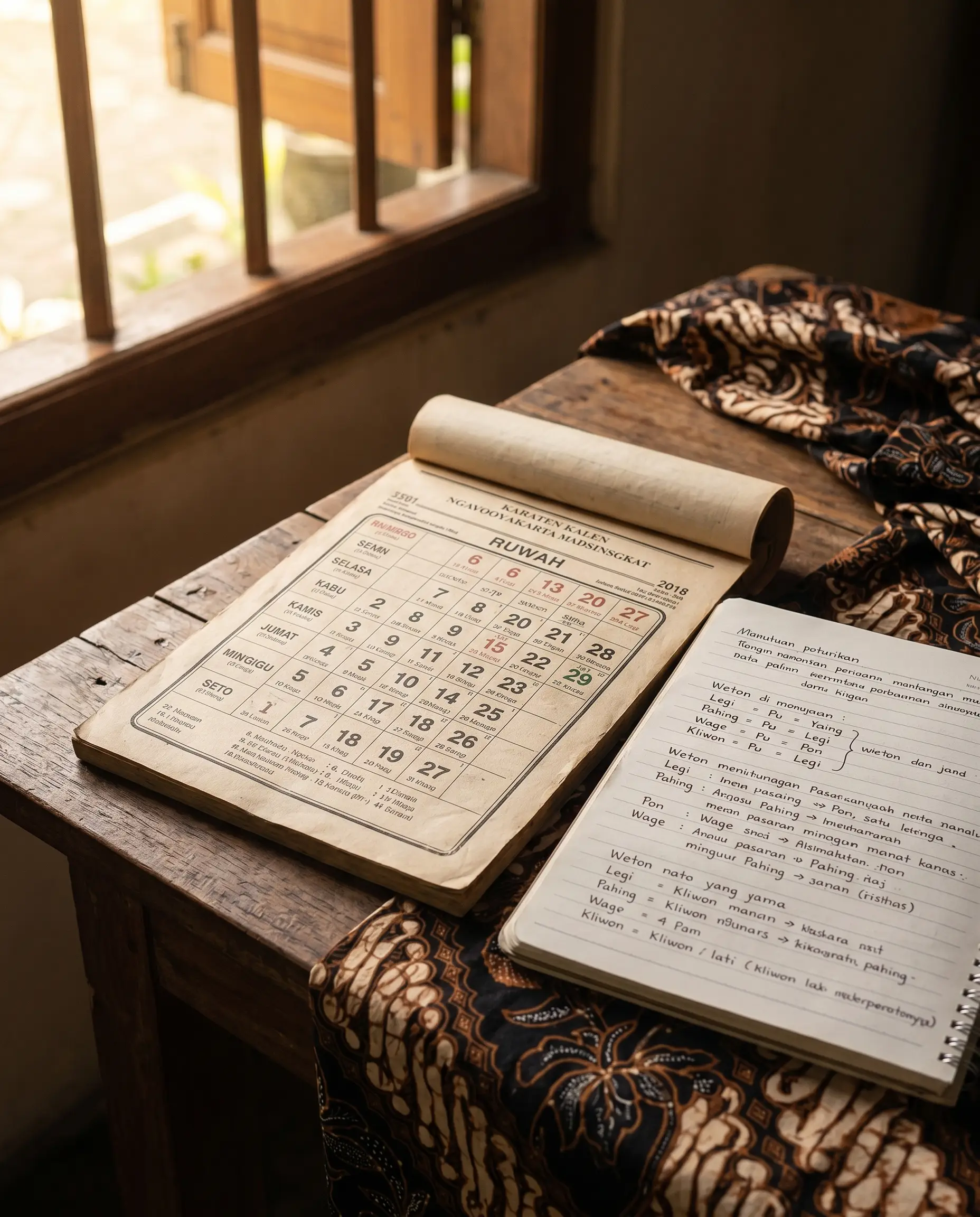
In Javanese tradition, time is not seen only as a date number. There are pasaran, wuku, neptu, Javanese months, and other cultural markers. Together, they form an older way of reading the rhythm of life.
The Javanese calendar can be used to learn culture, recognize pasaran, understand wuku, and see how ancestors arranged days. Use it as knowledge, not as a source of anxiety.
6. Practice Observation and Conscious Conduct
In Javanese culture, there is the habit of observing patterns over time. This is different from blaming fate. A person who observes does not rush to conclude. They watch, compare, reflect, and learn.
If you feel there is a repeated pattern in life, read it calmly. When does emotion rise easily? When do decisions often go wrong? When do relationships become tense? When does the body become tired quickly? From there, awareness can grow into improvement.
7. Place the Future in Effort, Prayer, and Responsibility
This is the most important part. Weton, neptu, wuku, and Primbon are not substitutes for effort. They are also not substitutes for prayer, ethics, knowledge, hard work, and responsibility.
Do not hand the future completely to one calculation. If the result feels good, do not become arrogant or careless. If the result feels heavy, do not become afraid and stop. Both need to be guarded with maturity.
Ky Tutur’s reflection: Weton is not a fence that imprisons life. It is closer to a small lamp: it may help us see the road, but each step still needs reason, feeling, prayer, and responsibility.
Common Mistakes When Reading Weton
Several mistakes often make weton reading unhealthy. First, reading one source and assuming it must be completely true. Weton interpretation can differ depending on text, region, teacher, and method of reading.
Second, remembering only the frightening parts. Many people remember only the difficult sentence, while forgetting that every tendency has a bright side and a side that needs training.
Third, using weton to judge other people. This is the most dangerous mistake because culture becomes a tool for lowering someone’s dignity.
Fourth, using weton as an excuse to avoid responsibility. Saying “I am just like this because of my weton” is not a mature reading. Weton may become a mirror, but behavior still needs to be improved.
How the Bad Weton Myth Connects with Weton Is Not Fortune Telling
This article shares the same spirit as weton is not fortune telling. Both explain that weton should not be treated as an absolute verdict on fate.
The difference is the focus. This article focuses on fear around the phrases “bad weton,” “heavy weton,” or “less suitable weton.” The weton is not fortune telling article explains the wider principle: weton should not be read as certainty over human life.
Weton can help someone recognize symbols, tradition, and older ways of reading the self. But it should never make a person lose hope. If a reading makes someone more afraid, more passive, or more hateful toward their own birth day, the way of reading needs to be corrected.

How JavaSense Reads Weton Safely
JavaSense reads weton with a simple principle: culture should make people clearer, not more afraid. Every weton reading should be placed as reflection. Not punishment. Not a label. Not a tool for rejecting people.
If you want to understand weton more fully, begin with the guide to Javanese weton. To understand the numerical side of weton, read neptu in the Javanese calendar. To follow pasaran, weton, wuku, and daily cycles, use the Javanese calendar.
If you want to explore weton, calendar, relationship reflection, Pawukon, wuku, and Javanese script in one place, open JavaSense cultural tools. For a broader cultural map, JavaSense can also be read as a Javanese cultural platform.
Closing: Do Not Fear Your Birth Day
Do not fear your birth day. There is no value in becoming hostile toward the doorway through which someone entered the world. A birth day is the beginning of a journey, not the end of a conclusion.
If part of a weton is called heavy, read it as a reminder to be more careful. If part of it is called strong, read it as a responsibility not to become arrogant. If part of it is called vulnerable, make it a space for training. If part of it is called good, make it an encouragement to benefit others.
In the end, human beings are not shaped by birth day alone. They are shaped by how they think, choose, improve themselves, care for relationships, work, pray, and rise after falling.
So read weton with a cool head and a clear heart. Take the wisdom. Let go of unnecessary fear. Become someone more aware, more responsible, and more peaceful in walking forward.
To learn weton, the Javanese calendar, script, and cultural reflection in a lighter way, you can also open JavaSense on Google Play.
FAQ About Bad Weton Myth Explained
Is there really a weton that brings bad luck?
No weton should be read as absolutely unlucky. In a healthier reading, a weton considered heavy is better understood as a reminder to become more aware, mature, and careful in taking steps.
What does the bad weton myth mean?
The bad weton myth is the belief that certain weton make someone destined for bad fate. This is not a healthy reading because weton should be treated as cultural reflection, not as a verdict on life.
Is there a worst weton?
It is better not to call any weton the worst in an absolute way. Every weton can be read as a tendency, a point of awareness, and a space for improvement, not as a label that lowers someone’s life.
How should I respond if my weton is called heavy?
Respond calmly. Treat the result as reflection to notice what needs to be improved. Do not immediately read it as punishment, curse, or certainty about your future.
Does a bad weton compatibility result mean a couple should separate?
No. Weton compatibility should be read as relationship reflection, not as an absolute decision. If there is possible tension, use it to improve communication, patience, and responsibility.
What is the danger of believing too strongly in bad weton?
The main danger is losing hope and stopping effort. If someone believes their life must be bad, they may become passive, fear opportunities, and blame weton for every problem.
How is the bad weton myth related to weton is not fortune telling?
Both ideas explain that weton should not be read as an absolute fate verdict. The bad weton myth focuses on fear of negative labels, while weton is not fortune telling explains the wider principle of reading weton safely.
How can weton be read wisely?
Read weton as a map of reflection. Notice tendencies, vulnerable points, and potential, while still using reason, effort, communication, prayer, and responsibility in life decisions.