

Javanese birth wuku cannot be guessed from the weekday alone. It needs to be read through the Javanese calendar, the Pawukon cycle, and the position of a birth date within the sequence of 30 wuku.
This is where many readers become confused. A person may already know their birth weekday, pasaran, or weton, but still not know their wuku. Weton and wuku are related to Javanese time, but they do not come from the same calculation.
Weton shows the meeting of a weekday and a Javanese pasaran. Neptu gives the numerical value of that weton. Wuku shows where a date sits in the Pawukon cycle. So a person can have a certain weton and a certain wuku at the same time.
Ky Tutur’s reflection: Wuku should not be guessed too quickly. It needs the calendar and the Pawukon cycle, so Javanese time is not mixed carelessly with weton, pasaran, or neptu.
Quick Answer: How Do You Find Javanese Birth Wuku?
To find Javanese birth wuku, match a birth date with the Javanese calendar and the 30-wuku Pawukon cycle. Wuku is not calculated the same way as weton, because wuku comes from a repeating Pawukon cycle that runs from Sinta to Watugunung.
The most practical way is to use a Javanese calendar or a tool that includes Pawukon information. In the JavaSense approach, birth wuku should be read as cultural time knowledge and reflection, not as a fixed label or a decision about someone’s fate.
Quick Table: Wuku, Weton, Neptu, and Pawukon
The following table helps separate the terms that often appear when readers try to find wuku from a birth date.
| Element | Function | How to Find It |
|---|---|---|
| Weton | The combination of a birth weekday and Javanese pasaran. | Read from a birth date in the Javanese calendar. |
| Neptu | The numerical value of weekday and pasaran. | Add the weekday value and pasaran value. |
| Wuku | A date’s position in the Pawukon cycle. | Match the date with the 30-wuku cycle. |
| Pawukon | The larger system containing 30 wuku. | Read through the Javanese calendar or Pawukon reference. |
| Wuku today | The wuku currently running. | Check the daily Javanese calendar. |
For a practical first step, use the JavaSense Javanese calendar, check a birth date with the JavaSense weton calculator, or learn the wider cycle through Javanese Pawukon and the 210-day cycle.
How to Find Javanese Birth Wuku in 3 Practical Steps
For most readers, the safest way is not to calculate the full cycle manually from the beginning. It is better to use a Javanese calendar or a tool that already includes Pawukon.
- Prepare the birth date in the Gregorian calendar, such as May 15, 2026.
- Open a Javanese calendar or a tool that shows weekday, pasaran, weton, and Pawukon.
- Read the wuku information for that date, then treat it as cultural knowledge, not as a verdict on life.
This method is more practical and less risky than guessing the wuku from the weekday alone. A date needs to be placed in the Pawukon cycle before the wuku can be known.
What Is Wuku?
Wuku is one part of the Javanese Pawukon cycle. In Javanese tradition, Pawukon consists of 30 wuku, beginning with Sinta and ending with Watugunung. After Watugunung, the cycle returns again to Sinta.
Each wuku has a name, position, symbol, and cultural reading. But this reading should not be treated as certainty about a person’s destiny. Wuku is healthier when read as a cultural layer of time, not as a fixed label for human life.
Wuku is different from weton. Weton comes from the combination of weekday and pasaran, while wuku comes from the Pawukon cycle.
Why Wuku Cannot Be Guessed from the Weekday Alone
Many people know their birth weekday, such as Monday, Friday, or Sunday. But this is not enough to know the wuku.
If someone only knows the weekday and pasaran, they may know the weton. For example, Senin Legi or Jumat Kliwon. But wuku needs the position of the date within the Pawukon cycle.
That is why the correct way to find wuku is to match the birth date with the Javanese calendar or a tool that includes the Pawukon sequence.
How to Find Wuku from a Birth Date
To find wuku from a birth date, the date must be placed inside the Javanese calendar and the Pawukon cycle. A Javanese calendar becomes important because it can show more than one layer of time at once.
The process is simple for readers: enter or choose the birth date, then read the weekday, pasaran, weton, neptu, and wuku that appear. If a source only shows weekday and pasaran, it may show weton, but not necessarily wuku.
For a broader daily calendar frame, readers can also study the Javanese Calendar today guide and the Javanese date today guide.
How to Check Wuku Today
If the question is not about birth wuku but about the wuku currently running today, use the Javanese wuku today guide.
For fuller daily context, the JavaSense Javanese calendar helps readers see the relationship between date, weekday, pasaran, weton, Javanese date, and wuku in one place.
This matters because today’s wuku and birth wuku are not always the same concern. Today’s wuku follows the current date. Birth wuku follows a person’s birth date.
The Difference Between Wuku, Weton, and Neptu
Wuku, weton, and neptu are often mentioned together, but they are different. Weton is a weekday-pasaran combination. Neptu is the number derived from weekday and pasaran. Wuku is a position in the Pawukon cycle.
| Element | Basis | Example |
|---|---|---|
| Weton | Weekday + Javanese pasaran. | Senin Legi, Jumat Kliwon. |
| Neptu | Weekday value + pasaran value. | Senin Legi = 9. |
| Wuku | The Pawukon cycle. | Sinta, Tolu, Watugunung. |
To understand the numerical side of weton, read Javanese neptu. To check weton from a birth date, use the JavaSense weton calculator.
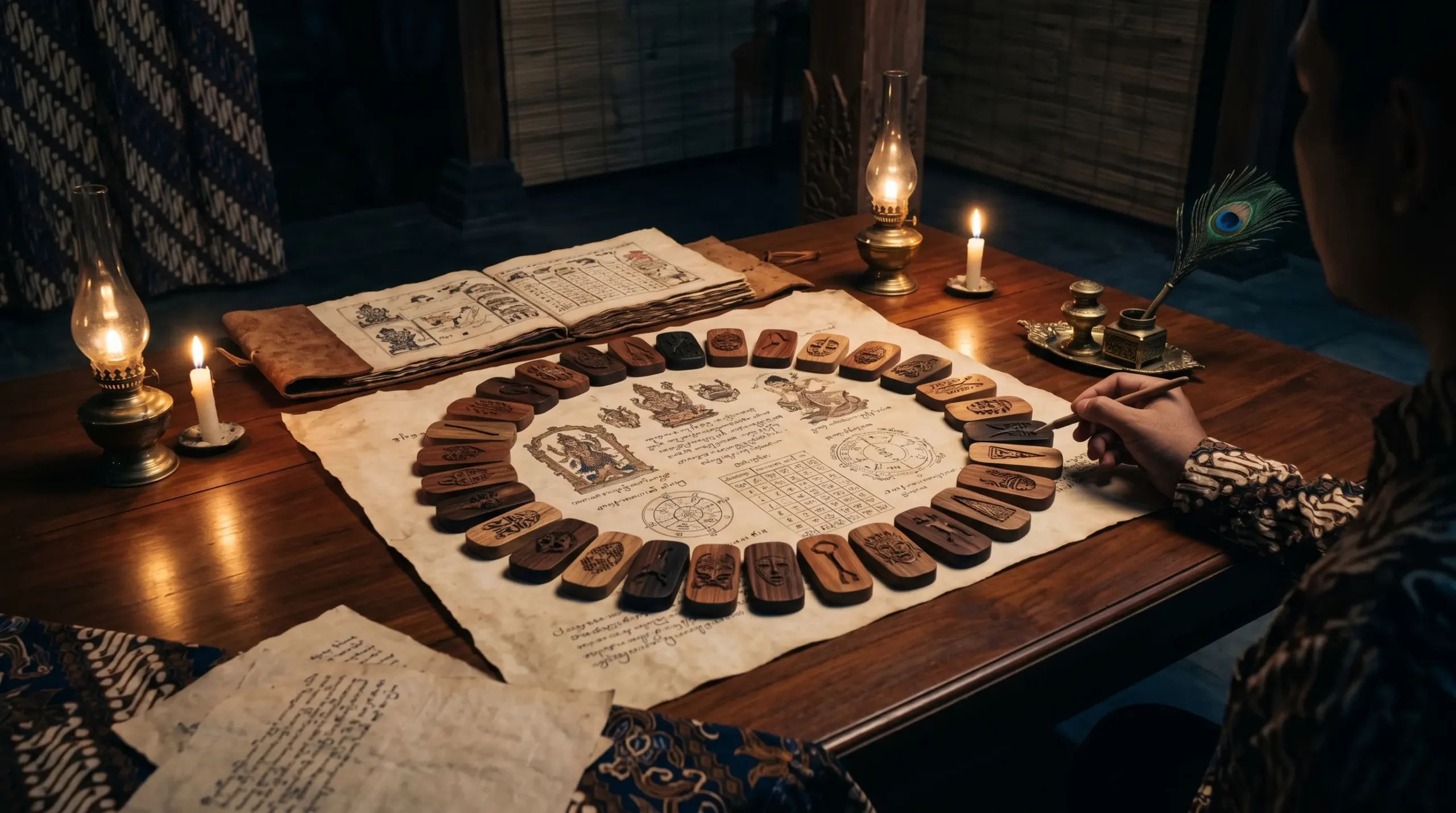
The 30 Wuku in the Javanese Pawukon Cycle
The following table shows the 30 wuku in the Javanese Pawukon cycle. This list is important because wuku moves in a repeating sequence.
| No | Wuku Name | Position in the Cycle |
|---|---|---|
| 1 | Sinta | Beginning of the Pawukon cycle. |
| 2 | Landep | Beginning of the cycle. |
| 3 | Wukir | Beginning of the cycle. |
| 4 | Kurantil | Beginning of the cycle. |
| 5 | Tolu | Early part toward the middle. |
| 6 | Gumbreg | Early part toward the middle. |
| 7 | Warigalit | Early part toward the middle. |
| 8 | Wariagung | Early part toward the middle. |
| 9 | Julungwangi | Early part toward the middle. |
| 10 | Sungsang | First third of the cycle. |
| 11 | Galungan | First third of the cycle. |
| 12 | Kuningan | First third of the cycle. |
| 13 | Langkir | Moving toward the middle. |
| 14 | Mandhasiya | Moving toward the middle. |
| 15 | Julungpujud | Middle of the cycle. |
| 16 | Pahang | Middle of the cycle. |
| 17 | Kuruwelut | Middle toward the end. |
| 18 | Marakeh | Middle toward the end. |
| 19 | Tambir | Middle toward the end. |
| 20 | Medangkungan | Middle toward the end. |
| 21 | Maktal | Moving toward the end. |
| 22 | Wuye | Moving toward the end. |
| 23 | Manahil | Moving toward the end. |
| 24 | Prangbakat | Moving toward the end. |
| 25 | Bala | End section of the cycle. |
| 26 | Wugu | End section of the cycle. |
| 27 | Wayang | End section of the cycle. |
| 28 | Kulawu | End section of the cycle. |
| 29 | Dukut | Near the closing of the cycle. |
| 30 | Watugunung | Closing of the Pawukon cycle. |
For the wider structure of the cycle, read Javanese Pawukon and the 210-day cycle.
How Wuku Relates to Pawukon
Wuku cannot be separated from Pawukon. If wuku is one name or position in the cycle, Pawukon is the larger system that contains all 30 wuku.
In Pawukon, wuku moves from Sinta to Watugunung. After that, the cycle returns to Sinta. Because it repeats, wuku becomes one way Javanese culture reads time as a cycle, not only as a line.
In JavaSense, Pawukon is read as cultural heritage that helps people understand the rhythm of time, not as a tool for locking the future.
How Wuku Relates to the Javanese Calendar
Wuku is one layer in Javanese calendar reading. In the Javanese calendar, readers may find the relationship between date, weekday, pasaran, weton, and wuku.
That is why the JavaSense Javanese calendar is useful. It helps readers view Javanese time more practically without opening many separate sources.
To understand the relationship between daily date and calendar layers, read the Javanese date today guide.
How Wuku Relates to Weton
Weton and wuku can be read together as two cultural layers. Weton shows weekday, pasaran, and neptu. Wuku shows position in the Pawukon cycle.
These two layers can complement each other, but they should still be read as cultural reflection, not as absolute certainty about a person’s life.
To find weton from a birth date, use the JavaSense weton calculator.
Common Mistakes When Looking for Wuku
The first mistake is assuming that wuku is the same as weton. Weton comes from weekday and pasaran, while wuku comes from Pawukon.
The second mistake is assuming that wuku can be known only from the birth weekday. Wuku needs the date’s position in the Pawukon cycle, so it requires a proper Javanese calendar or tool.
The third mistake is reading wuku as certainty about fate. No wuku makes someone certainly successful, failed, compatible, or unlucky.
The fourth mistake is making major decisions only from cultural reading. In relationships, family matters, work, or personal life, wuku may become reflection, but reason, communication, and real conditions still matter.
How to Read Wuku Wisely
After knowing a wuku, the next step is not to draw a large conclusion too quickly. Wuku is safest when read as a cultural mirror, not as a label that traps someone.
For example, Wuku Tolu may be read as a symbol of movement, building, or beginning. But that does not mean every person connected with Wuku Tolu will live the same pattern.
Wuku Watugunung, often understood as the closing of the cycle, can become an invitation to reflect, close what is no longer needed, and learn from experience. But it should never become a verdict on life.
JavaSense reads wuku with calmness: honoring tradition, keeping reason, and avoiding fear-based interpretation.
Wuku and Relationship Reading in Javanese Culture
In traditional reading, wuku can become one cultural layer. But for relationship reading, weton and neptu are more commonly used because they are directly related to weekday and pasaran of birth.
Wuku may add cultural atmosphere, but it should not become a relationship verdict. Human relationships are shaped by communication, family blessing, responsibility, emotional maturity, and shared values.
For relationship reflection, use the JavaSense weton compatibility tool with care. Treat the result as reflection, not as a command about whether a relationship must continue or end.
Cultural References and Reading Notes
Wuku belongs to the Javanese calendar and Pawukon tradition, which has its own structure of time calculation. For readers who want to see the structural side of Javanese calendar calculation, one useful reference is An ethnoarithmetic excursion into the Javanese calendar.
Such references do not replace family tradition or lived cultural memory. They help modern readers see that Javanese time calculation has structure, while its meaning still needs to be read with feeling, reason, and cultural care.
Use JavaSense to Read Wuku and Weton
JavaSense provides several entry points for understanding Javanese cultural time. To read a date through the Javanese calendar, use the JavaSense Javanese calendar. To find weton from a birth date, use the JavaSense weton calculator.
To understand the wider Pawukon system, read Javanese Pawukon and the 210-day cycle. To see the wuku currently running, use the Javanese wuku today guide.
To explore the Javanese calendar, weton, Primbon, wuku, Pawukon, and Javanese script in one place, visit JavaSense as a Javanese cultural platform.
For a more practical mobile experience, readers can download the JavaSense Android app through Google Play.
Closing Reflection: Wuku as a Layer of Javanese Time
Knowing wuku is not only about finding a name in a calendar. Behind wuku is a Javanese way of reading cycles, remembering time, and arranging conduct more carefully.
But wuku does not need to be feared. It is not a rope that binds the future. It is one cultural layer that can help people understand time more gently.
So read wuku calmly. Understand its sequence, know how it differs from weton, and use it as a cultural mirror. Life still moves through choice, effort, and wisdom.
FAQ About Javanese Birth Wuku
How do I find Javanese birth wuku from a birth date?
To find Javanese birth wuku, match the birth date with the Javanese calendar and the Pawukon cycle. The most practical way is to use a calendar or tool that shows Pawukon information.
What is wuku?
Wuku is one part of the Javanese Pawukon cycle, which consists of 30 wuku from Sinta to Watugunung.
Can wuku be known from weton alone?
No. Weton shows weekday and pasaran, while wuku needs the date’s position in the Pawukon cycle.
What is the difference between wuku and weton?
Weton comes from the combination of weekday and Javanese pasaran, while wuku comes from the Pawukon cycle. Weton relates to neptu, while wuku relates to position in the 30-wuku cycle.
Is wuku the same as neptu?
No. Neptu is the numerical value of weekday and pasaran in weton, while wuku is a name and position within the Pawukon cycle.
How many wuku are in Pawukon?
There are 30 wuku in Pawukon, beginning with Sinta and ending with Watugunung.
Where can I check wuku today?
Readers can use the JavaSense Javanese calendar or the Javanese wuku today guide to see the wuku currently running.
Does wuku determine fate?
No. Wuku should be read as cultural reflection and Javanese time knowledge, not as a fixed decision about fate.