


Many people can add neptu numbers once they see the table. The harder part usually comes earlier: how do you find the Javanese pasaran from a birth date?
A weekday may be easy to remember. But pasaran names such as Legi, Pahing, Pon, Wage, and Kliwon are not always written on ordinary calendars. That is why how to calculate weton needs to be explained step by step.
Weton calculation is not only about adding numbers. It begins by finding the birth weekday, identifying the Javanese pasaran, then adding the neptu value of both. The result should be read as cultural knowledge, not as an absolute prediction of fate.
Quick Answer: How Do You Calculate Weton?
To calculate weton, find the birth weekday and Javanese pasaran, then add their neptu values. The basic formula is: neptu weton = weekday neptu + pasaran neptu.
For example, someone born on Monday Legi has Monday 4 and Legi 5. The neptu weton is 4 + 5 = 9.
- Prepare the correct birth date.
- Find the birth weekday: Sunday, Monday, Tuesday, Wednesday, Thursday, Friday, or Saturday.
- Find the Javanese pasaran for that date: Legi, Pahing, Pon, Wage, or Kliwon.
- Check the weekday neptu value.
- Check the pasaran neptu value.
- Add both values to get the neptu weton.
For a practical result, you can calculate your weton from a birth date with JavaSense.
Why Calculating Weton Starts with Pasaran
The most common mistake in weton calculation is assuming that the weekday alone is enough. It is not. Weton is formed by two parts: the regular weekday and the Javanese pasaran.
This means knowing that someone was born on Monday is only half of the answer. You still need to know whether the date was Legi, Pahing, Pon, Wage, or Kliwon.
Once the weekday and pasaran are known, the neptu calculation becomes simple. Without pasaran, the result is incomplete.
What Is Weton?
Weton is the meeting of a birth weekday and a Javanese pasaran. The weekday comes from the seven-day cycle: Sunday, Monday, Tuesday, Wednesday, Thursday, Friday, and Saturday. Pasaran comes from the five-day Javanese cycle: Legi, Pahing, Pon, Wage, and Kliwon.
From these two cycles, Javanese tradition recognizes 35 weton combinations. Examples include Monday Legi, Tuesday Pahing, Wednesday Pon, Thursday Wage, Friday Kliwon, Saturday Pon, Sunday Wage, and others.
To understand the wider concept, read the guide to Javanese weton. This article focuses on the practical calculation process.
What Is Javanese Pasaran?
Pasaran is the five-day Javanese cycle. The five pasaran are Legi, Pahing, Pon, Wage, and Kliwon.
Pasaran is important because each pasaran has its own neptu value. That value is added to the weekday value to calculate neptu weton.
For many people, pasaran is the hardest part to find manually. A regular calendar may show the weekday but not the Javanese pasaran. This is why a Javanese calendar or weton calculator is often needed.
What Is Neptu Weton?
Neptu weton is the numerical value formed by adding the weekday value and the pasaran value. Each weekday has a value, and each pasaran also has a value. When both are added, the result is called neptu weton.
Neptu is often used in several traditional readings, including symbolic character reflection, relationship compatibility, and cultural timing.
Still, neptu should not be read absolutely. A small neptu does not mean bad, and a large neptu is not automatically better. Neptu is part of cultural reading, not a measure of human worth.
For a deeper explanation, read neptu in the Javanese calendar.
The Basic Weton Calculation Formula
The basic weton calculation formula is simple.
Neptu weton = weekday neptu + pasaran neptu.
This formula only works after two things are known: the birth weekday and the Javanese pasaran. If the pasaran is wrong, the neptu result will also be wrong.
That is why the Javanese calendar or an online weton calculator is often used to match a modern birth date with its correct pasaran.
Weekday Neptu Values
The table below shows the weekday neptu values commonly used in Javanese weton calculation.
| Weekday | Javanese / Indonesian Name | Neptu Value |
|---|---|---|
| Sunday | Minggu | 5 |
| Monday | Senin | 4 |
| Tuesday | Selasa | 3 |
| Wednesday | Rabu | 7 |
| Thursday | Kamis | 8 |
| Friday | Jumat | 6 |
| Saturday | Sabtu | 9 |
Javanese Pasaran Neptu Values
The table below shows the pasaran neptu values commonly used in Javanese weton calculation.
| Javanese Pasaran | Neptu Value |
|---|---|
| Legi | 5 |
| Pahing | 9 |
| Pon | 7 |
| Wage | 4 |
| Kliwon | 8 |
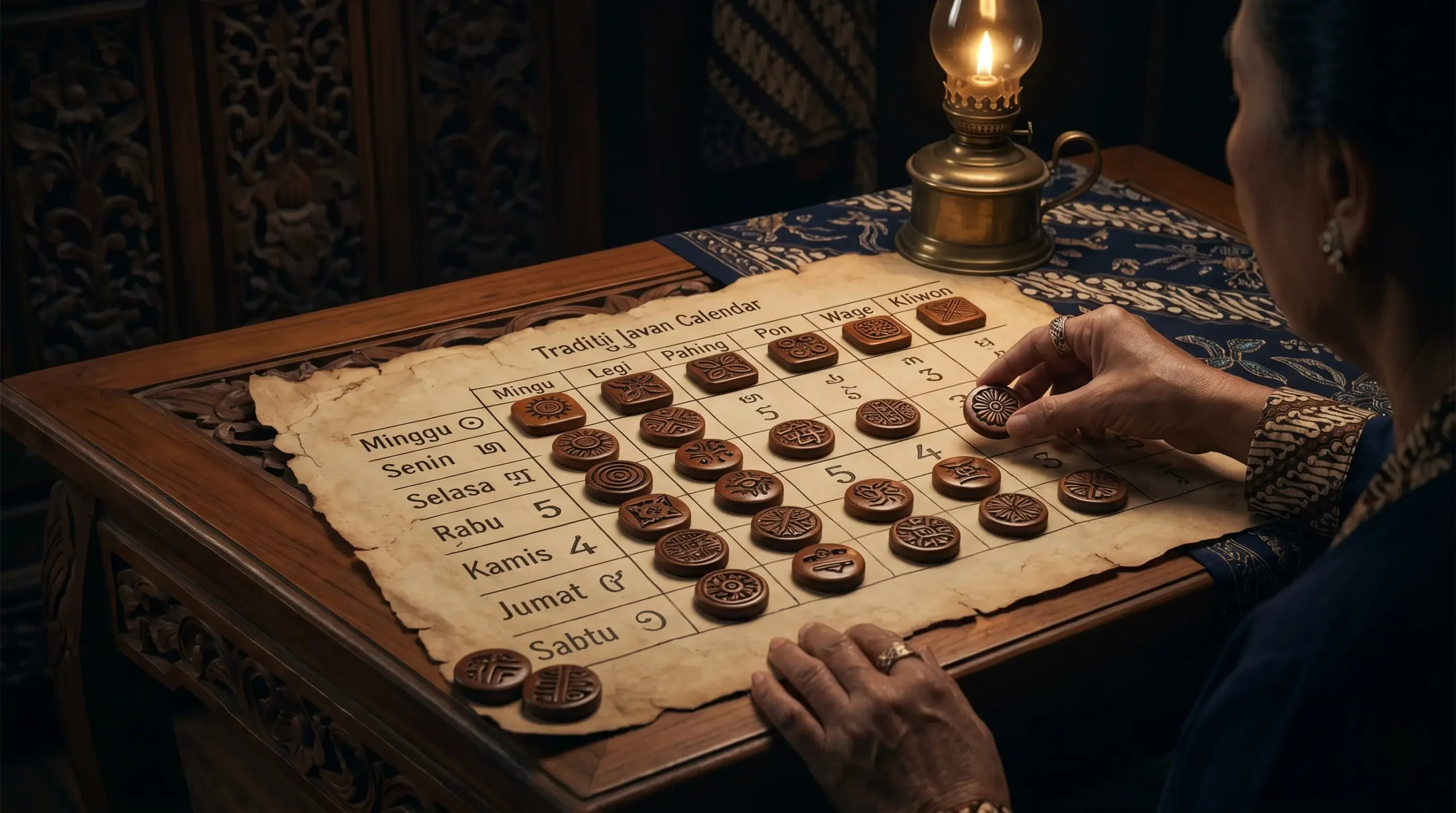
5 Steps to Calculate Weton from a Birth Date
Here is a practical step-by-step method for calculating weton from a birth date.
- Prepare the birth date. Use the correct Gregorian birth date so the weekday and pasaran are not mistaken.
- Find the birth weekday. The weekday may be Sunday, Monday, Tuesday, Wednesday, Thursday, Friday, or Saturday.
- Find the Javanese pasaran. The pasaran for that date may be Legi, Pahing, Pon, Wage, or Kliwon.
- Check the weekday and pasaran neptu values. Use the tables above.
- Add both values. The result is the neptu weton.
The first three steps are usually where mistakes happen, especially if you do not have a Javanese calendar. For a faster result, use the JavaSense weton calculator.
Popular Weton Calculation Examples
The examples below show how the formula works once the weekday and pasaran are known.
Monday Legi
Monday has a neptu value of 4. Legi has a neptu value of 5.
Monday Legi = 4 + 5 = 9.
Friday Kliwon
Friday has a neptu value of 6. Kliwon has a neptu value of 8.
Friday Kliwon = 6 + 8 = 14.
Saturday Pon
Saturday has a neptu value of 9. Pon has a neptu value of 7.
Saturday Pon = 9 + 7 = 16.
Wednesday Pon
Wednesday has a neptu value of 7. Pon has a neptu value of 7.
Wednesday Pon = 7 + 7 = 14.
Friday Pahing
Friday has a neptu value of 6. Pahing has a neptu value of 9.
Friday Pahing = 6 + 9 = 15.
Wednesday Kliwon
Wednesday has a neptu value of 7. Kliwon has a neptu value of 8.
Wednesday Kliwon = 7 + 8 = 15.
Thursday Pahing
Thursday has a neptu value of 8. Pahing has a neptu value of 9.
Thursday Pahing = 8 + 9 = 17.
These examples show that calculating neptu is easy once the weekday and pasaran are already known. The real challenge is often finding the correct pasaran from a birth date.
How to Find Pasaran from a Birth Date
To find pasaran from a birth date, use a Javanese calendar. A Javanese calendar shows the relationship between the Gregorian date, weekday, pasaran, and other Javanese calendar elements.
If a regular calendar does not show pasaran, you will need a Javanese calendar or a weton calculator. Pasaran runs in a five-day cycle, so it is not always easy to remember manually.
JavaSense provides a Javanese calendar to help readers understand the relationship between date, pasaran, weton, and Javanese time cycles.
A Practical Case: You Know the Birth Date, but Not the Pasaran
Imagine someone wants to calculate their weton. They know the birth date and even remember the weekday from family stories. But when asked about pasaran, they do not know whether it was Legi, Pahing, Pon, Wage, or Kliwon.
In this situation, the neptu table is not enough. The table only works after both weekday and pasaran are known. The safer step is to find pasaran through a Javanese calendar or use an online weton calculator.
Once the pasaran is known, the weekday value and pasaran value can be added. That way, the result is not a guess but a calculation built from the correct base.
When to Use a Weton Calculator
Manual calculation is helpful because it teaches the logic behind weton. But in some situations, using a weton calculator is more practical.
- When you only know the birth date but do not know the pasaran.
- When you want to confirm the weekday and pasaran of an older birth date.
- When you want to see neptu without opening manual tables.
- When you want supporting information such as wuku or Javanese calendar data.
- When you want to avoid mistakes caused by choosing the wrong pasaran.
Use the JavaSense weton calculator as a practical step, then read the result calmly without rushing into big conclusions.
Common Mistakes When Calculating Weton
Several mistakes often happen when people calculate weton.
First, knowing only the weekday but not the pasaran. Weton must have two parts: weekday and pasaran.
Second, reading the birth date incorrectly. This can happen when a date record is not clear or when someone mixes Gregorian date and Javanese date.
Third, treating neptu as a measure of good or bad. Neptu is not a measure of human worth. It is a symbolic number in tradition, not a verdict on someone’s fate.
Fourth, drawing conclusions too far from one calculation. Weton should be read with context, not used as the only basis for judging life, relationships, or the future.
How to Read the Weton Result Safely
After knowing your weton and neptu, the next step is not to predict fate. A healthier step is to read the result as cultural reflection.
For example, if a weton is often associated with strong character, the reflective message is not “I must be stubborn.” A better reading is: “I need to shape my will so it does not hurt other people.”
If a weton compatibility result feels heavy, the reflective message is not “this relationship must fail.” A better reading is: “we need more awareness in communication, ego, family dialogue, and how we resolve problems.”
Ky Tutur’s reflection: Numbers in weton are not fences that imprison life. They are closer to small signs that invite us to pause, arrange our feeling, and walk with reason and responsibility.
Weton Calculation and Compatibility
In weton compatibility, the neptu values of two people are often added or read through certain traditional patterns. From there, several terms and interpretations may appear in Javanese society.
Still, weton compatibility should not be read as an absolute decision. Human relationships are not determined by numbers alone. They are shaped by communication, blessing, shared values, responsibility, family situation, and the maturity of both people.
For a more focused relationship reflection, use weton compatibility with care. Read the result as cultural reflection, not as a verdict on the relationship.
Weton, Wuku, and Pawukon
Weton and wuku are often mentioned together, but they are different. Weton comes from the meeting of weekday and pasaran. Wuku comes from the Pawukon cycle, which consists of 30 wuku.
If weton helps read birth weekday and pasaran, wuku gives another layer of time within the Pawukon tradition. Both can complement each other in Javanese cultural reading.
To understand wuku more deeply, read about Pawukon and the 30 wuku cycle.
Weton Is Not Fixed Fortune-Telling
After understanding the calculation, it is important to keep the right inner attitude. The result should not make someone feel higher, lower, afraid, or certain about the future.
In the JavaSense approach, weton is not fixed fortune-telling. Weton is a cultural mirror. It may help people know themselves, but it does not replace effort, prayer, communication, education, environment, and life choices.
To understand this boundary more deeply, read weton is not fortune telling.
Learn Weton with JavaSense
To learn weton step by step, start from these JavaSense pages and tools.
- To understand the cultural foundation, read Javanese weton.
- To calculate directly from a birth date, use the JavaSense weton calculator.
- To understand weekday and pasaran numbers, read neptu in the Javanese calendar.
- To read daily pasaran, weton, and wuku, open the Javanese calendar.
- To read relationship reflection, use weton compatibility with care.
- To explore related resources, open JavaSense cultural tools.
For a broader cultural map, JavaSense can also be read as a Javanese cultural platform for weton, calendar, Primbon reflection, Pawukon, wuku, and Javanese script.
Closing: Calculating Weton to Understand Yourself
Calculating weton is not only about adding numbers. Behind weekday, pasaran, and neptu is an older Javanese way of reading time with care.
But numbers should not defeat wisdom. After finding weton, the human task is not to stop at the calculation. The better question is: what can I understand about myself, what should I guard, and what conduct should I improve?
Use weton as a mirror. Calculate it correctly, read it calmly, and do not turn it into a burden.
To learn weton, pasaran, neptu, compatibility, the Javanese calendar, and script in a lighter way, you can also open JavaSense on Google Play.
FAQ About How to Calculate Weton
How do you calculate weton from a birth date?
To calculate weton, find the birth weekday and Javanese pasaran, then add the weekday neptu value and the pasaran neptu value. For example, Monday Legi is 4 + 5 = 9.
What is the formula for calculating weton?
The formula is weekday neptu plus pasaran neptu. For example, Wednesday Pon is Wednesday 7 plus Pon 7, so the result is 14.
What are the weekday and pasaran neptu values?
The weekday values are Sunday 5, Monday 4, Tuesday 3, Wednesday 7, Thursday 8, Friday 6, and Saturday 9. The pasaran values are Legi 5, Pahing 9, Pon 7, Wage 4, and Kliwon 8.
How do you find pasaran from a birth date?
The easiest way to find pasaran from a birth date is to use a Javanese calendar or an online weton calculator that shows weekday, pasaran, weton, and neptu.
Can weton be calculated without a Javanese calendar?
Yes, but it is harder because you still need to know the correct Javanese pasaran for the birth date. A Javanese calendar or weton calculator makes the process easier.
Is weton the same as neptu?
No. Weton is the combination of weekday and pasaran, while neptu is the numerical value assigned to that weekday and pasaran.
Where can I calculate weton online?
You can use the JavaSense weton calculator to find weton, pasaran, neptu, and related Javanese calendar information from a birth date.
Does weton calculation determine fate?
No. Weton calculation should be read as cultural reflection, not as fixed prediction. Choices, effort, communication, environment, and maturity still matter.