

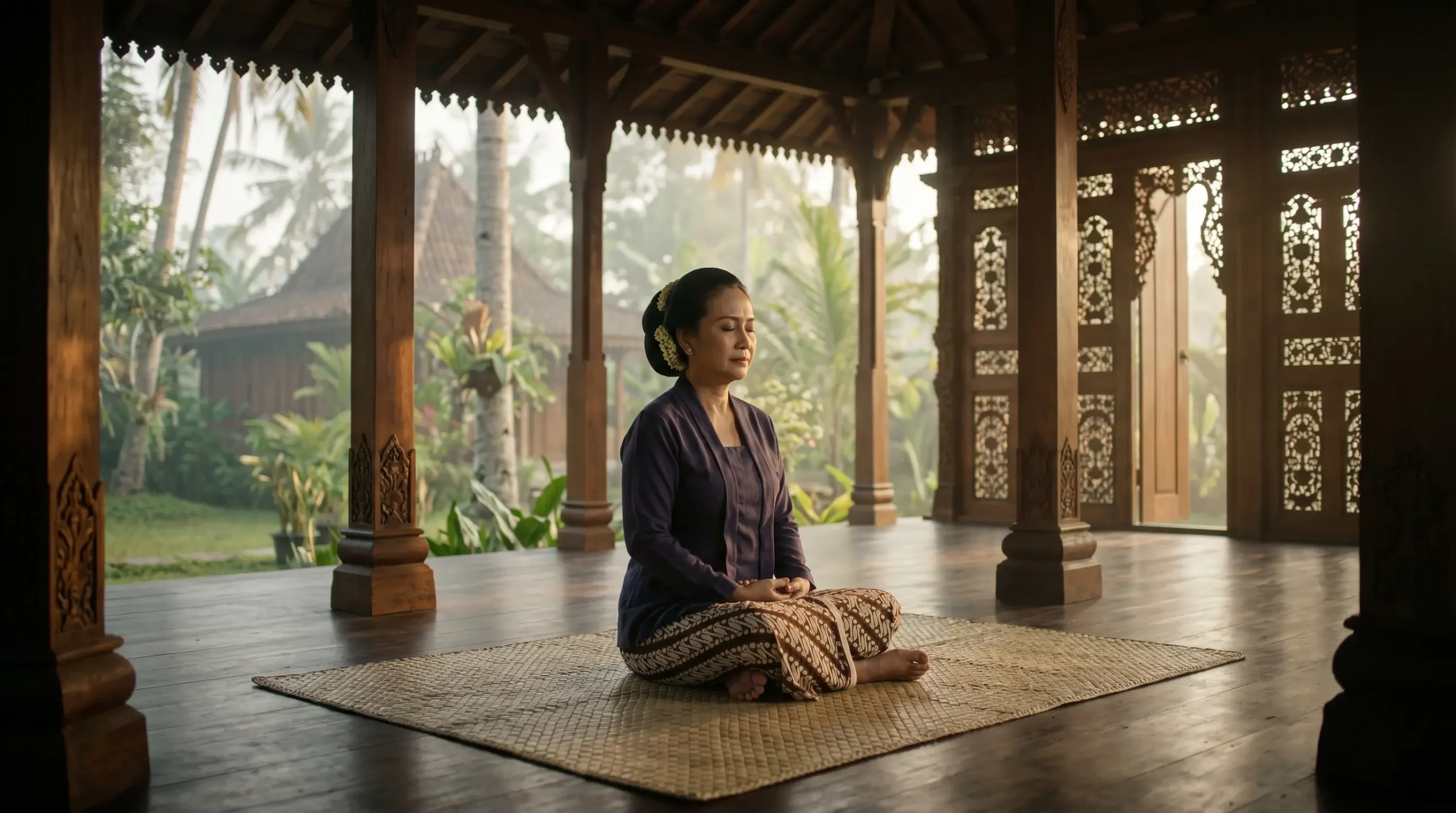
Angger, my child…
There are moments when a person is not defeated by a large problem, but by a small explosion inside the chest. One comment makes the heart hot. One message pulls the mind into fear. One mistake makes the self feel broken. In moments like this, Javanese wisdom whispers an old but living reminder: eling lan waspada.
Ky Tutur Summary
- Eling lan waspada is Javanese wisdom about awareness, caution, emotional pause, and careful conduct.
- Eling means remembering or becoming aware: returning to inner footing, life values, and self-direction.
- Waspada means alert and sensitive: reading signs, emotions, situations, and consequences before acting.
- In modern life, this teaching helps people pause before reacting, arrange anger, accept reality, and choose a clearer response.
Ky Tutur Note: This article discusses eling lan waspada as Javanese cultural wisdom and life reflection. It is not medical therapy, psychological diagnosis, or a replacement for professional help. If emotional pressure feels heavy, anxiety disrupts daily life, depression appears, or there are thoughts of self-harm, seek safe and qualified professional support.
Eling lan waspada is a Javanese teaching about staying aware and careful within life. It is not a command to suppress emotion until the heart becomes stone. It is also not a mystical shortcut that makes a person immune to anger, sadness, or fear. Instead, this pitutur invites human beings to recognize what is happening inside the self, then choose a response that does not damage life.
In a fast-moving age, this teaching becomes even more useful. People become angry because of a short comment. Anxious because of incomplete news. Tired because of constant comparison. Reactive because every screen seems to demand an instant answer. In this condition, eling lan waspada becomes a gentle brake: not to stop life, but to prevent us from crashing into ourselves.
JavaSense reads this wisdom as a cultural mirror. It helps people ask: what is happening in my heart, what may happen if I react now, and what response will keep dignity, clarity, and responsibility alive?
What Does Eling lan Waspada Mean?
In simple terms, eling lan waspada means awareness and caution. Eling is the ability to remember: remember the self, remember limits, remember purpose, remember values, and remember the direction being protected. Waspada is the ability to read: read the situation, read signs, read consequences, and read the movement of the heart before it becomes action.
In daily life, eling appears when someone realizes, “I am angry right now,” and does not immediately pour that anger onto another person. Waspada appears when that person sees that one sharp message can damage a relationship, reputation, or peace that has been built for a long time.
So this teaching is not only a spiritual phrase far from ordinary life. It lives in small moments: when driving, when replying to a work message, when reading social media comments, when choosing words in a family conversation, and when deciding whether to speak now or wait until the heart becomes clearer.
Eling: Returning to Inner Awareness
Eling is often translated as remembering or awareness. But in Javanese rasa, it is deeper than remembering information. Eling means returning to the center of the self.
When a person is overwhelmed by anger, fear, or disappointment, they often forget many things. They forget the purpose. They forget the consequence. They forget dignity. Sometimes they even forget that the person in front of them is also human.
A person who is eling does not mean they never feel anger. They can still feel anger, sadness, fear, and disappointment. The difference is that they do not immediately hand over the steering wheel of life to the emotion that has just arrived.
This small distance between emotion and action often saves many things. One breath before replying. One night before deciding. One pause before accusing. One question before judging. In that small space, eling works like an anchor that keeps the inner self from being carried too far by a temporary wave.
Waspada: Reading the Self and the Situation
Waspada does not mean living in suspicion. It does not mean seeing everyone as a threat. In Javanese wisdom, waspada is closer to sensitivity and alertness. It helps human beings avoid walking with closed inner eyes.
A person who is waspada can read signs. They notice when the body becomes tense, the breath becomes short, the voice begins to rise, or the mind starts searching for reasons to attack. They can also read the outside situation: whether this moment is right for speaking, whether the other person is ready to listen, and whether the words that are about to come out will bring clarity or only make things more clouded.
Waspada helps people avoid blind reaction. It does not remove firmness. A person can still be firm, but the firmness comes from clarity, not from an emotional explosion.
Difference Between Eling and Waspada
Eling and waspada are two movements that complete each other. Eling pulls a person back into inner awareness. Waspada opens the eyes toward the situation, consequence, and emotional movement that is happening.
| Aspect | Eling | Waspada |
|---|---|---|
| Basic Meaning | Remembering, becoming aware, returning to inner footing. | Being alert, sensitive, and able to read signs and situations. |
| Direction of Attention | Inward: intention, emotion, values, and purpose. | Inward and outward: situation, consequence, and movement of thought. |
| Main Function | Keeping the heart from being carried away by temporary emotion. | Helping a person choose a response that is careful and fitting. |
| Reflective Question | “What is happening inside me?” | “What may happen if I act now?” |
| Fruit of Practice | Calmness, awareness, and the ability to arrange rasa. | Carefulness, appropriate action, and clearer conduct. |
Why Eling lan Waspada Matters in Modern Life
Modern life accelerates almost everything. Information arrives quickly. Bad news spreads quickly. Comments are written quickly. Anger becomes contagious quickly. But speed does not always bring clarity. Many people react before understanding, answer before listening, and judge before knowing.
This is where eling lan waspada becomes important. It helps human beings delay destructive reactions. It reminds us that not every feeling must immediately become action. Not every thought must immediately become speech. Not every wound must be answered with another wound.
Modern health guidance also often recommends pause, breathing, and stress management as part of caring for balance. Readers may compare this cultural reflection with the NHS breathing exercises for stress and the WHO explanation of stress.
This does not mean eling lan waspada is the same as medical treatment. It means Javanese pitutur and modern self-care language can meet at one simple point: the pause before reaction matters.
7 Practices of Eling lan Waspada for Emotional Clarity
My child, good wisdom should not remain only as beautiful words. It must descend into conduct. Here are seven simple ways to bring eling lan waspada into daily life without making it complicated.
1. Mungguh: Return to the Present Body
When emotion rises, the body often gives signs. The breath becomes short. The shoulders tighten. The chest feels full. The hands want to type, point, or strike back. In moments like this, the first practice is to return to the body.
Feel the feet touching the floor. Feel the back supported by the chair. Feel air entering and leaving. There is no need to force instant calm. Simply notice that the body is reacting.
This small awareness helps the inner self avoid being completely carried by the wave. This is a simple form of eling: returning to the present moment, not drowning in past resentment or future fear.
2. Ngaso: Pause Before Responding
A pause is a doorway of safety. Many wounds are born not because people do not know right and wrong, but because they act while emotion is at its peak. One message sent too quickly can become long regret. One sharp sentence can leave a wound that is hard to heal.
Ngaso means stopping for a moment. Breathe slowly. Count a few seconds. Delay the reply. Let reason and rasa sit together before the mouth or fingers move.
A pause is not defeat. A pause is the way to keep the self from being ruled by a temporary storm.

3. Niteni: Recognize Emotional Patterns
Waspada means learning to read patterns. What usually makes anger rise? A certain comment? A certain tone? Feeling disrespected? Fatigue that has been ignored too long? An old wound that has been touched again?
Through niteni, a person begins to know the map of the inner self. Instead of saying, “I am just an angry person,” they begin to ask, “When does my anger appear? What triggers it? What am I actually protecting?”
This kind of observation is not absolute prediction. It is the habit of reading signs and patterns so that a person does not keep falling into the same hole.
4. Ngemong Rasa: Care for the Inner Self
Not every feeling needs to be fought. Sometimes it needs to be cared for. Anger needs to be calmed. Sadness needs to be heard. Disappointment needs space. Fear needs companionship.
When every feeling is suppressed, it does not always disappear. It may only search for a rougher way out.
Ngemong rasa means caring for the inner self without spoiling every impulse. A person learns to say, “I am angry, but I do not have to wound someone. I am sad, but I do not have to surrender. I am afraid, but I can still choose one steady step.”
5. Tepa Slira: Consider Another Person’s Feeling
After becoming aware of the self, human beings also need to read others. Before judging, ask: what if I were in that person’s position? Before mocking, ask: what if these words reach someone who is already fragile? Before pressing too hard, ask: will my way of speaking repair the situation or only make people afraid?
Tepa slira helps eling lan waspada become more social. Eling keeps us aware of ourselves. Waspada helps us see impact. Tepa slira helps us weigh another person’s rasa before speaking and acting.
This does not mean never being firm. It means firmness should not lose humanity.
6. Narima: Accept What Cannot Be Controlled
Many emotions become larger because human beings try to control what cannot be controlled. We want others to always understand. We want the past to change. We want all plans to follow the image in our head. We want life to obey our private map.
Narima helps a person stop fighting reality that cannot be changed. But narima is not blind passivity. It is accepting the ground of today, then choosing the sanest next step.
A person who practices narima does not lose power. They stop wasting energy against a wall that cannot be moved, then use that energy to open a door that can still be opened.
7. Tirakat: Train Yourself Not to Obey Every Impulse
Tirakat is often understood too narrowly as a heavy ascetic practice. In modern life, tirakat can begin with simple discipline: not immediately following every urge.
Do not buy everything just because desire appears. Do not reply immediately when anger rises. Do not open social media every time restlessness comes. Do not speak only because the ego wants to win.
Tirakat strengthens eling and waspada. It trains the inner muscles so that life is not easily pulled by temporary desire. From here, a person learns that freedom is not always obeying every impulse. Freedom is being able to choose which impulse deserves to be followed.
Case Studies in Daily Life
When Provoked on the Road
Imagine driving home after a tiring day. Suddenly, another vehicle cuts the lane without warning. The body tightens. The hand wants to press the horn. The mouth wants to release harsh words. At that point, waspada lights up: “I am being provoked.”
Then eling pulls back the main purpose: to return home safely. Not to win an emotional battle on the road. Not to prove who is right. The next step is simple: breathe, keep a safe distance, and let the vehicle go.
Not every battle needs to be won. Some only need to be passed while dignity remains intact.
When Cornered at Work
Imagine a work message arrives with a tone that feels cornering. The fingers are ready to reply sharply. This is where the practice is tested. Waspada reads the signs: held breath, hot chest, and the mind searching for the most piercing sentence. Eling reminds: do not let one message make you lose your dignity.
Instead of replying while hot, take a pause. Drink water. Walk for a moment. Write a draft without sending it. After the mind becomes cooler, answer with facts, clear boundaries, and professional language.
This is a subtler victory: not surrendering, but not allowing emotion to damage the next step.
Eling lan Waspada, Social Harmony, and Digital Life
In social life, eling and waspada help prevent people from damaging what has been built. A family can crack because of words that were not weighed. Friendships can become distant because of suspicion. Workplaces can heat up because ego is not managed.
In digital life, this becomes even more important. The screen makes reaction feel easy. Comment first, think later. Share first, verify later. Judge first, listen later. But the wound caused by careless words can travel far, even when written in only a few seconds.
Eling lan waspada teaches a different rhythm. Read before reacting. Pause before sharing. Ask before accusing. Clarify before judging. If emotion is hot, let the reply wait until the heart is clearer.

JavaSense and a Clearer Way to Read Javanese Pitutur
JavaSense reads Javanese culture as a mirror, not a verdict. Weton, the Javanese calendar, script, primbon, and pitutur should not make people afraid. They should help people recognize themselves, arrange relationships, and respect cultural heritage with clear reason.
If you want to understand the rhythm of days in Javanese tradition, open the JavaSense Javanese calendar. If you want to read weton as cultural reflection, use the JavaSense weton calculator wisely. If you want to slow down through letters and careful writing, try the JavaSense Javanese script tool.
For a companion reading on inner quiet, you may continue with Hening as Javanese inner quiet and clarity. For deeper reflection on origin and purpose, read Sangkan Paraning Dumadi as origin and purpose of life.
All of these are doors of learning. They are not tools for locking fate. They are ways to read the self, recognize heritage, and arrange rasa with more care.
Closing Reflection: Becoming the Caretaker of the Inner House
In the end, eling lan waspada is the practice of becoming the caretaker of one’s own inner house. Not a harsh caretaker who punishes every feeling. Not a careless caretaker who lets every room become messy. But a wise caretaker who knows when to open the door, when to close the window, when to clean the room, and when to sit quietly in the middle of the house.
Angger, my child, life will not always be gentle. There will be days when people misunderstand. There will be times when plans fail. There will be moments when the heart feels full. But as long as there is eling, we are not completely lost. As long as there is waspada, we can still choose the next step.
So carry this pitutur slowly. When angry, pause. When anxious, return to the breath. When disappointed, accept reality without losing strength. When words may wound, remember that every sentence leaves a trace. When the heart wants to give up, remember that the inner self can still be cared for.
To learn Javanese culture in a lighter and more modern way, you can download JavaSense on Google Play.
FAQ About Eling lan Waspada
What does eling lan waspada mean?
Eling lan waspada means awareness and caution. Eling invites a person to return to self-awareness, while waspada helps read situations, emotions, and consequences before reacting.
What is the difference between eling and waspada?
Eling points inward: intention, values, emotion, and inner condition. Waspada points toward sensitivity in reading signs, situations, and the possible effects of words or actions.
How can I practice eling lan waspada when angry?
Begin by pausing, arranging the breath, noticing body signs, and delaying response until the heart becomes clearer. Then choose words or actions that do not damage the self or the relationship.
Is eling lan waspada the same as mindfulness?
They are close in the sense of awareness and presence, but eling lan waspada comes from Javanese cultural wisdom and carries the nuance of pitutur, rasa, conduct, and responsibility.
Does eling lan waspada mean I should never be angry?
No. Anger is human. Eling lan waspada does not forbid anger. It teaches people to recognize anger and avoid letting it become destructive action.
How is eling lan waspada connected with narima ing pandum?
Narima ing pandum helps someone accept what cannot be controlled. Eling keeps self-awareness alive, waspada reads the situation, and narima helps choose a more spacious response.
Why is eling lan waspada important in the digital age?
In the digital age, people are easily provoked by comments, news, and comparison. Eling lan waspada helps a person pause before writing, sharing, judging, or deciding.
How can I practice eling lan waspada every day?
Practice through simple steps: pause before responding, arrange the breath, recognize emotional patterns, listen fully, weigh the impact of speech, and keep healthy boundaries with awareness.
Learn Javanese Pitutur with Clearer Awareness
Eling lan waspada is not merely old advice. It is a living practice of awareness, pause, and careful conduct. To explore weton, the Javanese calendar, script, and cultural heritage more easily, open JavaSense on Google Play.