

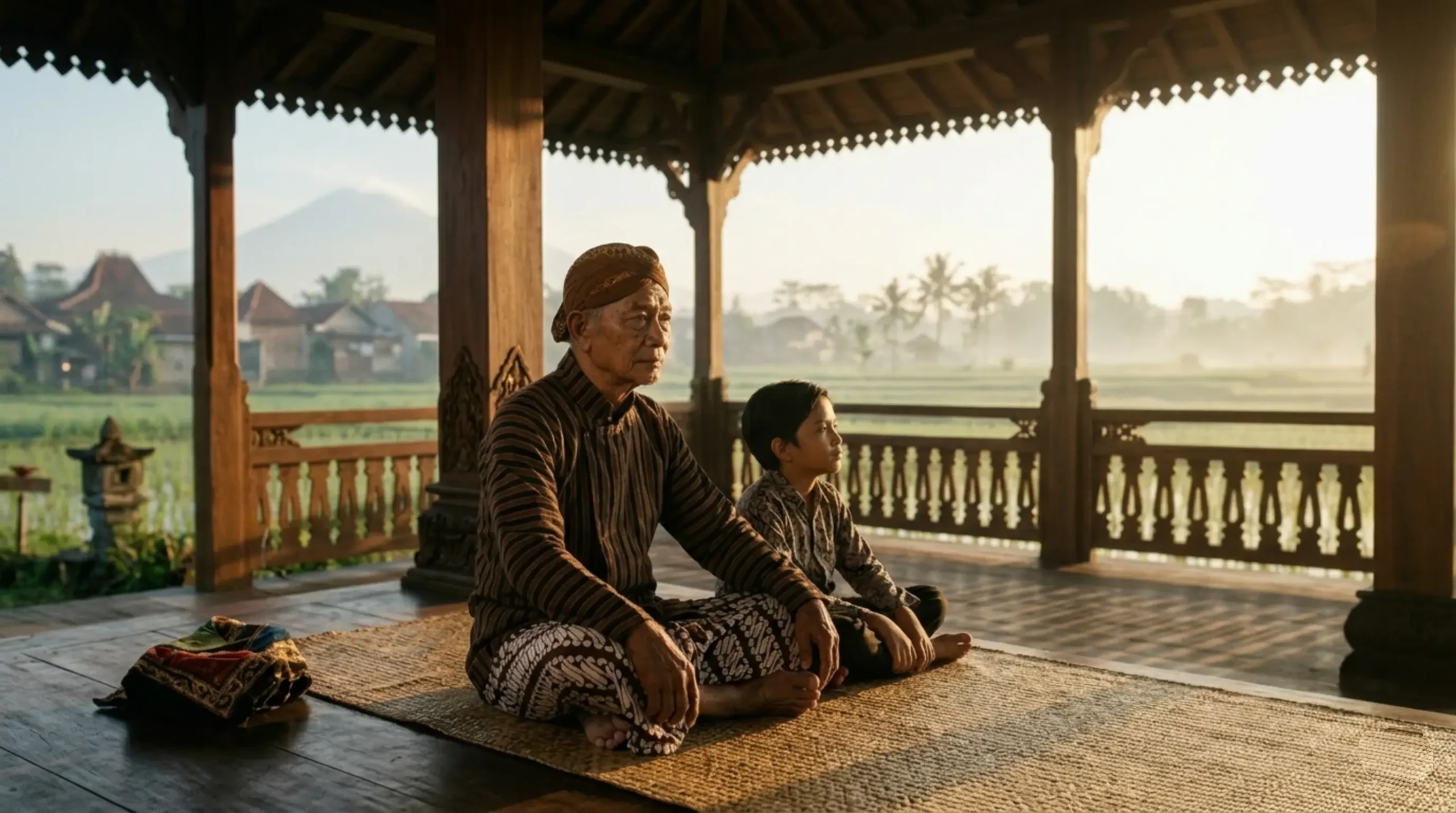
Angger, my child…
There is a question that does not always arrive loudly, yet it quietly follows human beings throughout life: where do I come from, why am I here, and where is this journey finally leading? In Javanese rasa, that deep question is held in one old teaching: sangkan paraning dumadi.
Ky Tutur Summary
- Sangkan paraning dumadi is Javanese wisdom about the origin, direction, and purpose of human life.
- Sangkan points to origin, paran points to direction or destination, and dumadi points to existence or the process of becoming.
- This teaching is not only about death. It is also about living consciously, arranging conduct, and becoming useful in daily life.
- In the modern age, sangkan paraning dumadi helps human beings avoid losing direction amid ambition, noise, comparison, and endless pressure.
Ky Tutur Note: This article discusses sangkan paraning dumadi as Javanese cultural wisdom, life philosophy, and inner reflection. It is not a single spiritual doctrine, not a spiritual verdict, and not a replacement for religious, medical, psychological, legal, or professional guidance. Read it as a mirror for arranging conduct, not as a tool for judging human beings.
Sangkan paraning dumadi can be understood as a Javanese reflection on the origin and purpose of life. It is often translated simply as “where human beings come from and where they return.” Yet its meaning does not stop at birth and death. It also asks a quieter and more practical question: how should a person live between origin and destination?
This is where the depth of the teaching begins to appear. It is not only a beautiful phrase for quiet contemplation. It is an inner compass. When human beings remember that life has origin, direction, and responsibility, they become less easily dragged by pride, anger, envy, or desires that never feel complete.
In the JavaSense reading, sangkan paraning dumadi is best understood as a cultural mirror. It does not exist to frighten people about the end of life. It reminds us that today must be lived with awareness. Every word, choice, work, and relationship leaves a trace.
What Does Sangkan Paraning Dumadi Mean?
In simple language, sangkan paraning dumadi means the origin and destination of all that exists. In the context of human life, it invites a person to reflect on origin, direction, and the way to become a more whole human being.
Sangkan means origin, beginning, or where something comes from. Paran means direction, destination, or where something is going. Dumadi means to become, to happen, or to exist. When these three are joined, a large life question appears: where do I come from, where am I going, and how should I live my present existence?
This question does not always need to be answered with complicated words. Sometimes it comes in simple forms: is my life today still aligned with the values I believe in? Do my actions bring benefit? Am I walking consciously, or only following the crowd because I am afraid of being left behind?
Sangkan: Remembering Origin Without Losing Roots
Sangkan is reflection on origin. In daily life, remembering origin does not only mean remembering family, birthplace, or lineage. More deeply, sangkan invites human beings to realize that no one appears from an empty space.
Every person grows from many gifts: the love of parents, the guidance of teachers, the land that feeds, the society that shapes language, and the experiences that refine the inner life. A person who forgets origin easily becomes arrogant. They feel every achievement stands only on their own strength. Yet behind every step, many hands have guided, directly or quietly.
Remembering sangkan makes a person more humble. They do not easily belittle others. They know that they too were once weak, once did not know, once needed help, and once learned from mistakes. Roots like these make life less easily shaken.
Sangkan also teaches gratitude. Not the loud kind of gratitude that only appears in words, but gratitude that becomes conduct. A person who remembers origin becomes more careful with speech, more respectful toward those who helped them grow, and more aware that success is never completely solitary.
Paran: Arranging Direction So Life Does Not Only Move
Paran is reflection on direction. Many people live busily, but do not always know where their busyness is taking them. Morning is filled with work, afternoon with pursuit, night with exhaustion, and tomorrow the same pattern returns. If one is not careful, life becomes long in time but short in meaning.
Paran invites human beings to arrange direction. It does not only ask, “What do I want to have?” It also asks, “What kind of human being do I want this journey to shape me into?” The second question is deeper because it does not stop at outer results. It touches character, conduct, and inner quality.
Life direction does not always need to look grand. For some, paran is becoming a more patient parent. For others, it is becoming an honest worker, repairing a relationship, learning to live more clearly after years of being ruled by wounds, or building a life that brings benefit to others.
All of these are directions, as long as they are walked with awareness. A small direction lived sincerely is better than a large ambition that makes the heart lose its way.
Dumadi: Becoming Aware of Present Existence
Dumadi means becoming or existing. In this teaching, dumadi reminds us that life is not only about origin and final destination. There is a long space between them: the days we are living now.
Often, human beings are too busy regretting origin or fearing destination until they forget to arrange today’s existence. Yet today is what can be touched: today’s speech, today’s decision, today’s patience, today’s courage, today’s willingness to repair one small thing.
Dumadi invites human beings to be present. Not only present in the body, but present in the inner life. When working, a person does not only chase results, but guards honesty. When speaking, they do not only want to win, but also guard rasa. When disappointed, they do not only blame, but learn to read meaning.
This is the living center of sangkan paraning dumadi. Origin gives roots. Direction gives purpose. Dumadi asks the present day to become worthy.

Not Only About Death
One common misunderstanding is thinking that sangkan paraning dumadi speaks only about death. Yes, this teaching reminds human beings that life has a direction of return. But if it is read only as the end of life, the meaning becomes too narrow.
Precisely because human beings know life is not forever, they are invited to live more sincerely. Not to become fearful, but to become eling. Not to delay goodness endlessly. Not to treat words that wound others as small things. Not to spend life only chasing empty recognition.
In this way, sangkan paraning dumadi is not an invitation to gloom. It is an invitation to conscious living. If life has origin and purpose, then today should not be lived carelessly.
The teaching asks: if the journey is limited, what truly deserves your energy? If speech leaves traces, what words should you guard? If relationships are part of your path, how should you care for them? These are not questions of death only. They are questions of daily life.
Sangkan Paraning Dumadi and Eling lan Waspada
This teaching is closely connected with eling lan waspada. Eling helps human beings remember origin, values, and life direction. Waspada helps them stay careful so their steps do not leave the path they want to protect.
A person who is eling will ask before acting: is this step aligned with my life direction? Will my speech bring light or add another wound? Am I walking from awareness, or only being pushed by pride, anger, or fear?
Waspada does not mean being suspicious of everything. Waspada means not living with the inner eyes closed. It reads consequences before acting. It creates a pause before deciding. It refuses to trade a long life direction for short-lived satisfaction.
When sangkan paraning dumadi and eling lan waspada meet, life becomes more ordered. A person knows the root, remembers the direction, and becomes more careful with the present step.
Hening, Tirakat, and Caring for the Inner Self
To understand origin and direction, human beings need a clearer inner space. This is why sangkan paraning dumadi is close to hening. In hening, the noise of the world softens, and a person can hear deeper questions rising from within.
It is also close to tirakat. Tirakat does not always need to be understood as a heavy practice. In modern life, tirakat may mean not always following every impulse, not replying immediately when angry, not letting desire control direction, and not feeding the ego with endless comparison.
There is also the need to care for the inner self. A person who cannot care for the inner life is easily dragged by wounds, envy, fear, and a feeling of lack. They may know the destination, but walking becomes difficult because the heart is not yet cared for.
So the practice is not only to think about origin and purpose. It is to make the inner life healthy enough to walk toward that purpose.
7 Practices of Sangkan Paraning Dumadi in Daily Life
A deep teaching needs to descend into conduct. If it remains only a beautiful phrase, it easily becomes decoration. Here are seven simple practices for bringing sangkan paraning dumadi into daily life.
1. Remember Your Roots Before Feeling Highest
When success arrives, remember those who helped you. Parents, teachers, friends, and even failures that forced you to learn. Remembering roots prevents achievement from turning into arrogance.
2. Arrange Intention Before Beginning Work
Before working, ask: what is this work for? Is it only to look impressive, or to bring benefit? Clear intention makes ordinary work feel more dignified.
3. Create a Pause Before Important Decisions
A major decision should not be born from a clouded inner life. Pause. Breathe. Write the choices. Look at the consequences. If needed, ask advice from someone more mature.
4. Care for Relationships with Respect
A person who understands origin and purpose does not use relationships only for personal gain. They learn to guard speech, keep promises, apologize, and not belittle those who are weak.
5. Release What No Longer Brings Benefit
Not everything that once mattered must be carried forever. There may be habits, wounds, ambitions, and anger that are ready to be placed down. Letting go is not always defeat. Sometimes it is a sign that life is becoming more spacious.
6. Close the Day with Small Reflection
Before sleeping, ask three questions: what did I learn today, what should I repair, and what should I be grateful for? These small questions help life avoid passing without awareness.
7. Make Life More Migunani
In Javanese rasa, a good life is not only a successful life. It is also a life that is migunani: useful, beneficial, and not adding damage. Life direction becomes clearer when its benefit touches others.

Sangkan Paraning Dumadi in the Modern Age
The modern age gives many choices, but not always direction. Human beings can work faster, buy more easily, comment more freely, and become more visible. Yet none of that automatically makes the inner life meaningful.
In a world like this, sangkan paraning dumadi reminds human beings not only to ask, “What can I get?” but also, “Who am I becoming?” This question matters because outer success is not always the same as inner maturity.
If you are building a career, remember direction. If you are building a family, remember values. If you are building a business, remember benefit. If you are building a name, remember dignity. Do not let life look advanced on the outside while the inner self loses its way home.
Modern life often teaches speed. This Javanese teaching invites depth. Speed may help the body arrive somewhere faster. Depth helps the heart understand why it is walking.
JavaSense and a Clearer Way to Read Javanese Pitutur
JavaSense reads Javanese culture as a mirror, not a chain. Weton, the Javanese calendar, script, primbon, and pitutur should not make human beings afraid. They should help people become more aware, more responsible, and more refined in arranging life.
If you want to understand the rhythm of days in Javanese tradition, open the JavaSense Javanese calendar. If you want to read weton as cultural reflection, use the JavaSense weton calculator wisely. If you want to train attention through letters, try the JavaSense Javanese script tool.
As a broader public cultural reference, readers may also visit the National Library of Indonesia. References like this help cultural reading stay connected with learning and public knowledge.
All of these are not tools for locking fate. They are doors of learning: ways to recognize heritage, arrange rasa, and read the self with a clearer heart.
Closing Reflection: Returning to a Clear Direction
In the end, sangkan paraning dumadi reminds us that life is not only about movement. Life is also about understanding direction. Not only about being busy, but becoming aware. Not only about having many things, but knowing what truly needs to be guarded.
Angger, my child, do not be afraid of large questions about life. Such questions do not always come to make the heart heavy. Sometimes they arrive to save us from a life that has become too shallow.
Remember your origin so you do not become arrogant. Remember your purpose so you do not become lost. Care for your existence today so life does not pass without meaning. If the step becomes unclear, pause for a moment. Let the inner life become still. Ask again: from where am I walking, where am I going, and what conduct should I choose today?
To learn Javanese culture in a lighter and more modern way, you can download JavaSense on Google Play.
FAQ About Sangkan Paraning Dumadi
What does sangkan paraning dumadi mean?
Sangkan paraning dumadi means reflection on the origin and purpose of life. Sangkan means origin, paran means destination, and dumadi means existence or the process of becoming.
What does sangkan mean?
Sangkan means origin or where something begins. In human life, it invites people to remember roots, gratitude, and the many sources that shaped them.
What does paran mean?
Paran means direction or destination. It invites human beings to ask where their life is heading and what kind of person the journey is shaping them into.
What does dumadi mean?
Dumadi means to become, to happen, or to exist. It points to the present life that must be lived consciously between origin and destination.
Is sangkan paraning dumadi only about death?
No. It does remind people that life has a direction of return, but it also teaches how to live today with awareness, responsibility, and meaningful conduct.
How is sangkan paraning dumadi connected with eling lan waspada?
Eling helps people remember origin, value, and direction. Waspada helps them guard each step so they do not leave the path they want to protect.
Why is this Javanese teaching relevant today?
It is relevant because modern life often makes people busy but directionless. This teaching helps people ask again about meaning, purpose, benefit, and inner maturity.
Is this article a fixed spiritual doctrine?
No. This article is cultural literacy and reflection. For religious, health, psychological, legal, or professional guidance, readers should still consult the appropriate qualified sources.
Learn Javanese Pitutur with Clearer Awareness
Sangkan paraning dumadi is not merely a beautiful phrase. It is an invitation to remember origin, arrange direction, and live more consciously. To explore weton, the Javanese calendar, script, and cultural heritage more easily, open JavaSense on Google Play.