

Angger, my child…
There is a word that often makes the human heart restless: rejeki. Some chase it in haste. Some fear it will run out. Some measure their life against what others seem to receive. Yet in Javanese rasa, rejeki is not only about money. It is also about effort, gratitude, enoughness, trust, good relationships, and the ability to keep the heart from feeling endlessly lacking.
Ky Tutur Summary
- Rejeki in Javanese culture does not stop at money. It may also include health, opportunity, knowledge, good relationships, calmness, trusted work, and a path of effort that is cared for well.
- Rejeki should not be read as a fate label or a promise of instant results. It is healthier to read it as a mirror of conduct: how a person works, gives thanks, protects trust, and uses what has arrived.
- Rasa cukup does not mean stopping growth. It means not being enslaved by envy, fear of lack, status anxiety, or endless accumulation.
- In JavaSense, rejeki is read as life guidance: make honest effort, keep gratitude alive, share without turning it into a transaction, and use common sense in modern opportunities.
Ky Tutur Note: This article discusses rejeki as Javanese cultural wisdom and life reflection. It is not a prophecy, not a guarantee of results, not professional financial advice, and not a replacement for careful planning. For major matters such as investment, debt, business, or financial decisions, use data, risk awareness, and relevant expert advice.
Rejeki is often imagined as something that arrives from outside: money coming in, a job promotion, a successful sale, or a large opportunity that suddenly opens. This understanding is not completely wrong, but it is too narrow. If rejeki is only seen as a final result, a person may forget the process that keeps life standing.
In Javanese culture, rejeki is clearer when read as the meeting of effort, opportunity, trust, relationship, and enoughness. There is a part that must be worked for. There is a part that must be received with gratitude. There is also a part that must be protected from greed, haste, and the habit of comparing one’s life with others.
So, my child, reading rejeki is not only asking, “How much did I get?” It is also asking, “How did I make the effort? Was my way honest? Is my heart still steady? Can I still share? Have I recognized what has already arrived?”
What Is Rejeki in Javanese Culture?
In daily speech, rejeki often means income, money, or the result of work. But in cultural rasa, its meaning is wider. Rejeki can appear as health, a peaceful family, a chance to learn, lawful work, sincere friends, enough time, useful knowledge, and a heart that can still feel calm.
Rejeki also does not always arrive in a form that is easy to recognize. Sometimes it appears as a person who helps at the right time. Sometimes it appears as a failure that saves us from a worse path. Sometimes it appears as a small job that opens a larger door. Sometimes it appears as advice that first feels uncomfortable, but later helps rearrange life.
That is why rejeki should not only be chased. It also needs to be recognized. Many people have already received many things, yet still feel as if they have nothing because their eyes are fixed only on what has not arrived.
In the JavaSense reading, rejeki is not a label that someone will surely be rich or surely struggle. Rejeki is not a fate stamp. It is a mirror for seeing how human beings arrange effort, gratitude, trust, and enoughness.
Rejeki Is More Than Money
Money matters. It helps people meet needs, care for family, pay obligations, and run many parts of life. But if rejeki is narrowed only to money, life can feel poor even when the account balance grows.
Some people have money but lose peace. Some have high income but broken relationships. Some look successful, yet their body is exhausted because they never rest. Others may live simply, but their heart is spacious, their family is warm, and their steps are not chased by the feeling of always lacking.
So, my child, rejeki needs to be read more widely. Money is one form. But rejeki is also the body that can still work, the mind that can still learn, parents who can still be prayed for, children who grow well, a partner who is willing to talk, and friends who do not leave when life becomes difficult.
This way of reading is not an invitation to reject money. It is not an excuse for laziness either. By understanding rejeki more completely, a person can pursue sufficiency without losing life itself.
Rejeki, Effort, and Responsibility
Rejeki should not become an excuse for passivity. In Javanese life wisdom, effort still matters. A person who wants harvest must prepare the soil. A person who wants to be trusted must keep promises. A person who wants their work to grow must learn, improve quality, and care for relationships.
Effort is an important part of rejeki. But good effort is not only hard work without direction. It also needs order: honesty, patience, consistency, and the willingness to improve. Many doors open not because a person chases the hardest, but because they can be trusted.
In this sense, rejeki is close to responsibility. If you are given ability, use it well. If you are given opportunity, do not waste it. If customers trust you, do not betray them. If knowledge is given to you, do not use it to deceive. If you are given an advantage, do not use it to look down on others.
Rejeki becomes clearer when effort is joined with responsibility. Without responsibility, income can become noise. With responsibility, even a small opportunity can become a seed.
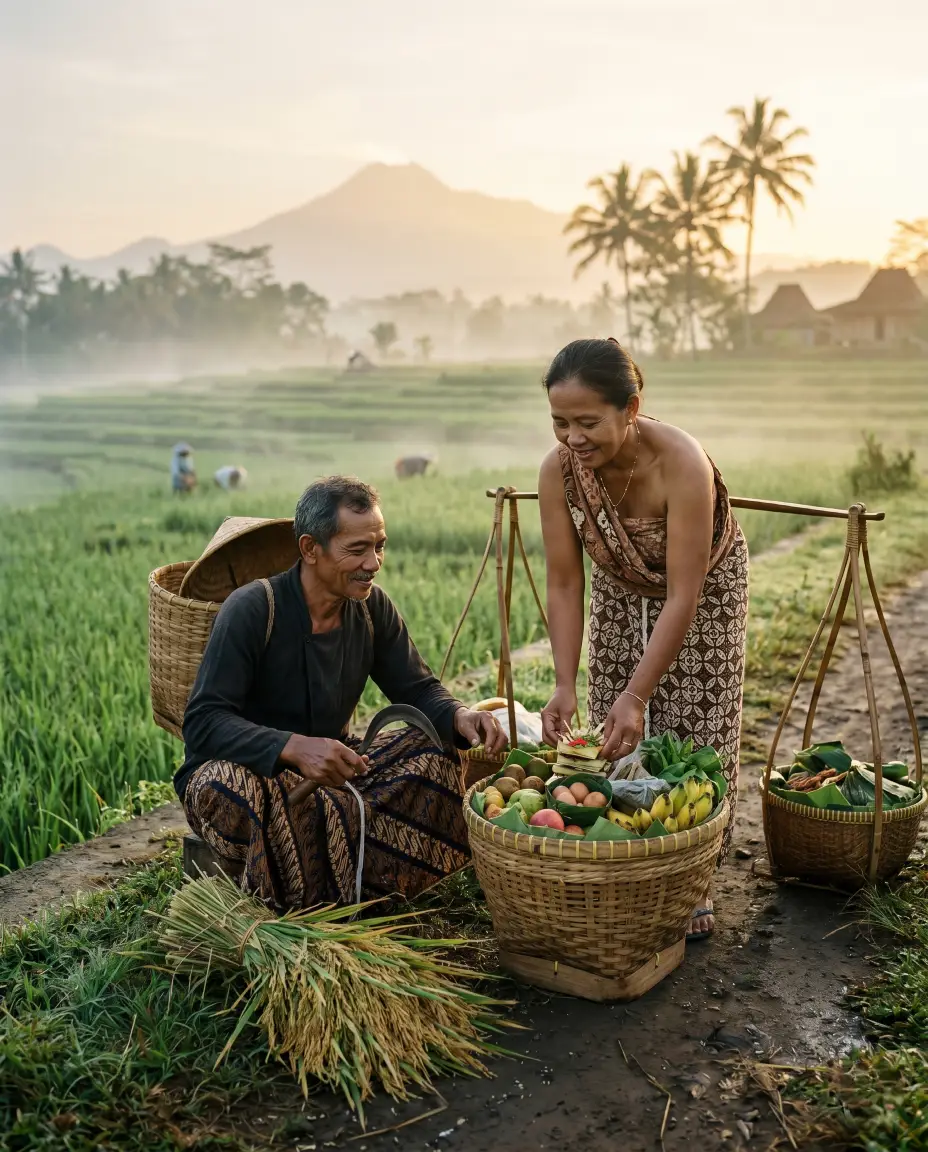
The Pattern of Rejeki: Readiness, Trust, and Consistency
Many people think rejeki comes only by luck. Sometimes there are indeed things we cannot fully explain. A meeting may look accidental. An opportunity may arrive suddenly. Yet when read more deeply, rejeki often follows a grounded pattern: readiness, trust, and consistency.
Readiness allows a person to receive opportunity when it comes. Without readiness, even a large opportunity can pass by. Trust makes others willing to entrust work, responsibility, or a chance. Consistency makes goodness visible not only once, but as a known way of conduct.
In work, this pattern is clear. Someone who is honest, neat, and dependable is easier to trust. In business, buyers return not only because the price is cheap, but because they feel respected. In relationships, someone who guards their words becomes easier to return to.
So rejeki is not only “waited for.” Its vessel is also prepared. That vessel is ability, honesty, discipline, enoughness, and relationships that are cared for.
Rasa Cukup Is Not the End of Effort
Rasa cukup, or the feeling of enoughness, is often misunderstood as a lack of ambition. As if someone who feels enough no longer wants to grow. This is mistaken. Rasa cukup is not the end of effort. It is the ability to keep the heart from being ruled by lack.
A person with rasa cukup may still work hard. They may still build a business. They may still improve life. The difference is that they do not make other people’s lives the only measurement of their own. They do not feel failed merely because someone else seems faster. They do not easily sell inner peace for temporary recognition.
Rasa cukup helps a person see life more clearly. It helps distinguish need from prestige, opportunity from trap, growth from greed dressed as ambition.
In an age of constant comparison, rasa cukup is an important practice. Not to reduce dreams, but so dreams do not become a hole that is never full.
Gratitude as a Way to Read What Has Arrived
Gratitude is not only a sentence spoken after receiving something. Gratitude is a way of reading life. A grateful person does not mean someone without problems. They are simply learning to see that even within difficulty, there may still be something to protect, learn from, or repair.
Gratitude keeps a person from becoming blind to what has already arrived. Health today is rejeki. The ability to work is rejeki. Someone who still prays for us is rejeki. A chance to repair a mistake is also rejeki.
But gratitude should never be used to silence pain. If there is a problem, it still needs to be addressed. If there is injustice, it still needs to be corrected. Gratitude is not pretending that everything is fine. Gratitude is the awareness that life is not made only of what is lacking.
This is close to eling lan waspada. Eling helps a person remember what matters. Waspada keeps the feeling of lack from dragging a person into careless decisions.
Sharing Without Turning It into a Transaction
In many traditions, sharing is often connected with the spaciousness of rejeki. This value is good when read clearly. But it can become mistaken if treated as a transaction: give so that more will surely return, help so that life immediately becomes smooth, or donate so every wish is quickly fulfilled.
Sharing should not be read as a machine of return. It is healthier to understand it as a practice of caring for relationships, softening the heart, and helping shared life. A person who shares recognizes that rejeki is not only for storage. There may be a part that can strengthen others.
Sharing also does not have to be large. It can be time, energy, attention, knowledge, food, or simply presence when someone needs support. What matters is not only the size of the gift, but sincerity and appropriateness.
In Javanese culture, shared life is close to gotong royong. When one person is helped, the surrounding life becomes stronger. When one family is lightened, the sense of guyub is also cared for. From here, rejeki is not only a private matter, but part of social relationship.

Rejeki in the Age of Algorithms and Anxiety
The modern world easily makes people feel left behind. Social media shows other people’s achievements every day. Algorithms push images of lifestyle, success, income, and status, often only from the outside. From there, the feeling of lack can grow quietly.
In this condition, reading rejeki becomes important. Rejeki should not be measured only by visible numbers. Not everything viral is good. Not everything that makes money quickly is safe. Not every opportunity that looks attractive is fitting for your life.
Rejeki in the digital age needs clarity. Do not rush into get-rich-quick schemes without understanding the risk. Do not sacrifice your good name for temporary profit. Do not compare your whole process with another person’s stage that you cannot see completely.
Read rejeki as a combination of effort, trust, quality, and calmness. If you build work, build it with integrity. If you build a business, care for quality. If you seek opportunity, understand the risk. Do not let anxiety become your compass.
Common Misunderstandings About Rejeki
There are several misunderstandings about rejeki that need to be cleared.
First, rejeki is often seen only as money. Money is one form, but not the only one. Health, time, good relationships, learning opportunities, and peace of mind are also part of rejeki.
Second, rejeki is sometimes treated as fully fixed so human beings no longer need to make effort. This can make people passive. Effort, responsibility, and the ability to protect trust remain important.
Third, rejeki is sometimes seen only as the result of personal hard work. This is also incomplete. Human life is always connected with help from others, prayer, environment, opportunity, and many things that cannot be fully controlled.
Fourth, rejeki is sometimes assumed to be guaranteed by a certain sign, date, ritual, or reading. In the JavaSense approach, culture may become a mirror, but it should not be turned into a promise of results. No cultural teaching should replace real work and careful consideration.
Fifth, sharing is sometimes treated as a guaranteed formula for getting more. This is risky. Sharing is noble, but it should not be reduced to a transaction.
Practical Ways to Arrange Rejeki Today
There are several simple practices to arrange the way we read rejeki.
First, write down three things that have arrived today. Not only money. It may be health, time, help, an idea, a small chance, or a moment of clarity. This practice helps the heart stop looking only at what is missing.
Second, tidy one part of your effort. It may be financial notes, a promise to a customer, work quality, study time, or communication with someone connected to your work.
Third, reduce one comparison. When you see another person’s achievement, do not immediately punish yourself. Ask: what lesson can I take without losing gratitude for my own path?
Fourth, choose one form of sharing. It does not need to be large. Help family, give time to listen, share knowledge, or support someone who is struggling.
Fifth, pause before making a money decision. If the decision is born from fear of missing out, envy, panic, or pressure, stop for a while. Good rejeki should not make the heart lose common sense.
Rejeki and Javanese Pitutur
Rejeki is close to many layers of Javanese pitutur, or life advice. It touches values such as eling, waspada, rukun, rasa cukup, effort, gratitude, restraint, and the ability to control emotion.
With eling, a person remembers that life is not only about chasing. With waspada, a person does not easily fall for risky shortcuts. With rukun, a person protects relationships because many doors of rejeki open through trust. With emotional discipline, a person does not make decisions while the inner life is hot.
Rejeki also reminds us that what is received today should not only be accumulated. It should be carried responsibly. The more a person receives, the more carefully they need to use, protect, and share it.
In this way, rejeki does not remain a word that creates anxiety. It becomes a doorway into reading life: what am I chasing, how am I chasing it, and can I still keep enoughness while walking?
JavaSense and a Clearer Way to Read Rejeki
JavaSense reads rejeki as cultural wisdom that needs to walk with common sense. It should not be used to frighten people. It should not become a promise of instant results. It should not be used to blame people who are struggling.
If you are struggling, do not immediately conclude that life is closed. Check the effort. Check the quality. Check the relationships. Check the habit. Check the decisions. Sometimes the door of rejeki is not gone; it is covered by a pattern that needs to be repaired.
If you want to explore Javanese letters and written heritage more easily, use the JavaSense Javanese script tool. If you want to connect this reflection with Javanese time and cultural rhythm, you may also open the JavaSense Javanese calendar.
As a broader public cultural reference, readers may also visit the National Library of Indonesia. References like this help cultural reflection stay connected to learning, not merely to scattered claims without direction.
Closing Reflection: Rejeki That Does Not Make the Heart Lose Direction
In the end, rejeki teaches balance. Make effort without forgetting gratitude. Receive without stopping growth. Chase without losing enoughness. Share without turning it into a transaction.
Angger, my child, do not read rejeki only from what enters the hand. Read it also from what grows inside the heart. Does life make you more honest? Does effort make you more responsible? Does enoughness make you calmer? Can what you have also strengthen others?
Good rejeki does not only increase what is in the wallet. It also increases clarity, responsibility, and the ability to care for life. When the heart is no longer enslaved by lack, a person can more easily see the path that may already be open.
To learn Javanese culture in a lighter and more modern way, you can download JavaSense on Google Play.
FAQ About Rejeki in Javanese Culture
What does rejeki mean in Javanese culture?
Rejeki in Javanese culture can be understood as a life provision that is not only money, but also health, opportunity, good relationships, knowledge, calmness, and trusted effort.
Is rejeki only about money?
No. Money is one form of rejeki, but it is not the only one. Time, health, family, trust, and the opportunity to improve life can also be part of rejeki.
What is the relationship between rejeki and effort?
Effort is an important part of rejeki. Rejeki is easier to care for when a person protects quality, honesty, consistency, responsibility, and trust.
Is rejeki already fully determined?
In cultural reflection, rejeki should not become an excuse for passivity. A person still needs to make effort, learn, care for relationships, and make wise decisions.
What does rasa cukup mean when reading rejeki?
Rasa cukup is the ability to be grateful for what has arrived while still improving life without being enslaved by envy, fear of lack, or status anxiety.
Does sharing guarantee more rejeki?
No result is guaranteed instantly. Sharing is better read as a practice of caring for relationships, softening the heart, and helping shared life, not as a transaction of return.
How should rejeki be understood in modern life?
Rejeki should be understood with common sense: know the risks, avoid get-rich-quick schemes, build quality, protect trust, and do not live only through comparison.
What is a simple practice for arranging rejeki?
A simple practice is to name what has already arrived, tidy one part of your effort, protect honesty, reduce comparison, share according to capacity, and pause before making money decisions.
Learn Rejeki with Clearer Awareness
Rejeki is not a fate label and not a promise of instant results. It is a mirror of effort, gratitude, enoughness, trust, and the practice of sharing. To explore Javanese script, calendar, weton, and daily heritage in a simpler way, open JavaSense on Google Play.