


Angger, my child…
Some people sit in a quiet place, yet their thoughts remain loud. Some people stand in the middle of responsibility, family, and work, yet their inner life remains calm. From here we learn that hening is not only the absence of sound. It is a clearer state of the heart.
Ky Tutur Summary
- Hening is not merely silence, solitude, or being far from noise.
- In Javanese rasa, hening can be read as an inner space for clearing the mind, arranging rasa, and seeing life more calmly.
- This practice does not belong only to ascetics. It can be trained through small pauses in ordinary daily life.
- Its value is close to eling lan waspada, caring for the inner self, tirakat, and the ability to keep the heart from becoming cloudy.
Ky Tutur Note: This article discusses hening as Javanese cultural wisdom and life reflection. It is not medical advice, psychological treatment, or professional therapy. If inner pressure feels heavy, anxiety becomes disruptive, depression appears, or there are thoughts of self-harm, seek safe and qualified professional help.
Hening is the state in which the inner life begins to become clear. The mind is no longer completely ruled by noise, and rasa has enough space to see life more gently. It is different from mere silence. Silence can happen outside the self, while the heart remains restless. Hening grows from within: from the ability to pause, listen to oneself, and not react too quickly to every stimulus.
In modern life, many people search for calm by removing outer noise. The television is turned off. The door is closed. Notifications are muted. These actions can help, but they are not always enough. Sometimes after the outside becomes quiet, another noise becomes clearer: racing thoughts, unfinished worries, old regret, hidden anger, and desires pulling the heart in different directions.
That is why hening should be read as a practice of arranging the inner life. It is not an escape from the world. It is a short return to oneself, so when a person faces the world again, they do not carry a clouded heart.
What Does Hening Mean?
In simple language, hening means quiet, clear, still, and not noisy. But in inner practice, its meaning is wider than silence. A person can be silent because of fear, anger, exhaustion, or confusion. That is not always hening. Hening appears when silence opens a space for clarity instead of pressure.
In Javanese culture, this quality is close to sareh, menepi, semedi, tirakat, and eling. These words do not need to be understood in a heavy or frightening way. Their simple center is the ability to avoid being fully controlled by outer noise or by the noise of one’s own thoughts.
Hening helps a person see what truly matters and what is only noise. Which wound needs care. Which ego needs to be softened. Which decision needs to wait. Which small step should be taken today.
Hening Is Not Just Silence
Silence is often an outer condition. Hening is an inner condition. They may meet, but they are not the same. A house can be silent while the person inside is anxious. A room can be closed while the mind is loud. Someone can walk alone while carrying many unfinished conversations in the heart.
On the other hand, someone may live among work, family, and responsibility while still keeping a clear inner room. They do not panic easily. They are not quickly provoked. Not every comment enters the heart. Not every piece of news immediately steals their direction.
This is why hening matters. It does not turn life off. It helps life become more ordered. It does not erase sound. It helps us avoid being ruled by every sound.
Hening in Javanese Culture
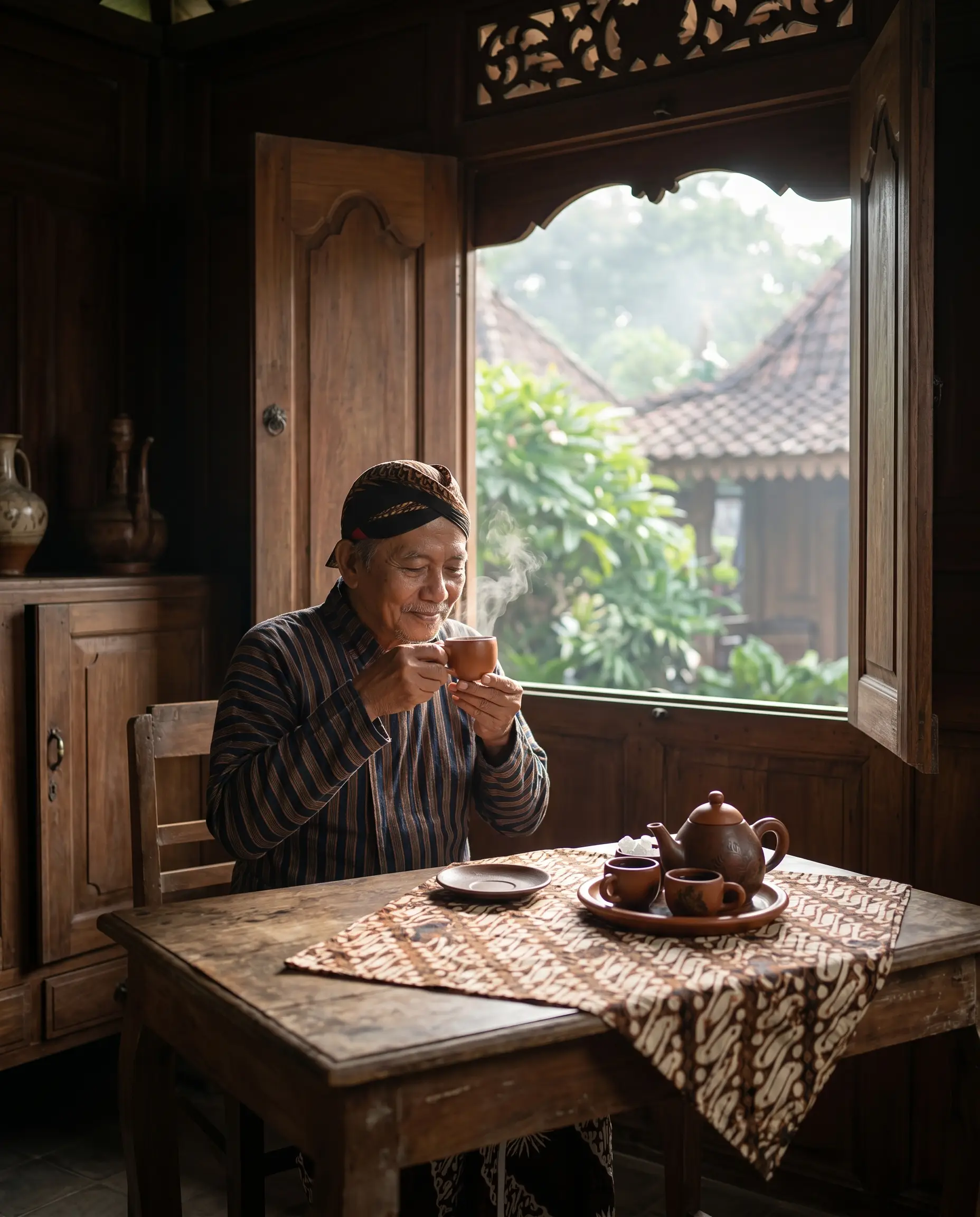
In Javanese rasa, a person is not always asked to answer life in a hurry. There is space to step aside, arrange the breath, weigh rasa, and read the situation before acting. Practices such as semedi, tapa, and tirakat often contain the element of pause: reducing outer disturbance so the inner condition can be seen more clearly.
But, my child, we need to be careful. Speaking about old practices does not mean forcing modern people to imitate every form literally. What needs to be carried is the essence: there are moments when human beings need to stop briefly from noise, so life is not driven only by sudden impulse.
In modern life, hening can appear without going to a cave or mountain peak. It can appear at a work desk before replying to a message. In the morning before opening a device. In the middle of a conversation before speaking a sharp sentence. At night before closing the day with a heart that is still tangled.
7 Practices of Hening for Inner Clarity
Good pitutur needs to become conduct. Hening is not only something to admire as a word. It needs to be trained through small, repeatable steps.
1. Step Away from Noise for a Moment
The first step is creating distance from unnecessary noise. This does not mean hating crowds or rejecting the world. It simply means the inner life needs a chance not to be constantly filled with news, comments, demands, and stimulation.
Begin small. Five minutes without a device after waking up. One meal without opening a screen. A few breaths before starting work. Small pauses like these may look simple, but they often become the first doorway to seeing oneself more clearly.
2. Arrange the Breath Before Reacting
When the heart becomes heated, the breath often changes. It becomes short, fast, and uneven. Before replying to a message, raising your voice, or making an important decision while emotion is rising, stop for a moment.
Breathe slowly. Feel the body. Let a small pause work. In that pause, the inner self has a chance to hold the steering wheel again. This is close to eling lan waspada: being aware of the self and careful toward the consequences of speech and action.
3. Reduce Unnecessary Voices
Not every voice needs to enter the heart. Not every comment needs to be read. Not every debate needs to be followed. Not every argument needs to be won. One form of hening is choosing which voices deserve space.
This is not closing oneself from the world. It is guarding the door. A house with every door open and no guard can be entered by anything. The inner life is similar. It needs openness, but it also needs boundaries.
4. Observe Thoughts Without Being Carried Away
When the outer world becomes quieter, the mind often appears louder. It brings memory, worry, plans, judgment, and desire. Do not rush to fight all of it. Learn to observe.
Imagine sitting beside a river. Thoughts come like leaves floating on water. Some are small. Some are heavy. Some move quickly. Your task is not to jump after every leaf. Your task is to see that they are passing.
From here, a person learns that not every thought must be believed. Not every feeling must be followed. Some are only asking to be seen, named, and allowed to pass.
5. Clear Rasa Before Deciding
Many decisions become heavy because they are made while the heart is cloudy. When angry, everything looks wrong. When afraid, everything looks dangerous. When disappointed, everything looks unfair. Before taking an important step, clear the rasa first.
Hening gives space to ask: is this decision born from wisdom, or only from a wound that wants to answer quickly? Am I choosing a path, or running away? Am I speaking to repair the situation, or only to release what burns inside?
6. Write or Read as a Quiet Practice
In Javanese tradition, writing, script, and song can become ways to arrange rasa. In modern life, begin simply: write one paragraph about your inner condition today.
It does not need to be beautiful. It does not need to be shown to anyone. Let it be honest. “Today I am tired.” “Today I feel jealous.” “Today I am afraid.” When rasa receives words, it often becomes easier to understand.
If you want to practice through a cultural doorway, you can explore the JavaSense Javanese script tool. Slow strokes and careful attention can become a small practice of calmness.
7. Close the Day with Awareness
A day that is not closed can follow a person into sleep. Work problems enter the bed. A painful conversation keeps turning in the head. Guilt follows until morning.
Before sleeping, take a small moment. Ask three questions: what should I be grateful for today, what should I repair, and what should I release until tomorrow? This is a small inner closing: a sign that one chapter of the day is placed down more neatly.
Hening, Eling lan Waspada, and Caring for the Inner Self
Hening does not stand alone. It is close to many other Javanese teachings. Through eling lan waspada, a person learns to be aware of the inner condition and careful toward sudden impulses. Through caring for the inner self, a person learns to tend rasa without spoiling the self.
Hening also supports tepa slira. A person whose inner life is too noisy often struggles to understand another person’s feeling. They conclude too quickly, interrupt too easily, and take offense too fast. When the inner life becomes clearer, empathy has more room to grow.
In tirakat, hening becomes a space for not immediately obeying every desire. In narima ing pandum, it helps human beings accept reality without losing strength. In daily conduct, it becomes a small lantern that keeps the heart from becoming too dark.
Hening in Modern Life
The modern age makes human beings feel that they must always be connected. Always replying. Always knowing the newest news. Always filling empty time. A pause is often treated as if it were a failure, while constant busyness is praised as progress.
But the human inner life was not made to receive endless stimulation without rest. The mind needs space. Rasa needs air. The heart needs time to settle before choosing words, making decisions, or carrying another responsibility.
Hening in this age does not mean being anti-technology. It means using technology with awareness. Choosing when to open, when to close, when to respond, and when to let a message wait so the heart does not answer while cloudy.

Empty space is not always an enemy. Sometimes it is the place where thoughts settle. It is where tangled rasa begins to loosen. It is where human beings can hear the small voice that has been covered by too much noise.
JavaSense and a Clearer Way to Read Javanese Pitutur
JavaSense reads Javanese culture as a mirror, not a verdict. Weton, the Javanese calendar, script, primbon, and pitutur should not make human beings afraid. They should help people become more aware, more ordered, and more responsible in living.
If you want to read the rhythm of days in Javanese tradition, open the JavaSense Javanese calendar. If you want to understand weton as cultural reflection, use the JavaSense weton calculator wisely. If you want to explore written heritage, try the JavaSense Javanese script tool.
As a broader public cultural reference, readers may also visit the National Library of Indonesia. References like this help cultural reading stay connected with learning and public knowledge.
All of these should be used as doors of learning, not tools for judging oneself or others. Healthy culture makes human beings clearer, not more afraid.
Closing Reflection: A Space for Clarity
In the end, hening is a space for clarity. Clarity in seeing oneself. Clarity in reading rasa. Clarity in weighing decisions. Clarity in separating which voice should be heard and which voice can pass like wind.
Angger, my child, life will never become completely silent. The world will still make sound. Responsibility will still come. Other people will still have opinions. Problems will still knock on the door. But when there is a space of hening inside, a person does not easily lose direction.
So care for that space. Do not let everything enter without a filter. Do not let every comment become a wound. Do not let every desire become an order. Sit for a moment. Breathe. Listen inwardly. Clear the way of seeing.
To learn Javanese culture in a lighter and more modern way, you can download JavaSense on Google Play.
FAQ About Hening
What does hening mean?
Hening means quiet and clear. In inner practice, it is not only the absence of sound, but a state where the mind and rasa have space to become clearer.
What is the difference between hening and silence?
Silence is closer to an outer condition without noise, while hening is closer to an inner condition of clarity. A person can be in a silent place while the heart remains noisy.
What does hening mean in Javanese culture?
In Javanese culture, hening can be read as a practice of arranging rasa, stepping aside from noise for a moment, and returning to awareness before acting.
How can I practice hening in daily life?
Begin with small pauses: arrange the breath, reduce unnecessary voices, observe thoughts without being carried away, write the inner condition, and close the day with awareness.
Does hening mean escaping from the world?
No. Hening is not escaping from the world. It is a way of returning to oneself so a person can face the world with more clarity, calmness, and responsibility.
How is hening connected with eling lan waspada?
Hening gives space for eling lan waspada. When the inner life is calmer, a person can become more aware of themselves and more careful about the effects of words and actions.
Why is hening important in modern life?
Hening is important because modern life is full of notifications, demands, and stimulation. Without pause, human beings easily become reactive, tired inside, and distant from their own needs.
Is hening part of Javanese pitutur?
Hening can be read as part of Javanese inner conduct. Its values are close to sareh, eling, waspada, tirakat, and the ability to arrange rasa before acting.
Learn Javanese Pitutur with Clearer Awareness
Hening is not merely silence. It is a space for clarity: where thoughts settle, rasa is arranged, and the next step is chosen with more awareness. To explore weton, the Javanese calendar, script, and cultural heritage more easily, open JavaSense on Google Play.