
Angger, my child…
There is a kind of togetherness that looks crowded on the outside, yet feels empty within. There is also a togetherness that may not be loud, but feels warm because the people inside it know how to care for one another. In Javanese culture, this living sense of togetherness is called guyub.
Ky Tutur Summary
- Guyub is a Javanese practice of togetherness that grows from mutual belonging, mutual care, and the willingness to hold back ego for the sake of rukun.
- Guyub is not merely gathering, being crowded, working together, or repeating a cultural slogan. It needs to live as feeling, intention, and social responsibility.
- Guyub is closely connected with rukun, gotong royong, tepa slira, ngajeni, and the ability to hear differences without immediately breaking the relationship.
- In JavaSense, guyub is read as social wisdom that remains relevant for family, neighbors, community, workplace, and digital spaces today.
Ky Tutur Note: This article discusses guyub as Javanese cultural heritage and reflective guidance. Guyub is not a tool to force agreement, not an excuse to silence differences, and not a duty to sacrifice oneself without limits. Healthy guyub still needs honesty, personal boundaries, and mutual respect.
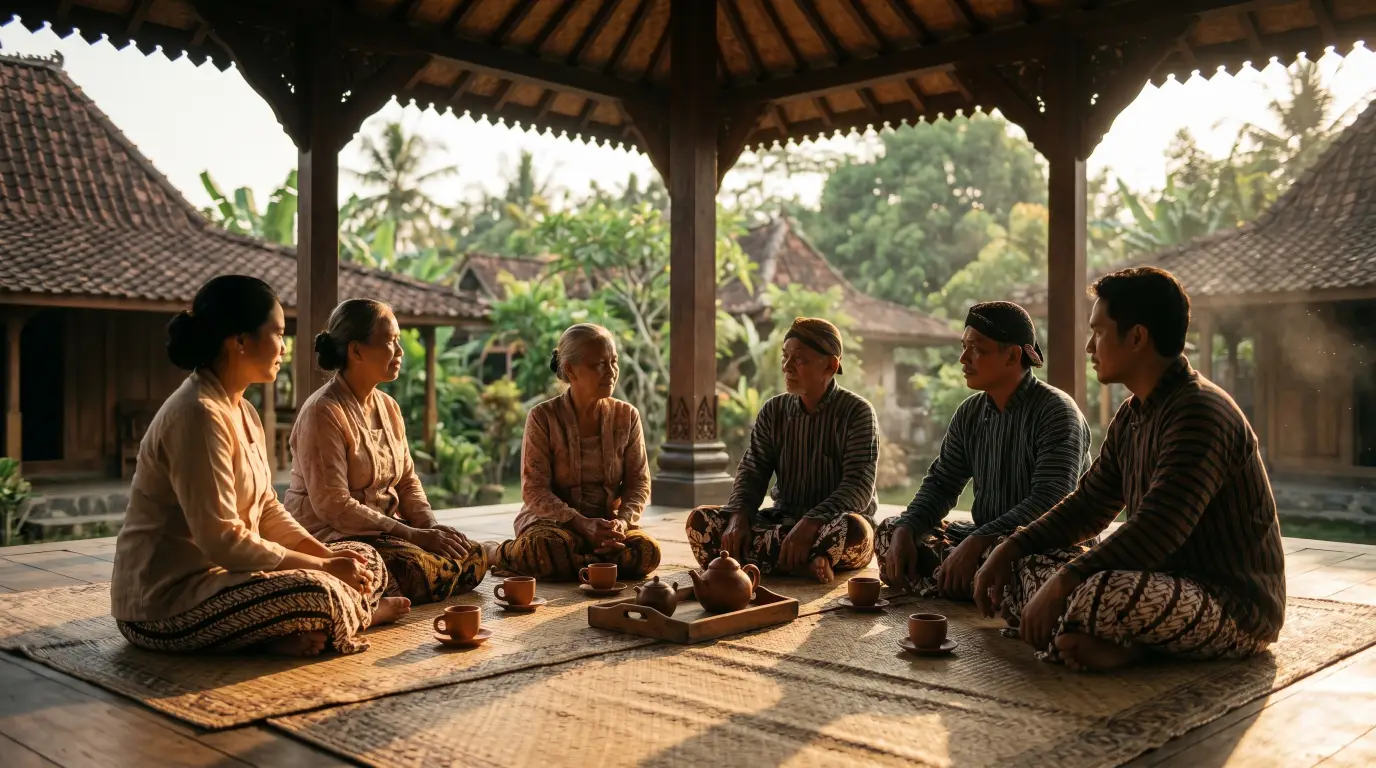
Guyub is often understood as a warm, familiar, and communal atmosphere. When people gather, help at a family event, join community work, or sit in one circle, it is easy to call the scene guyub. That understanding is not wrong, but it is not complete.
In Javanese rasa, guyub is deeper than simply being together. Guyub is the condition where human beings feel part of a shared life. There is a sense of belonging. There is a willingness to help without always counting gain and loss. There is also the ability to hold back ego so relationships do not break too easily.
So, my child, guyub is not measured only by how many people are present. Guyub appears in how people listen, care, and do not leave one another when life becomes difficult. This is the social strength of guyub: not as something mystical, but as a grounded form of togetherness that makes life stronger.
What Is Guyub in Javanese Culture?
Guyub in Javanese culture can be understood as a warm condition of togetherness, harmony, and shared belonging. People who are guyub are not only physically present. They also bring a heart that wants to care for the relationship.
In everyday Javanese speech, guyub often appears close to the word rukun. The two are related. Rukun emphasizes peaceful and well-arranged relations, while guyub emphasizes the warmth of togetherness. If rukun is the harmony being protected, guyub is the social energy that makes that harmony feel alive.
Guyub is also close to gotong royong. Yet gotong royong is more visible as shared action, while guyub touches the feeling behind that action. People can work together because they are forced to. But when shared work grows from mutual care and belonging, guyub begins to appear.
In the JavaSense reading, guyub is not merely a term. It is a cultural mirror. From this word, we may ask: am I still able to care? Am I still willing to listen? Do I only want to win for myself, or am I still willing to protect the relationship?
Guyub Is More Than Gathering
One common misunderstanding is treating guyub as the same as gathering. Yet not every gathering is guyub. People can sit in the same room while their hearts are full of suspicion. People can work together while each person only calculates personal interest. People can look united from the outside while quietly storing wounds that are never discussed.
Guyub needs rasa. Without rasa, togetherness becomes only a crowd. Without honesty, guyub becomes only an appearance. Without mutual respect, guyub can turn into social pressure.
That is why guyub should not be measured only by the number of people. What matters more is the quality of relationship inside it. Is there room to listen? Is there willingness to help someone in difficulty? Is there courage to apologize when wrong? Can differences still be discussed without immediately cutting the bond?
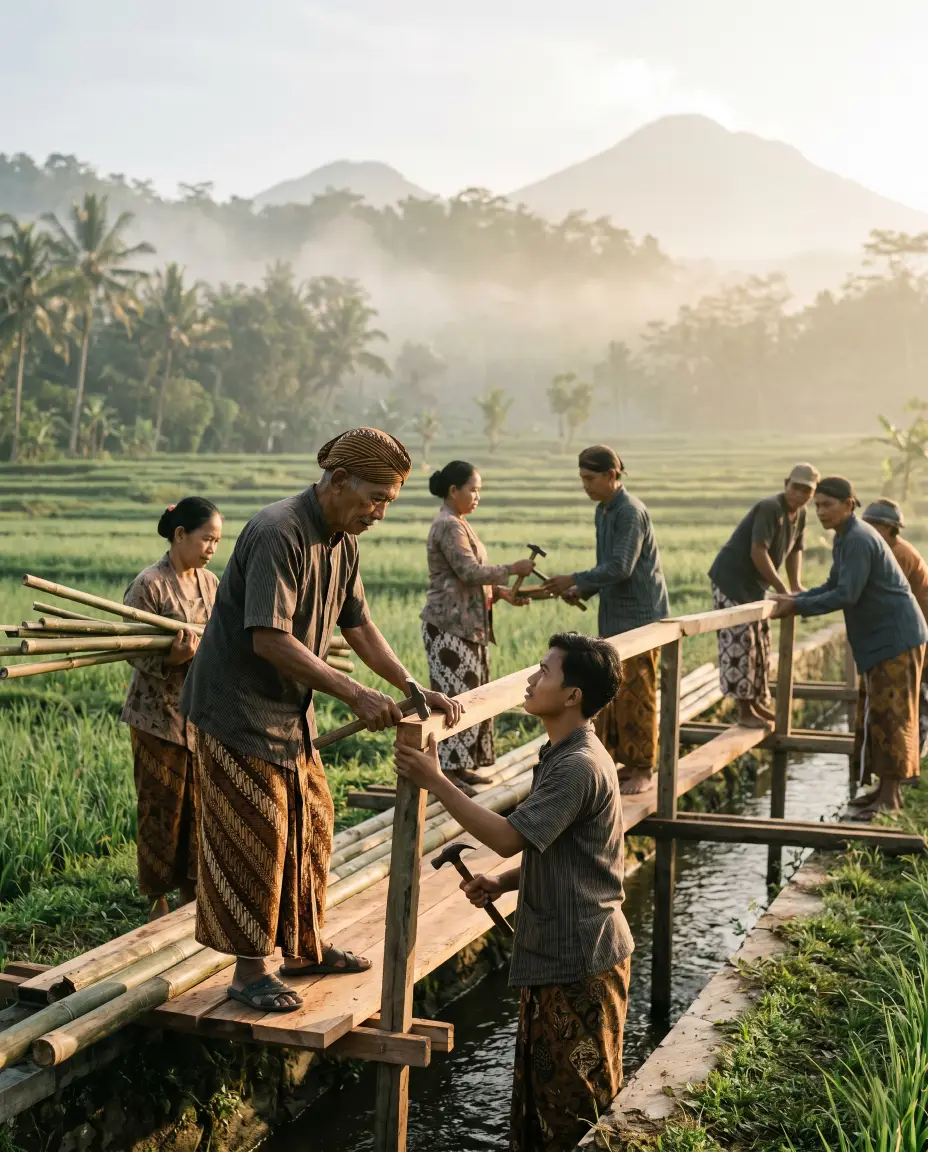
Mature guyub is not always noisy. Sometimes it appears in small actions: a neighbor who comes to help without being asked, a family that sits and listens patiently, a friend who does not leave when we fall, or a community that fixes a problem without humiliating one another.
Guyub, Rukun, and Mutual Belonging
Guyub is very close to rukun. Rukun does not mean everyone must be the same, never disagree, or remain silent all the time. Healthy rukun is the ability to protect relationships while still giving space for honesty.
In Javanese life, mutual belonging is an important foundation. When a neighbor faces hardship, others move. When there is a family event, many hands help. When there is a shared problem, people gather to find a path. This does not happen only because of written rules. It grows from handarbeni: the feeling of belonging and shared responsibility.
Mutual belonging keeps people from leaving their community too easily. A person realizes that life does not stand alone. The road used together needs to be cared for. The relationship that supports life needs to be protected. Those who once helped should not be forgotten.
Yet this sense of belonging also needs wisdom. Guyub should not become excessive interference. Rukun should not become pressure that forbids personal boundaries. Healthy guyub still respects each person’s space.
Gotong Royong as a Living Form of Guyub
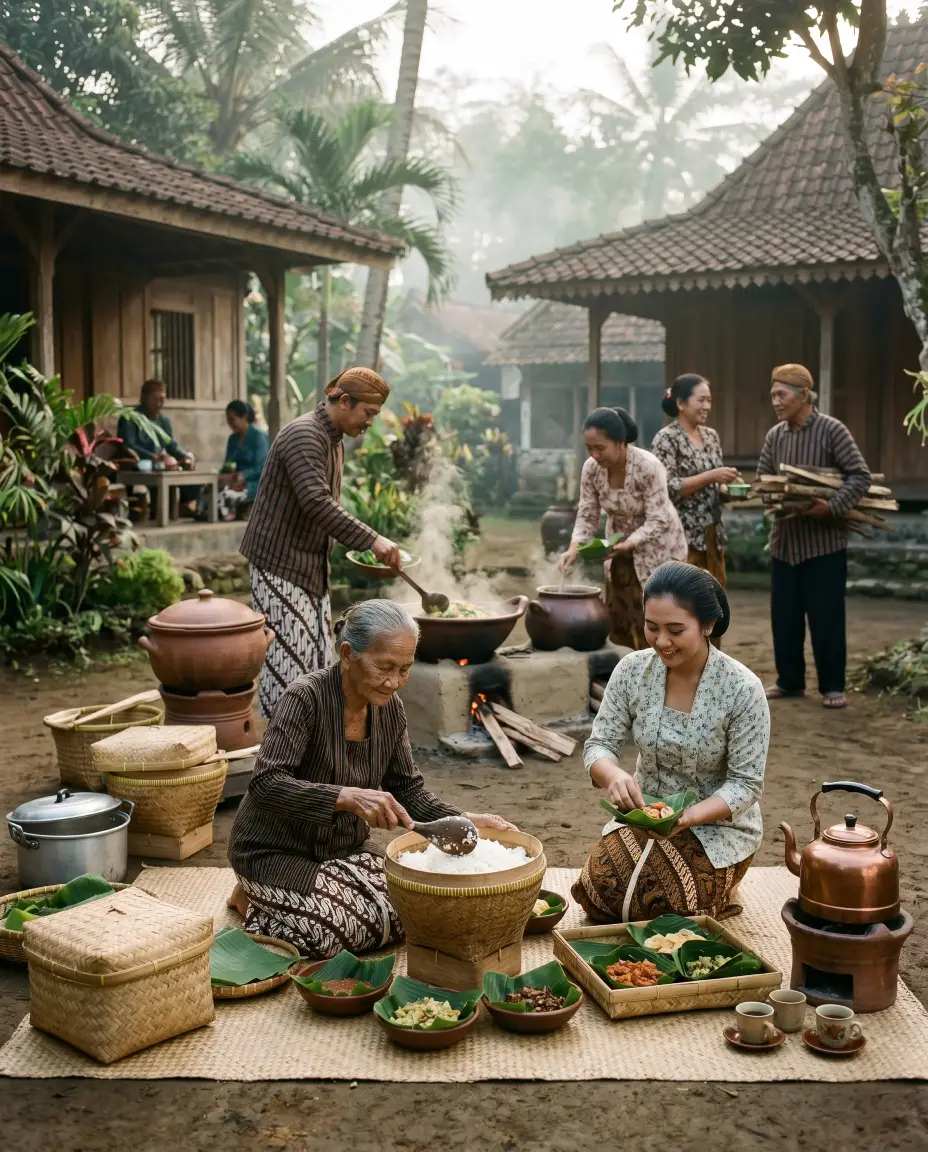
Gotong royong is one of the clearest living forms of guyub. When people build a house together, repair a road, clean the environment, help during a family event, or support a household struck by misfortune, guyub moves into action.
But living gotong royong does not stop at physical labor. It also carries rasa. People come not only because they are afraid of being judged, but because they understand that shared life needs mutual help. Today we help others. Tomorrow, perhaps we are the ones being helped.
Through gotong royong, people learn that heavy work becomes lighter when carried together. A large burden becomes easier when many hands help hold it. Yet the deeper result is not only the completed work. It is the bond that grows afterward.
People who have worked together often understand one another more easily. There is conversation, laughter, waiting for one another, and learning each person’s capacity. From there, gotong royong does not only finish a task. It also cares for the relationship.
Tepa Slira in the Practice of Guyub
Guyub cannot last without tepa slira. Tepa slira is the ability to consider another person’s feelings. If we do not want to be looked down on, we should not look down on others. If we want to be heard, we should learn to listen. If we want help when life is difficult, we should not close our eyes when another person needs support.
In the practice of guyub, tepa slira helps a person think beyond the self. It asks: does my attitude hurt someone else? Does my way of speaking make the room hotter? Am I demanding too much while forgetting to understand another person’s condition?
Tepa slira also keeps guyub from becoming pressure. Not everyone has the same strength. Some can help with labor. Some can help with time. Some can help with thought. Some are weak at the moment and can only be present briefly. Healthy guyub understands these differences.
With tepa slira, togetherness becomes more humane. A person is not only used for their energy, but also respected in their condition.
Healthy Guyub Does Not Silence Difference
This must be said clearly, my child. Guyub does not mean everyone must agree. Guyub does not mean differences must be hidden. Guyub is also not an excuse to silence criticism only so everything looks harmonious from the outside.
In many communities, the words rukun or guyub can be misused. A person who speaks about a problem may be seen as disturbing togetherness. A person with a different opinion may be called disloyal. A person who protects a boundary may be judged as uncaring. Yet healthy guyub is exactly the kind of togetherness that can hold honest conversation.
Difference does not always destroy. What destroys is handling difference without rasa. If an opinion is expressed with insult, the relationship breaks. If criticism is delivered to humiliate, trust disappears. But if difference is discussed with respect, a community can become more mature.
Healthy guyub gives room for musyawarah, or deliberation. Not everything needs to be about winning. Not everything needs to be about losing. What is sought is a path that protects shared dignity.
Guyub in the Digital Age
In the digital age, guyub faces a new form. We may not always gather in a pendopo, village hall, or front yard. Much togetherness now happens in messaging groups, online communities, comment sections, and other digital spaces.
The form may change, but the spirit remains. Digital guyub means using digital space to strengthen one another, not to bring one another down. It means sharing reliable information, not spreading unclear news. It means giving support, not humiliating. It means reminding others kindly, not attacking.
Digital spaces often make people react too quickly. One comment can trigger a long quarrel. One unclear piece of news can divide a relationship. One sarcastic line can make a community tense. That is why guyub in the digital age needs a pause.
Before sending a message, ask quietly: is this necessary? Is it true? Does it help? Does the way I say it protect rasa? If not, perhaps silence for a moment is also part of guyub.
Common Misunderstandings About Guyub
There are several misunderstandings about guyub that need to be cleared.
First, guyub is often treated as the same as being crowded. But a crowd can be empty of rasa. Guyub is deeper than many people simply gathering in one place.
Second, guyub is sometimes understood as always agreeing. This is mistaken. Mature guyub can hold differences in a way that does not destroy the relationship.
Third, guyub can be misused to pressure people into having no boundaries. Healthy togetherness still respects each person’s capacity, condition, and private space.
Fourth, guyub is often imagined as something that belongs only to villages or the past. In truth, guyub remains relevant in modern families, workplaces, creative communities, organizations, and digital spaces.
Fifth, guyub can become a slogan. The word is pleasant to say, but difficult to live if ego is still too large. That is why guyub must become laku: listening, helping, holding back, and caring for rasa.
Practical Ways to Care for Guyub Today
There are several simple practices for caring for guyub.
First, listen before answering. Many relationships are damaged not because the problem is too large, but because people reply too quickly without truly hearing.
Second, help according to capacity. Guyub does not always ask for a large act. Sometimes it is enough to be present, send a message, give time, or help one small part that can truly be done.
Third, guard speech. Harsh words can damage trust that has been built for a long time. If correction is needed, correct without humiliating.
Fourth, do not spread unclear news. In a community, gossip can damage guyub faster than honest disagreement.
Fifth, give room for personal boundaries. Not everyone can be present every time. Not everyone has the same strength to carry burdens. Healthy guyub does not force people to give until they are empty.
Sixth, care for musyawarah. When there is a problem, discuss it with the intention to repair, not merely to find who is most at fault.
A Brief Javanese Glossary
- Guyub: A warm sense of togetherness rooted in mutual belonging, care, and shared responsibility.
- Rukun: Social harmony, peaceful relationship, and the effort to protect togetherness without erasing honesty.
- Gotong royong: Shared work and mutual help, often seen as a living expression of guyub.
- Tepa slira: The practice of considering another person’s feelings and condition.
- Ngajeni: To respect, honor, and treat another person with dignity.
- Handarbeni: A sense of belonging and shared responsibility toward something or someone.
- Rasa: Inner feeling, sensitivity, and refined awareness in Javanese thought.
- Laku: Conduct, practice, or a lived path of discipline and awareness.
- Musyawarah: Deliberation or collective discussion to seek a better shared path.
- Aja dumeh: A reminder not to misuse power, status, closeness, or advantage to look down on others.
JavaSense and a Clearer Way to Read Guyub
JavaSense reads guyub as cultural heritage that needs to be kept alive with clear judgment. It should not become an empty slogan. It should not be used to force people into silence. Good guyub should make relationships healthier, not make wounds stay hidden.
The essence is simple: caring for one another, listening, daring to deliberate, holding back ego, and not leaving others when circumstances become difficult. That is the grounded meaning of guyub as social care.
If you want to explore Javanese letters and written heritage more easily, use the JavaSense Javanese script tool. As broader public cultural references, readers may also visit the National Library of Indonesia and the Indonesian Ministry of Culture archive. References like these help cultural reflection stay connected to learning and public knowledge.
Closing Reflection: Guyub That Lives in Rasa
In the end, guyub is not only a beautiful word. It is a practice that must be cared for. Guyub lives when people are willing to listen, help, hold back ego, guard speech, and not leave one another too easily.
Angger, my child, do not read guyub only as gathering. Read it as a gentle but strong social practice. In guyub, human beings learn that life is not only about I, mine, and my interest. There is we. There is shared rasa. There is a responsibility to keep relationships worthy of being lived in.
In an age that often makes people feel alone, guyub reminds us that togetherness can still be cared for. Not togetherness that forces, but togetherness that strengthens. Not rukun that silences, but rukun that gives room for honesty.
To learn Javanese culture in a lighter and more modern way, you can download JavaSense on Google Play.
FAQ About Guyub in Javanese Culture
What does guyub mean in Javanese culture?
Guyub in Javanese culture means warm togetherness, rukun, and mutual care. It is not only gathering, but also the presence of shared belonging and social responsibility.
Is guyub the same as simply gathering?
No. Gathering only means people are in the same place. Guyub goes deeper because it involves rasa, good intention, listening, and the willingness to protect relationships.
What is the relationship between guyub and rukun?
Guyub and rukun are closely connected. Rukun is the peaceful relationship being protected, while guyub is the warm togetherness that makes the relationship feel alive and supportive.
Is guyub the same as gotong royong?
Not exactly. Gotong royong is shared work and mutual help, while guyub is the feeling of togetherness behind that action. Sincere gotong royong often grows from guyub.
How can guyub stay healthy without silencing differences?
Healthy guyub gives room for deliberation, respectful criticism, and personal boundaries. Differences do not need to be silenced, but discussed with respect and care.
What is an example of guyub in modern life?
Examples include helping neighbors, keeping community groups healthy, not spreading unclear news, listening before judging, and supporting one another in digital spaces.
Why is guyub important for social life?
Guyub is important because it strengthens relationships, helps communities endure difficulty, and reminds people that they do not have to walk through life alone.
How can we care for guyub in family and community?
We can care for guyub by guarding speech, helping according to capacity, respecting boundaries, discussing problems with good intention, and not letting ego damage shared relationships.
Learn Guyub with Clearer Awareness
Guyub is not merely a crowd. It is the practice of rukun, tepa slira, gotong royong, and mutual care. To explore Javanese script, culture, weton, and daily heritage in a simpler way, open JavaSense on Google Play.