

Angger, my child…
There are people who know how to calm others, yet do not know how to calm themselves. There are people who are gentle toward everyone else, yet harsh toward their own inner life. There are people who become a place of return for many, but when night arrives, they do not know where to return within themselves.
Ky Tutur Summary
- Ngemong diri can be understood as Javanese self-nurturing: caring for rasa, recognizing tiredness, and guiding the inner self with patience.
- This practice is close to the meaning of ngemong: nurturing, guiding, protecting, and caring without inner violence.
- Ngemong diri is not self-indulgence, not running away from responsibility, and not justifying every desire.
- In Javanese reflection, this practice is connected with eling lan waspada, tepa slira, sumeleh, and the ability to keep healthy boundaries.
Ky Tutur Note: This article discusses ngemong diri as cultural reflection and life guidance. It is not medical advice, psychological advice, or professional therapy. If you are experiencing severe emotional distress, intense anxiety, depression, or any urge to harm yourself, please seek safe and trusted professional support immediately.
Ngemong diri is a way of caring for the self from within: recognizing the rasa that is present, giving room to tiredness, arranging anger, accepting disappointment, and choosing the next step with more awareness. In Javanese rasa, this practice is close to the word ngemong, which means to nurture, guide, protect, serve, and care.
When we speak of ngemong in ordinary life, we may imagine caring for a child, guiding a student, protecting a family member, or patiently accompanying someone we love. But ngemong diri turns the direction inward. The one being cared for is not only another person. The one being guided is also the inner self.
Many people grow up being taught to be strong. Do not cry. Do not complain. Do not look weak. Do not become a burden. Such teachings may create endurance, but without tenderness they can make the inner life hard. A person may look strong outside, while inside there is a wound that has never been allowed to sit and breathe.
This is where ngemong diri becomes important. It is not an invitation to worship the self. It is not an excuse to abandon duty. It is a quiet path: treating the self as something entrusted to us, not as a tool that may be forced endlessly until all its strength is gone.
What Does Ngemong Diri Mean?
In simple terms, ngemong diri means caring for the inner world with awareness. When tiredness appears, we recognize tiredness. When disappointment appears, we recognize disappointment. When anger rises, we do not immediately throw that fire at other people. When failure happens, we do not turn failure into a hammer to strike our own worth.
This practice does not mean every feeling must be followed. It means recognizing feelings without being ruled by them. Anger may appear, but it does not have to become violence. Sadness may come, but it does not have to become surrender without effort. Fear may be felt, but it does not have to lead the whole path.
In simpler words, ngemong diri is the ability to say to oneself, “I am not okay right now, but I will not abandon myself.” This sentence sounds quiet, but it can become the first doorway toward healing and clearer conduct.
In the JavaSense reading, ngemong diri is a cultural mirror. It asks: how do I speak to myself when I fail? Do I listen to tiredness before it becomes collapse? Do I know my boundary? Can I care for others without turning myself empty?
Inner Care Is Not Self-Indulgence
This part needs to be made clear. Ngemong diri is not the same as self-indulgence. Self-indulgence often follows momentary desire even when life becomes more scattered afterward. Inner care asks something deeper: what does my rasa truly need so it can return to clarity?
Self-indulgence may say, “I am stressed, so I may run away from every responsibility.” Inner care says, “I am stressed, so I need to pause, breathe, and arrange a step I can still carry responsibly.”
Self-indulgence may avoid the problem. Ngemong diri helps a person return to life with more complete strength. That is the difference. One numbs. The other guides. One feeds impulse. The other restores direction.
This is why ngemong diri should not become a soft excuse for neglecting duties. It should also not become harsh discipline that ignores feeling. The middle path is clearer: be gentle toward the inner self, but remain honest toward responsibility.
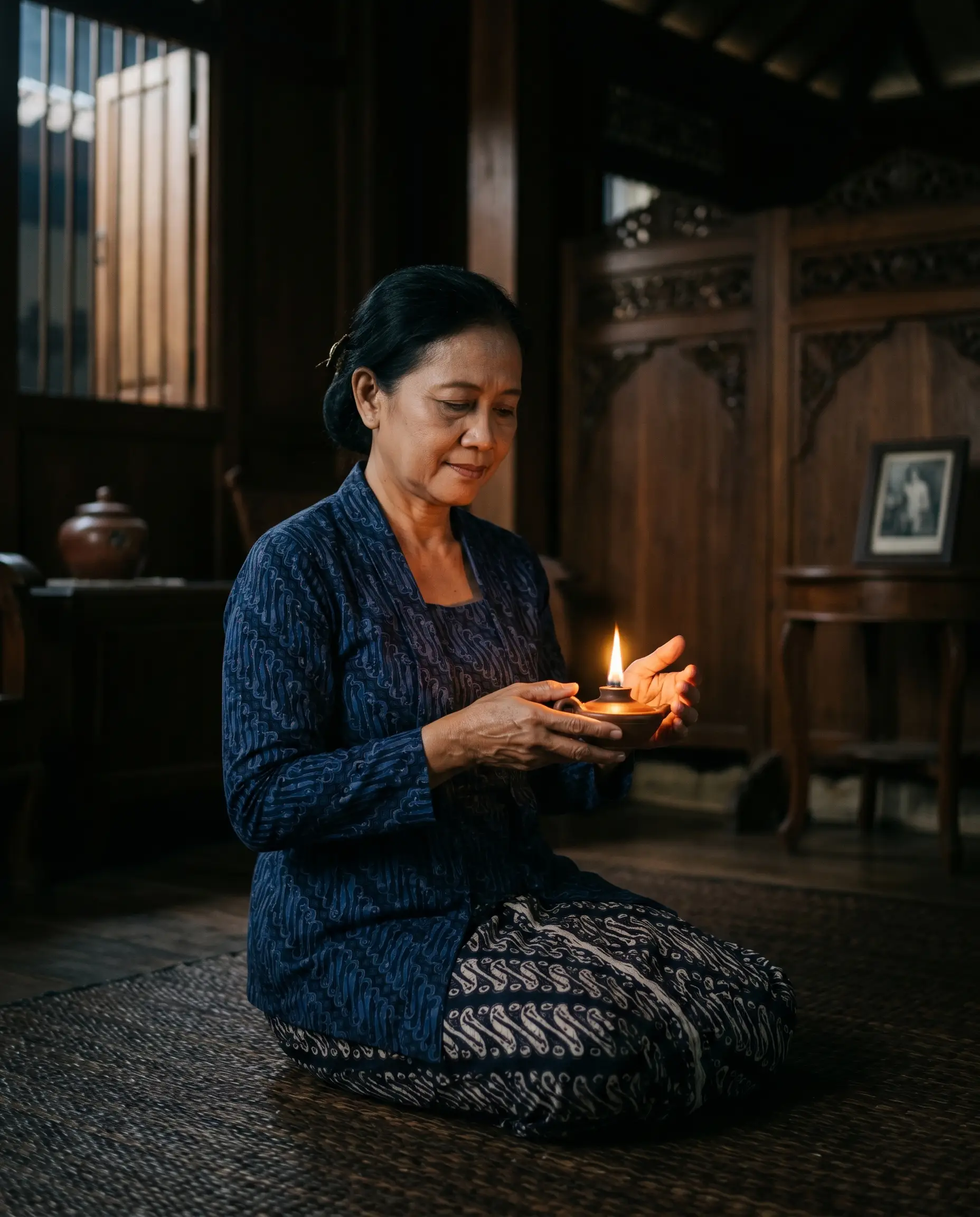
Caring for the Inner Self When Tired
Tiredness is a sign. It is not an enemy. A tired body is giving news that its energy needs to be restored. A tired inner life is giving news that something has been carried alone for too long. Yet many people respond to tiredness with guilt, as if rest is weakness, as if pausing means losing.
In Javanese reflection, body and rasa should not be treated like lifeless objects. When tiredness arrives, we do not immediately whip the self. We ask honestly: is this tiredness caused by lack of sleep, too much work, too many hidden feelings, or because I am forcing myself to become someone who is always strong?
Questions like these are simple, but they open a door. From there, we can distinguish physical tiredness, emotional tiredness, and tiredness caused by losing direction. The medicine is not always the same. Physical tiredness may need rest. Emotional tiredness may need a safe space to name rasa. Tiredness from losing direction may need stillness to arrange intention again.
Ngemong diri begins when a person stops treating tiredness as a personal failure. Sometimes the wisest thing is not to push harder, but to listen more clearly.
Caring for the Inner Self When Angry
Anger is fire. When left wild, it burns. When denied for too long, it becomes hidden ember. A clear inner practice does not ask us to pretend that anger never exists. Anger can sometimes signal a crossed boundary, an unhealed wound, or an injustice that needs to be seen.
But anger still needs to be guided. Before speaking sharply, pause. Before replying to a message with a heated heart, breathe first. Before making a large decision while emotion is burning, give distance so reason and rasa can sit together.
This is close to eling lan waspada. Eling means remembering the condition of the inner self. Waspada means being alert to the consequences of words and actions.
A person who can care for anger is not a person who never gets angry. It is a person who does not hand the whole steering wheel of life to anger.
Caring for the Inner Self When Disappointed
Disappointment often appears when reality does not follow expectation. We hope to be appreciated, but are ignored. We hope to be understood, but are misunderstood. We hope to succeed, but the result is not yet what we wanted. At this point, the inner life can easily become bitter.
Ngemong diri invites us not to rush into blaming everything. Not immediately blaming the self. Not immediately blaming others. Not immediately deciding that life is always unfair. We learn to sit with disappointment and ask: what is actually wounded here? My hope, my pride, my trust, or an image I created in my own mind?
This question is not meant to torture the self. It is meant to clarify. Sometimes disappointment comes because someone really did not treat us well. Sometimes it comes because we placed too much expectation without clear communication. Sometimes it comes because we are not yet ready to accept that life does not always follow the picture in our head.
Here, sumeleh can be read carefully. Sumeleh is not blind surrender. It is receiving reality as the first ground, then choosing the sanest next step. Ngemong diri helps us accept without drowning.
Boundaries in Javanese Reflection
A person who cannot care for the self often does not know their own boundary. They say yes when the heart is not able. They help everyone, yet quietly become angry because no one seems to help them. They are afraid of disappointing others, until they disappoint themselves again and again.
In Javanese culture, sungkan and ewuh pakewuh can become part of social manners. But if not read clearly, reluctance can become a prison. A nurtured inner life helps a person distinguish between respecting others and erasing one’s own needs.
Boundaries are not signs of not caring. Boundaries are fences so care does not become self-destruction. We can remain polite without always agreeing. We can remain gentle without always yielding. We can respect others without allowing ourselves to be stepped on.
Healthy ngemong diri does not make a person selfish. It makes care more honest, because care that destroys the caregiver will eventually become resentment.
The Relationship Between Ngemong Diri and Tepa Slira
Tepa slira is often understood as the ability to place oneself within another person’s rasa. This is important. But healthy tepa slira also needs to be turned inward. Before understanding others, a person also needs to learn to understand the condition of the self.
If someone never listens to their own inner life, they may misread others. They may think they are patient, while actually only burying hurt. They may think they are sincere, while quietly accumulating disappointment. They may think they are strong, while actually rejecting pain.
Ngemong diri makes tepa slira more complete. We learn that the self is also human and needs to be understood. Not to become egoistic, but so empathy toward others does not come from an empty and pressured inner life.
A person who understands their own rasa is often better able to respect the rasa of others. They know how it feels to be tired, so they do not easily demand endless strength from someone else. They know how it feels to be wounded, so they become more careful with speech.
The Relationship Between Ngemong Diri and Sumeleh
Sumeleh may become part of ngemong diri, but it should not take over the whole meaning. Sumeleh means placing a burden down more clearly after effort has been made. It is not raw resignation. It is not running away from responsibility. It is an inner posture that understands there are things we can control and things outside our grasp.
In daily life, sumeleh helps us stop striking ourselves over what cannot be changed. For example, we have tried carefully, yet the result is not what we hoped. At that point, the inner self needs to be nurtured. Not with cruel words such as, “I am a failure,” but with a clearer sentence: “I have tried. There are things I can learn. There are things I need to release.”
In this way, sumeleh does not become a reason to stop. It becomes a way to continue life without carrying unnecessary weight.
Ngemong diri is the broader practice. Sumeleh is one of the attitudes within it. The heart is cared for, the effort is examined, the limit is recognized, and the next step is chosen with more clarity.
Daily Practices for Caring for Rasa
Ngemong diri does not need to begin with something grand. It can begin with small habits carried with awareness.
When waking up, ask yourself: “What is the condition of my inner life today?” This simple question helps us avoid living like a machine.
When facing a difficult day, pause before reacting. Breathe. Feel the body. Name the emotion that appears. Is this anger, fear, shame, disappointment, or tiredness? Naming rasa often makes it less like a frightening fog.
When making a mistake, change the way you speak to yourself. Do not immediately say, “I am stupid.” Say, “I made a wrong step. What can I learn?” The difference is large. The first sentence destroys dignity. The second opens a path of repair.
When the body asks for rest, listen. Rest is not always the enemy of productivity. In many situations, rest is part of responsibility, so we do not live with an inner life that is burned out.

Living in an Age That Demands Too Much
Modern life often makes human beings feel they must always be fast. Quickly succeed, quickly be known, quickly be rich, quickly heal, quickly become strong, quickly forget. Yet the human inner life does not always work like a machine. Some wounds need time. Some changes need process. Some understanding only arrives after we fall and rise many times.
Ngemong diri becomes important because it returns human beings to a more humane measure. We may still have targets. We may still work hard. We may still pursue dreams. But all of that should not make us lose the ability to hear the voice within.
In work, ngemong diri means knowing when to focus and when to stop. In family, it means learning to love without erasing oneself. In friendship, it means being present for others without becoming a dumping place for every burden. In digital spaces, it means not handing self-worth to numbers, comments, and comparison.
A life that constantly demands more can make people forget that the inner self also needs to be guided. Not spoiled. Not ignored. Guided.
JavaSense and a Clearer Way to Read the Self
JavaSense reads Javanese culture not as decoration from the past, but as a way to arrange life today. Weton, the Javanese calendar, script, pitutur, and philosophy should not be understood as rigid things. They can become mirrors for recognizing the self, as long as they are read calmly and not turned into verdicts.
If you want to read Javanese dates, pasaran, and cultural rhythm, open the JavaSense Javanese calendar. If you want to understand weton as cultural reflection, use the weton calculator wisely. If you want to explore Javanese letters and written heritage, use the Javanese script tool.
As broader public cultural references, readers may also visit the National Library of Indonesia and the Indonesian Ministry of Culture archive. References like these help cultural reflection stay connected to learning and public knowledge.
All of this should not be used to judge the self harshly. Do not let weton, dates, or cultural terms make you feel trapped. Healthy culture should help human beings become clearer, not more afraid. That is the JavaSense path: caring for heritage while still giving space to common sense, responsibility, and compassion.
Closing Reflection: Becoming a Pamong for Your Own Inner Life
In the end, ngemong diri means learning to become a pamong for the self. Not a king who commands harshly. Not a judge who always gives punishment. Not an escape that closes its eyes to reality. A pamong: one who protects, guides, calms, and directs.
Angger, my child, life is not always easy. There are days when good intention is not understood. There are times when effort has not yet borne fruit. There are moments when the heart feels full, but the mouth does not know whom to tell. At such times, do not abandon yourself.
Sit for a moment. Listen to your breath. Name the rasa that is present. Separate what can be repaired, what must be accepted, and what needs to be released. You do not need to become perfect today. It is enough not to become an enemy to your own inner life.
A person who can care for their inner life will more easily care for others. They help without feeling most holy. They advise without belittling. They love without controlling. They work without burning themselves completely. They walk more calmly, more clearly, and more gently.
To learn Javanese culture in a lighter and more modern way, you can download JavaSense on Google Play.
FAQ About Ngemong Diri
What does ngemong diri mean?
Ngemong diri means caring for the inner self with patience, awareness, and compassion. It includes recognizing tiredness, accepting imperfection, arranging emotion, and remaining responsible for one’s next step.
Is ngemong diri the same as self-indulgence?
No. Self-indulgence often follows momentary desire, while ngemong diri helps the inner self recover so a person can face life with more clarity and responsibility.
Why is caring for the inner self important?
Caring for the inner self is important because many people are too harsh toward themselves. Through this practice, a person learns to understand emotions, keep boundaries, and not abandon the self when tired, angry, or disappointed.
What is an example of ngemong diri in daily life?
Examples include pausing before reacting when angry, resting when truly tired, speaking to yourself more gently after failure, and having the courage to keep healthy boundaries in relationships.
How is ngemong diri connected with eling lan waspada?
Ngemong diri is connected with eling lan waspada because both invite a person to be aware of the inner condition and alert to the consequences of action. With eling, a person is less easily ruled by emotion.
How is ngemong diri connected with tepa slira?
Tepa slira teaches the ability to understand another person’s rasa. Ngemong diri completes it by teaching a person to understand their own rasa, so empathy does not come from an empty or pressured inner life.
Is ngemong diri part of Javanese wisdom?
Yes. Ngemong diri can be read as an inward development of the Javanese value of ngemong. If ngemong means nurturing and guiding, that value can also be directed toward one’s own inner life.
How can I start practicing ngemong diri?
Start by naming the rasa that appears, creating a pause before reacting, reducing harsh self-talk, keeping boundaries, and choosing one small step that makes the inner self clearer.
Learn Ngemong Diri with Clearer Awareness
Ngemong diri is not merely caring for feelings. It is the practice of becoming a pamong for your own inner life. To explore Javanese script, calendar, weton, and daily heritage in a simpler way, open JavaSense on Google Play.