
Angger, my child…
There are teachings that do not only ask human beings to memorize advice, but invite them to arrange the self. There are old words that do not only speak about outer manners, but also guide the inner life to become more mindful, more refined, and more responsible. In Javanese culture, one of these inheritances is called Serat Wulangreh.
Ky Tutur Summary
- Serat Wulangreh is a Javanese piwulang text often associated with Sri Susuhunan Pakubuwana IV of the Surakarta court.
- Its teachings discuss inner ethics, speech, self-restraint, tepa slira, aja dumeh, choosing one’s circle, and living with more ordered conduct.
- Serat Wulangreh should not be read as a rigid tool for judging others, but as a cultural mirror for arranging rasa and laku.
- In JavaSense, Serat Wulangreh is read as Javanese wisdom that remains relevant for family, work, leadership, digital spaces, and shared life today.
Ky Tutur Note: This article discusses Serat Wulangreh as Javanese cultural heritage and reflective guidance. Its teachings are not meant to judge, silence, or force people into blind obedience. Read it as piwulang for arranging the self, guarding speech, and caring for relationships with clearer awareness.
Serat Wulangreh is often mentioned as one of the important works of Javanese piwulang literature. Many people know it as a text of moral teaching, but not everyone touches the rasa behind it. If it is read only as a list of old advice, Serat Wulangreh may feel distant, heavy, and rigid.
Yet inside it there is a teaching very close to daily life: how human beings guard speech, arrange rasa, restrain themselves, choose their surroundings carefully, and avoid becoming drunk on power, knowledge, age, wealth, or position.
The word wulang can be understood as teaching or lesson. The word reh is close to order, method, or arrangement. In that sense, Wulangreh can be read as a teaching for arranging conduct. Not only arranging body movement, but also arranging the inner life so a person does not become harsh, arrogant, careless, or numb toward others.
In a fast age, Serat Wulangreh becomes even more relevant. We live in a time when people easily comment, easily feel offended, easily retaliate, and easily believe they are the most correct. In such a world, this old teaching quietly reminds us: before arranging the outside world, a human being must first learn to arrange the self.
What Is Serat Wulangreh?
Serat Wulangreh is a Javanese literary work in the form of piwulang, or life teaching. It is widely associated with Sri Susuhunan Pakubuwana IV, the king of the Surakarta court who ruled from the late eighteenth century into the early nineteenth century.
As a piwulang text, Serat Wulangreh does not only contain beautiful language. It carries teachings about ethics, manners, self-restraint, social conduct, the choice of companions, the way of learning, the way of speaking, and the inner attitude that needs to be guarded.
This work was born from a Javanese cultural world that paid close attention to unggah-ungguh. But unggah-ungguh here should not be read only as formal rules. It is deeper than how to sit, speak, or walk. It is a way of realizing that the self lives with others, so every word and action has consequence.
In the JavaSense reading, Serat Wulangreh is not a text meant to frighten people into fear of making mistakes. It is a mirror. From that mirror, a person may ask: does my speech still protect rasa? Does my knowledge make me humble? Does my position make me arbitrary? Is my life still mindful enough?
Who Was Pakubuwana IV and Why Was This Text Written?
Sri Susuhunan Pakubuwana IV was a king of the Surakarta court who is often remembered for his attention to moral teaching, etiquette, and inner life. Serat Wulangreh is commonly understood as part of a piwulang heritage that came from the courtly environment, but its message reaches beyond palace walls.
The social and political life of Java in that period was not always calm. There were shifts of power, colonial pressure, competing interests, and inner anxieties within society. In such conditions, teachings about self-order became important. Outer disorder often begins from an inner life that is not arranged: desire for power, arrogance, envy, stubbornness, and the loss of respect.
Serat Wulangreh can be read as an effort to rebuild order from within the human being. Not through noise, but through piwulang. Not by forcing others first, but by inviting each person to restrain and examine the self.
That is why, although it was born in a courtly context, its teaching can still be brought into life today. Parents and children, teachers and students, leaders and teams, and human beings among one another still need the same inner ethics: do not become dumeh, do not speak harshly, and do not abandon rasa.
The Meaning of Wulangreh: Teaching for Arranging Conduct
The meaning of Wulangreh can be read as a teaching for arranging conduct. Conduct here does not only mean grand actions. Serat Wulangreh often reminds us of small things: how to speak, how to choose companions, how to carry oneself, how to learn, how to restrain desire, and how to guard rasa.
Small things such as speech are often treated as trivial. Yet from speech, the condition of the inner life can be seen. A heated heart easily releases sharp words. A person who feels superior easily belittles others. A person who is not mindful easily speaks without considering the effect.
Serat Wulangreh teaches that ethics do not begin on a grand stage. Ethics begin from small habits cared for each day: sitting with respect, speaking with order, listening before interrupting, restraining oneself before replying, and admitting mistakes when wrong.
Such teaching does not make a person weak. It trains inner strength. A person who can restrain the self when they could retaliate is someone learning to hold the reins of their own inner life.
Tepa Slira in Serat Wulangreh
One value closely connected with Serat Wulangreh is tepa slira. Tepa slira is the ability to consider another person’s rasa before speaking or acting. If you do not want to be looked down on, do not look down on others. If you want to be heard, learn to listen. If you want to be respected, begin by respecting.
In daily life, tepa slira prevents a person from speaking carelessly. It asks us to read the situation. Is the time right? Are the words necessary? Does the way of saying it protect dignity? Is this advice born from care, or from the desire to look smarter?
Serat Wulangreh invites human beings to place rasa before action. This does not mean every truth must be hidden. It does not mean correction is forbidden. But truth delivered without rasa can turn into a new wound.
In the digital age, tepa slira becomes even more important. One comment can wound many people. One post can spread misunderstanding. One sentence written while angry can damage a long relationship. Before pressing send, a person can ask: is this true, necessary, and delivered with dignity?
Aja Dumeh: Do Not Be Drunk on Power, Knowledge, or Status
Another value deeply aligned with Serat Wulangreh is aja dumeh. Aja dumeh means do not act arrogantly just because you have something more. Do not misuse authority because you have power. Do not refuse to listen because you are older. Do not belittle others because you know more. Do not look down on people because you have wealth or position.
Aja dumeh is an inner brake. It reminds human beings that every advantage can become a test. Knowledge can become light, but it can also become arrogance. Position can become trust, but it can also become pressure. Wealth can become a way to share, but it can also make a person forget the self.
Serat Wulangreh teaches that a person must be careful when standing in a stronger position. There, true character often becomes visible. A strong person who remains refined, a leader who still listens, and a knowledgeable person who remains humble show an inner life that is more ordered.
In family life, aja dumeh means parents do not use age to erase a child’s voice. At work, superiors do not use position to humiliate the team. In social life, people who know more do not turn knowledge into a tool for judging.
Small Ethics That Shape the Inner Life
Serat Wulangreh gives much attention to small ethics: how to sit, speak, look, listen, choose company, and carry oneself. To modern eyes, these may look too detailed. Yet in Javanese culture, small things often become a doorway to greater things.
The way a person speaks shows how they manage the inner life. The way a person listens shows whether they give space to others. The way a person restrains the self shows whether they are mindful of consequences.
Small ethics are not empty formalities when carried with awareness. Saying thank you, apologizing, not interrupting, not embarrassing someone in public, and guarding the tone of voice are small actions that shape shared life.
This value is close to the wider discussion of basa krama. Basa krama is not merely refined language. It is a practice of arranging speech so respect does not become helplessness, and firmness does not become harshness.
Rasa as the Compass of Conduct
In Javanese culture, rasa is not only a passing emotion. Rasa can become an inner compass. It helps a person read whether an action is fitting, whether a word is necessary, and whether a decision comes from clarity or from desire that is currently ruling the self.
Serat Wulangreh invites human beings to sharpen rasa. This is not done through endless talking, but by learning to be still, to observe, and to create a pause. When the heart is hot, pause. When you want to retaliate, pause. When you feel most correct, pause. In that pause, rasa has space to work.
A trained rasa makes a person less careless. It knows when to speak, when to remain silent, when to correct, and when to listen longer. Rasa also keeps a person from thinking only about what is right from their own side, while forgetting the effect on relationships and the surrounding condition.
This value is close to eling lan waspada. Eling keeps a person mindful of direction. Waspada keeps a person careful so action does not arise from a darkened ego.
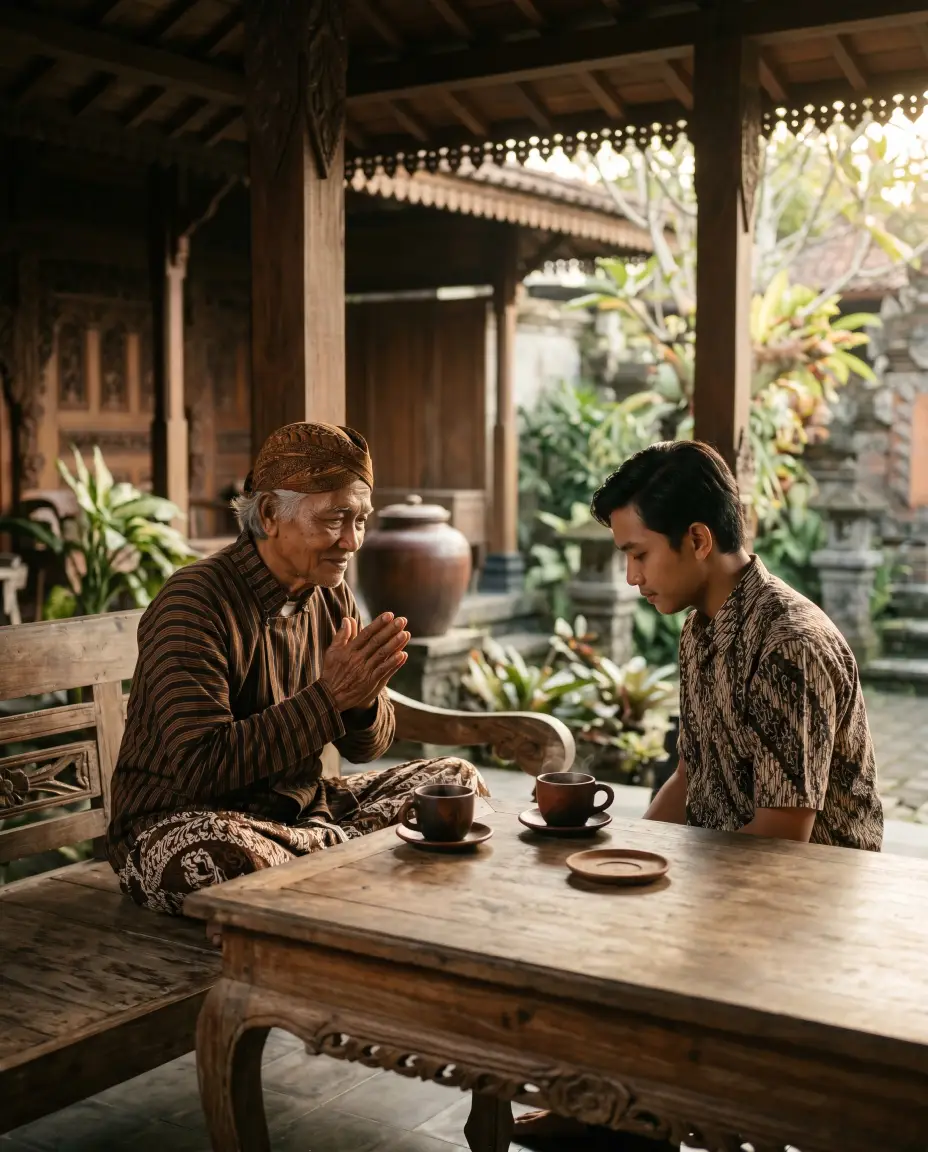
Serat Wulangreh in the Digital Age
Serat Wulangreh was born long before notifications, messaging groups, social media comments, and viral culture. Yet the values inside it feel sharply relevant today. The problem of modern life is not a lack of voices. Often, it is a lack of pause.
We react easily. We reply easily. We mock easily. We feel correct after reading only a little. Here, aja dumeh and tepa slira become important. Do not become dumeh because you have an account, then feel free to insult. Do not become dumeh because you have followers, then pressure others. Do not become dumeh because you have information, then spread it without checking.
Serat Wulangreh teaches ethics before action. In digital life, this can be practiced simply: reread before sending, verify before sharing, do not write while the heart is hot, and do not humiliate people merely to gain attention.
This is not an invitation to stay silent about wrongdoing. Criticism is still allowed. Truth still needs to be spoken. But good criticism does not need to lose adab. A true correction does not need to destroy dignity. A strong voice does not need to become cruel.
Memayu Hayuning Bawana as Shared Responsibility
In Javanese culture, there is the phrase memayu hayuning bawana, often understood as an effort to beautify or care for the safety and harmony of the world. It can be read as an invitation for human beings not to live only for themselves.
In relation to Serat Wulangreh, memayu hayuning bawana can be understood in a grounded way. If our speech becomes better, the relationships around us become calmer. If our actions become more responsible, our small environment becomes safer. If we do not become dumeh, other people are less wounded by the power we hold.
So, caring for the world does not always begin with a large action. It can begin from how we speak at home, how we treat those with less power, how we give criticism at work, and how we restrain ourselves in digital spaces.
This reading does not need to become overly mystical. The core is simple: an ordered inner life influences how human beings treat one another. From clear small conduct, shared life becomes more worthy to inhabit.
Serat Wulangreh Is Not a Tool for Judging
This needs to be said clearly, my child. Serat Wulangreh is not a tool for judging others. Do not use it to say, “You have no character,” “You are not Javanese enough,” or “You do not know manners.” If noble teaching is used to belittle others, the spirit of the teaching has been lost.
Serat Wulangreh is better used as a mirror for the self. Not to search for other people’s faults, but to examine one’s own conduct. Have I guarded my speech? Do I still often become dumeh? Do I easily interrupt? Do I use knowledge to help, or to feel higher?
Good piwulang does not make human beings feel most holy. It makes human beings more able to examine themselves. It reminds us that each person is learning to arrange their own inner life.
So, when reading Serat Wulangreh, carry humility. Take the essence. Adjust it to the age. Do not get trapped only in the outer form. What matters is not merely memorizing the teaching, but allowing it to become conduct.
Practical Ways to Read Serat Wulangreh Today
There are several simple practices that can be carried from Serat Wulangreh.
First, create a pause before speaking. Not every truth needs to be delivered in haste. Choose the time, choose the words, and examine the intention.
Second, practice aja dumeh. When you feel more knowledgeable, stronger, older, wealthier, or more powerful, ask: am I using this advantage to nurture or to pressure?
Third, practice mawas diri before sleep. Remember the words and actions of the day. Did anything wound? Is anything asking to be repaired? Did a small arrogance grow quietly?
Fourth, guard your circle. Serat Wulangreh often reminds readers about the importance of choosing companions and environments. Not to feel more holy, but because the environment helps shape conduct.
Fifth, care for stillness. In hening, a person can see the movement of the inner life more clearly. Without stillness, life easily becomes only reaction after reaction.
Serat Wulangreh, Pitutur, and Javanese Culture
Serat Wulangreh is one important doorway into reading Javanese pitutur. Within it are values connected with many other teachings: tepa slira, aja dumeh, rukun, eling lan waspada, basa krama, hening, and ngendhaleni emosi.
Through rukun, Serat Wulangreh teaches that shared life needs to be cared for through speech and rasa. Through emotional restraint, it reminds us that a heated inner life needs to be guided before becoming words that wound. Through the awareness of origin, direction, and responsibility, it asks human beings not to live carelessly.
If pitutur is only memorized, it easily becomes a slogan. If pitutur is practiced, it becomes laku. Serat Wulangreh invites human beings to choose the second path: not stopping at beautiful sound, but descending into conduct that can be felt by others.
JavaSense and a Clearer Way to Read Javanese Texts
JavaSense reads Serat Wulangreh as cultural heritage that should be cared for with common sense. Not to make younger generations afraid of tradition. Not to close criticism. Not to revive rigid social structures without reflection.
What matters is the essence: inner ethics, respect, self-restraint, courage to examine the self, and the ability to care for shared life. These values can be brought into family, school, work, community, and digital spaces.
If you want to explore Javanese letters and written heritage more easily, use the JavaSense Javanese script tool. If you want to connect this reflection with Javanese time and cultural rhythm, you may also open the JavaSense Javanese calendar.
For broader public cultural references, readers may also visit the National Library of Indonesia and the Indonesian Ministry of Culture archive. References like these help cultural reflection stay connected to learning and public knowledge.
Closing Reflection: Teaching That Lives Through Conduct
In the end, Serat Wulangreh teaches that a good life is not built by intelligence alone. It needs rasa. It needs self-restraint. It needs guarded speech. It needs the ability not to be drunk on power, knowledge, age, wealth, or status.
Angger, my child, do not read Serat Wulangreh only as an old relic. Read it as a companion that sits beside you. It asks slowly: have I guarded my words? Have I arranged my rasa? Have I stopped before dumeh takes over the self?
A teaching like this will not live if it only remains in text. It lives when human beings try to practice it: in the way they speak, listen, lead, apologize, and care for relationships.
To learn Javanese culture in a lighter and more modern way, you can download JavaSense on Google Play.
FAQ About Serat Wulangreh
What is Serat Wulangreh?
Serat Wulangreh is a Javanese piwulang text containing teachings about inner ethics, manners, self-restraint, choosing companions, and living with more ordered conduct.
Who wrote Serat Wulangreh?
Serat Wulangreh is widely associated with Sri Susuhunan Pakubuwana IV of the Surakarta court, who is remembered for his attention to moral teaching and Javanese conduct.
What does Wulangreh mean?
Wulangreh can be understood as teaching for arranging conduct. Wulang means teaching, while reh is connected with order, method, or the arrangement of life.
What are the main teachings of Serat Wulangreh?
The main teachings include self-restraint, guarding speech, self-examination, tepa slira, aja dumeh, choosing good company, and arranging rasa so shared life becomes more harmonious.
How is Serat Wulangreh connected with tepa slira?
Serat Wulangreh is connected with tepa slira because both teach human beings to consider another person’s rasa before speaking or acting.
What does aja dumeh mean in Serat Wulangreh?
Aja dumeh means do not act arrogantly just because you have power, age, knowledge, wealth, opportunity, or status. It is a reminder to carry advantage with humility.
Is Serat Wulangreh still relevant today?
Yes. Serat Wulangreh remains relevant for family, education, work, leadership, and digital spaces because it teaches ethical speech, self-control, and social responsibility.
How should Serat Wulangreh be read clearly?
Read Serat Wulangreh as a cultural mirror and life teaching, not as a tool for judging others. Take its essence, adjust it to the present age, and practice it in daily conduct.
Learn Serat Wulangreh with Clearer Awareness
Serat Wulangreh is not merely an old text. It is Javanese piwulang about rasa, speech, tepa slira, aja dumeh, and inner ethics. To explore Javanese script, calendar, weton, and daily heritage in a simpler way, open JavaSense on Google Play.