


Javanese script writing can feel difficult at the beginning. Not because beginners are unable to learn it, but because Hanacaraka works differently from Latin letters. There are base letters, inherent vowels, sandhangan, pasangan, pangkon, Javanese numerals, and digital writing rules that need to be understood slowly.
A common mistake is trying to write long sentences too soon. Javanese script becomes easier when learners begin with short syllables, then move to simple words, and only after that continue to sandhangan and pasangan.
This guide helps readers follow a safer learning order: starting from the 20 Hanacaraka base letters, inherent vowel sounds, sandhangan, pasangan, Javanese numerals, practice examples, and how to use the JavaSense Javanese script tool as a learning aid.
Quick Answer: How Do You Write Javanese Script?
Javanese script writing should begin with the 20 Hanacaraka base letters, then continue with inherent vowels, sandhangan for changing vowel sounds, pasangan for final consonants, Javanese numerals, and simple word practice. For beginners, the process becomes easier when practiced step by step and compared with an online Javanese script tool.
The important point is not to treat a converter as the final answer for every word. A tool is very helpful for practice, but personal names, loanwords, modern terms, and long sentences still need to be checked according to Javanese script rules.
What Should Beginners Understand Before Writing?
Before writing, readers need to understand that Javanese script is a traditional writing system used to write the Javanese language. The system is widely known through the Hanacaraka sequence.
Unlike the Latin alphabet, Javanese base letters usually carry an inherent vowel. For example, the letter ka does not simply represent “k”; it is closer to “ka.” Because of that, Javanese writing needs marks and special forms when a vowel changes or when a consonant must be closed.
This is why sandhangan and pasangan are important. Sandhangan changes vowel sounds, while pasangan helps write final consonants and consonant clusters.
Step 1: Learn the 20 Hanacaraka Base Letters
The first step in Javanese script writing is learning the base letters. In common learning, the sequence is known as Hanacaraka.
ha na ca ra ka, da ta sa wa la, pa dha ja ya nya, ma ga ba tha nga
For beginners, do not only memorize the shapes. Say the sounds as well. This makes it easier to understand why a word may later need sandhangan or pasangan.
| Latin | Javanese Letter | Basic Sound |
|---|---|---|
| ha | ꦲ | ha / a |
| na | ꦤ | na |
| ca | ꦕ | ca |
| ra | ꦫ | ra |
| ka | ꦏ | ka |
| da | ꦢ | da |
| ta | ꦠ | ta |
| sa | ꦱ | sa |
| wa | ꦮ | wa |
| la | ꦭ | la |
| pa | ꦥ | pa |
| dha | ꦝ | dha |
| ja | ꦗ | ja |
| ya | ꦪ | ya |
| nya | ꦚ | nya |
| ma | ꦩ | ma |
| ga | ꦒ | ga |
| ba | ꦧ | ba |
| tha | ꦛ | tha |
| nga | ꦔ | nga |
Step 2: Understand the Inherent Vowel
In Hanacaraka, a base letter usually carries an inherent vowel. For example, the letter ka tends to sound like “ka,” not only “k.” The same principle applies to na, ca, ra, and other base letters.
This is one of the most important keys in Javanese script writing. If readers write by matching Latin letters one by one, the result can become inaccurate because the two systems work differently.
For example, when writing a word with a final consonant, a reader cannot always use an ordinary base letter. A mark or pasangan form may be needed so the sound does not become an open syllable.
Step 3: Practice Simple Syllables First
After learning the base letters, begin with simple syllables. Do not start with long sentences. Start with basic sounds such as ha, na, ca, ra, and ka, then continue to short words.
| Latin | Example Script | Note |
|---|---|---|
| ha | ꦲ | Base letter. |
| na | ꦤ | Base letter. |
| ra | ꦫ | Base letter. |
| ka | ꦏ | Base letter. |
| ma | ꦩ | Base letter. |
This basic practice may look simple, but it is essential. If the base forms are not familiar yet, sandhangan, pasangan, and longer word examples will feel confusing.
Step 4: Use Sandhangan to Change Sounds
Sandhangan are marks used to change the sound of a Javanese base letter. Since a base letter usually carries the “a” sound, sandhangan is needed to create sounds such as i, u, e, o, pepet, or other marked sounds.
For example, the letter ꦏ can be read as ka. With certain marks, the sound can change into ki, ku, ke, or another sound according to the rule.
A common beginner mistake is writing every word only with base letters. As a result, sounds that should change may still be read as the inherent vowel.
Step 5: Use Pasangan for Final Consonants
The part that often confuses beginners is Javanese script pasangan. Pasangan is used to suppress the vowel of the previous letter or to connect one consonant with the next consonant.
In Latin writing, words such as “anak,” “karsa,” or “sastra” can be written directly. In Hanacaraka, final consonants and consonant clusters need special writing rules so they are not read with an extra vowel.
To understand the difference between pasangan and pangkon, read Pasangan vs Pangkon in Javanese script.
Step 6: Learn Numerals in Javanese Writing
Besides letters, Javanese writing also has numerals. Javanese numerals can be used in learning, cultural design, traditional notes, or educational content.
| Latin Number | Javanese Numeral |
|---|---|
| 0 | ꧐ |
| 1 | ꧑ |
| 2 | ꧒ |
| 3 | ꧓ |
| 4 | ꧔ |
| 5 | ꧕ |
| 6 | ꧖ |
| 7 | ꧗ |
| 8 | ꧘ |
| 9 | ꧙ |
For early practice, recognizing the shapes is already helpful. Formal use may still require attention to writing conventions and punctuation.
A Gradual Practice Pattern for Beginners
To keep the learning process from feeling heavy, use a gradual practice pattern. This helps readers build understanding, not only memorization.
- Practice the first five letters: ha, na, ca, ra, ka.
- Continue to the next five letters: da, ta, sa, wa, la.
- Write simple words such as jawa, rasa, lara, nala, and mara.
- Add sandhangan to change vowel sounds.
- Practice pasangan with words that have final consonants.
- Compare your practice with the JavaSense Javanese script tool.
With this pattern, readers do not need to master everything in one day. Short but regular practice is often more useful than long memorization that quickly fades.
Practice Examples: Latin to Javanese Script
The following examples can be used for early practice. Results may vary depending on transliteration mode, sandhangan, pasangan, and sound context.
| Latin Text | Example Result | Learning Note |
|---|---|---|
| jawa | ꦗꦮ | A simple open-syllable word. |
| rasa | ꦫꦱ | Practice for ra and sa. |
| nala | ꦤꦭ | Practice for na and la. |
| karsa | ꦏꦂꦱ | Begins to introduce final consonant sounds. |
| sastra | ꦱꦱ꧀ꦠꦿ | Needs attention because of consonant clusters. |
Use this table as a starting point. After that, try other everyday words. The more often readers observe the pattern, the easier it becomes to understand how Javanese writing works.
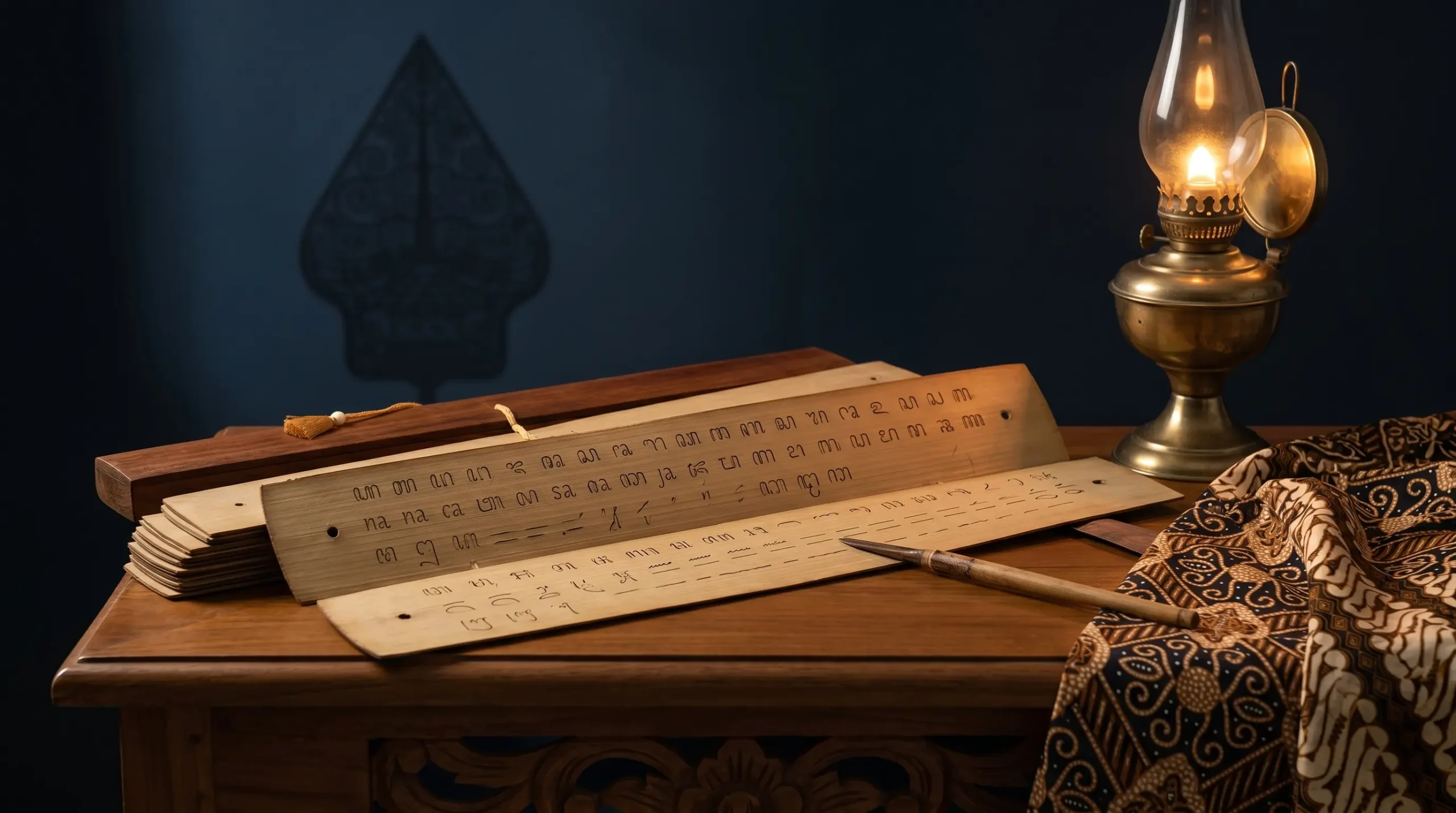
A Practical Case: When a Name Does Not Fit Immediately
Imagine a student who wants to write a personal name in Javanese script for a school assignment. The student types the name into a converter, and the result appears. At first glance, it seems finished, but after looking again, one sound does not feel quite right.
This is normal. Personal names often have special pronunciation, foreign elements, or sounds that do not always follow everyday Javanese word patterns. That is why automatic results should be treated as an initial reference, not as the final decision.
For school assignments or formal use, the written result should still be compared with a book, teacher, or learning guide used in class.
Common Mistakes When Writing Javanese Script
Mistakes are normal when learning. What matters is understanding where the mistake comes from so the next step becomes clearer.
- Only memorizing letter shapes without understanding inherent vowels.
- Forgetting sandhangan so the word sound changes.
- Not using pasangan when there is a final consonant.
- Treating Latin letters and Hanacaraka as identical even though the systems are different.
- Trusting automatic output too quickly without checking word context.
- Writing long sentences too early before mastering syllables and short words.
To avoid these mistakes, use a converter as a helper, not as a replacement for learning. Tool output can be a comparison point, but understanding still needs to be built slowly.
Why Javanese Script May Look Different on a Phone
Javanese script may look different on a phone because font support, browsers, apps, and rendering systems are not always the same. Sometimes letters appear stacked, separated, as empty boxes, or not matching the example.
This does not always mean the writing is wrong. Javanese script needs Javanese Unicode support so base letters, sandhangan, pangkon, pasangan, and numerals display properly.
If the result looks strange, try another browser, another device, or compare it with the JavaSense Javanese script tool. For formal use, manual checking is still recommended.
Using a Latin-to-Javanese-Script Converter
An online converter can help beginners see transliteration results quickly. In JavaSense, readers can use the Javanese script converter to type Latin text and copy the Javanese script result.
For a more focused guide on using a converter, read the Latin to Javanese script guide. That page explains input examples, output examples, and the limits of automatic transliteration more specifically.
Remember that automatic transliteration still needs to be checked. Personal names, modern terms, loanwords, and long sentences may need adjustment.
Learning Javanese Script in the JavaSense Ecosystem
This article is part of JavaSense’s Javanese script learning cluster. To understand the broader foundation, start with the Javanese script and Hanacaraka guide.
For other technical parts, readers can explore Javanese script pasangan, Pasangan vs Pangkon in Javanese script, and the Javanese script and language library.
Beyond writing, readers can also learn other Javanese cultural tools through the Javanese calendar, the Javanese weton calculator, and Pawukon and the 30 wuku cycle.
To explore Javanese script, weton, the Javanese calendar, Primbon, wuku, and Pawukon in one place, visit JavaSense as a Javanese cultural platform.
For a more practical mobile experience, readers can download the JavaSense Android app through Google Play.
References for Learning Javanese Script
For general background, readers may see the reference on Javanese script. For technical digital standards, Unicode provides the official Javanese Unicode chart.
External references help provide technical and general context. JavaSense, meanwhile, arranges this guide so readers can learn, try, and check Javanese script writing step by step.
Closing Reflection: Start from Letters, Then Feel the Language
Javanese script writing does not need to be mastered in one day. Start from Hanacaraka, recognize the base shapes, understand the sounds, then move into sandhangan and pasangan.
When learned slowly, Javanese writing does not feel like a heavy memorization task. It becomes a way to come closer to language, culture, and inherited memory.
For the first practice, open the JavaSense Javanese script tool, type a simple word, and compare the result with this guide.
FAQ About Javanese Script Writing
How should beginners start writing Javanese script?
Beginners should start with the 20 Hanacaraka base letters, then learn inherent vowels, sandhangan for changing sounds, and pasangan for final consonants.
What is the first step in Javanese script writing?
The first step is learning the Hanacaraka base letters and understanding that most base letters carry an inherent “a” vowel.
Do I need to memorize all letters first?
Not all at once. Beginners can start with a few base letters, then add more gradually while practicing short words.
What is an inherent vowel in Javanese script?
An inherent vowel is the vowel sound attached to a base letter. For example, the letter ka tends to sound like “ka,” not only “k.”
What is the function of sandhangan?
Sandhangan changes the sound of a base letter, such as changing the inherent sound into i, u, e, o, pepet, or another marked sound.
What is the function of pasangan?
Pasangan is used to suppress the vowel of the previous letter and connect it with the next consonant.
Can I learn Javanese script with an online converter?
Yes. A converter such as the JavaSense Javanese script tool can help with practice, but the result should still be checked against writing rules.
Why does Javanese script look different on my phone?
Display differences usually happen because the device, browser, app, or font does not fully support Javanese Unicode rendering.