
Angger, my child…
There are moments in life that cannot be welcomed only with clothes, a room, a name, or a list of things to buy. Some moments also ask the heart to become calmer, the family to come closer, prayers to be arranged, and gratitude to be guarded. In Javanese culture, one way to welcome such a moment is called mitoni.
Ky Tutur Summary
- Mitoni is a Javanese seven-month pregnancy tradition, often held when pregnancy enters the seventh month.
- Its meaning is not only ceremonial. It includes prayer, gratitude, family support, and emotional readiness for the mother, father, and wider family.
- Symbols such as pitu, siraman, changing cloth, brojolan, and dawet should be read as cultural language, not as a guarantee of fate.
- In modern life, mitoni can be practiced simply, safely, and meaningfully while still prioritizing the health of the mother and baby.
Ky Tutur Note: This article discusses mitoni as Javanese cultural tradition and life reflection. It is not medical advice, not a religious obligation, not a guarantee of a smooth birth, and not a replacement for pregnancy checkups. For pregnancy, birth preparation, nutrition, maternal health, and baby health, always prioritize qualified doctors, midwives, or authorized health professionals.
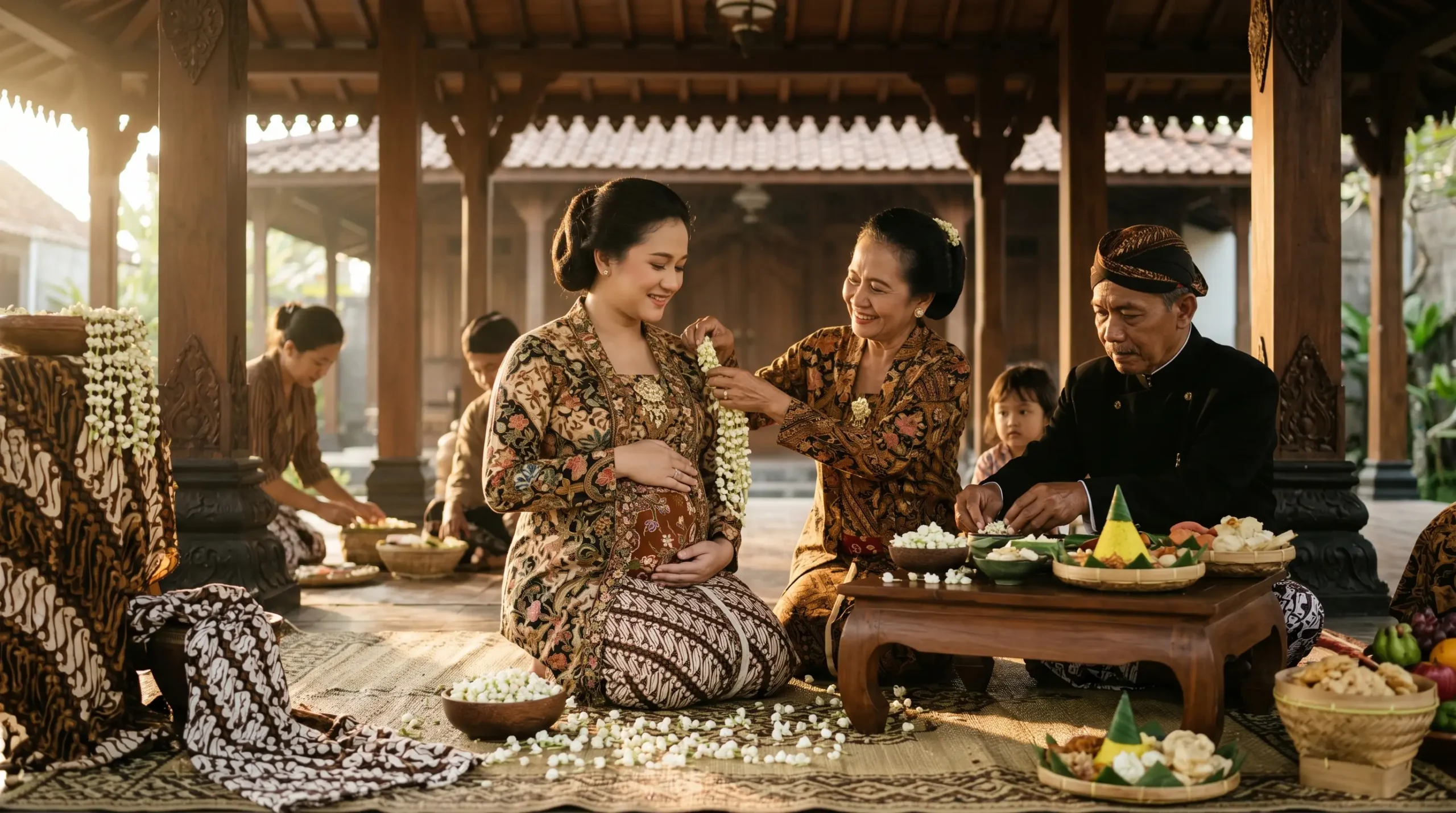
Mitoni is one of the Javanese traditions connected with seven-month pregnancy. In some places, it is also known as tingkeban. In simple understanding, mitoni is a form of gratitude, prayer, and family support for the mother who is carrying a child and for the baby who will soon be born.
Yet, my child, mitoni should not be read as a frightening ritual or a burden that must be forced. It is healthier to understand it as cultural language. Javanese ancestors used symbols, water, cloth, food, prayer, and family gathering to arrange rasa. The purpose was not to lock fate, but to welcome new life with a more ordered heart.
In the JavaSense reading, mitoni is a mirror. It reminds us that birth is not only a biological event. It is also a family, social, and emotional event. There is a mother who needs strength. There is a father who needs to awaken into responsibility. There is a family that needs to gather prayer. There is a new life that deserves to be welcomed with care, gentleness, and practical readiness.
What Is Mitoni?
Mitoni is commonly associated with the word pitu, meaning seven. Because of this, the tradition is usually performed when pregnancy enters the seventh month. In cultural interpretation, pitu is also often connected with pitulungan, or help. From this layer, mitoni can be read as a prayer for safety, ease, and goodness for the mother and baby.
But this meaning must be read carefully. Pitu and pitulungan are symbolic language and cultural wisdom. They do not mean that the ceremony guarantees the birth process. In modern life, prayer and culture should walk together with pregnancy checkups, good nutrition, enough rest, birth preparation, and the guidance of health professionals.
So the meaning of mitoni should not be narrowed only into “a seven-month ritual.” More deeply, it is a Javanese way of arranging hope. Hope that the mother remains strong. Hope that the baby grows safely. Hope that the family becomes ready. Hope that new life is not welcomed with panic, but with gratitude and responsibility.
Why the Seventh Month Matters
In community tradition, the seventh month of pregnancy is often seen as an important phase. At this stage, the family usually begins to feel the closeness of birth more clearly. The mother’s body has changed. The baby’s movement may be felt more strongly. Practical and emotional preparation often becomes more serious.
Culturally, this phase becomes a space for gathering and strengthening. The mother is not the only one being reminded. The father and the wider family are also invited to recognize that birth is a shared responsibility. The mother should not feel that she walks alone. Family presence becomes a fence of prayer and support.
This is where the beauty of mitoni can be felt. It reminds people that pregnancy is not only the private matter of the mother. It is a journey that needs compassion, attention, and real help. Good prayer should be accompanied by good action.
Mitoni Is Prayer and Family Support, Not Fate
One misunderstanding needs to be corrected: mitoni should not be treated as a ritual that determines the baby’s fate. No, my child. This tradition should not be used to label a child, frighten a family, or make people believe that life will become bad without a certain ceremony.
Mitoni is better read as cultural effort. Human beings pray, gather, give thanks, and arrange rasa. All of that is good when done with a clear intention. But safety still needs to be pursued through real steps: pregnancy checkups, birth planning, emotional support, a safe environment, and proper health guidance.
With this reading, tradition becomes lighter. It does not force. It does not judge. It does not become an economic burden or social pressure. What is taken is the inner flame: gratitude, prayer, order, and readiness to welcome new life.
Mitoni Rituals and Their Meanings
The sequence of mitoni can differ between families, regions, and local traditions. Not every family follows the same form. Some perform it fully. Some do it simply. Some take only the essence of prayer and gratitude. The important point is to understand the meaning, not to force the form.
1. Siraman: Cleansing Body and Rasa
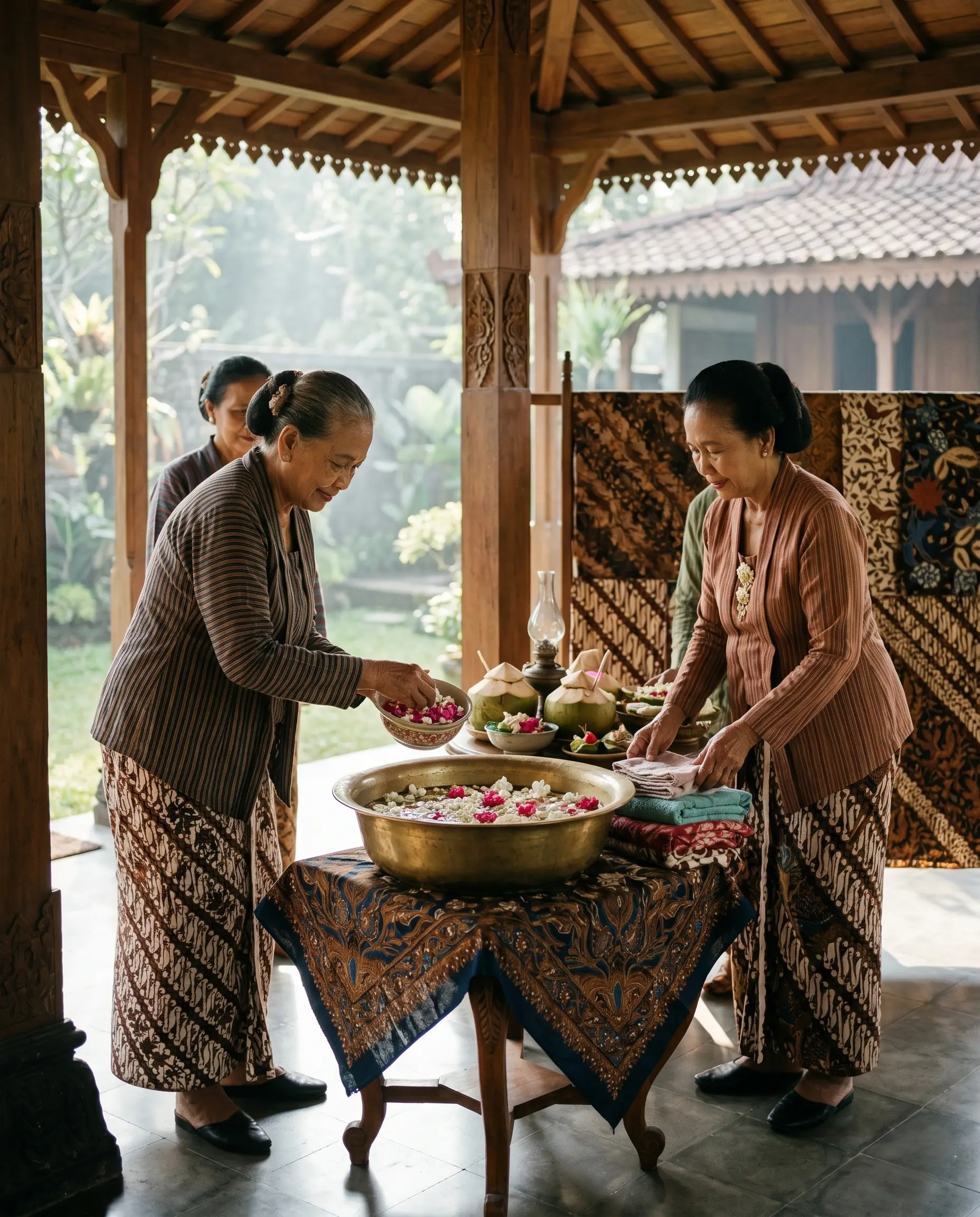
Siraman is one of the most recognized parts of mitoni. The expectant mother is bathed or poured with water, often with flowers. In many cultures, water symbolizes life, freshness, cleansing, and renewal. In mitoni, siraman can be read as an invitation to clear fear, anxiety, and inner heaviness before entering the birth phase.
However, this meaning must remain symbolic. Flower water does not replace medical hygiene, pregnancy care, or birth preparation. Its value lies in arranging the inner life: the mother is reminded that she is not alone, that the family is present, and that the road toward birth is walked with prayer.
2. Changing Cloth: Framing Hope
In some traditions, the expectant mother changes cloth or clothing several times. Each cloth may carry a motif and a hope. Some motifs are read as prayers for love, order, nobility, safety, or a good life for the child.
Do not read the cloth as something that determines the future. Read it as a reminder. Beautiful cloth teaches that hope should be wrapped in good conduct. Parents should not only hope that the child will grow well. Parents also need to prepare example, safety, tenderness, and a home where care can grow.
3. Brojolan: Prayer for a Smooth Birth
Brojolan is often understood as a symbolic prayer for a smooth birth. In several forms, this procession uses a young coconut or another symbol passed through cloth as an image of smooth passage.
Its meaning is hope. The family asks that the mother and baby be given safety. But hope needs to be accompanied by practical preparation: knowing where to give birth, preparing a companion, recognizing danger signs in pregnancy, and consulting qualified health professionals.
4. Dodol Dawet: Sharing Sweet Hope
Dodol dawet, or the symbolic selling of dawet in the mitoni sequence, is often read as a symbol of sustenance, togetherness, and shared happiness. The sweet and refreshing dawet becomes a simple cultural language: may new life bring coolness, joy, and goodness.
This part also carries a social lesson. Birth is not only a matter of one small household. Relatives, neighbors, and close people may gather. Prayer is collected. Relationships are cared for. The sense of guyub, or warm togetherness, becomes stronger.
Pitu, Pitulungan, and the Language of Hope
The number seven in mitoni is not only a count. It becomes a language of hope. In Javanese rasa, numbers can be used to hold meaning so it becomes easier to remember. Pitu reminds people of the seventh month, and it is often associated with pitulungan, or help.
But, my child, a symbol should not become a burden. If a family cannot afford a complete ceremony, it does not mean their prayer is lacking. If the event is made simple, the meaning does not disappear. What matters most is good intention, the safety of the mother, the health of the baby, and family support.
Healthy culture does not press human beings with fear. Healthy culture guides people to become more aware, more ordered, and more loving.
The Father’s Role in Mitoni
Attention during pregnancy often centers on the mother. That is natural, because the mother carries the body changes and the biological process of pregnancy. But mitoni can also become a reminder for the father: welcoming new life is not only the mother’s task.
The father needs to be present in real ways. Not only during the ceremony, but also in daily life. Helping with household needs. Accompanying pregnancy checkups when possible. Listening to anxiety. Preparing birth needs. Learning to become a safe place for the mother and baby.
In JavaSense language, mitoni teaches the practice of ngemong. Caring does not begin only after the baby is born. It begins when a family learns to care for rasa, guard speech, and build a calmer home.
Mitoni as Social Support for the Mother
Pregnancy can bring joy, but also anxiety. There are body changes, emotional changes, role changes, and many questions about the future. Mitoni becomes a social space that says to the mother: you are not walking alone.
Family prayer, the presence of relatives, and the attention of close people can support the inner life. In Javanese tradition, this support is often wrapped in ceremony, symbol, and food. But the deepest essence remains the same: to create a sense of safety.
In modern life, this support can be very simple. Accompanying the mother to checkups. Helping prepare food. Avoiding comments that increase anxiety. Giving space to rest. Listening without judgment. All of these are mitoni in daily conduct.
Mitoni in Modern Life: Simple, Safe, and Meaningful
Is mitoni still relevant today? Yes, if read clearly. What needs to be preserved is not the obligation to perform every detail in an expensive and complicated way, but the meaning: gratitude, prayer, support, and readiness to welcome a child.
Modern families can make mitoni simpler. It does not have to be large. It does not have to be luxurious. It should not make the mother exhausted. If the mother’s health requires rest, the event should adjust. If the family’s economy is limited, do not force a costly event for the sake of pride.
A good tradition should care for human beings, not burden them. If mitoni makes the family more united, the mother calmer, the father more aware, and prayer more ordered, then the cultural value is alive. If it becomes only social pressure, the form needs to be reconsidered.

Mitoni and Javanese Pitutur
Mitoni stands close to many Javanese teachings. It is close to eling lan waspada, because the family is invited to become aware of a major phase of life and careful in preparing for birth. It is close to tepa slira, because everyone needs to guard the feelings of the mother who is going through a major change.
Mitoni is also close to sangkan paraning dumadi. Birth reminds human beings of origin, direction, and the responsibility of life. When a baby is about to arrive, parents are asked again: what kind of home do we want to build? What values do we want to pass on?
If the inner life of the parents is full of anxiety, the value of hening can help. A small silence, a calmer breath, and a clearer arrangement of hope can be more useful than chasing unnecessary demands.
Health First: Culture Should Support, Not Replace Care
This part must be stated clearly. Mitoni may strengthen rasa, family support, gratitude, and prayer. But it does not replace medical care. A tradition may calm the heart, but pregnancy still needs proper health attention.
Qualified health professionals can monitor the condition of the mother and baby, check risks, give guidance, and help prepare for birth. Families should also understand danger signs, nutrition, rest, emotional condition, and where to seek help if something feels unusual.
If the mother feels tired, the ceremony should be made lighter. If there is a medical concern, health advice should come first. If the family wants to hold mitoni, let it support the mother, not exhaust her. Culture should become shade, not pressure.
Readers may refer to Ayo Sehat Kemenkes on antenatal care and WHO recommendations on antenatal care for public health information about pregnancy care.
JavaSense and a Clearer Way to Read Javanese Tradition
JavaSense reads Javanese culture as a mirror, not a verdict. Weton, the Javanese calendar, script, primbon, wayang, babad, and traditions such as mitoni should not make people afraid. They are better used as doors of learning, spaces of gratitude, and ways to arrange life with more awareness.
If you want to read the rhythm of days in Javanese tradition, open the JavaSense Javanese calendar. If you want to understand weton as cultural reflection, use the JavaSense weton calculator wisely. If you want to explore written heritage, try the JavaSense Javanese script tool.
As a broader public cultural reference, readers may also visit the National Library of Indonesia. References like this help cultural reading stay connected to learning and public knowledge.
The JavaSense path is simple: honor tradition, but do not lose clear reason. Read symbols, but do not turn them into fear. Preserve prayer, but do not abandon health, responsibility, and practical readiness.
Closing Reflection: Welcoming New Life with Order
In the end, mitoni teaches that new life deserves to be welcomed with order. Order does not mean rigidity. Order means knowing what needs to be prepared, what needs to be prayed for, what needs to be cared for, and what should not be forced.
Angger, my child, this tradition does not need to be read with fear. It is not a tool to punish families who cannot perform every procession. It is not a measure of parental love. It is one cultural way to express gratitude and hope.
If mitoni is performed, perform it with a clear intention. If it is made simple, do not feel lacking. If it is not performed for certain reasons, still care for its deepest values: gratitude, prayer, family support, health, and readiness to become parents.
Because welcoming a child is not only about preparing the outer world. More deeply, it is about preparing an inner home: a home warm enough to receive the first cry, patient enough to face long nights, and clear enough to raise a small human being with compassion.
To learn Javanese culture in a lighter and more modern way, you can download JavaSense on Google Play.
FAQ About Mitoni
What is mitoni?
Mitoni is a Javanese seven-month pregnancy tradition, usually held when pregnancy enters the seventh month, as a form of gratitude, prayer, and family support for the mother and baby.
What does mitoni mean in Javanese culture?
In Javanese culture, mitoni is often connected with pitu, meaning seven. It can also be read as a symbolic prayer for help, safety, and readiness before birth.
Is mitoni the same as tingkeban?
In many contexts, mitoni and tingkeban are used to refer to the Javanese seven-month pregnancy tradition, although the details of the ritual may differ by region and family.
What is the meaning of siraman in mitoni?
Siraman in mitoni can be read as a symbol of cleansing body and rasa. It represents the hope that fear and anxiety are softened before welcoming birth.
Is mitoni mandatory?
No. Mitoni is a cultural tradition, not something that must be forced. Families can take its values of gratitude, prayer, and support in a simple and safe way.
Does mitoni guarantee a smooth birth?
No. Mitoni is prayer and cultural tradition, not a medical guarantee. A safe birth still needs pregnancy checkups, preparation, and support from qualified health professionals.
How can mitoni be practiced safely in modern life?
It can be practiced simply, without exhausting the mother, without forcing cost, while keeping the meaning of gratitude and still prioritizing the health of the mother and baby.
What is the main life lesson of mitoni?
Mitoni teaches that new life should be welcomed with order: arranging intention, strengthening family support, caring for the mother, preparing the father, and welcoming the child with prayer and responsibility.
Learn Mitoni with Clearer Awareness
Mitoni is not merely a seven-month ceremony. It is a cultural mirror about gratitude, family support, prayer, and readiness to welcome new life. To explore the Javanese calendar, weton, script, and cultural heritage more easily, open JavaSense on Google Play.