
Angger, my child…
There are traditions that cannot be understood only from offerings, flower water, incense, or a shadow puppet performance through the night. Behind the outer form, ruwatan carries a deeper invitation: human beings need to recognize burdens, release what has become tangled, and begin a new conduct with a clearer inner life.
Ky Tutur Summary
- Ruwatan is a Javanese tradition often understood as a symbolic ceremony for releasing burden, arranging what is considered sukerta, and seeking clearer balance in life.
- In cultural reading, ruwatan should not be treated as an instant solution, but as a symbol of acknowledgment, release, and the beginning of renewed conduct.
- Sukerta, Batara Kala, and the Murwakala story are safer to read as symbolic language about burden, fear, time, vulnerability, and the human need to restore balance.
- In JavaSense, ruwatan is read as cultural heritage and inner reflection, not as a guarantee that fate will instantly change, not as a personal verdict, and not as a replacement for professional help.
Ky Tutur Note: This article discusses ruwatan as Javanese cultural heritage and reflective guidance. Mentions of sukerta, Batara Kala, offerings, and Murwakala are placed as symbolic cultural language, not absolute claims. If you face serious health, legal, family, financial, or psychological problems, seek appropriate professional support.
Ruwatan is often imagined as a ceremony filled with symbols: flower water, offerings, prayer, shadow puppets, and the Murwakala story. Some people see it as a sacred tradition. Others see it as a difficult inheritance from the past. Between those two views, JavaSense invites a clearer reading: do not reject it carelessly, but also do not turn it into an absolute certainty.
In Javanese culture, ruwatan can be understood as a symbolic path for releasing what has become tangled. What is being arranged is not only the outer condition, but also rasa that may have been held for too long: fear, guilt, pressure, inherited burden, or the feeling that life is moving under a shadow that cannot yet be named.
But ruwatan is not a magic button. It does not automatically remove every problem. Its value lives in awareness: a person pauses, recognizes that something needs to be arranged, and begins a new conduct with a cleaner intention.
What Is Ruwatan Jawa?
Ruwatan Jawa is a Javanese tradition that aims to meruwat, or symbolically release a person, family, place, or situation from a burden believed to disturb balance. In certain traditions, ruwatan is often connected with those called sukerta, people or conditions considered to need symbolic protection and arrangement.
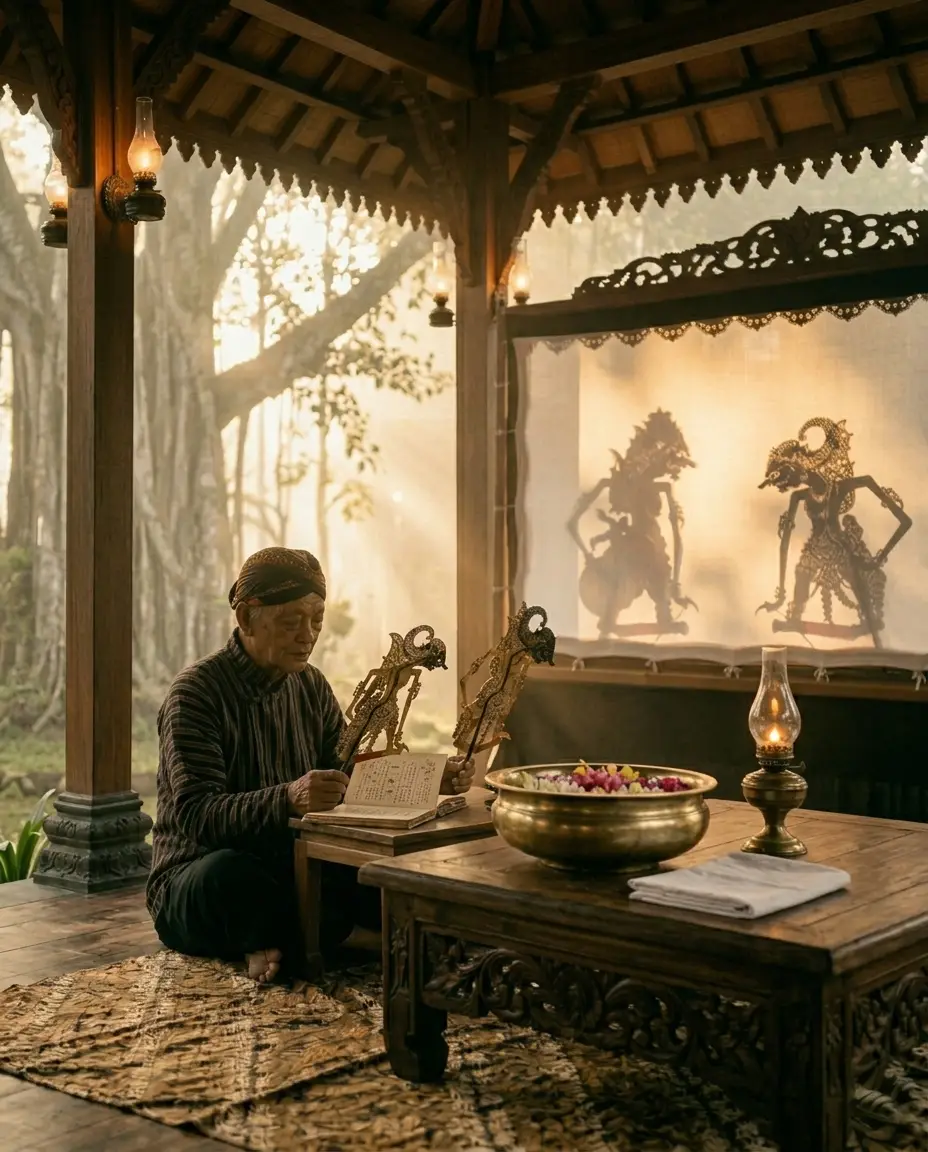
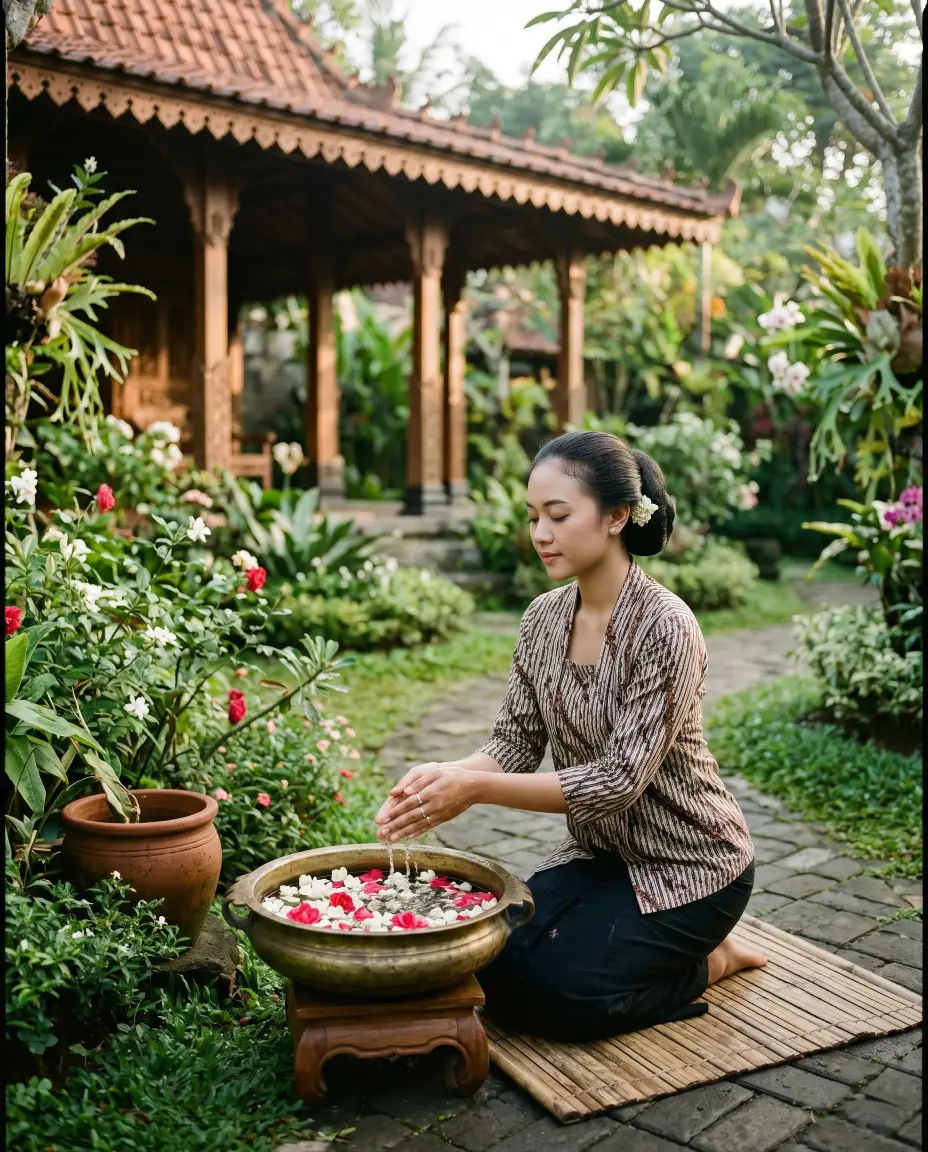
In practice, ruwatan may involve prayer, offerings, flower water, communal meals, wayang performance, or the Murwakala story. The form can differ depending on region, family tradition, elders, and local practice. Some carry it out in a complete ceremonial form, while others understand its value more simply.
Yet the heart of ruwatan does not live only in objects. Those objects are language. Water becomes a symbol of cleansing. Flowers become a symbol of hope that life may become more fragrant. White cloth becomes a sign of new intention. Wayang becomes a mirror of the human journey in facing fear, burden, and shadow.
For that reason, ruwatan is better understood as cultural conduct: a way for Javanese society to mark release, pray for safety, strengthen family solidarity, and begin life again with rasa that has been more carefully arranged.
The Meaning of Ruwat: Releasing and Passing Beyond Burden
The word ruwat is commonly connected with release, liberation, or being freed from a difficult condition. In Javanese rasa, meruwat does not only mean cleaning what is visible outside. It may also mean trying to pass beyond an inner shackle.
That shackle can take many forms. In older tradition, it may be described as sukerta or a condition believed to carry vulnerability. In modern life, the shackle can be read as an old mindset, guilt, inner wound, harmful habit, or self-story that keeps a person feeling trapped.
This is where ruwatan becomes meaningful. It does not only teach cleansing. It teaches movement beyond the burden. A human being is not asked to stop at fear. They are invited to pass through it. Not to remain trapped in a label, but to rearrange meaning. Not to stop at ceremony, but to carry the message of the ceremony into daily conduct.
Read this way, ruwatan does not become a dead object from the past. It becomes a mirror: what do I need to release, what do I need to care for, and what new conduct should begin after this burden has been acknowledged?
Sukerta in Javanese Tradition
In ruwatan tradition, the term sukerta often appears. Sukerta can be understood as a certain condition that, in customary reading, is considered vulnerable or in need of ruwatan. Some commonly known examples include an only child, a child born in certain sibling arrangements, or other birth conditions that are traditionally read as carrying symbolic burden.
This needs to be stated clearly: sukerta should not be used to lower anyone. It is not a bad label. It is not a verdict that someone’s life will certainly be full of misfortune. It is part of how older communities read uncertainty and sought protection through symbol, prayer, and togetherness.
In cultural reading, sukerta can be understood as a language for human vulnerability. Every person has a part of life that may feel fragile. Some are born into family burdens. Some grow under pressure. Some feel followed by fear. Some carry wounds that other people cannot see.
Ruwatan gives space for that vulnerability. Not to shame it, but to acknowledge it. Not to lock someone inside a label, but to mark that they have the right to move beyond the burden.
Batara Kala and Murwakala as Symbolic Language
Ruwatan is often connected with the Murwakala story. In wayang, Batara Kala is commonly associated with a threat toward those classified as sukerta. Ruwatan then appears as a path of saving, arranging, and restoring balance.
But this story should not be read rigidly. In the JavaSense reading, Batara Kala can be understood as a symbolic figure for destructive force: time that seems to devour, fear that grows too large, inner confusion, or a way of life that becomes harmful when left unexamined.
Murwakala, then, is not only a story about a wayang figure. It can be read as a symbolic performance about human beings facing their own shadows. There is fear. There is burden. There is threat. But there is also a path to make peace, rearrange, and continue life with greater awareness.
Wayang in ruwatan becomes a mirror. It makes inner conflict visible through story. It gives language to something that may be difficult to say directly. In that way, ruwatan is not merely a ritual event, but also a cultural way of naming and arranging what has been hidden.
Symbols in Ruwatan: Water, Flowers, Tumpeng, and Wayang
Symbols have an important role in ruwatan. Flower water, or kembang setaman, is often used as a symbol of cleansing, fragrance, and hope that life may flow more clearly. Water does not only wash the body. It reminds people to wash the way of seeing when it has become cloudy.
Flowers such as jasmine, rose, kenanga, or kantil may be read as symbols of refined conduct, sincerity, respect, and gentle intention. This does not mean the flowers have automatic power. It means culture gives meaning to objects so human beings can remember the values they want to carry.
Tumpeng is often read as a symbol of life direction that rises toward what is higher. Its cone shape reminds people that life needs direction. Meanwhile, ingkung or other ceremonial dishes may carry the meaning of surrender, seriousness of intention, and gratitude.
The Murwakala wayang performance becomes a symbol of the human journey through burden and release. The dalang does not only move puppets. He connects story, prayer, sound, symbol, and collective rasa. This is where ruwatan becomes an art of culture that unites body, word, object, sound, story, and intention.
Ruwatan as Acknowledgment and Release
One important layer of ruwatan is acknowledgment. A person or family acknowledges that there is a burden that needs to be arranged. This acknowledgment is not disgrace. It is the beginning of release.
In modern life, many people are used to hiding burdens. Guilt is covered with a smile. Wounds are stored so the self can look strong. Inner disorder is covered by busyness. Ruwatan teaches a different path: a burden needs to be recognized before it can be placed down.
Acknowledgment gives a name to what has been unclear. When a human being can say, “I am carrying something heavy,” they begin to stop lying to themselves. From there, release becomes possible.
In ruwatan symbols, water washes, hair that is cut marks release, offerings express intention, and prayer becomes a space of surrender. All of this gives outer form to an inner process that is difficult to see.
It is not only the burden that makes a person fall, but also the refusal to admit that the burden is being carried.
Ruwatan Is Not an Instant Solution
One of the biggest misunderstandings about ruwatan is thinking that everything is finished when the ceremony ends. As if after the procession is completed, all problems automatically disappear. This kind of reading makes ruwatan lose its depth.
Ruwatan is better understood as an opening door. It marks an intention to change, but change still has to be lived. If a person wants a clearer life, they still need to improve conduct. If a family wants more harmony, they still need to learn how to speak. If an inner burden is to be released, human beings still need the courage to care for themselves after the ritual passes.
In simple language, ruwatan is not a replacement for laku. Ruwatan is a reminder that laku must begin. What is being ruwat is not only “fate,” but also the way of living, the way of thinking, the way of treating the self, and the way of relating to others.
So do not make ruwatan a shortcut. Make it a mirror. If ruwatan invites cleansing, ask: what speech needs to be cleaned? What habit needs to be left behind? Which relationship needs repair? What rasa needs to be arranged?
Ruwatan in Modern Life
Is ruwatan still relevant today? Yes, if it is read clearly. Not as a frightening obligation, but as cultural heritage that gives language to the human need to release burden and begin again.
In modern life, the spirit of ruwatan may be read more widely. Some people feel the need to tidy their home after a difficult period. Some write in a journal to release guilt. Some apologize to family. Some reduce harmful habits. Some seek professional support because they realize the inner burden is too heavy to carry alone.
These are not ruwatan in the complete customary sense, but they carry a similar breath: acknowledging what is tangled, cleaning what blocks the path, and beginning a new conduct.
Culture gives symbols. Life asks for action. When both meet, ruwatan does not only remain in the past. It becomes a practice of caring for awareness.
Daily Practices Inspired by Ruwatan
There are several simple practices that can be carried from ruwatan into daily life.
First, recognize what is tangled without insulting yourself. When the heart is chaotic, do not immediately say that you have failed. Say more clearly: there is a part of me that needs care.
Second, give form to release. Write down what needs to be released. Clean a space that has long been messy. Apologize if there is a real mistake. Stop carrying objects, relationships, or habits that keep binding the inner life.
Third, create a simple new intention. Do not wait for life to become perfect before beginning. One honest small step is more useful than a large promise that is never practiced.
Fourth, do not walk alone when the burden is too heavy. Ruwatan reminds us that human beings need witnesses and support. In tradition, family and community are present. In modern life, support may come from friends, family, teachers, counselors, or appropriate professionals.
Fifth, repeat inner care regularly. The inner life is like a house. If it is not cared for, dust will gather. Ruwatan reminds us that inner cleansing is not a one-time event, but a habit of returning to clarity.
Ruwatan, Pitutur, Wayang, and the Javanese Calendar
Ruwatan does not stand alone. It is close to Javanese pitutur, because within it there are teachings about acknowledgment, release, safety, and renewed conduct. It is also close to wayang, especially Murwakala, because wayang gives narrative form to the human struggle with fear and tangled feeling.
Ruwatan is also connected with time. In Javanese tradition, ceremonies often consider days, pasaran, and family circumstances. To read dates, pasaran, and broader cultural timing more easily, open the JavaSense Javanese calendar. If you want to know weton as part of Javanese timekeeping and cultural reflection, use the weton calculator wisely.
This value also stands near eling lan waspada and hening. Eling keeps human beings mindful of life direction. Waspada keeps them from repeating harmful patterns. Hening gives space so the inner life is not filled only with noise.
If you want to explore written heritage and Javanese letters, use the JavaSense Javanese script tool. These tools help cultural learning stay connected, not scattered.
JavaSense and a Clearer Way to Read Ruwatan
JavaSense reads ruwatan as cultural heritage that deserves respect without making people afraid. A tradition like this should not be used to pressure people with bad labels. It also should not be turned into a promise that life will automatically change after one procession.
What matters more is the wisdom: human beings need to acknowledge burdens, clean the inner life, involve support, and begin a new conduct. If a ceremony is performed, perform it with respect. If it is not performed, the value of ruwatan can still be carried as a practice of caring for oneself and one’s relationships.
As a broader public cultural reference, readers may also visit the National Library of Indonesia. References like this help cultural reflection stay connected to learning and public knowledge.
In JavaSense, tradition is not used to trap human beings. Tradition becomes useful when it helps people become clearer, kinder, more responsible, and more willing to repair what can still be repaired.
Closing Reflection: Releasing Burden, Renewing Conduct
In the end, ruwatan teaches that human beings may begin again. Not everything heavy must be carried until the end. Not every wound should become identity. Not every label should be accepted as fate.
Angger, my child, when ruwatan is read clearly, it is no longer only an old ceremony far from modern life. It becomes pitutur: recognize what is tangled, release what no longer needs to be carried, care for what can still grow, and begin again with a cleaner inner life.
Do not turn ruwatan into fear. Make it a mirror. Do not turn symbols into chains. Make them language for understanding the self. Do not stop at procession. Continue with conduct.
To learn Javanese culture in a lighter and more modern way, you can download JavaSense on Google Play.
FAQ About Ruwatan Jawa
What is ruwatan Jawa?
Ruwatan Jawa is a Javanese symbolic tradition for meruwat, releasing burden, or arranging a condition considered sukerta so life can be read again with clearer awareness.
What does ruwat mean?
Ruwat can be understood as releasing, freeing, or passing beyond a difficult condition. In inner reflection, it means trying to move beyond life’s tangled burden.
What is sukerta in ruwatan tradition?
Sukerta is a certain condition that, in customary reading, is considered vulnerable or in need of ruwatan. It should be read as cultural language, not as a bad label placed on a person.
How are Batara Kala and Murwakala connected with ruwatan?
In the Murwakala story, Batara Kala is often connected with a threat toward sukerta. Symbolically, he may be read as fear, time, tangled burden, or destructive force that needs to be arranged.
Does ruwatan guarantee that bad fate is removed?
No. Ruwatan should not be read as a guarantee that fate will instantly change. It is better understood as a symbolic tradition for acknowledging burden, releasing what is tangled, and beginning renewed conduct.
What symbols often appear in ruwatan?
Common symbols include flower water, kembang setaman, white cloth, tumpeng, ingkung, prayer, offerings, and Murwakala wayang. These symbols carry messages of cleansing, release, intention, safety, and renewal.
Is ruwatan still relevant today?
Yes, when read clearly. Ruwatan remains relevant as cultural heritage that teaches acknowledgment of burden, inner cleansing, family support, and the courage to begin life with more awareness.
How should ruwatan be read safely and clearly?
Read ruwatan as cultural language and reflective guidance, not as a personal verdict or absolute promise. Its value lies in awareness, release, and the conduct that follows afterward.
Learn Ruwatan with Clearer Awareness
Ruwatan is not merely an old ceremony. It is Javanese pitutur about releasing burden, cleansing the inner life, and beginning renewed conduct. To explore the Javanese calendar, weton, script, and daily heritage in a simpler way, open JavaSense on Google Play.