
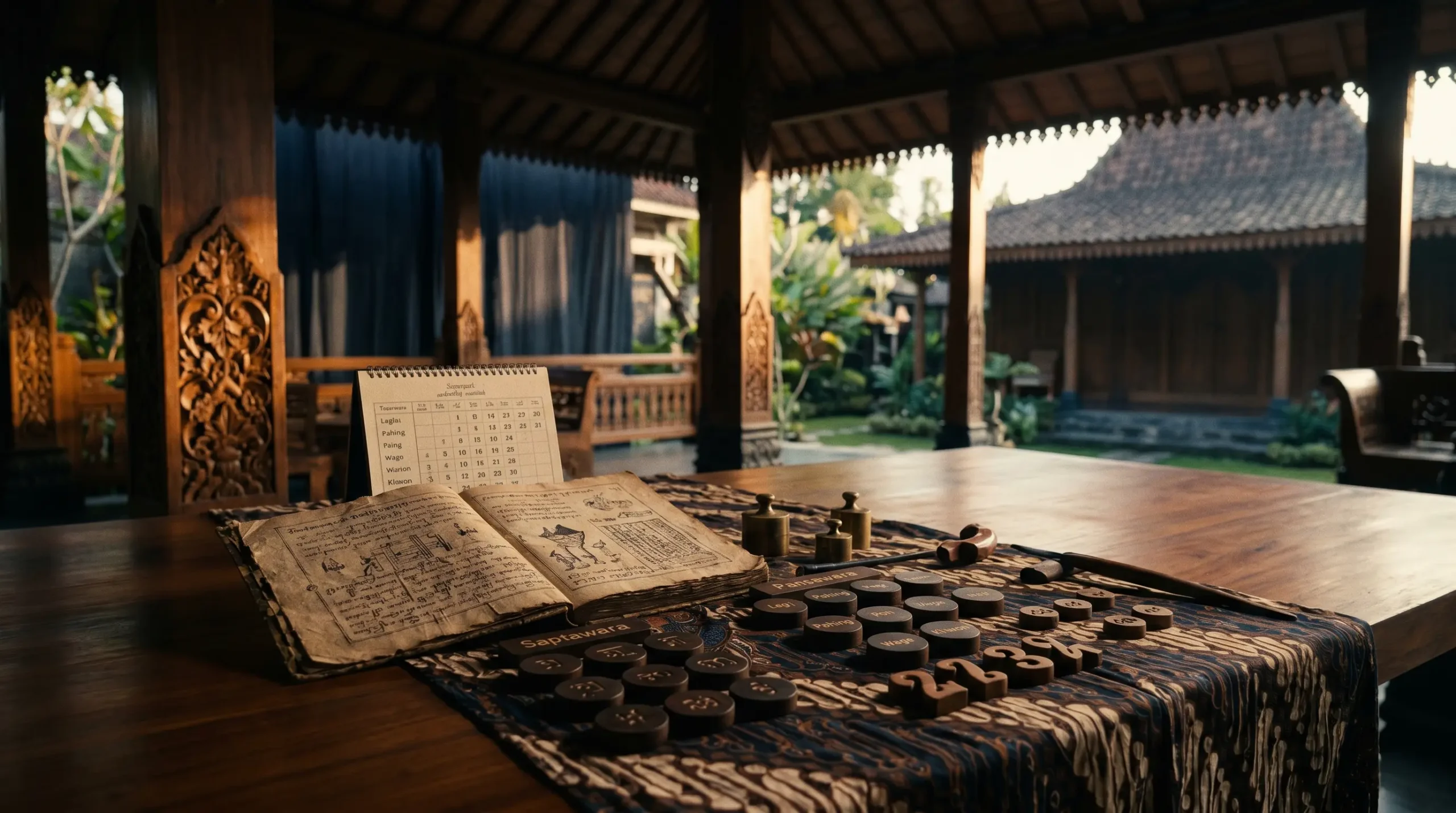
Javanese good days are often searched when a family wants to arrange an important event with care. In Primbon tradition, a good day may be considered for a wedding, engagement, moving house, starting a business, building a home, a long journey, or another family occasion that feels meaningful.
In Javanese culture, choosing a date is not only about finding an empty slot on the calendar. It may also involve family feeling, inner readiness, location, budget, communication, and traditional considerations. This is where Primbon Hari Baik, or the reading of good days, often appears as a cultural language.
Still, Javanese good days do not need to be read with fear. JavaSense places them as cultural considerations, not guarantees. Time may help people arrange a step more carefully, but the success of an event still depends on preparation, communication, responsibility, and real conditions.
Quick Answer: What Are Javanese Good Days in Primbon?
Javanese good days in Primbon are days considered culturally aligned with a certain activity through readings of the Javanese calendar, weekday, pasaran, weton, and neptu. In some families, the reading may also consider other cultural layers such as wuku or Pawukon.
In the JavaSense approach, a good day is safest when understood as a consideration, not as certainty that an event will run smoothly. A day considered favorable still needs real preparation. A day that feels less aligned should not make people afraid or stop them from acting responsibly.
What Is Read When Choosing Javanese Good Days?
When families read Javanese good days, they usually do not look at only one number. A family or cultural reader may consider several connected elements: the purpose of the event, the date, weekday, pasaran, weton, neptu, the Javanese calendar, and the readiness of the family.
That is why reading a good day should not be too narrow. A date that feels culturally aligned still needs to be combined with practical matters: venue availability, family agreement, budget, health, travel time, and whether the event can be held responsibly.
| Element Read | Basic Meaning | Safe Way to Read It |
|---|---|---|
| Purpose of the event | The kind of activity being planned. | A wedding, moving house, starting a business, and a long journey may need different considerations. |
| Javanese calendar | A cultural time map containing weekday, pasaran, and Javanese date. | Used as an entry point, not the only basis for a decision. |
| Weekday and pasaran | The meeting of the seven-day week and the five-day Javanese cycle. | Read as part of weton and neptu. |
| Weton | The combination of weekday and pasaran. | Read as a cultural consideration, not as a fixed label for a person. |
| Neptu | The numerical value of weekday and pasaran. | Used to understand a calculation pattern, not as a guarantee of good or bad results. |
| Real readiness | Family condition, budget, venue, health, timing, and communication. | Must still be considered before the event is held. |
How Javanese Primbon Relates to Good Days
Javanese Primbon is the larger body of traditional Javanese knowledge. It includes weton, pasaran, neptu, relationship readings, ilmu titen, the Javanese calendar, personal conduct, and good-day considerations.
Good days are one part of reading time within Primbon. They help families arrange timing so an event feels more culturally aligned. But cultural alignment is not the same as a guarantee of success.
To understand the connection with birth time and neptu, readers can also explore Primbon Weton and Javanese neptu.
7 Wise Ways to Read Javanese Good Days
To avoid misunderstanding, here are seven ways to read Javanese good days with care, clarity, and the JavaSense balance of feeling and reason.
1. Start from the Purpose of the Event
The first step is understanding the purpose of the event. A good day for a wedding, moving house, starting a business, building a home, or an important journey may involve different cultural considerations.
So do not read good days too generally. Begin with these questions: what event will be held, who is involved, and what preparation is already in place?
2. Look at the Javanese Calendar
The Javanese calendar helps readers see the date, weekday, pasaran, weton, and other elements of Javanese time. It becomes the first doorway for reading time more clearly.
From the calendar, a family can understand the weekday and pasaran before moving into other considerations.
3. Pay Attention to Weekday and Pasaran
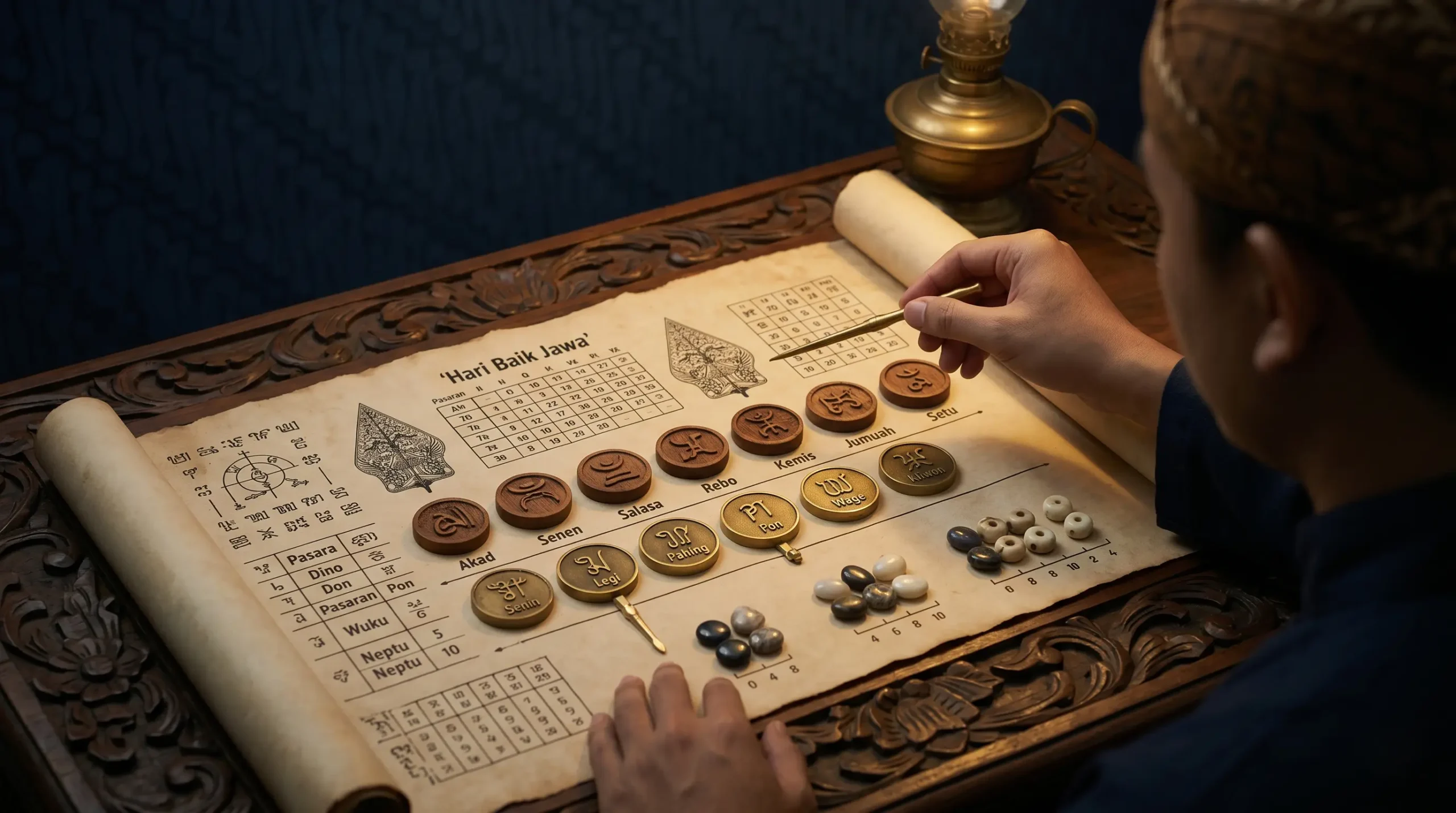
The ordinary weekday consists of Sunday, Monday, Tuesday, Wednesday, Thursday, Friday, and Saturday. The Javanese pasaran consists of Legi, Pahing, Pon, Wage, and Kliwon.
In Javanese culture, weekday and pasaran often form the foundation for weton and neptu. From here, good-day consideration can begin.
4. Understand Weton and Neptu
Weton is the combination of an ordinary weekday and a Javanese pasaran. Neptu is the numerical value of that weekday and pasaran.
For example, Jumat Kliwon has neptu 14 because Jumat is valued at 6 and Kliwon is valued at 8. Senin Legi has neptu 9 because Senin is valued at 4 and Legi is valued at 5.
To find weton from a birth date more practically, use the JavaSense tool to calculate weton from a birth date.
5. Do Not Forget Real Preparation
A good day should not stand alone. Real preparation remains essential: family readiness, budget, venue, health, timing, communication, and responsibility.
A day considered culturally favorable can still become difficult if preparation is weak. A simple day can still go well when everyone is ready, honest, and willing to work together.
6. Read It as Consideration, Not Guarantee
A common mistake is treating a good day as a guarantee. A healthier reading sees it as a cultural consideration.
It helps people arrange time and feeling. But the final result is still shaped by effort, communication, decisions, circumstances, and human responsibility.
7. Involve Family Calmly
In many Javanese families, good-day reading may involve parents or elder relatives. This can become a good space for dialogue when discussed calmly.
If there are different opinions, avoid blaming each other. Let Primbon become a cultural language for discussion, not a tool for forcing one side.
Neptu Values for Javanese Weekdays
These are the weekday neptu values commonly used in weton and good-day readings:
| Javanese / Indonesian Day | English Day | Neptu |
|---|---|---|
| Minggu | Sunday | 5 |
| Senin | Monday | 4 |
| Selasa | Tuesday | 3 |
| Rabu | Wednesday | 7 |
| Kamis | Thursday | 8 |
| Jumat | Friday | 6 |
| Sabtu | Saturday | 9 |
Neptu Values for the Javanese Pasaran Cycle
These are the pasaran neptu values commonly used in weton reading:
| Javanese Pasaran | Neptu |
|---|---|
| Legi | 5 |
| Pahing | 9 |
| Pon | 7 |
| Wage | 4 |
| Kliwon | 8 |
Example of Reading a Javanese Good Day
Imagine a family wants to choose a date for an important event. The first step is to look at the Javanese calendar, then notice the weekday, pasaran, weton, and neptu of the date being considered.
If a certain date falls on Jumat Kliwon, the weekday is Jumat and the pasaran is Kliwon. The neptu is:
Jumat Kliwon = Jumat 6 + Kliwon 8 = 14
But the number 14 should not be read immediately as a guarantee of good or bad results. It needs to be placed within the context of the event, family readiness, time, place, and real conditions.
This is how JavaSense reads Javanese good days: as cultural consideration, not as certainty about the outcome.
A Practical Case: When Family Opinions Differ
Imagine a family preparing an engagement event. One side wants to choose the nearest available date because the venue is ready. The other side wants to find a day that feels more aligned according to the Javanese calendar.
If this is not discussed calmly, the search for a good day can become a source of tension. Yet the original intention is usually simple: to arrange the event respectfully and make the family feel heard.
In a situation like this, Primbon Hari Baik should become a language for dialogue. The date can be considered, but venue readiness, budget, family health, guest timing, and communication between both sides must still be read together.
Ky Tutur’s reflection: A good day is not found only in calculation. A day becomes good when intention is arranged, dialogue is protected, and responsibility is not left behind.
Javanese Good Days for Marriage
In Javanese culture, good days are often discussed when a family plans a wedding. Families may look at the Javanese calendar, the weton of the couple, pasaran, neptu, and other traditional considerations.
But a good wedding day is not a guarantee that married life will always be easy. A marriage still needs communication, loyalty, family blessing, responsibility, and emotional maturity from both people.
If a couple wants to reflect on relationship patterns first, they can use the JavaSense tool to read weton compatibility with care.
Javanese Good Days for Moving House
Moving house is often seen as a major step. In Javanese culture, some families choose a day that feels aligned so the move feels more settled both emotionally and socially.
Still, real preparation matters. The house should be ready, family members should agree, documents should be clear, and the physical condition of the family should allow the move.
A good day can strengthen the feeling of readiness, but it cannot replace preparation.
Javanese Good Days for Starting a Business
In Javanese tradition, starting a business may also be connected with good-day reading. Reading time can help someone feel more steady when beginning a new step.
But a business does not succeed only because it starts on a certain day. Planning, capital, market research, honesty, service quality, and consistency remain essential.
A good day is best read as a reminder to begin with clear intention, not as a guarantee of success.
How Good Days Relate to the Javanese Calendar
The Javanese calendar is the main doorway into good-day reading. From the calendar, readers can see the date, weekday, pasaran, weton, and other cultural elements.
To check a specific date, use the JavaSense Javanese calendar. It helps readers follow the Javanese calendar cycle with pasaran and wuku more practically.
How Good Days Relate to Weton
Weton is often part of good-day consideration. In some family traditions, a person’s weton may be considered when deciding the timing of an important event.
Still, weton needs to be read wisely. It is not a fixed label and not a measure of human worth.
To understand weton more deeply, read Primbon Weton or use the JavaSense weton calculator when you need the practical result from a date.
How Good Days Relate to Wuku and Pawukon
Besides weton and pasaran, some Javanese cultural readings also pay attention to wuku and Pawukon. Wuku comes from the Pawukon cycle, which consists of 30 wuku across 210 days.
Wuku is different from weton. Weton comes from weekday and pasaran, while wuku comes from the Pawukon cycle. They can complement each other as cultural layers, but they should not be treated as the same thing.
To understand this layer of time, explore Pawukon and the 30 wuku cycle.
Common Mistakes When Reading Javanese Good Days
The first mistake is treating a good day as a guarantee. A good day is only one cultural consideration.
The second mistake is frightening the family with a certain day. In the JavaSense approach, no day should be used to make readers feel helpless or doomed.
The third mistake is ignoring real preparation. A good event needs planning, communication, budget, health, timing, and responsibility.
The fourth mistake is using Primbon to force a decision. Tradition should become a space for dialogue, not a pressure tool.
Safe Principles for Reading Good Days
Several principles can help readers approach good-day reading in Javanese Primbon:
- Read it as cultural consideration, not certainty about the result.
- Do not frighten yourself with a certain date or day.
- Do not force family members to accept only one reading.
- Use it as material for dialogue, not as an absolute decision.
- Combine it with real readiness, communication, and responsibility.
With this approach, reading a good day does not become a burden. It becomes a cultural space for arranging time more gently and consciously.
Use JavaSense to Read the Calendar and Weton
JavaSense offers several entry points for reading Javanese culture more practically. To read daily Javanese time, use the JavaSense Javanese calendar. To find weton from a birth date, use the JavaSense weton calculator.
To understand the wider Primbon frame, read Javanese Primbon. To reflect on relationship patterns, use the JavaSense weton compatibility tool. To try another cultural tool, readers can also write in Javanese script.
To explore weton, the Javanese calendar, Primbon, wuku, Pawukon, and Javanese script in one place, visit JavaSense as a Javanese cultural platform.
For a more practical mobile experience, readers can download the JavaSense Android app through Google Play.
Cultural References for Javanese Good Days
For general background, readers may also see external references on Primbon and the Javanese calendar.
External references help give basic context. JavaSense, meanwhile, presents good-day reading in a practical, reflective, and safer language for modern readers.
Closing Reflection: Read Good Days with Awareness
Javanese good days in Primbon are a cultural way of reading time with care. Inside the reading are weekday, pasaran, weton, neptu, the Javanese calendar, and sometimes wuku as part of the feeling of time.
But a good day should not make people forget effort. A good time still needs good intention, good preparation, and good responsibility.
So read Javanese good days calmly. Honor the tradition, understand its limits, and use it as a cultural mirror for arranging life more wisely.
FAQ About Javanese Good Days
What are Javanese good days?
Javanese good days are days considered culturally aligned with a certain activity through readings of the Javanese calendar, weekday, pasaran, weton, and neptu.
Does a good day guarantee that an event will run smoothly?
No. A good day does not guarantee that an event will run smoothly. Real preparation, communication, responsibility, and circumstances still matter.
How are Javanese good days related to weton?
Weton is often one consideration in good-day reading because it relates to weekday, pasaran, and neptu.
How do I read good days in the Javanese calendar?
The first step is to look at the date, weekday, pasaran, weton, and other Javanese calendar elements, then read them together with the purpose of the event and real readiness.
Is Primbon Hari Baik the same as fortune telling?
No. In the JavaSense approach, Primbon Hari Baik is read as cultural consideration and reflection, not as absolute prediction.
Should a day considered less favorable always be avoided?
Not always. A day considered less aligned is safer when read as a reminder to prepare more carefully, not as a reason to be afraid.
Where can I check the Javanese calendar online?
Readers can use the JavaSense Javanese calendar to view Javanese dates, pasaran, weton, and related calendar elements more practically.