

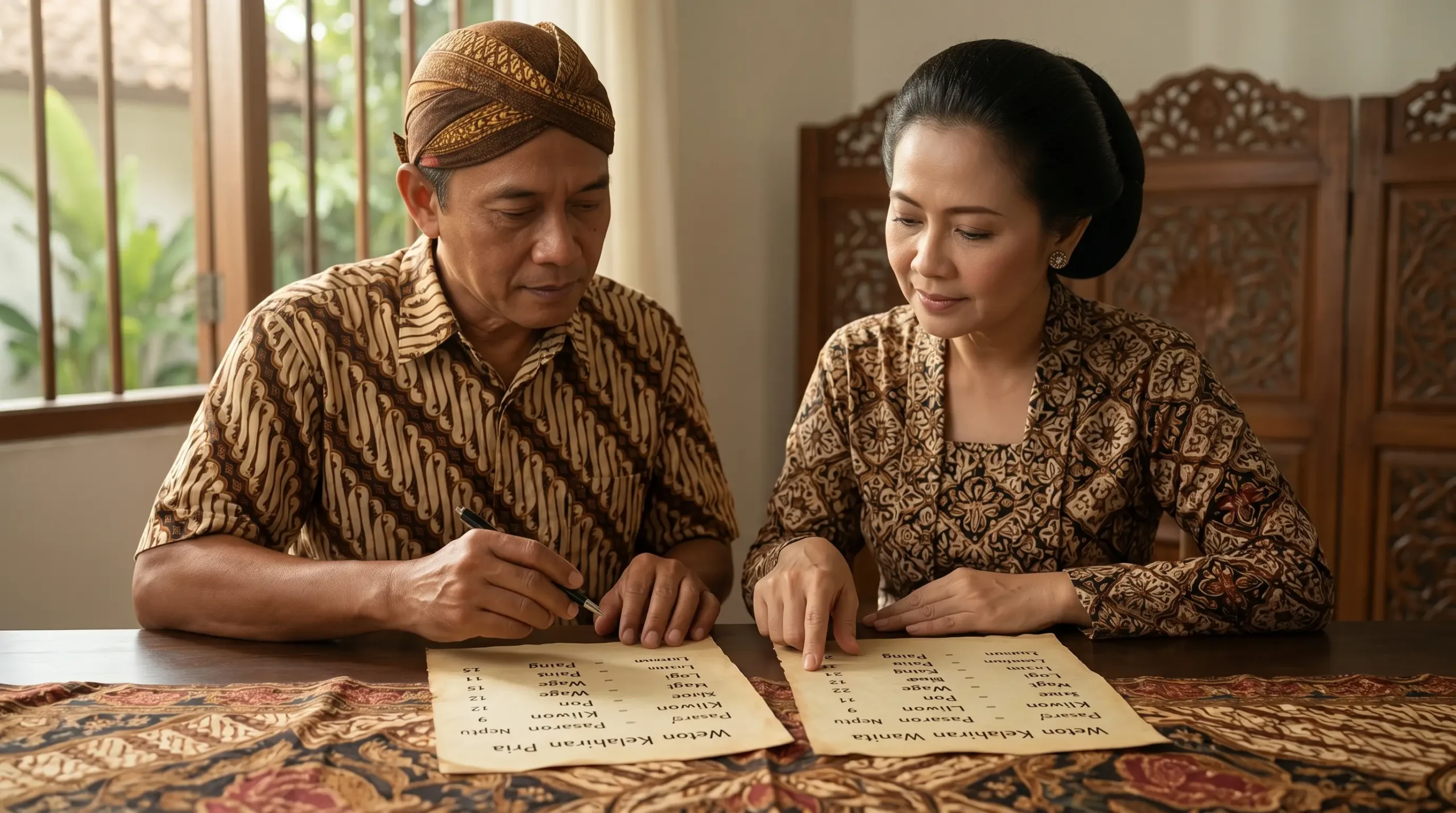
Some couples begin with a simple question: what is my weton, and what is my partner’s weton? The answer may feel small, but in Javanese family conversations, it often opens the door to pasaran, neptu, and relationship reflection.
This is why check Weton for couples should begin calmly. The first step is not to judge whether a couple is suitable or not. The first step is to find the basic data: each partner’s birth weekday, Javanese pasaran, and neptu.
In JavaSense, couple weton is read as a cultural doorway. After both weton are known, readers can continue toward Weton compatibility with more care, without turning the result into fear or a final verdict.
Quick Answer: How Do You Check Weton for Couples?
To check Weton for couples, find each partner’s birth weekday and Javanese pasaran from their birth dates, then calculate each neptu by adding the weekday value and pasaran value. This gives the basic weton data for both partners before reading Weton compatibility.
In JavaSense, the result should be read as cultural reflection, not as a final verdict on the relationship.
- Couple weton helps identify each partner’s birth weekday and Javanese pasaran.
- Neptu is calculated from weekday value plus pasaran value.
- Weton compatibility is the next step after both weton are known.
- Heavy results should be read as signs for caution, not as commands to separate.
- To begin, calculate each partner’s weton from a birth date.
What Does It Mean to Check Weton for Couples?
Checking Weton for couples means finding the weton of two people from their birth dates. Each weton is formed from the meeting of a weekday and a Javanese pasaran.
For example, one partner may have the weton Friday Kliwon. Another partner may have Monday Legi. Each weton has its own neptu value, and those values become the first foundation before reading compatibility.
This process is not the same as deciding the whole relationship. It only helps the couple and family understand the cultural data that appears before a deeper Weton compatibility reading.
To understand the foundation more fully, read Javanese weton and Javanese pasaran.
Check Weton for Couples vs Weton Compatibility
Many readers use these two phrases as if they mean the same thing. They are connected, but their focus is different.
| Term | Main Focus | What You Get |
|---|---|---|
| Check Weton for couples | Finding each partner’s weton, weekday, pasaran, and neptu. | Basic weton data for both partners. |
| Weton compatibility | Reading the combined neptu of two people through relationship patterns. | Results such as Pegat, Ratu, Jodoh, Topo, Tinari, Padu, Sujanan, or Pesthi. |
So, checking couple weton is the first door. After both weton and neptu are known, readers can continue to how to check Weton compatibility or use the JavaSense Weton compatibility tool.
What You Need Before Checking Both Partners’ Weton
The data needed is simple. You need the birth dates of both partners. From those dates, the weekday and Javanese pasaran can be found.
- The first partner’s birth date, to find their weekday and Javanese pasaran.
- The second partner’s birth date, to find their weekday and Javanese pasaran.
- Birth weekday, such as Monday, Tuesday, Wednesday, Thursday, Friday, Saturday, or Sunday.
- Javanese pasaran, namely Legi, Pahing, Pon, Wage, or Kliwon.
- Neptu weton, which is the total value of weekday and pasaran.
If you only know the birth dates but not the pasaran, use the JavaSense Weton calculator first. It helps find weton, pasaran, and neptu from a birth date without doing the calendar work manually.
How to Find Each Partner’s Weton from a Birth Date
To find each partner’s weton from a birth date, the process can be arranged step by step.
- Enter or identify the first partner’s birth date.
- Find the birth weekday, such as Monday, Wednesday, or Friday.
- Find the Javanese pasaran, such as Legi, Pahing, Pon, Wage, or Kliwon.
- Combine weekday and pasaran into weton, such as Monday Legi or Friday Kliwon.
- Repeat the same steps for the second partner.
- Calculate the neptu of each weton.
- Use both neptu values as the basic data before reading compatibility.
The key is not to skip the pasaran. Two people may share the same weekday, but different pasaran can produce different weton and neptu values.
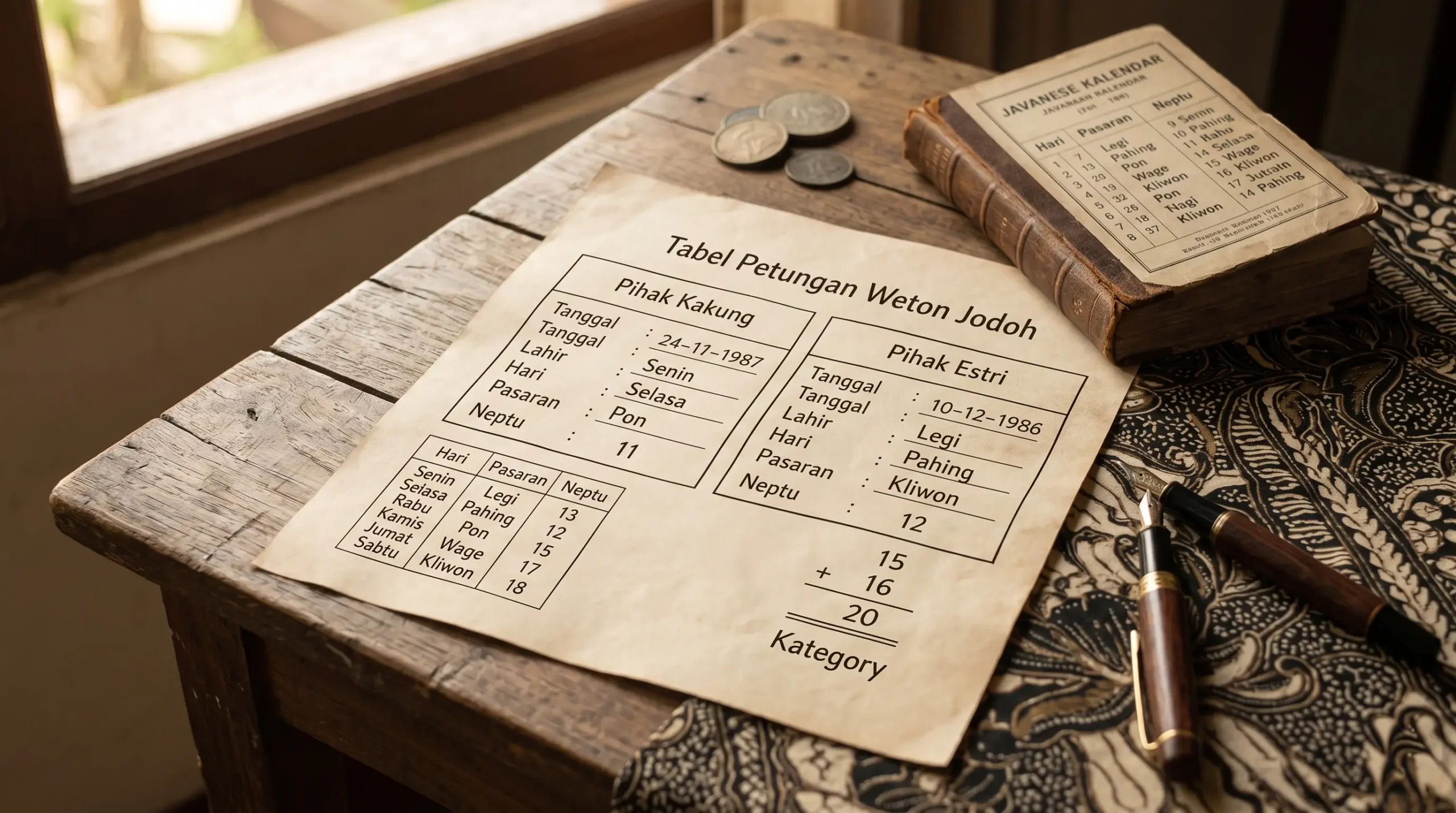
Weekday Neptu Values
Neptu is the numerical value used in Javanese weton reading. The table below shows the weekday values commonly used as the foundation of weton calculation.
| Weekday | Javanese / Indonesian Name | Neptu Value |
|---|---|---|
| Sunday | Minggu | 5 |
| Monday | Senin | 4 |
| Tuesday | Selasa | 3 |
| Wednesday | Rabu | 7 |
| Thursday | Kamis | 8 |
| Friday | Jumat | 6 |
| Saturday | Sabtu | 9 |
Javanese Pasaran Neptu Values
Javanese pasaran also has neptu values. These values are added to weekday values to form neptu weton.
| Javanese Pasaran | Neptu Value |
|---|---|
| Legi | 5 |
| Pahing | 9 |
| Pon | 7 |
| Wage | 4 |
| Kliwon | 8 |
These numbers help give structure to the reading. Still, neptu should be understood as a cultural symbol, not as a measure of someone’s worth. For a fuller explanation, read neptu weton values.
Example: Friday Kliwon and Monday Legi
Imagine the first partner was born on Friday Kliwon. Friday has a neptu value of 6, and Kliwon has a neptu value of 8.
Friday Kliwon = Friday 6 + Kliwon 8 = neptu 14.
Now imagine the second partner was born on Monday Legi. Monday has a neptu value of 4, and Legi has a neptu value of 5.
Monday Legi = Monday 4 + Legi 5 = neptu 9.
At this stage, readers already have the basic weton data of both partners. The next step is to read compatibility carefully, not to judge the relationship too quickly from numbers alone.
What Comes After Both Weton Are Known?
After both weton and neptu values are known, the combined neptu can be read through Weton compatibility patterns. The result may appear as Pegat, Ratu, Jodoh, Topo, Tinari, Padu, Sujanan, or Pesthi.
Each result has a symbolic meaning. Some results are often read as lighter. Others are often read as heavier or asking for caution. But every result still needs to be placed as reflection, not as an absolute decision.
To understand the method more fully, read how to calculate Weton compatibility. To understand each result name, open Weton compatibility results.
Light and Heavy Results in Couple Weton Reading
In everyday conversation, some Weton compatibility results are often considered supportive, while others are considered heavy. JavaSense keeps this distinction careful and non-deterministic.
| Result Group | Examples | JavaSense Reading |
|---|---|---|
| Often read as lighter | Ratu, Jodoh, Tinari, Pesthi | Supportive signs that still need care, humility, and responsibility. |
| Often read as heavier | Pegat, Topo, Padu, Sujanan | Signs for caution so the couple does not rush and can communicate more maturely. |
A supportive result can still become difficult if the couple does not care for the relationship. A heavy result can become useful if it helps the couple become more patient, open, and responsible.
If the result feels heavy, read when Weton compatibility does not match. For the wider safety principle, read Weton compatibility is not a verdict.
A Case Example: When Topo Makes a Couple Worried
Imagine a couple preparing to talk about engagement. They already know each other’s family, but after the weton is calculated, the result falls into Topo. One side becomes anxious because Topo is often connected with tests, patient effort, or a demanding process.
If read with fear, this result may make the couple feel the relationship is already heavy from the beginning. But in JavaSense, Topo can be read as a reminder that a serious relationship should not rely only on affection.
The couple may need to prepare patience, better discussion habits, readiness under pressure, and the courage to grow together. In this way, the weton result does not become a wall. It becomes a small sign that asks the couple to become more aware.
When Should Couples Check Weton?
Couples often check weton when the relationship begins to feel serious. This may happen before engagement, before marriage talks, or when family members start asking about Javanese tradition.
But checking weton can also be done earlier as cultural learning. The important thing is not to use the result to pressure a partner or make a rushed decision.
- When both partners want to know their weton and neptu.
- When the couple wants to understand pasaran and Javanese calendar context.
- When the relationship begins to move toward a serious stage.
- When family members want to include Javanese tradition in the discussion.
- When the couple wants to read compatibility as a starting point for dialogue.
If the discussion has already moved toward marriage, read Weton for marriage for a wider guide.
Myths and Safer Facts About Checking Couple Weton
Several misunderstandings often appear when people check Weton for couples. These myths need to be softened so tradition does not turn into fear.
| Myth | Safer Fact |
|---|---|
| Couple weton can decide whether a relationship will succeed or fail. | No. Weton is one cultural language for reflection, not certainty about fate. |
| If the result feels heavy, the couple is certainly not suitable. | No. Heavy results are safer as reminders to care for communication, trust, and readiness. |
| If the result feels supportive, the relationship will always be easy. | No. Supportive results still need responsibility, maturity, and daily care. |
| Couple weton can replace family dialogue. | No. In Javanese culture, family discussion, blessing, and real conditions still matter. |
Common Mistakes When Checking Weton for Couples
Several mistakes can make couple weton feel more frightening than it should be. These are the ones to avoid.
- Looking for a verdict too quickly. Begin by understanding the data: weekday, pasaran, and neptu.
- Treating heavy results as the end of the relationship. Pegat, Topo, Padu, and Sujanan are safer as signs for caution.
- Feeling too safe with supportive results. Ratu, Jodoh, Tinari, and Pesthi still need care.
- Using weton to blame a partner. Weton should become a shared mirror, not a tool for pressure.
- Ignoring the real relationship. Communication, responsibility, family blessing, readiness, and shared values still need to be seen clearly.
Ky Tutur’s reflection: Two weton may be calculated, but two hearts still need to speak. Do not only look for harmony in numbers. Look also for harmony in conduct.
Use JavaSense to Check Weton and Compatibility
JavaSense provides digital tools to help readers calculate weton and compatibility more practically. If you want to find each partner’s weton first, use the JavaSense Weton calculator.
If you want to read the couple’s compatibility result directly, use the JavaSense Weton compatibility tool. If you want to explore several tools in one place, open JavaSense cultural tools.
Digital tools can help calculate faster, but the reading still needs a calm heart. JavaSense does not place weton as fixed prediction. It is read as cultural inheritance that can help couples and families speak more carefully.
How Couple Weton Connects with the Javanese Calendar
Checking Weton for couples cannot be separated from the Javanese calendar. To know someone’s weton, the weekday and pasaran of the birth date need to be known.
The Javanese calendar helps readers understand the relationship between Gregorian date, weekday, pasaran, weton, neptu, and other Javanese time elements.
If you want to understand the five-day cycle that forms weton, read Javanese pasaran. To understand the number side, continue to neptu weton values.
Cultural References on Weton and Primbon
In Javanese tradition, weton reading is often connected with Primbon, petungan, pasaran, good-day considerations, and the way communities arrange caution before making important decisions. Because of that, couple weton is safer when placed as cultural literacy, not certainty about fate.
For library references, readers may explore Kitab Primbon Jawa Serbaguna in BintangPusnas. The Primbon catalog entry at the National Library of Indonesia also shows Primbon as part of written cultural heritage around good days, character reflection, and Javanese tradition.
External references help place weton in a wider cultural context. The final relationship decision still needs real conditions, communication, readiness, and family dialogue.
Learn Weton Compatibility with JavaSense
If you want to learn in order, start with the Weton calculator to find each person’s weton. After that, continue to Weton compatibility with care.
To learn the practical process, read how to check Weton compatibility. To understand the formula, read how to calculate Weton compatibility. To understand results such as Pegat, Ratu, Jodoh, Topo, Tinari, Padu, Sujanan, and Pesthi, open Weton compatibility results.
To keep the reading safe, read weton is not fortune telling and Javanese weton myths.
To explore weton, the Javanese calendar, Primbon reflection, wuku, Pawukon, and Javanese script in one place, JavaSense can also be read as a Javanese cultural platform.
Closing: Read Two Weton with a Calm Heart
Checking Weton for couples can help two people understand birth weekday, Javanese pasaran, and neptu. From there, they can continue toward Weton compatibility with more care.
But numbers should not replace affection, responsibility, communication, and family dialogue. Weton may give a sign, but a relationship is still cared for by the people who live it.
So read couple weton calmly. If the result feels supportive, care for it with humility. If the result feels heavy, use it as a starting point for dialogue so the relationship can grow with more maturity.
To learn weton, relationship reflection, pasaran, neptu, the Javanese calendar, and script in a lighter way, you can also open JavaSense on Google Play.
FAQ About Checking Weton for Couples
What does it mean to check Weton for couples?
Checking Weton for couples means finding the weton of two people from their birth dates, then reading each person’s weekday, Javanese pasaran, and neptu as basic relationship data in Javanese tradition.
How do you check Weton for two partners?
Check each partner’s birth date, find the weekday and Javanese pasaran for each date, then calculate each neptu by adding the weekday value and pasaran value.
What data is needed to check couple Weton?
The main data needed is the birth date of each partner. From each birth date, the weekday, Javanese pasaran, weton name, and neptu can be found.
What is the difference between couple Weton and Weton compatibility?
Couple Weton focuses on finding each partner’s weton, pasaran, and neptu. Weton compatibility reads the combined neptu of two people through relationship categories such as Pegat, Ratu, Jodoh, Topo, Tinari, Padu, Sujanan, or Pesthi.
Does couple Weton decide compatibility?
No. Couple Weton gives basic cultural data, but compatibility should still be read with communication, responsibility, readiness, family blessing, and real-life context.
Does a heavy result mean the relationship should stop?
No. A heavy result is safer to read as a reminder for caution, communication, trust, and maturity, not as an immediate reason to stop the relationship.
Where can I check couple Weton online?
You can use the JavaSense Weton calculator to find each partner’s weton, or use the JavaSense Weton compatibility tool to read the couple’s compatibility result from two birth dates.
Is checking Weton for couples the same as fortune-telling?
No. In JavaSense, checking Weton for couples is read as Javanese cultural reflection, not as fixed fortune-telling or an absolute prediction about the relationship.