

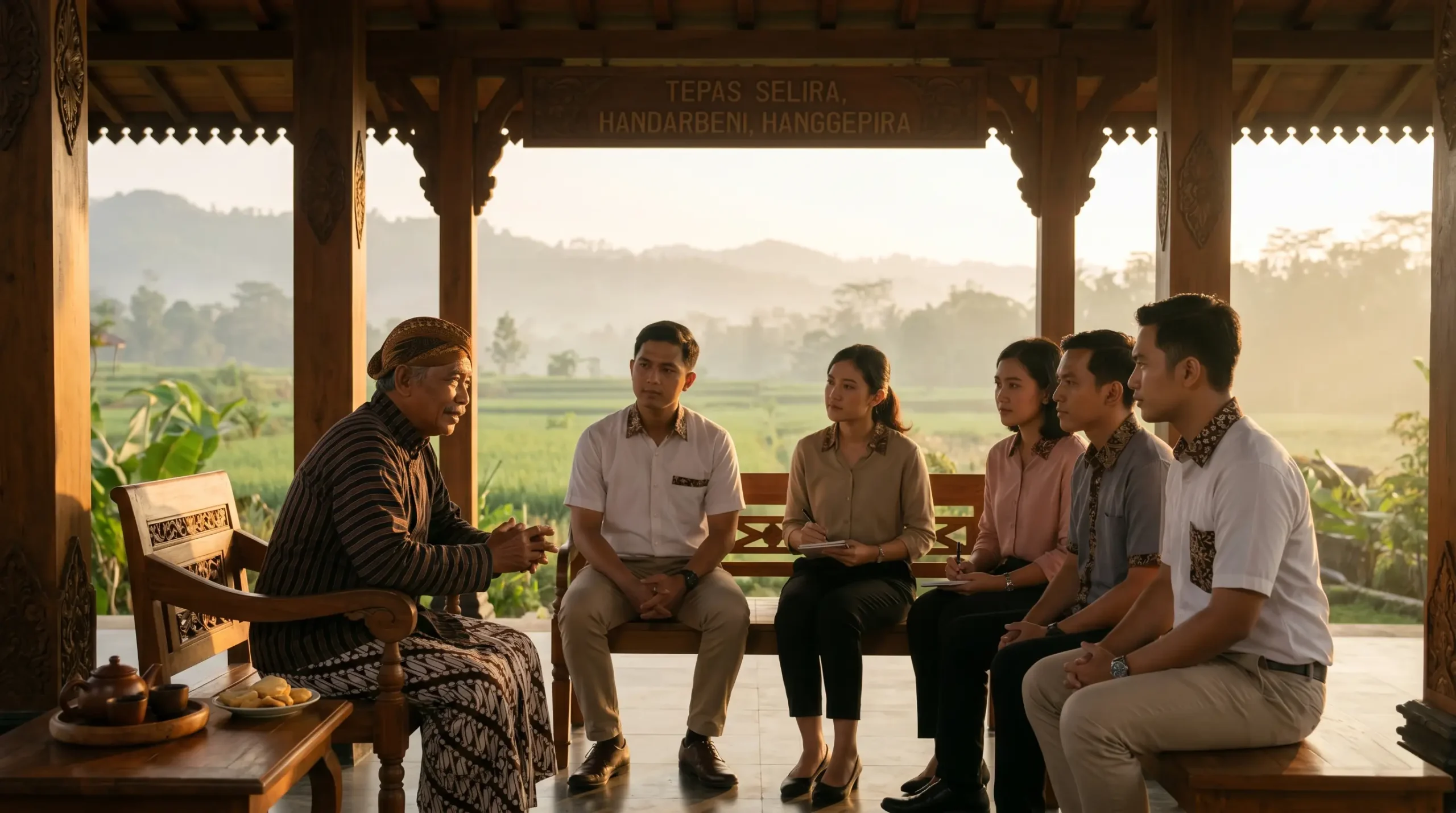
Angger, my child…
There are people who rise a little, then feel higher than everyone else. There are people who receive a position, then forget how to listen. There are people who know more, then belittle those who are still learning. In moments like these, Javanese pitutur speaks softly but firmly: aja dumeh.
Ky Tutur Summary
- Aja dumeh is Javanese wisdom that reminds people not to act entitled because of position, wealth, knowledge, age, experience, or success.
- Its meaning is not to forbid confidence, but to prevent confidence from turning into arrogance or domination.
- In teamwork, aja dumeh helps leaders listen, seniors guide without belittling, juniors respect experience, and teams work without being ruled by ego.
- This teaching is close to eling lan waspada, tepa slira, rukun, ngemong, and the ability to receive feedback without feeling destroyed.
Ky Tutur Note: This article discusses aja dumeh as Javanese cultural wisdom and reflection for teamwork. It is not formal management theory, not employment-law advice, and not a replacement for professional workplace policy. Read it as a mirror for ethics, communication, humility, and daily conduct.
Aja dumeh can be understood simply as “do not act entitled” or “do not be arrogant just because you have something.” Do not act entitled because you have authority. Do not act entitled because you are older. Do not act entitled because you are smarter. Do not act entitled because you have succeeded before. Do not act entitled because others currently need your help.
In Javanese rasa, this pitutur is not merely a warning against obvious arrogance. It is a reminder that every advantage is temporary. Position can change. Wealth can decrease. Knowledge can become outdated. The body can weaken. Praise can turn into criticism. Even experience can become a wall if it is no longer willing to learn.
Because of that, aja dumeh is deeply relevant to modern teamwork. In workplaces, communities, organizations, and digital projects, many problems are not born from lack of skill, but from ego that has not been arranged. A clever person refuses to listen. A leader refuses correction. A senior feels they know everything. A junior becomes afraid to speak. The team still moves on the surface, but inside it, distance grows.
What Does Aja Dumeh Mean?
Aja dumeh means do not become “because I am…” in a harmful way. Because I am the leader, I can pressure others. Because I am older, I must always be right. Because I know more, I may belittle those who are still learning. Because I have succeeded once, I no longer need evaluation.
The problem is not the advantage itself. A person may be intelligent. A person may become a leader. A person may have long experience. A person may be successful. What becomes dangerous is when that advantage is used as permission to lower another human being.
So, aja dumeh is not a teaching that makes people shrink themselves. It is not a command to hide ability or reject confidence. It teaches a more mature courage: to be capable without belittling, to lead without oppressing, to understand without feeling most sacred, and to stand tall without stepping on others.
This is why aja dumeh should not be read as weak humility. It is disciplined humility. It asks human beings to remember that every advantage carries responsibility.
The Meaning of Aja Dumeh in Javanese Culture
In Javanese culture, people are invited to guard rasa. The content of speech matters, but so do the way, timing, tone, and effect on relationships. A person who is dumeh often fails to read this rasa. They speak as if everyone must accept. They decide as if no one else is affected. They advise as if the other person has no dignity.
Aja dumeh becomes a fence so human beings remain eling. Eling that today they may be above, but life can turn. Eling that success rarely appears alone. There are teachers, family members, coworkers, opportunities, health, timing, and circumstances that help a person arrive where they are.
This value is close to eling lan waspada. Eling keeps a person from forgetting origin and responsibility. Waspada keeps advantage from turning into carelessness. A person who is eling does not become drunk on praise. A person who is waspada does not use power recklessly.
Aja dumeh also protects social harmony. It does not erase difference, rank, or responsibility. It simply reminds every person that rank without humility can become a wound.
Visible Dumeh and Subtle Inner Dumeh
There is visible dumeh. This appears when someone speaks harshly to a subordinate, dismisses other people’s opinions, displays wealth to humiliate, or uses position to force decisions. This kind is easier to recognize because it leaves clear marks.
But there is also subtle dumeh. A person may not speak harshly, yet always feel their idea is the best. They may sit in a meeting only to wait for their turn to refute. They may praise others on the surface, yet inwardly believe their own contribution matters most. They may appear humble, but never truly listen.
This subtle dumeh is often more difficult to clean because it hides behind experience, achievement, status, or the feeling of “I already know.” It does not always shout. Sometimes it speaks gently, but closes the door to learning.
Here, aja dumeh becomes inner practice, not only social etiquette. It asks: do I still listen? Do I still learn? Do I still remember the people who helped me? Do I still respect those who are walking behind me?

Aja Dumeh in Teamwork
Teamwork needs the ability to listen. Without listening, a team becomes only a group of people working near each other while walking with their own egos. Aja dumeh helps a team remember that no contribution deserves to be carelessly dismissed.
A leader needs a team. A senior needs fresh perspective. An expert needs other people who can see gaps from another side. A junior also needs room to learn so courage can grow. When one person feels most important, the flow of work begins to clog.
In a healthy team, people may disagree without tearing one another down. Criticism may be given without humiliation. Experience is respected, but new ideas are still given room. This is aja dumeh becoming alive in real work.
The goal is not to make everyone equal in role. Roles may differ. Responsibility may differ. But dignity should still be protected. A team becomes stronger when power is used to guide, not to silence.
When Seniors Feel They Know Best
One common form of dumeh in the workplace is dumeh because of experience. A person who has worked longer may feel that every new idea is unnecessary. They may see juniors as people who do not understand anything, even though juniors may bring fresh perspective.
Experience is valuable. But experience that refuses renewal can become a fence. Someone who trusts the old way too much may not realize that the situation has changed. Technology changes. User behavior changes. Communication habits change. Team needs also change.
Aja dumeh reminds seniors to become guides, not walls. A mature senior is not afraid to share knowledge. They do not feel their value decreases when others grow. The dignity of experience appears not only in knowing much, but in helping others become capable.
A senior who practices aja dumeh does not say, “You know nothing.” They say, “Let us understand this path together. I have seen some parts before, and perhaps you see what I no longer see.”
When Juniors Feel New Ideas Are Always Better
Dumeh does not only happen to seniors. Juniors can also become dumeh. Because they master new tools, they may belittle older experience. Because they bring fresh ideas, they may assume every previous method is outdated. This is also a form of forgetfulness.
New ideas matter. But new ideas still need to understand the field. There may be a history behind old decisions, limits in the team, user habits, technical risks, and lessons learned from failures that are not visible from the outside.
So, aja dumeh applies in both directions. Seniors learn to listen to what is new. Juniors learn to respect what has already walked. When both meet with humility, a team does not only move faster. It also moves more maturely.
This is the balance JavaSense wants to preserve: old wisdom does not kill innovation, and innovation does not mock old wisdom.
Aja Dumeh for Leadership
In leadership, aja dumeh becomes an important fence. Position can easily make someone feel that every decision must follow their will. Yet a good leader does not only give orders. A good leader guards direction, listens to conditions on the ground, and dares to correct themselves.
A leader who is dumeh often creates a fearful team. People do not dare to give input. Problems are hidden to avoid anger. Mistakes are covered up. On the surface everything may look orderly, but inside, the structure is fragile.
A leader who lives aja dumeh is different. They remain firm, but do not belittle. They can decide, but do not close their ears. They give room for team members to grow. This is close to the value of ngemong: guiding without dominating.
Leadership with aja dumeh does not remove authority. It purifies authority. Power is no longer used to make others smaller, but to help the shared work become clearer.
Aja Dumeh and Tepa Slira
Aja dumeh cannot be separated from tepa slira. A person who is dumeh struggles to place themselves in another person’s position because they are too busy seeing the world from the throne of their own ego.
Tepa slira helps someone ask: how does it feel to be the person I lead? How does it feel to be a teammate whose opinion is always cut off? How does it feel to be a junior who is afraid to ask because they might be called foolish?
Questions like these make aja dumeh more than moral advice. It becomes communication practice. Before speaking, weigh rasa. Before correcting, choose the way. Before deciding, see the impact on others.
The point is not to soften every truth until it becomes unclear. Truth still matters. But truth delivered without tepa slira can become a weapon. Aja dumeh asks truth to walk with dignity.
Aja Dumeh and Rukun in Teams
Rukun does not mean everyone must always agree. Healthy rukun gives space for different opinions without allowing people to damage one another. Aja dumeh helps preserve rukun because it brings ego down from the highest chair.
In a team, conflict often happens not only because of the work itself, but because people feel unappreciated. Someone’s idea is taken without being credited. Someone’s hard work is invisible. Someone is always blamed while another is always praised.
Rukun invites human beings to care for relationships. Aja dumeh reminds us that relationships are damaged when one person feels most important. When people respect one another, work becomes lighter and results become easier to care for together.
In this sense, aja dumeh is not only about one person’s humility. It is also a cultural tool for keeping a team human.
7 Practices of Aja Dumeh in Work and Life
Good pitutur needs to descend into laku. Here are seven simple ways to bring aja dumeh into daily life, especially in teamwork.
1. Remember Who Helped You
When you succeed, do not remember only yourself. Remember the people who taught you, opened doors, helped the process, corrected mistakes, or quietly kept the work moving.
2. Give Others Room to Speak
In meetings or discussions, do not always become the loudest voice. Sometimes wisdom comes from the person who speaks the least. Your task is to create enough room for that voice to appear.
3. Receive Feedback Without Feeling Humiliated
Criticism is not always an attack. Feedback can be a mirror. When someone corrects you, breathe first. Listen to the content. Separate wounded pride from the chance to improve.
4. Do Not Use Position to Pressure Others
Position is a responsibility, not a tool for frightening people. Leaders may be firm, but firmness does not need to belittle. People respect fair leaders more deeply than leaders who are only feared.
5. Respect Another Person’s Learning Process
Everyone was once a beginner. When a coworker does not understand yet, guide patiently. Do not make people afraid to learn because you forgot that you too once did not know.
6. Celebrate Results Without Becoming Drunk on Praise
Success may be celebrated. But after that, evaluate. What worked well? What needs improvement? Who deserves appreciation? Praise should not close the eyes.
7. Close the Day with Eling
Before resting, ask: did I belittle someone today? Did I truly listen? Is there someone I need to thank? This small practice keeps the heart close to the ground.

Aja Dumeh in the Digital Age
In the digital age, dumeh appears in new forms. Because someone has many followers, they may feel every opinion is correct. Because something goes viral, they may look down on people who are not known. Because someone masters one field, they may feel allowed to insult those with different views.
Digital space can enlarge ego quickly because applause arrives quickly. But quick applause can also disappear quickly. Because of that, aja dumeh becomes an inner brake. It reminds human beings not to measure dignity only from numbers, praise, or attention.
If you build work, apps, content, communities, or a digital business, treat visibility as responsibility. The more people see you, the more important it is to guard speech. The greater the influence, the greater the need for accountability.
Aja dumeh in the digital age can be simple: do not mock people who are still learning, do not humiliate someone for engagement, do not confuse virality with truth, and do not use knowledge as a weapon for lowering others.
Aja Dumeh, Ewuh Pakewuh, and Emotional Control
Aja dumeh is connected with several other Javanese teachings. Ewuh pakewuh reminds us that reluctance can protect harmony, but it can also make people unable to speak. In a team, a dumeh leader often makes members even more ewuh pakewuh when they need to raise problems.
Because of that, ngendhaleni emosi, or guiding emotion, is needed. When receiving criticism, do not become hot immediately. When an idea is rejected, do not quickly feel belittled. When a decision differs from your wish, do not rush to attack.
These teachings are connected. Aja dumeh guards the ego. Ewuh pakewuh reminds us about social hesitation. Ngendhaleni emosi keeps reaction from causing damage. Tepa slira makes communication more humane.
Together, they invite people to build relationships that are not only polite on the surface, but also healthier inside.
JavaSense and a Clearer Way to Read Javanese Pitutur
JavaSense reads Javanese culture as a mirror, not a verdict. Weton, the Javanese calendar, script, primbon, wayang, and pitutur should not make people afraid or feel locked. They are better used as doors of learning so life becomes more aware.
If you want to read the rhythm of days in Javanese tradition, open the JavaSense Javanese calendar. If you want to know weton as cultural reflection, use the JavaSense weton calculator wisely. If you want to explore written heritage, try the JavaSense Javanese script tool.
As a broader public cultural reference, readers may also visit the National Library of Indonesia. References like this help cultural reading stay connected to learning and public knowledge.
The JavaSense path is simple: honor old teachings, but do not use them to judge carelessly. Study culture, but do not freeze in the past. Bring pitutur into conduct, so knowledge becomes useful.
Closing Reflection: Standing Tall Without Lowering Others
In the end, aja dumeh teaches human beings to stay grounded. Not so they never grow, but so their growth does not wound. Not so they never become excellent, but so excellence does not become a tool for humiliating others.
Angger, my child, if today you are given knowledge, use it to illuminate. If you are given position, use it to protect and guide. If you are given sustenance, use it to bring benefit. If you are given experience, use it to accompany those who are still learning.
A person who is not dumeh is not a small person. They are large because they can restrain the ego. They know dignity is not born from making others look low. Dignity is born from the ability to stand firm without stepping on anyone.
So bring this pitutur into your home, work, digital space, and daily relationships. Rise when it is time to rise. But never forget to bow inwardly, remembering the ground that once held your steps.
To learn Javanese culture in a lighter and more modern way, you can download JavaSense on Google Play.
FAQ About Aja Dumeh
What does aja dumeh mean?
Aja dumeh means do not act entitled or arrogant just because you have position, wealth, knowledge, experience, age, success, or temporary advantage.
Is aja dumeh the same as not being confident?
No. Aja dumeh does not forbid confidence. It reminds people that confidence should not turn into arrogance, domination, or the habit of belittling others.
What is an example of aja dumeh in teamwork?
Examples include leaders who keep listening to the team, seniors who patiently guide juniors, and experienced people who do not dismiss fresh ideas too quickly.
Why is aja dumeh important for leaders?
Aja dumeh is important for leaders because position can make people feel most correct. This teaching helps leaders stay humble, fair, open to feedback, and careful with power.
How is aja dumeh connected with tepa slira?
Aja dumeh lowers the ego, while tepa slira helps people weigh another person’s rasa. Together, they make communication more respectful, humane, and fair.
Can juniors also act dumeh?
Yes. Juniors can act dumeh when they believe new ideas are always better and then belittle older experience. Aja dumeh applies to every position.
How can someone practice aja dumeh?
Start by remembering who helped you, giving others room to speak, receiving feedback calmly, not using position to pressure people, and ending the day with self-reflection.
Why is aja dumeh relevant in the digital age?
Aja dumeh is relevant in the digital age because visibility, followers, virality, and expertise can easily make people feel most correct. It helps keep influence responsible.
Learn Aja Dumeh with Clearer Awareness
Aja dumeh is not merely a warning against arrogance. It is Javanese guidance for humility, teamwork, leadership, and digital responsibility. To explore the Javanese calendar, weton, script, and cultural heritage more easily, open JavaSense on Google Play.