
Angger, my child…
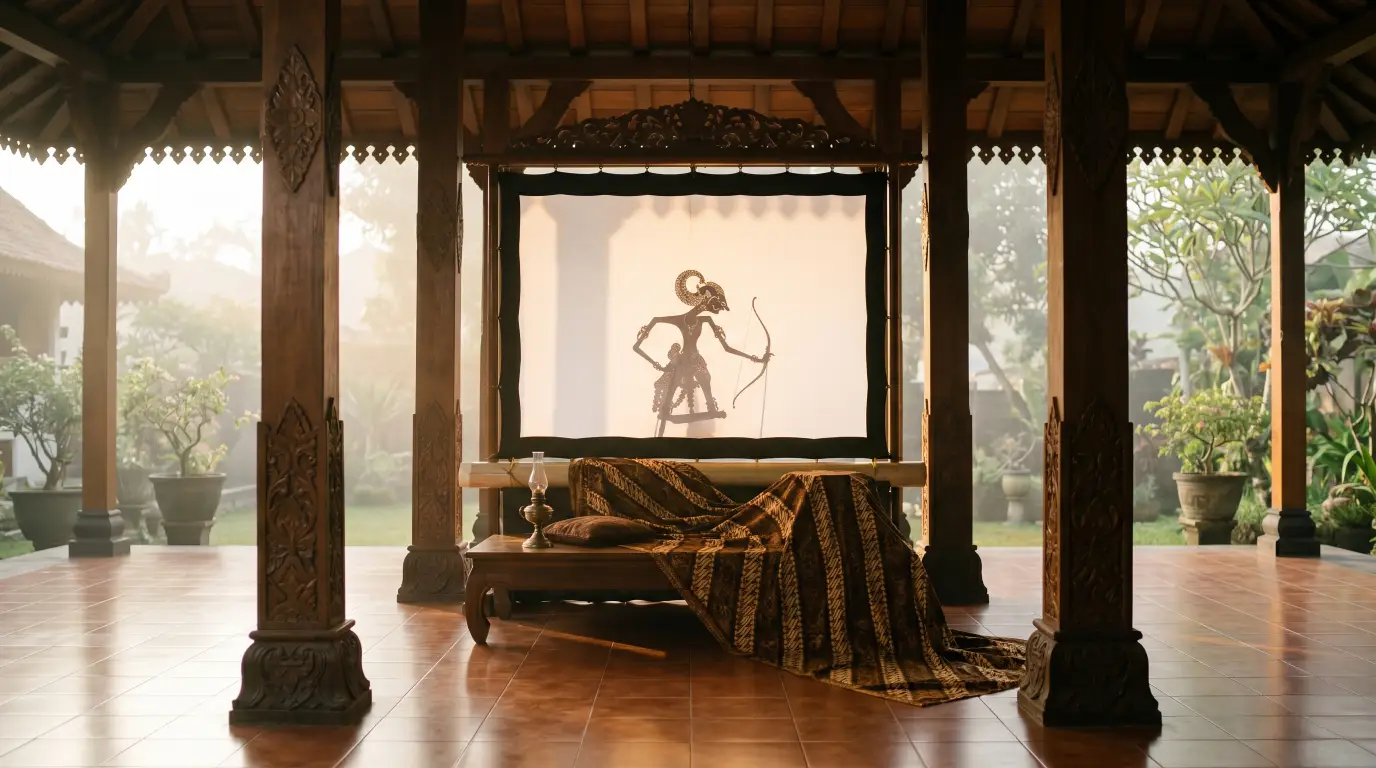
There is a figure often remembered for beauty, skill, and the bow in his hand. Yet if we stop there, we only see the shadow, not the rasa. In Javanese wayang, Arjuna is deeper than outer charm. He is a mirror of gentle focus, inner clarity, tirakat, humility, and strength that still listens to conscience.
Ky Tutur Summary
- Arjuna in Javanese wayang can be read as a cultural symbol of gentle focus, refined character, humility, self-control, and moral responsibility.
- The meaning of Arjuna does not stop at beauty, romance, or power. His deeper lesson lies in inner discipline, clear intention, and the ability to restrain the self before acting.
- Gentle focus means firmness without harshness, sharpness without haste, and strength that does not lose rasa.
- In JavaSense, Arjuna is read as cultural reflection, not as a perfect figure to worship blindly, not as a personal prophecy, and not as a tool to judge others.
Ky Tutur Note: This article discusses Arjuna as a Javanese wayang figure and cultural symbol. References to dharma, tirakat, arrows, and knightly conduct are read as symbolic language for arranging the self, not as absolute claims and not as a tool for judging modern human beings.
Arjuna often appears in conversation as a symbol of beauty, skill, and noble charm. In wayang, he is known as one of the Pandawa, a refined knight, a master archer, and a figure whose movement is calm yet full of direction. But reading Arjuna only from the outside makes his meaning too narrow.
In Javanese rasa, Arjuna is not merely a handsome warrior. He is a picture of a human being who learns to sharpen the inner life. His focus does not come from tension, but from clarity. His strength does not only live in the arrow, but in the ability to arrange rasa before taking action.
So, my child, reading Arjuna is also reading the self. In a noisy life filled with distraction, pressure, and the desire to appear strong, Arjuna reminds us that true strength often appears quietly. It does not need to shout. It does not need to force. It only knows where the inner direction is placed.
Who Is Arjuna in Javanese Wayang?
Arjuna is one of the central figures in the Mahabharata story as lived through Javanese wayang tradition. He is the son of Pandu and Kunti, and the brother of Yudhistira, Bima, Nakula, and Sadewa. Within the Pandawa family, Arjuna is often described as refined, skilled in archery, diligent in learning, and strong in inner discipline.
In Javanese wayang, Arjuna is also known by several names, including Janaka, Permadi, Dananjaya, and Parta. Each name carries its own nuance, but they all point to a knight whose meaning is not limited to physical ability.
Arjuna is often a symbol of refinement. His body is depicted as graceful. His speech is not harsh. His movement is measured. His attitude is full of consideration. Yet refinement does not mean weakness. Behind his gentleness, there is long discipline and courage to face difficult decisions.
This is why Arjuna remains important to read today. He shows that a knight does not always need a loud voice or a fierce face. There is another kind of strength: the ability to direct oneself, restrain impulse, and act only after the inner life becomes clear enough.
Arjuna Is More Than Handsome and Powerful
One of the most common misunderstandings about Arjuna is seeing him only as a symbol of beauty or romance. In popular stories, this side often appears. He is described as graceful, admired, and charming. But if that is all we take, the meaning becomes shallow.
Arjuna is also not merely a powerful figure. In wayang, power rarely stands alone. It is tied to laku, teachers, self-training, moral choices, and responsibility. Weapons and skills are not empty gifts. There is a long process behind them.
In the JavaSense reading, what matters is not only what Arjuna possesses, but how he arranges himself. He learns. He hesitates. He asks. He receives guidance. He faces moral dilemmas. He does not always make decisions easily. That is where his humanity becomes visible.
A figure who is only strong is not always wise. A figure who is only charming is not always mature. Arjuna becomes meaningful because he carries the meeting of refinement, focus, self-training, and moral responsibility.
The Meaning of Arjuna: Clear, Bright, and Ordered
The name Arjuna is often connected with meanings such as white, bright, or clear in Sanskrit tradition. In cultural reading, this can be brought into the inner life: clarity, clean intention, and the ability to see the target without being clouded.
But the name is only a doorway. What matters more is the conduct shown by the figure. Arjuna is not bright only because of appearance or skill. He becomes bright because he learns to guard the inner life from anger, arrogance, greed, and the desire to win for the ego alone.
In daily life, this kind of clarity is deeply needed. Many people have ability, but their inner life is clouded. Many people have knowledge, but their speech wounds others. Many people hold position, but are easily ruled by ego.
Arjuna reminds us that true brightness is not only seen in outer achievement. It is also seen in the way a person carries praise, pressure, temptation, and difficult choices.
Gentle Focus: The Arrow as Self-Control
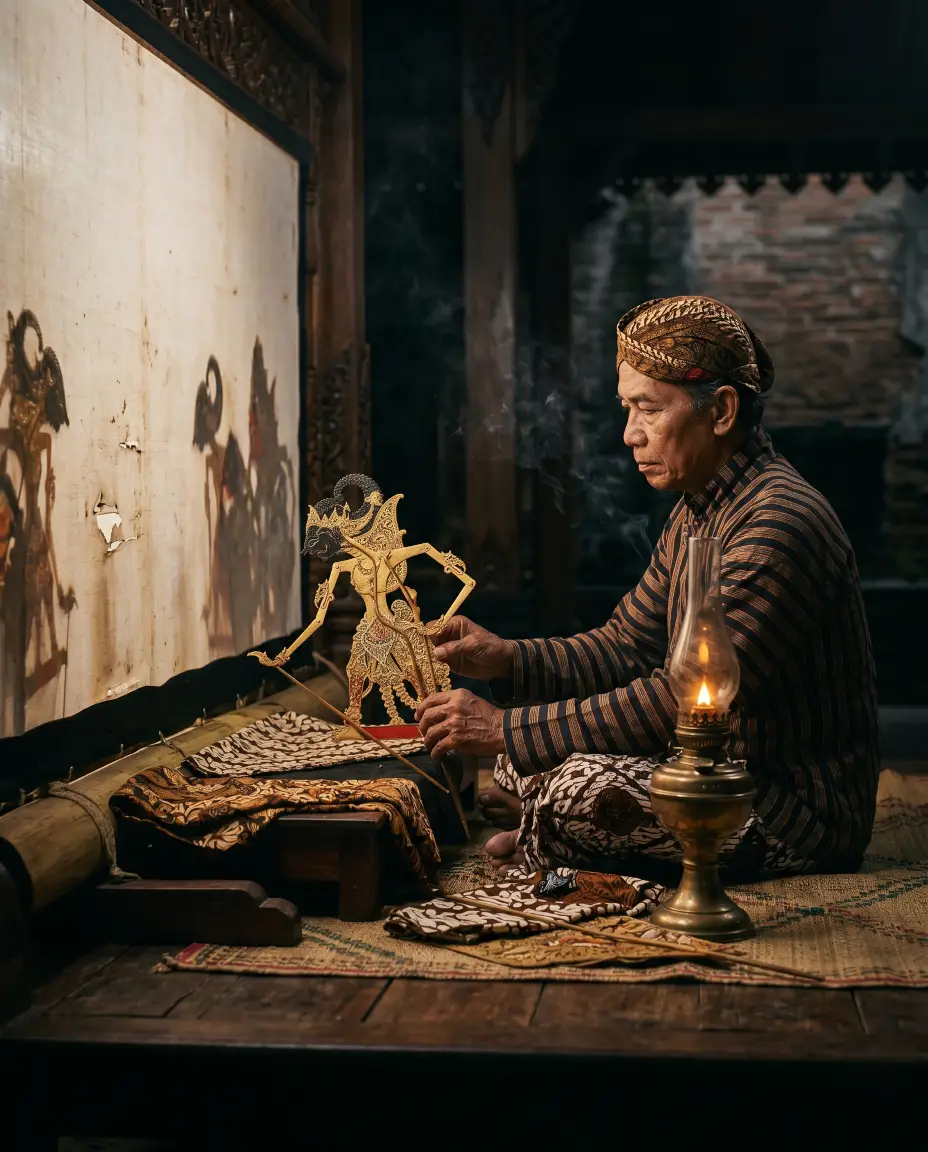
Arjuna is known as a master archer. In wayang reading, the arrow is not merely a weapon. It can be read as a symbol of focus. A person who releases an arrow must see the target, arrange the breath, restrain unnecessary movement, and let go at the right moment.
Here, focus does not mean tension. Focus that is too hard often makes a person rigid. They want quick success, force the result, and eventually lose rasa. Arjuna teaches another kind of focus: gentle focus.
Gentle focus is full attention without force. Firm, but not harsh. Sharp, but not rushed. Like a bowstring drawn with the right measure, not pulled until it breaks.
In modern life, this kind of focus is essential. Many people want to be productive, but the inner life is scattered. Many people want success, but the mind is chased by comparison. Many people want to arrive quickly, but forget to build calmness.
Arjuna teaches that a clear target needs a quiet inner life. Without stillness, the arrow may miss. Without self-control, great ability can become dangerous.
Arjuna’s Dilemma at Kurukshetra
One of the most important moments in Arjuna’s story is his hesitation at Kurukshetra. When he sees teachers, relatives, elders, and people he respects standing on the opposing side, he does not rush into battle with blind eagerness. He trembles. He doubts. He faces an inner struggle.
This moment matters because it shows that Arjuna is not a war machine. He has conscience. He does not see battle only as a stage for victory. He understands that every action has consequence, especially when those involved are not strangers, but people connected to his life.
Arjuna’s dilemma teaches that doubt is not always weakness. Sometimes doubt is a sign that conscience is still alive. A person who never doubts may simply be ruled by ego. A person who examines the self before acting shows deeper rasa.
In daily life, we also face smaller Kurukshetras: between truth and comfort, honesty and fear of wounding, responsibility and heaviness, principle and relationship. Arjuna’s lesson is not to run from dilemma, but to face it with clarity.
Tirakat and the Practice of Self-Refinement
Arjuna’s excellence does not appear from nowhere. In wayang stories, he undergoes many processes of refinement: learning, practicing, receiving guidance, facing tests, and training the self. This is what makes him different from someone who only relies on talent.
Tirakat in cultural reading does not only mean fasting or going to a silent place. More broadly, tirakat is the practice of arranging desire. Not every impulse is followed. Not every pleasure is taken. Not every anger is released. Something is restrained so the inner life becomes stronger.
Arjuna reminds us that focus needs practice. The mind cannot suddenly become sharp if it is scattered every day. The inner life cannot suddenly become calm if it is constantly fed by envy, pride, and the urge to retaliate.
If you want to understand this discipline more widely, you can read tirakat as a practice of self-restraint. In this way, tirakat is not a display of spiritual strength, but a way to train self-control, clarity, and humility.
Humility While Carrying Excellence
Arjuna is known for excellence, but in many stories he remains a student. He receives guidance. He learns. He does not stop refining himself. This is an important part of his lesson: mature excellence does not give birth to arrogance.
A truly strong person does not always need to show strength. A truly knowledgeable person does not always need to make others feel small. A truly focused person is not always busy seeking recognition.
Humility in Arjuna’s conduct does not mean feeling worthless. It means understanding that ability is a responsibility. If given advantage, use it to protect. If given skill, use it to serve. If given sharpness, use it to distinguish what matters from what only feeds ego.
This value is close to the Javanese reminder aja dumeh. Do not misuse ability to look down on others. Do not use expertise to close the ears. Do not let excellence make you forget that every human being still needs to learn.
Arjuna, Dharma, and Moral Responsibility
In the Mahabharata story, Arjuna stands within the struggle of dharma. Dharma may be understood as moral duty, the path of truth, or responsibility that must be carried with awareness. In cultural reading, dharma is not merely a rule. It is a call to act according to values higher than personal ego.
Arjuna does not always choose the easiest path. He faces difficult choices. Here we learn that focus is not only about reaching a target. Focus also means staying faithful to values when the road becomes complicated.
In modern life, moral responsibility can appear in many forms. A leader must choose what is fair, not only what is popular. A worker must guard integrity, not only chase results. A child may respect parents while still learning to speak truth in a good way.
Dharma in Arjuna’s path reminds us that ability without responsibility can become arrogance. Focus without values can become blind ambition. Courage without rasa can become violence.
Arjuna in Modern Life
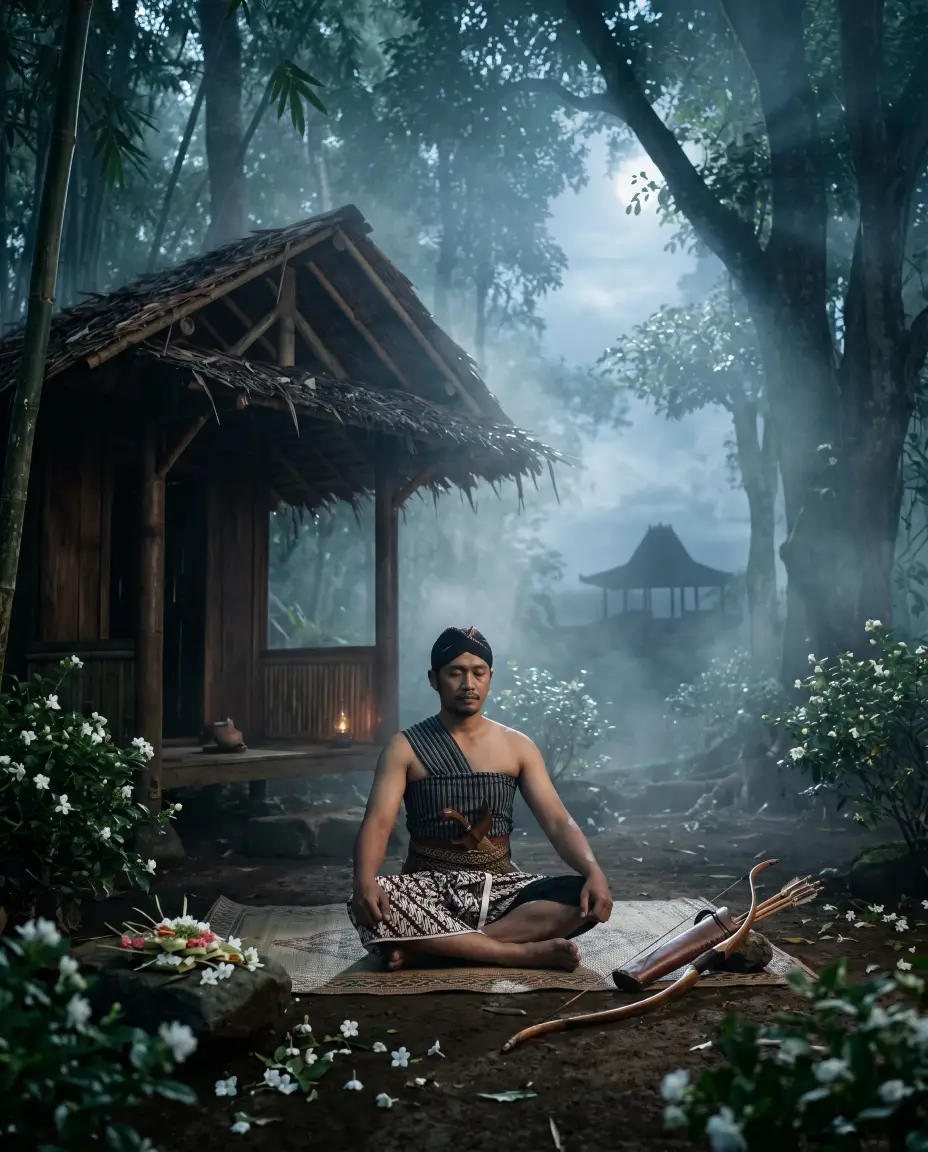
What does Arjuna mean for life today? We do not carry a bow into the office. We do not stand in the battlefield of Kurukshetra. We do not live in the world of kingdoms and great wars. Yet the inner life still faces its own battlefield.
Today’s battlefield may appear as distraction, work pressure, digital comments, competition, ambition, envy, and the desire to look successful quickly. In such a world, gentle focus becomes deeply relevant.
Arjuna teaches that a person needs a target, but should not lose rasa. A person needs practice, but should not become arrogant. A person needs firmness, but not harshness. A person needs to make decisions, but should not close the door of conscience.
In digital spaces, Arjuna’s lesson appears when someone refuses to be easily provoked. At work, it appears when someone stays focused without bringing others down. In family life, it appears when someone can express an opinion without humiliating. In learning, it appears when someone practices consistently without endlessly comparing themselves with others.
This is close to eling lan waspada. Eling means remembering direction. Waspada means staying alert so ability and ambition do not make a person lose rasa.
Practical Ways to Carry Arjuna’s Lesson
There are several simple ways to carry Arjuna’s lesson into daily life.
First, choose one truly important target. Do not chase everything at once. Gentle focus begins with the courage to choose.
Second, practice the pause before acting. When the heart is hot, do not release the arrow immediately. Breathe. Examine the intention. Ask whether the action comes from clarity or from the desire to win.
Third, care for small discipline. Arjuna becomes sharp through refinement. In modern life, refinement may appear as regular learning, keeping a schedule, reducing distraction, and keeping small promises to yourself.
Fourth, remain humble when you excel. Do not use ability to embarrass others. Refined excellence always leaves room for compassion.
Fifth, create stillness. In silence, a person can hear the movement of the inner life. Without stillness, focus can easily become obsession.
Arjuna, Pitutur, and Javanese Wayang
Arjuna is one doorway into reading Javanese wayang. Through him, we understand that wayang is not only entertainment, but also guidance. Each figure carries an inner mirror: courage, weakness, hesitation, arrogance, devotion, and the practice of arranging oneself.
Arjuna teaches the refined path of the knight. Yet wayang also gives other mirrors. Semar teaches humble wisdom. The Punakawan bring honesty through laughter. Other figures show how desire, pride, and forgetfulness can cloud the inner life.
That is why Arjuna should not be read alone as an unreachable model of perfection. He is one part of a wider cultural landscape. His lesson becomes clearer when placed beside other figures and other pitutur.
In that wider reading, Arjuna brings focus, tirakat, humility, self-control, conscience, and moral responsibility. These are not values to memorize only, but values to test gently in everyday conduct.
JavaSense and a Clearer Way to Read Wayang
JavaSense reads Arjuna as cultural heritage that should be cared for with both rasa and clear judgment. There is no need to make him a flawless figure beyond criticism. There is also no need to reduce him only into a symbol of beauty. What matters is the essence: focus, clarity, tirakat, conscience, and responsibility.
Wayang becomes alive when read as a mirror. A mirror does not force a person to become a certain figure. It helps the person see something within the self. From Arjuna, we may ask: is my focus clear? Does my ability make me humble? Does my action still carry rasa?
If you want to explore Javanese letters and written heritage more easily, use the JavaSense Javanese script tool. If you want to connect this reflection with Javanese time and cultural rhythm, you may also open the JavaSense Javanese calendar.
As a broader public cultural reference, readers may also visit the National Library of Indonesia. References like this help cultural reflection stay connected to learning, not merely to scattered claims without direction.
Closing Reflection: Focus That Does Not Lose Rasa
In the end, Arjuna teaches that focus is not only staring at a target. Focus also means arranging intention, guarding the inner life, controlling the self, and choosing actions that do not lose conscience.
Angger, my child, carry Arjuna as a mirror. Do not stop at beauty and power. See his tirakat. See his hesitation. See his humility. See how the arrow becomes a symbol of thought directed with calmness.
In a noisy age, gentle focus is a provision. It helps a person keep moving without haste, remain strong without harshness, become sharp without wounding, and hold a target without losing rasa.
To learn Javanese culture in a lighter and more modern way, you can download JavaSense on Google Play.
FAQ About Arjuna in Javanese Wayang
Who is Arjuna in Javanese wayang?
Arjuna is one of the Pandawa figures in the Mahabharata story as lived through Javanese wayang. He is known as a refined knight, a skilled archer, a diligent learner, and a figure of inner discipline.
What does the name Arjuna mean?
The name Arjuna is often connected with meanings such as white, bright, or clear. In cultural reading, this can be understood as a symbol of inner clarity and ordered intention.
Why is Arjuna a symbol of gentle focus?
Arjuna is a symbol of gentle focus because his sharpness does not come from harshness, but from calmness, self-training, inner clarity, and self-control.
What can we learn from Arjuna’s dilemma at Kurukshetra?
Arjuna’s dilemma at Kurukshetra teaches that doubt can be a sign of conscience. Before acting, a person needs to examine intention, consequence, and moral responsibility.
How is Arjuna connected with tirakat?
Arjuna is connected with tirakat because his excellence is shown as the result of training, self-refinement, learning, and the ability to restrain desire.
Is Arjuna only a symbol of beauty?
No. In Javanese reading, Arjuna is not only a symbol of beauty. He also reflects focus, humility, tirakat, refined rasa, self-control, and knightly responsibility.
How can Arjuna’s lesson be applied in modern life?
Arjuna’s lesson can be applied by choosing a clear target, reducing distraction, staying humble, pausing before action, and keeping moral responsibility alive.
How should Arjuna be read clearly?
Arjuna should be read as a cultural mirror, not as a flawless figure beyond criticism. Take his focus, tirakat, inner clarity, and self-control as guidance for arranging conduct.
Learn Arjuna with Clearer Awareness
Arjuna is not merely a handsome and powerful figure. He is a mirror of gentle focus, tirakat, humility, conscience, and moral responsibility. To explore Javanese script, calendar, weton, and daily heritage in a simpler way, open JavaSense on Google Play.