
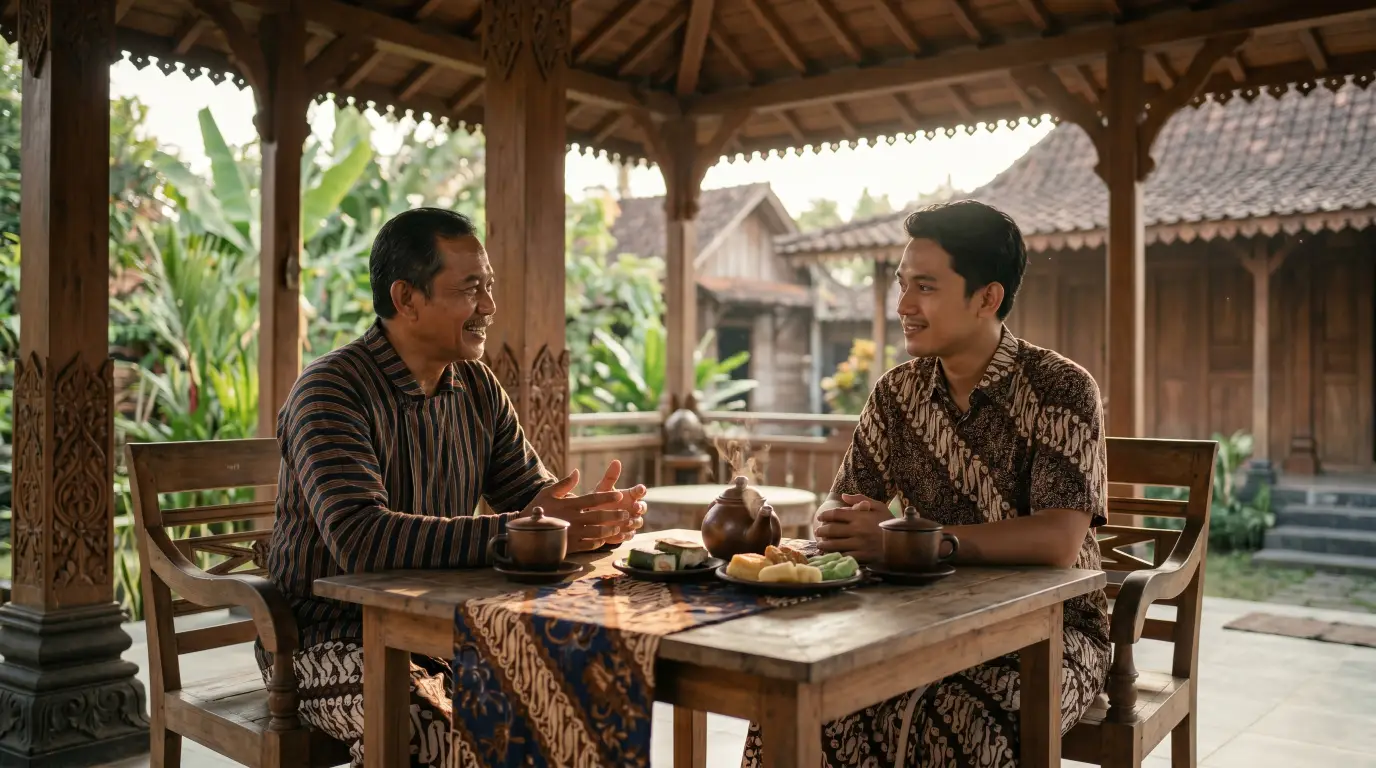
Angger, my child…
There is a form of speech that often feels ordinary because it lives so close to daily life. It appears in jokes, family conversations, friendly greetings, and the words we use with people who already feel near. This speech is called ngoko. Yet ngoko is not merely casual language. When read with rasa, it becomes a practice of closeness that still needs boundaries, manners, and tepa slira.
Ky Tutur Summary
- Ngoko is a Javanese speech level often used in familiar, equal, family, or relaxed relationships.
- Ngoko is not automatically rude. It can feel warm, honest, and close when used in the right relationship, setting, and tone.
- Ngoko still needs tata rasa. Misreading age, social distance, setting, or comfort can make ngoko feel disrespectful.
- In JavaSense, ngoko is read as a teaching of speech: close without carelessness, familiar without demeaning, direct without losing respect.
Ky Tutur Note: This article discusses ngoko as part of Javanese language and culture. It is not a single fixed rule for every region, family, or community. Javanese speech habits can differ by place, household, age, and social context. Read this as guidance for rasa, not as a tool to judge how others speak.
Ngoko is often understood as everyday Javanese speech. Many people use it when speaking with friends of the same age, siblings, children, or people who are already very close. Because it is direct, ngoko is sometimes misunderstood as rough or rude. But the matter is not that simple.
Ngoko can become warm when used in the right relationship. It can show trust, closeness, and the feeling that two people do not need to keep too much distance. Yet ngoko can also feel impolite when used without reading the situation, especially toward older people, new acquaintances, guests, teachers, or people who expect a more respectful speech level.
So, my child, ngoko is not only about words. It is about rasa. What matters is not only the form of the language, but also who is being addressed, how close the relationship is, what the situation feels like, and what intention is carried by the speaker.
What Is Ngoko in Javanese Language?
Ngoko is one of the speech levels in Javanese language. It is commonly used in familiar, relaxed, and informal situations. In many Javanese families, ngoko appears in daily speech between parents and children, among siblings, or among friends who already know each other well.
Ngoko differs from krama. Krama is often used to express respect, polite distance, or formal courtesy. Ngoko is closer to directness and familiarity. But this difference should not be read too simply: ngoko does not mean low, and krama does not automatically mean better. Each has its place.
Javanese language carries tata rasa, the sense of placing words properly. The same sentence can feel appropriate or inappropriate depending on who says it, to whom it is said, and in what situation. This is what makes ngoko important. It looks simple on the surface, but it asks for social sensitivity.
Some readings connect ngoko with a sense of equality or closeness. This article does not treat that as a single fixed etymology. What matters more here is its cultural function: ngoko creates a speech space for closeness, directness, and relationships that do not require a high formal distance.
Ngoko Is Not Automatically Rude
One of the most common misunderstandings is the idea that ngoko is always rude. This idea appears because ngoko is more direct, uses fewer refined forms, and does not create the respectful distance often carried by krama. But directness is not the same as rudeness.
When a mother speaks ngoko to her child, it is not humiliation. When two old friends joke in ngoko, it is not a lack of manners. When siblings speak ngoko at home, it may show the warmth of their relationship.
What makes ngoko feel rude is not the speech level alone, but the way it is used. A demeaning tone, sharp words, arrogance, or the wrong context can make ngoko unpleasant. On the other hand, ngoko spoken with warmth and care can feel deeply human.
So do not rush to conclude that ngoko is always rough. Read the context. In Javanese speech, rasa often matters as much as the outer form of the words.
Ngoko as Familiar Speech with Tata Rasa
Ngoko can be a language of familiarity. It gives people space to speak more freely, honestly, and without the weight of too much formality. In close relationships, ngoko can make conversation feel alive.
But familiarity does not mean the absence of manners. Healthy closeness still has boundaries. Not everyone should be addressed in ngoko right away. Not every situation is suitable for ngoko. Not every close relationship gives permission to speak carelessly.
This is where ngoko becomes a social practice. It asks a person to read the relationship. Is the other person of the same age? Have both people known each other for a long time? Is the setting relaxed? Is the other person comfortable with ngoko? Is there an age difference or social role that needs to be respected?
When these questions are read clearly, ngoko becomes warm. When they are ignored, ngoko can turn into speech that feels pressing, careless, or demeaning.
When Is Ngoko Appropriate?
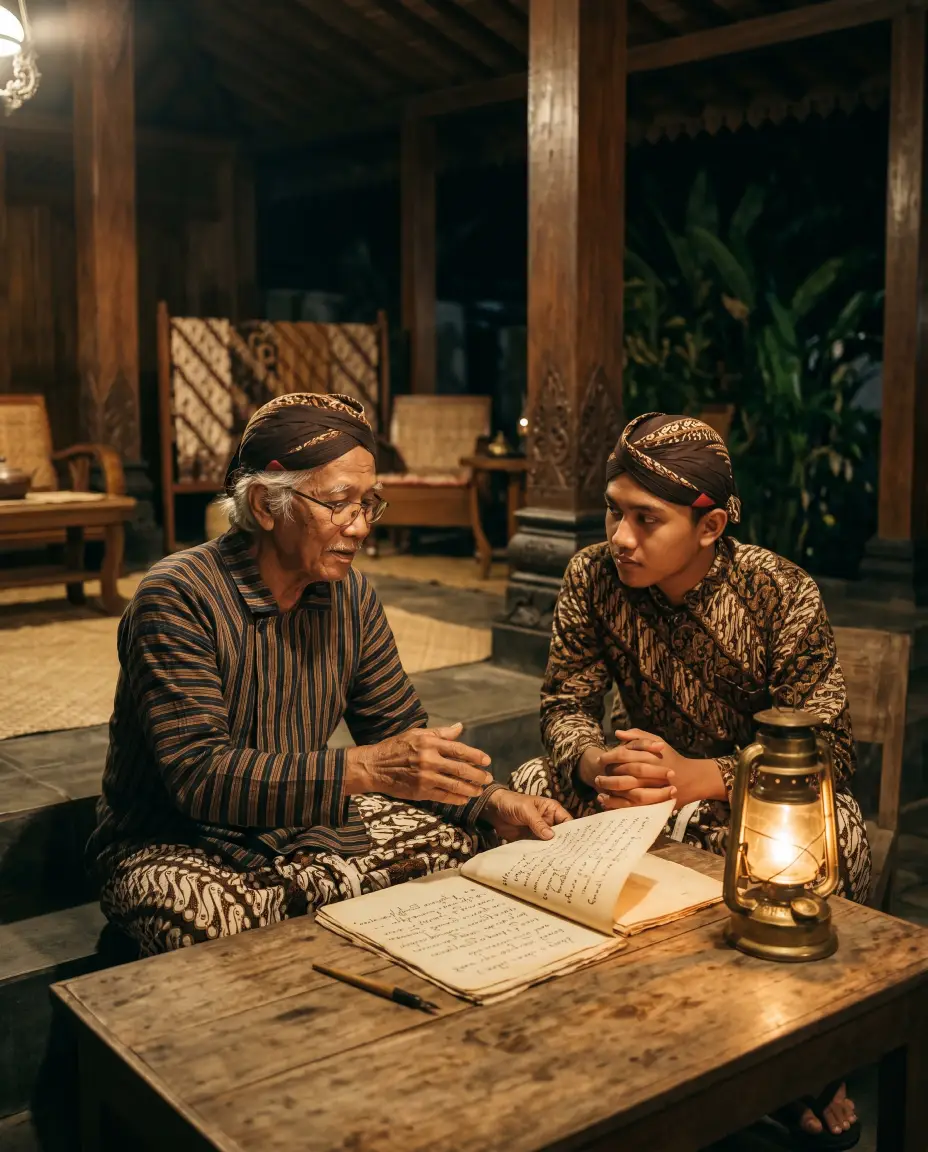
Ngoko is usually appropriate in relationships that are already close. It may be used among friends of the same age, siblings, close family members, or people who share a relaxed way of speaking. In some environments, it may also appear among coworkers who are already comfortable with one another.
But there are situations where ngoko should be reconsidered. When speaking to someone newly met, an elder, a teacher, a guest, a community figure, or anyone whose level of closeness is still unclear, a more respectful form is usually safer.
The important point is this: language is not only about being grammatically correct. It also needs to be socially fitting. A person may use ngoko correctly in structure, but still make it feel wrong in rasa. On the other hand, ngoko can feel very warm when the relationship and setting support it.
A simple guideline is useful: when unsure, choose the form that shows more respect. When the relationship becomes closer and both sides feel comfortable, ngoko can appear more naturally.
Ngoko, Krama, and Ngoko Alus
Ngoko, krama, and ngoko alus show how rich Javanese language is in reading relationships. Ngoko is close to familiarity. Krama is close to respect. Ngoko alus stands between them: still familiar, yet carrying elements of respect.
Ngoko alus is often used when the relationship is close, but the speaker still wants to show honor. It may be used toward an older relative who is familiar, someone respected but not fully distant, or a person who does not need very formal speech but still deserves careful address.
Here, Javanese language becomes more than a communication tool. It becomes a way of reading rasa. Some distance needs to be kept. Some closeness needs to be cared for. Some respect does not need to be stiff. Some familiarity does not need to be careless.
This is why ngoko alus is important. It reminds us that closeness and respect do not have to fight each other. They can live together in the same sentence.
Familiarity Without Demeaning
Good ngoko teaches us to be close without demeaning. This matters because many people assume that the closer a relationship becomes, the more freely words may be thrown around. But closeness without care can wound.
Being close does not mean having permission to insult. Being familiar does not mean being free to embarrass someone. Joking does not mean lowering another person’s dignity. In any language, including ngoko, the other person’s worth must still be protected.
The boundary of familiarity can be seen through word choice, tone, and timing. Some jokes only belong among old friends. Some words may be normal in one family but inappropriate in public. Some speaking styles feel funny in one group but harsh to another.
This is why ngoko needs tepa slira. If we do not like being demeaned, we should not demean. If we want to be understood, we should try to understand the rasa of others. If we want respect, we should not use familiarity as an excuse to hurt.
Ngoko in Family, Friendship, and Community
In family life, ngoko often becomes the language of everyday affection. Parents may speak ngoko to children as a sign of closeness. Siblings of similar age often speak ngoko to one another. Yet in many families, children are still taught to use krama, or at least a more respectful way of speaking, toward parents and elders.
In friendship, ngoko can show equality. Two close friends do not always need formal distance. They can speak directly, joke, and correct each other more freely. Still, directness needs rasa. The closer the friendship, the more important it becomes not to take that closeness for granted.
In community life, ngoko can build warmth and a sense of togetherness. People may feel more connected when speech does not become too stiff. But community leaders, elders, or people with influence should still be careful, so ngoko does not become a tool to pressure others.
A good community does not only need shared activities. It also needs speech that keeps people safe, respected, and willing to return.
Ngoko in Digital Communication
In digital spaces, ngoko often appears in short messages, comments, captions, family groups, and community chats. Because digital spaces lose voice tone and facial expression, ngoko can be misunderstood more easily.
A sentence meant as a joke can feel like sarcasm. A familiar correction can feel like public embarrassment. A word that is ordinary inside a close circle can sound rude when read by outsiders. This is why ngoko in digital communication needs extra care.
Before sending a message, ask quietly: is the other person close enough? Could these words be read as demeaning? Is this a private space or a public one? Is this joke still safe if many people read it?
Good digital ngoko still protects rasa. It can be relaxed, but not reckless. It can be familiar, but not boundaryless. It can be funny, but not at the cost of another person losing face.

Common Misunderstandings About Ngoko
There are several misunderstandings about ngoko that need to be cleared.
First, ngoko is often seen as always rude. In the right context, ngoko can be warm, honest, and full of closeness.
Second, ngoko is sometimes treated as speech that can be used with anyone. This is mistaken. Ngoko still needs attention to age, relationship, setting, and the other person’s comfort.
Third, ngoko is thought to have no rules. In reality, ngoko still has tata rasa. What makes it different from krama is not the absence of manners, but a different form of familiarity.
Fourth, ngoko is sometimes seen as lower than krama. In cultural reading, ngoko and krama have their own functions. Krama arranges respect. Ngoko cares for closeness. Both can be valuable when used properly.
Fifth, ngoko is misused as an excuse for careless speech. This is the dangerous part. Familiarity should never become permission to demean another person.
Practical Ways to Use Ngoko Clearly
There are simple practices that help ngoko remain healthy and respectful.
First, read the relationship. Do not immediately use ngoko with someone newly met, especially when the person is older, respected, or in a formal role.
Second, read the setting. Ngoko that fits a relaxed room may not fit a formal meeting, public event, or serious conversation.
Third, guard your tone. The same words can feel different when carried with a demeaning, sarcastic, or overly harsh tone.
Fourth, use ngoko alus when needed. If you want to stay close while keeping respect, a softer mixed form can help.
Fifth, apologize when the rasa is wrong. Sometimes we feel close, but the other person is not comfortable. If someone feels hurt, do not immediately defend yourself. Listen first.
Sixth, do not use ngoko to embarrass. Especially in digital spaces or crowded rooms. A good correction does not need to make someone lose face.
A Brief Javanese Glossary
- Ngoko: A Javanese speech level often used in familiar, relaxed, or equal relationships.
- Krama: A more respectful Javanese speech level often used toward elders, guests, or formal situations.
- Ngoko alus: A softer form of ngoko that includes respectful elements while keeping a familiar tone.
- Tata rasa: The ability to place words with the right feeling, context, and social sensitivity.
- Rasa: Inner feeling, sensitivity, and refined awareness in Javanese thought.
- Tepa slira: Considering another person’s feelings without losing one’s own clarity.
- Aja dumeh: A reminder not to misuse closeness, power, age, or position to look down on others.
- Guyub: A warm sense of togetherness in community life.
- Rukun: Social harmony, peaceful relationship, and the effort to avoid unnecessary conflict.
- Ngajeni: To respect, honor, and treat another person with dignity.
JavaSense and a Clearer Way to Read Javanese Speech
JavaSense reads Javanese language as living heritage. Ngoko, krama, Javanese script, pitutur, and spoken tradition do not need to be treated as rigid museum objects. But they should not be used carelessly either, as if they have no roots.
The middle path is clearer: modern, but still carrying rasa; relaxed, but still respectful; familiar, but not demeaning. This is where ngoko finds its place in daily life today.
If you want to explore Javanese letters and written heritage more easily, use the JavaSense Javanese script tool. For broader language and cultural references, readers may also visit KBBI Kemdikbud and the National Library of Indonesia. References like these help cultural reflection stay connected to learning and language awareness.
Closing Reflection: Familiar Without Losing Respect
In the end, ngoko teaches that closeness also needs tata rasa. It is not a low language. It is not permission to speak carelessly. Ngoko is a familiar space that needs to be guarded so it does not turn into a space of demeaning.
Angger, my child, when you use ngoko, use it with a heart that reads the situation. Be close without pressing down. Joke without embarrassing. Correct without breaking dignity. Be honest without losing gentleness.
Good language does not only deliver a message. Good language also keeps the relationship worthy of being lived in. That is where ngoko finds its meaning: familiar, direct, warm, and still ngajeni.
To learn Javanese culture in a lighter and more modern way, you can download JavaSense on Google Play.
FAQ About Ngoko in Javanese Language
What is ngoko in Javanese language?
Ngoko is a Javanese speech level commonly used in familiar, relaxed, and close situations, such as between friends, siblings, or people who know each other well.
Does ngoko mean rude speech?
No, not always. Ngoko can feel warm and familiar when used in the right context. It becomes rude when used without reading age, relationship, setting, or the other person’s rasa.
When is ngoko appropriate to use?
Ngoko is usually appropriate with close friends, siblings, family members, or people who are comfortable with familiar speech. When unsure, choose a more respectful form first.
What is the difference between ngoko, krama, and ngoko alus?
Ngoko is close to familiarity, krama is close to respect, and ngoko alus stands between them: still familiar, but carrying respectful elements toward the person being addressed.
Can ngoko still be polite?
Yes. Ngoko can still be polite when used with a good tone, proper context, and respectful intention. Politeness is shaped not only by speech level, but also by the rasa that carries it.
How should ngoko be used with older people?
Ngoko should be used carefully with older people. If the relationship is not close or the person’s preference is unclear, krama or ngoko alus is usually safer.
What is a common misunderstanding about ngoko?
A common misunderstanding is thinking that ngoko is always rude, can be used with anyone, or has no manners. In reality, ngoko still needs tata rasa.
How should ngoko be used in digital communication?
In digital communication, ngoko needs extra care because tone and facial expression are missing. Make sure the person is close enough, the context is relaxed, and the words are not easily read as demeaning.
Learn Ngoko with Clearer Awareness
Ngoko is not rude speech and not a tool for demeaning others. It is familiar Javanese speech that needs rasa, context, and boundaries. To explore Javanese script, culture, weton, and daily heritage in a simpler way, open JavaSense on Google Play.