

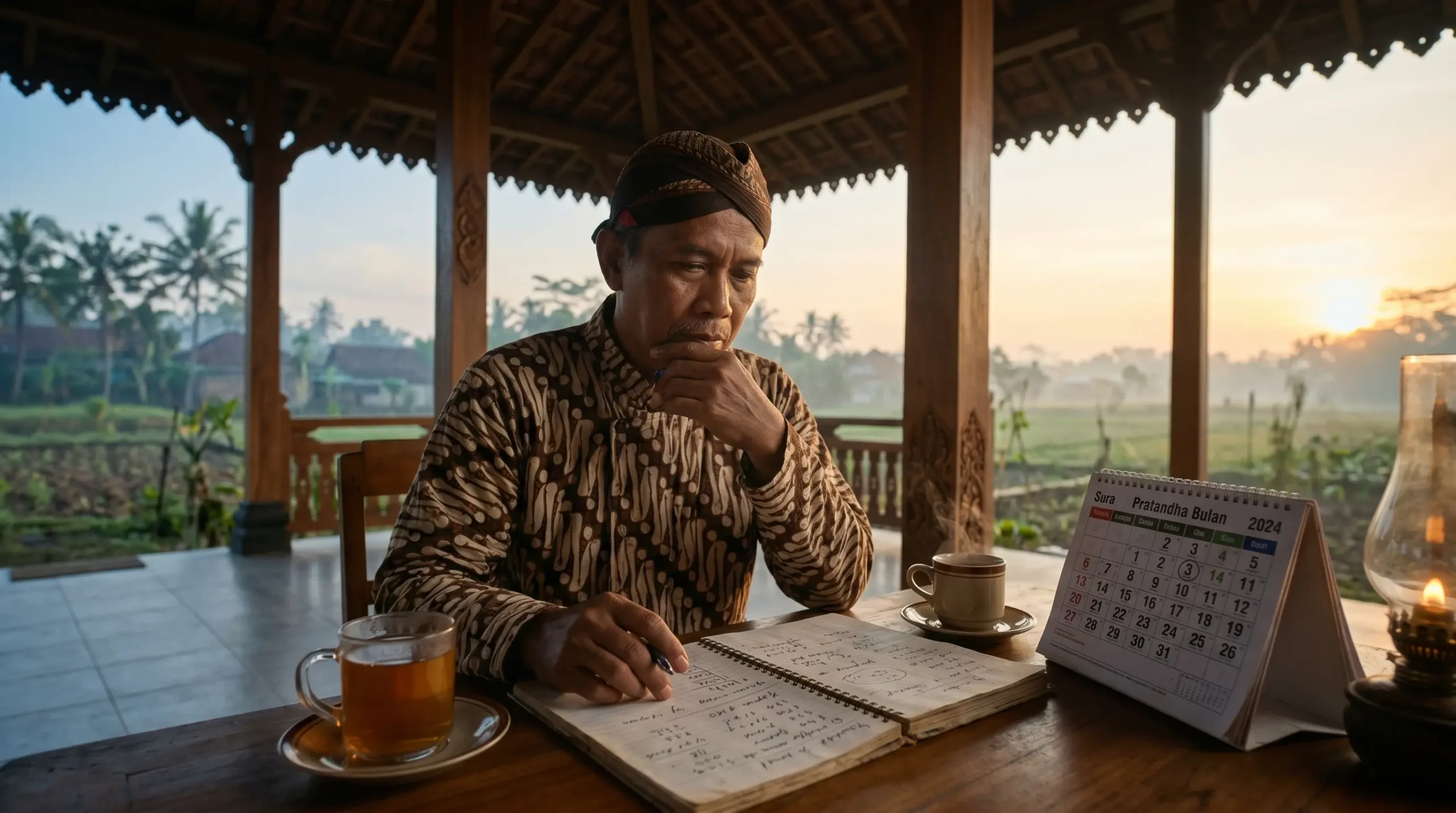
Angger, my child…
Some people work day and night, yet their hearts remain restless. Some move little by little, yet their steps feel more ordered. From here we learn that usaha is not only about how hard someone moves, but also about how clearly they arrange intention, timing, strategy, ethics, and prayer.
Ky Tutur Summary
- Usaha can be read as a Javanese reflection on effort, intention, timing, strategy, ethics, prayer, and steady action.
- Hard work matters, but hard work without direction can make a person tired without truly learning.
- Timing in usaha does not mean waiting for rigid signs. It means reading readiness, risk, opportunity, market needs, and real conditions.
- In JavaSense, usaha is not a guarantee of rezeki or success. It is a cultural mirror for making effort more conscious, ethical, and grounded.
Ky Tutur Note: This article discusses usaha as cultural reflection and life guidance. It is not financial, legal, investment, business, or professional advice. For major decisions, use data, risk calculation, expert advice, practical readiness, and responsible judgment.
Usaha is often understood as hard work. People wake up early, seek opportunity, open a small business, offer a service, build a product, process land, write a plan, or begin work from zero. All of that is usaha. Yet if the meaning stops only at outer movement, it is still incomplete.
In the JavaSense reading, usaha is a form of laku. It is not merely moving. It is moving with intention. It is not merely wanting success. It is learning to read time, arrange strategy, keep ethics, evaluate mistakes, pray, and receive outcomes with a more mature heart.
Javanese wisdom does not invite people to passively wait for fortune to fall from the sky. But it also does not invite people to force everything as if life can be conquered only by ambition. The middle path is conscious effort: move, learn, weigh, pray, evaluate, and improve the step.
What Does Usaha Mean?
In simple English, usaha means effort, endeavor, undertaking, or striving toward a goal. In daily life, it may refer to work, business, seeking livelihood, or a serious attempt to improve a condition.
But in cultural reflection, the meaning is wider. Usaha includes the intention that begins a step, the knowledge that guides action, the experience that corrects direction, the ethics that keeps the path clean, and the prayer that keeps the heart from becoming arrogant when success comes or broken when failure arrives.
In Javanese rasa, usaha is close to ngupaya or ngupadi: seeking a way, trying sincerely, and not stopping only at complaint. But mature effort does not walk blindly. It needs eling lan waspada: awareness of purpose, caution toward risk, and the ability not to lose dignity while pursuing results.
Usaha Is More Than Hard Work
Hard work is important. Without hard work, goals easily become dreams that never touch the ground. But hard work alone is not always enough. Some people are busy every day, yet never evaluate direction. Some move a lot, yet repeat the same mistake. Some work hard, yet their method hurts trust, family, or other people.
Mature effort needs three things: energy, direction, and awareness. Energy makes us move. Direction keeps movement from circling endlessly. Awareness keeps the step from damaging the self, relationships, and dignity.
So when effort feels heavy and results have not appeared, do not only blame yourself. Ask more clearly: is the direction still right? Has the method been improved? Is the timing suitable? Is the strategy still relevant? Is there a small habit that quietly blocks the road?
A person who works hard but refuses to learn may only repeat exhaustion. A person who works, learns, and adjusts begins to turn effort into growth.
Timing: Reading Readiness Without Fear
In many matters, timing matters. Farmers know when to plant and when to wait for rain. Traders know when the market is active and when stock needs to be held. Workers know when to speak, when to learn, and when to change direction.
Timing in usaha should not be read as something frightening or rigid. It is healthier to understand timing as the ability to read conditions. Is the self ready? Does the market need this? Is the capital enough? Is the energy available? Is the family situation supportive? Has the risk been calculated?
Javanese tradition carries many ways of reading time, including calendars, pasaran, and sensitivity toward season. To understand Javanese timing as cultural knowledge, readers may open the JavaSense Javanese calendar. But use it as a cultural mirror, not as a reason to be afraid of moving.
Good timing does not replace effort. It helps effort become more orderly.

Strategy: Mind, Rasa, and Data
Strategy is the way a path is arranged. In the modern world, strategy may include market research, financial notes, target customers, work schedules, product quality, promotion, distribution, and evaluation. These are important because good intention still needs a clear road.
But mature strategy does not use the mind alone. It also needs rasa. Rasa helps people read human needs. Rasa keeps a seller from chasing profit while destroying trust. Rasa reminds a creator not only to make something viral, but also useful.
Data and rasa do not need to fight each other. Data helps us see reality. Rasa helps us remain human inside that reality. If effort uses only rasa without data, the step may become vague. If effort uses only data without rasa, the work may become cold and lose ethics.
The clearer path is to bring both together: measure what can be measured, but do not throw away the human feeling that makes work meaningful.
Rezeki as Direction, Not a Guarantee
Rezeki is often translated as sustenance or fortune, but it should not be reduced only to money. Sometimes rezeki comes as trust, knowledge, health, a good network, a chance to learn, a calmer family, or a realization that helps someone improve their way of working.
Because of this, rezeki needs to be read widely, but still with grounded awareness. It is not a magical promise. It does not arrive only because a person uses the right words, reads the right sign, or waits for a perfect day.
In Javanese laku, seeking rezeki should not make human beings lose values. Rezeki pursued through deception may look fast, but it leaves a burden. Rezeki pursued with honesty may move more slowly, but it can protect sleep, trust, and dignity.
If you are building work or business, use results as a measure, but do not make results the only measure of human worth. A person who fails today is not necessarily finished. A person who succeeds today still needs humility, because conditions can change.
Prayer and Pasrah Are Not Excuses to Stop
Prayer is not a replacement for action. Pasrah is not a reason to stop. Prayer keeps the heart from losing direction. Pasrah is spacious acceptance after a person has truly done the part they can do.
A misunderstanding often appears when pasrah is treated as giving up. True pasrah is different. A person works, learns, weighs, improves, asks for advice, then receives the result with a heart that does not force the world to follow every personal desire.
In this way, prayer and effort walk together. Prayer softens arrogance when results are good. Prayer gives strength when results are delayed. Pasrah helps a person accept without becoming passive, and continue improving without being destroyed by disappointment.
A mature person does not use prayer as an excuse to avoid responsibility. They pray, then still repair the step that needs repairing.
7 Practices of Usaha for Clearer Steps
Good pitutur needs to become daily conduct. Here are seven simple practices so effort is not only busy outside, but also ordered within.
1. Arrange Intention Before Moving
Before beginning, ask: why am I doing this? Is it only to look successful, or to build a life that is more useful and responsible? Clear intention gives strength when results do not arrive quickly.
2. Measure Energy, Cost, and Time
Spirit matters, but measurement also matters. Do not begin something only because of temporary emotion. Count the ability, cost, time, energy, and risk. A small measured step is often safer than a large vague step.
3. Read What People Need
Good effort begins from benefit. What do people need? What problem can be helped? What value can be given? Rezeki is easier to approach when a person sincerely understands the needs of others.
4. Move Small but Consistently
Not everything must begin big. Sometimes what is needed is a repeated small movement: improving a product, learning promotion, recording finances, greeting customers, keeping quality, or correcting one detail every day.
5. Evaluate Without Insulting Yourself
Failure is not a reason to hate yourself. Evaluate clearly. What did not work? What needs to change? What should be learned? A person who evaluates is giving the future a second chance.
6. Keep Ethics in Seeking Rezeki
Do not let effort make the heart harsh. Selling is allowed, but do not deceive. Competing is allowed, but do not destroy others. Seeking profit is allowed, but do not sacrifice trust.
7. Pray, Then Keep Improving the Step
Prayer calms the heart, but the hands still need to work. After praying, see what can be improved today. Send one message. Fix one note. Learn one skill. Repair one mistake. Take one step that is still possible.

Usaha, Gotong Royong, and Rukun
In Javanese culture, seeking livelihood is not always seen as a lonely road. There are values of guyub, rukun, and gotong royong. A person may have their own path, but still lives within a web of family, neighbors, customers, coworkers, and society.
Because of this, healthy effort does not only ask, “How can I gain?” It also asks, “Does my step bring benefit? Does my method protect relationships? Am I growing while still respecting others?”
Rukun does not mean there is no competition. It means competition should not destroy ethics. It means people may walk different roads while still preserving respect. It means seeking profit should not make another human being only a target, obstacle, or tool.
A business or work path becomes stronger when it creates trust. Trust is not built only by good products, but also by fair behavior, clear communication, and the willingness to protect relationships.
When Effort Feels Heavy
There are seasons when effort feels heavy. Sales are quiet. Applications are not accepted. Ideas do not work yet. Products do not sell. The body is tired, the mind is full, and the heart begins to ask whether all of this still has meaning.
If you are in that place, stopping for a moment is not defeat. Take a small space of hening. Look at the map again. Do you need rest? Do you need new knowledge? Do you need advice from someone more experienced? Do you need to change the method, not the dream?
When effort feels heavy, discipline may need to become smaller and more concrete. Tidy one note. Make one honest evaluation. Remove one wasteful habit. Ask one person for feedback. Learn one thing that can improve the next step.
Sometimes the road becomes lighter not because the problem disappears, but because the next step becomes clearer.
Usaha, Weton, and the Javanese Calendar
Some people use weton or the Javanese calendar to reflect on timing before beginning an important step. JavaSense reads this as cultural reflection, not certainty. If you use the JavaSense weton calculator, use it as a mirror, not as a replacement for data and preparation.
The principle remains the same: tradition may remind, but decisions still need common sense. A “good day” becomes more meaningful when the person also prepares a good method.
The Javanese calendar can help readers understand pasaran and time layers as cultural literacy. The Javanese script tool can also become a small doorway for learning written heritage with patience and attention.
Culture should not make effort fearful. It should help effort become more aware.
JavaSense and a Clearer Way to Read Effort and Rezeki
JavaSense reads Javanese culture as a mirror, not a verdict. Weton, the Javanese calendar, script, primbon, pitutur, and daily laku should not make human beings afraid. They are better used as doors of learning so each step becomes more conscious.
If readers want to explore Javanese timing, use the JavaSense Javanese calendar. To calculate weton as cultural reflection, use the weton calculator. To learn written heritage, try the Javanese script tool.
As a broader public cultural reference, readers may also visit the National Library of Indonesia. References like this help cultural reading stay connected to learning and public knowledge.
The JavaSense path is simple: honor tradition, but keep clear reason. Read symbols, but do not turn them into fear. Work hard, but do not abandon ethics. Pray, but do not abandon responsibility.
Closing Reflection: Moving with Sareh
In the end, usaha is one way human beings answer life. Not only by complaining. Not only by waiting. But also not by forcing everything without pause. Mature effort knows when to move, when to learn, when to ask for advice, and when to accept results with a spacious heart.
Angger, my child, do not measure yourself only by today’s result. Measure also the courage to improve, the honesty you keep, the strategy you arrange, and the prayer you carry when the road is not yet bright.
If success comes, be grateful without arrogance. If success has not arrived, evaluate without insulting yourself. If you must wait, use the time to strengthen knowledge. If you must change direction, do it with a clearer heart.
Because rezeki is not only what reaches the hand. Rezeki is also what grows within the self while walking: persistence, wisdom, patience, trust, and the ability to bring benefit.
To learn Javanese culture in a lighter and more modern way, you can download JavaSense on Google Play.
FAQ About Usaha, Rezeki, Timing, Strategy, and Prayer
What does usaha mean in Javanese reflection?
Usaha can be understood as conscious effort: moving with intention, strategy, ethics, timing, prayer, and the willingness to keep improving.
Is hard work always enough to bring rezeki?
Hard work is important, but not always enough. Rezeki is also connected with direction, quality, strategy, people’s needs, trust, timing, and the ability to improve the method.
What does timing mean in usaha?
Timing means reading readiness and conditions: personal capacity, market needs, energy, cost, risk, opportunity, and support. It is not a reason to fear movement, but a way to move more clearly.
How are usaha and prayer connected?
Prayer keeps the heart grounded so a person does not become arrogant when successful or broken when facing difficulty. But prayer should still be accompanied by real action, evaluation, and responsibility.
What is the difference between pasrah and giving up?
Giving up means stopping without doing the part that can still be done. Pasrah means accepting the result with a spacious heart after sincere effort, correction, and responsibility.
Can weton be used before starting a business?
Weton may be used as cultural reflection, but it should not become the only basis for a business decision. Use data, risk calculation, capital readiness, and common sense.
How can someone keep ethics in usaha?
Keep honesty, avoid deception, do not destroy others, keep promises, improve quality, and let profit grow from benefit rather than harm.
What should I do when usaha feels heavy?
Pause for a moment, evaluate one thing, tidy your notes, ask for feedback, learn a useful skill, care for your health, and take one small step that can still be done today.
Learn Usaha with Clearer Awareness
Usaha is not merely chasing results. It is a way to arrange intention, timing, strategy, ethics, prayer, and the courage to keep improving. To explore the Javanese calendar, weton, script, and cultural heritage more easily, open JavaSense on Google Play.