

Some people open a book of Javanese Primbon out of curiosity. Others arrive with a more personal question: what should a family do when weton, good days, or traditional signs begin to shape an important decision?
Primbon often stands between two strong reactions. Some people treat it as certainty. Others reject it too quickly because it feels old. JavaSense takes a calmer path: reading Primbon as cultural heritage, pattern observation, and a reflective language of Javanese life.
Read this way, Primbon does not need to become a source of fear. It can become a doorway into how older Javanese communities observed time, family, relationships, signs, conduct, and readiness before taking a step.
Quick Answer: What Is Javanese Primbon?
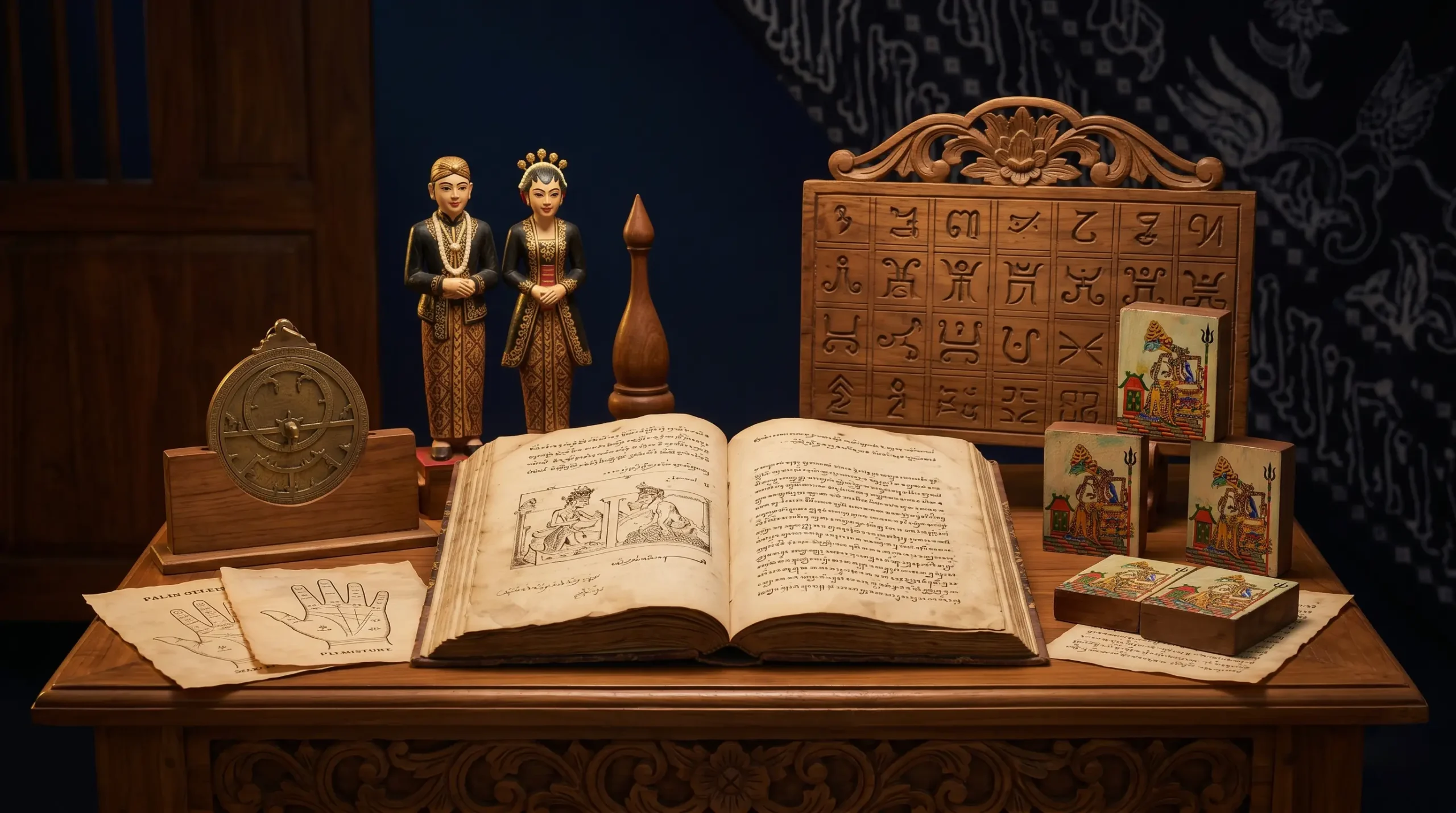
Javanese Primbon is a traditional Javanese body of knowledge used to read patterns, signs, timing, relationships, conduct, weton, pasaran, neptu, good days, and the Javanese calendar. In daily life, it is often mentioned when families discuss marriage dates, important ceremonies, personal direction, or the relationship between human choices and cultural time.
Primbon is safest when read as cultural reflection, not as a verdict on fate. It may help people notice patterns, become more careful, and understand how Javanese ancestors read life, but final decisions still need reason, responsibility, communication, and real-world awareness.
Primbon as Ilmu Titen and Pangilon Rasa
In Javanese tradition, much knowledge grows from niteni: observing repeated events, remembering the atmosphere around them, and turning that memory into guidance. Through this habit, people learned to see time, action, family, and nature as connected parts of life.
Primbon can be understood as one vessel for that knowledge. It contains numbers, days, pasaran cycles, signs, advice, and symbols. But these elements should not be read as laws that force human life. They are closer to pangilon rasa, a cultural mirror that helps people look inward and read a situation more carefully.
Ky Tutur’s reflection: Tradition should not become a cage. It is closer to a small lamp: it may help us see the road, but each step still needs awareness, reason, and responsibility.
What Does Javanese Primbon Contain?
The contents of Javanese Primbon are wide. In popular reading, Primbon is often connected with weton, relationships, good days, natural signs, and personal conduct. Each part needs to be read in context, not merged into one rigid judgment about a person’s life.
| Part of Primbon | What It Reads | Safe Way to Read It |
|---|---|---|
| Weton | The combination of a birth weekday and the five-day Javanese pasaran cycle. | Read as cultural tendency, not as a fixed label for a person. |
| Neptu | The numerical value of a weekday and pasaran. | Used to understand a calculation pattern, not to measure human worth. |
| Relationship reading | Compatibility reflection based on weton and neptu. | Read as a starting point for family dialogue, not a final decision about love. |
| Good days | Timing considerations for certain events. | Read together with readiness, family agreement, location, budget, and real conditions. |
| Ilmu titen | Patterns noticed through repeated experience and signs. | Read as careful awareness, not as certainty about the future. |
| Javanese calendar | Days, pasaran, Javanese dates, weton, and cultural cycles of time. | Read as a cultural map of time, not as a command that closes reason. |
9 Meanings of Javanese Primbon
To make Primbon easier to understand, here are nine important meanings of Javanese Primbon when read calmly, respectfully, and without fatalistic claims.
1. Primbon as Javanese Knowledge Heritage
Primbon is one trace of Javanese knowledge shaped by long experience. Inside it are ways of reading time, human relationships, natural signs, and habits of life passed across generations.
This heritage deserves respect. But respecting tradition does not mean accepting everything without thought. Modern readers still need context, limits of interpretation, and real conditions before making decisions.
2. Primbon as a Mirror of Time
In Primbon, time is not only a date or an hour. Time has layers: weekday, pasaran, weton, neptu, Javanese months, wuku, and other cycles that live inside Javanese tradition.
This is why Primbon often touches the Javanese calendar. The calendar helps readers see how dates, pasaran, weton, wuku, and other elements of Javanese time relate to one another.
3. Primbon as Symbolic Language
Many parts of Primbon use symbolic language. Terms such as weton, good days, titen, or weton-based relationship results should not always be read in a stiff or literal way.
Symbolic language invites reflection. It gives a person a sign to pause, become more careful, and prepare better before acting. But every symbol still needs to be translated through common sense.
4. Primbon as Ilmu Titen
Ilmu titen is the Javanese habit of noticing patterns from repeated experience. Older Javanese communities often observed the relationship between time, atmosphere, events, and what followed afterward.
Primbon can be seen as one container of this pattern-based knowledge. But a pattern once observed should not be treated as an absolute rule for every person, every age, and every situation.
5. Primbon as Personal Reflection
Through weton, neptu, or certain signs, Primbon often invites a person to look at the self more slowly. A reader may reflect on tendencies, emotional habits, and the conduct that needs care.
Still, a human being is never finished by weton or numbers alone. Character is also shaped by family, education, environment, experience, choices, and self-awareness.
6. Primbon as Family and Social Language
In many Javanese families, Primbon appears as a social language. It may come up when families discuss a wedding date, moving house, a major event, or a decision that involves many people.
Here, Primbon can become a doorway for dialogue. What needs care is how it is used. It should not be used to force, pressure, blame, or make someone feel that life has already been judged from the beginning.
7. Primbon as a Bridge to Weton and Neptu
Primbon is closely related to weton. Weton is the combination of a weekday and a Javanese pasaran, such as Senin Legi, Jumat Kliwon, Rabu Pon, or Sabtu Pahing.
To understand this foundation, readers can use the JavaSense tool to calculate weton from a birth date. For the numerical side, read more about Javanese neptu and how it belongs to the wider calendar tradition.
8. Primbon as Advice for Carefulness
Many parts of Primbon can be read as advice for carefulness. When a certain day feels heavy, or a relationship reading feels difficult, the deeper message does not always have to become a strict prohibition.
It can become a reminder to prepare better, communicate more honestly, and act with responsibility. What feels heavy may point to a place that needs attention. What feels favorable should still invite humility.
9. Primbon as Cultural Mirror, Not a Verdict
The most important meaning is this: Javanese Primbon is best read as a cultural mirror, not a verdict on life. A mirror helps a person see, but it does not walk in that person’s place.
Life is still shaped by choices, effort, prayer, communication, responsibility, environment, and wisdom. Primbon may accompany reflection, but it should not replace mature decision-making.
A Practical Example: When a Family Discusses a Good Day
Imagine a family preparing for a wedding. A date is almost chosen, the venue search has begun, but the parents ask that a good day still be considered. What felt practical suddenly becomes sensitive, because each person carries a different mixture of belief, memory, and worry.
In a situation like this, Primbon does not need to become a judge. It can become a language for honoring family concerns while still considering real matters: readiness on both sides, budget, health, guest travel, venue availability, and communication between families.
With a healthy reading, tradition does not need to defeat reason. Reason also does not need to mock tradition. Both can sit together so the final decision feels calmer.
How Javanese Primbon Relates to Weton
Javanese Primbon is deeply connected with weton. In many readings, weton is used to understand a birth day, pasaran, neptu, cultural tendencies, and sometimes relationship considerations.
But weton should not be used to place a fixed label on someone. It is safer to read weton as an entry point for reflection, not as a stamp that closes the possibility of growth.
Readers who feel worried by terms such as “bad weton” can also read why “bad weton” should be read carefully so cultural language does not become fear.
How Javanese Primbon Relates to Relationship Readings
In relationship matters, Primbon is often used to read compatibility through weton and neptu. This is where traditional results such as Pegat, Ratu, Jodoh, Topo, Tinari, Padu, Sujanan, and Pesthi often appear.
These results should not be read as final judgments. They are better understood as symbolic points of reflection: communication, ego, family blessing, emotional readiness, and the ability of two people to carry a relationship responsibly.
For a more careful reading, use the JavaSense tool to read weton compatibility with care. The tool should be treated as cultural reflection, not as a machine that decides whether a relationship must continue or end.
How Javanese Primbon Relates to Good Days
Primbon is also often connected with the search for good days. In Javanese culture, good days may be considered for weddings, moving house, family ceremonies, starting a business, or other important activities.
But a good day is not a guarantee that everything will be smooth. A day considered favorable still needs preparation. A day that feels heavy does not automatically mean a person must stop moving.
This is why a good-day reading should be placed beside real-world readiness: family agreement, budget, health, time, travel, venue, and emotional clarity.
How Javanese Primbon Relates to Wuku and Pawukon
Beyond weton and pasaran, Javanese culture also knows wuku and Pawukon. Wuku belongs to the 210-day Pawukon cycle, which contains 30 wuku, from Sinta to Watugunung.
Wuku is different from weton. Weton comes from the combination of a weekday and pasaran, while wuku comes from the Pawukon cycle. Both may appear in Javanese cultural reading, but they should not be treated as the same thing.
To understand this layer of time, explore Pawukon and the 30 wuku cycle as part of the wider Javanese calendar tradition.
Common Mistakes When Reading Javanese Primbon
The first mistake is treating Primbon as a fixed prediction. Primbon is safer when read as cultural knowledge and reflection.
The second mistake is using Primbon results to judge other people. For example, calling someone bad only because of weton, neptu, a birth day, or a certain calculation.
The third mistake is making major decisions based only on Primbon. For marriage, family, work, health, or financial matters, cultural reading may become a space for reflection, but it should not replace reason and real-world consideration.
The fourth mistake is reading Primbon with fear. If tradition only makes a person afraid, the way it is being read needs to be softened and clarified.
How to Read Javanese Primbon Wisely
Several simple principles can help readers approach Javanese Primbon with more balance:
- Read it as cultural heritage, not as certainty about fate.
- Use it as reflection, not as a tool to judge other people.
- Pay attention to family and social context, especially in relationship and good-day discussions.
- Do not frighten yourself with traditional terms you do not yet understand.
- Combine tradition with reason, communication, and real conditions.
- Respect the roots, but understand the limits of interpretation.
With this approach, Primbon does not become a burden. It returns to being a cultural space that helps people become more aware, more careful, and more responsible.
Learn Javanese Primbon with JavaSense
JavaSense offers practical entry points for reading Javanese culture. To find weton from a birth date, use the JavaSense weton calculator. To follow daily cultural time, check the Javanese calendar.
To reflect on relationships through weton, use the JavaSense weton compatibility tool. To explore several tools in one place, visit JavaSense cultural tools.
For wider cultural learning, JavaSense also offers a way to write in Javanese script and explore JavaSense as a Javanese cultural platform.
For a more practical mobile experience, readers can download the JavaSense Android app through Google Play.
Cultural References for Javanese Primbon
For general background, readers may also see external references on Primbon and the Javanese calendar.
External references help give basic context. JavaSense, meanwhile, presents the topic in a practical, reflective, and safer language for modern readers.
Closing Reflection: Reading Primbon with More Awareness
Javanese Primbon is a long cultural inheritance. Inside it are weton, pasaran, neptu, good days, relationship readings, the Javanese calendar, wuku, Pawukon, and ilmu titen. All of these show that Javanese ancestors paid close attention to life.
But attention is not the same as fear. Tradition, when read clearly, does not imprison people. It invites them to become more aware of time, more careful in conduct, and more responsible for their choices.
So read Javanese Primbon calmly. Honor its roots, understand its limits, and use it as a cultural mirror for living with more wisdom.
FAQ About Javanese Primbon
What is Javanese Primbon?
Javanese Primbon is a traditional Javanese body of knowledge that discusses weton, pasaran, neptu, good days, relationships, natural signs, the Javanese calendar, and ilmu titen.
Is Javanese Primbon the same as fortune telling?
Not necessarily. Javanese Primbon is safer when read as cultural heritage and reflection, not as absolute prediction or a final decision about life.
How is Javanese Primbon related to weton?
Primbon often uses weton as a foundation for reading. Weton comes from the combination of a birth weekday and Javanese pasaran, then may be connected with neptu and other cultural considerations.
How is Javanese Primbon related to relationships?
In Javanese culture, Primbon is often used to reflect on relationship compatibility through weton and neptu. The result should not be used as a verdict on whether a relationship must succeed or fail.
How is Javanese Primbon related to good days?
Primbon often contains considerations for choosing good days for certain events. A good day should still be read together with family readiness, communication, venue, budget, health, and real conditions.
What is ilmu titen in Javanese Primbon?
Ilmu titen is the practice of noticing patterns from repeated experiences and signs. In Javanese Primbon, it becomes one basis for reading life with more awareness and care.
How should modern readers read Javanese Primbon?
Modern readers should read Primbon as cultural heritage, avoid using it to judge others, avoid fear-based interpretation, and keep reason, responsibility, and real-world context in every decision.