

Many people search for Primbon Jodoh when a relationship begins to move toward something more serious. Some want to know whether two weton values are compatible. Some are asked by family to calculate neptu. Others feel uneasy after hearing traditional terms such as Pegat, Topo, Padu, or Sujanan.
In moments like this, weton compatibility can become sensitive. If it is read too rigidly, a number can turn into fear. If it is rejected too quickly, families who still respect tradition may feel unheard.
JavaSense places Primbon Jodoh in the middle path: respected as cultural heritage, but not used as a judge of relationships. Weton and neptu may become material for dialogue, while the decision still needs communication, family blessing, responsibility, and the real readiness of two people to build a life together.
Quick Answer: What Is Primbon Jodoh?
Primbon Jodoh is a Javanese relationship compatibility reading based on weton, pasaran, and neptu. In traditional reading, the result is often connected with terms such as Pegat, Ratu, Jodoh, Topo, Tinari, Padu, Sujanan, and Pesthi.
However, Primbon Jodoh should not be read as a verdict that a relationship will certainly succeed or fail. In the JavaSense approach, it is safer to understand Primbon Jodoh as a cultural mirror that opens dialogue: how a couple communicates, keeps trust, respects family, and prepares for shared responsibility.
Primbon Jodoh, Weton, Pasaran, and Neptu
Javanese Primbon is the larger body of traditional Javanese knowledge. It includes weton, good days, pasaran, neptu, ilmu titen, and many forms of cultural consideration.
In relationship reading, the process usually begins with each person’s weton. Weton is the combination of a birth weekday and the five-day Javanese pasaran cycle, such as Senin Legi, Jumat Kliwon, Rabu Pon, or Sabtu Pahing.
From each weton, neptu is calculated. Neptu then becomes one foundation for reading compatibility. To understand this foundation more clearly, readers can explore Primbon Weton and Javanese neptu.
Neptu Values for Weekdays and Javanese Pasaran
The following neptu values are commonly used in weton and Primbon Jodoh readings.
| Javanese / Indonesian Day | English Day | Weekday Neptu |
|---|---|---|
| Minggu | Sunday | 5 |
| Senin | Monday | 4 |
| Selasa | Tuesday | 3 |
| Rabu | Wednesday | 7 |
| Kamis | Thursday | 8 |
| Jumat | Friday | 6 |
| Sabtu | Saturday | 9 |
| Javanese Pasaran | Pasaran Neptu |
|---|---|
| Legi | 5 |
| Pahing | 9 |
| Pon | 7 |
| Wage | 4 |
| Kliwon | 8 |
These tables help readers understand the basis of calculation. Still, neptu should be read as a cultural symbol, not as a measure of human worth or a guarantee of a relationship’s future.
7 Wise Ways to Read Primbon Jodoh
To avoid fear and misunderstanding, here are seven safer ways to read Primbon Jodoh with clarity, respect, and emotional maturity.
1. Start with Each Person’s Weton
The first step is knowing the weton of each person. Weton becomes the starting point before reading neptu and relationship compatibility.
If the weton is not yet known, use the JavaSense tool to calculate weton from a birth date. It helps readers find the weekday, pasaran, and neptu more practically.
2. Calculate Neptu Correctly
After each weton is known, the weekday neptu and pasaran neptu are added. For example, Jumat Kliwon has neptu 14 because Jumat is valued at 6 and Kliwon is valued at 8.
A mistake in calculating neptu can make the reading inaccurate. That is why the values of weekdays and pasaran should be checked carefully before moving to compatibility reading.
3. Read the Result as a Cultural Mirror
The result of Primbon Jodoh is best read as a cultural mirror. A mirror helps people notice what needs attention, but it does not determine the whole direction of life.
If the result feels supportive, do not assume the relationship will always be easy. If the result feels heavy, do not assume the relationship is destined to fail.
4. Do Not Use the Result to Pressure a Partner
One common mistake is using weton results to pressure a partner. For example, blaming one person because a certain result is considered difficult.
This is not a healthy use of tradition. Primbon should help people become more aware, not make a relationship full of accusation.
5. Separate Calculation from Real Relationship Quality
Weton calculation belongs to tradition. A real relationship is lived every day.
If two people respect each other, communicate well, take responsibility, and share a direction in life, a calculation should not erase those qualities.
6. Use the Result to Open Dialogue
A Primbon Jodoh result can become a good doorway for conversation when read gently. A couple can talk about emotional patterns, family blessing, future plans, and responsibility after marriage.
In this way, Primbon Jodoh becomes a space for dialogue, not a threat.
7. Remember That Relationships Must Be Cared For
A good relationship cannot survive through calculation alone. It needs communication, loyalty, responsibility, patience, and the willingness to grow together.
Primbon can offer a cultural language. But the people who care for the relationship are still the couple themselves.
Example of a Weton Compatibility Calculation
For example, one person has the weton Senin Legi. Senin is valued at 4 and Legi is valued at 5, so the neptu is 9.
The partner has the weton Jumat Kliwon. Jumat is valued at 6 and Kliwon is valued at 8, so the neptu is 14.
Senin Legi = Senin 4 + Legi 5 = 9
Jumat Kliwon = Jumat 6 + Kliwon 8 = 14
Total couple neptu = 9 + 14 = 23
In traditional reading, certain totals and patterns may be used to reflect on compatibility. But the reading must be handled carefully. If the result feels supportive, the couple still needs communication. If the result feels heavy, the couple does not need to fall into fear.
For a practical reading, use the JavaSense tool to check weton compatibility and treat the result as cultural reflection, not as a final decision.
A Practical Case: When the Weton Result Feels Heavy
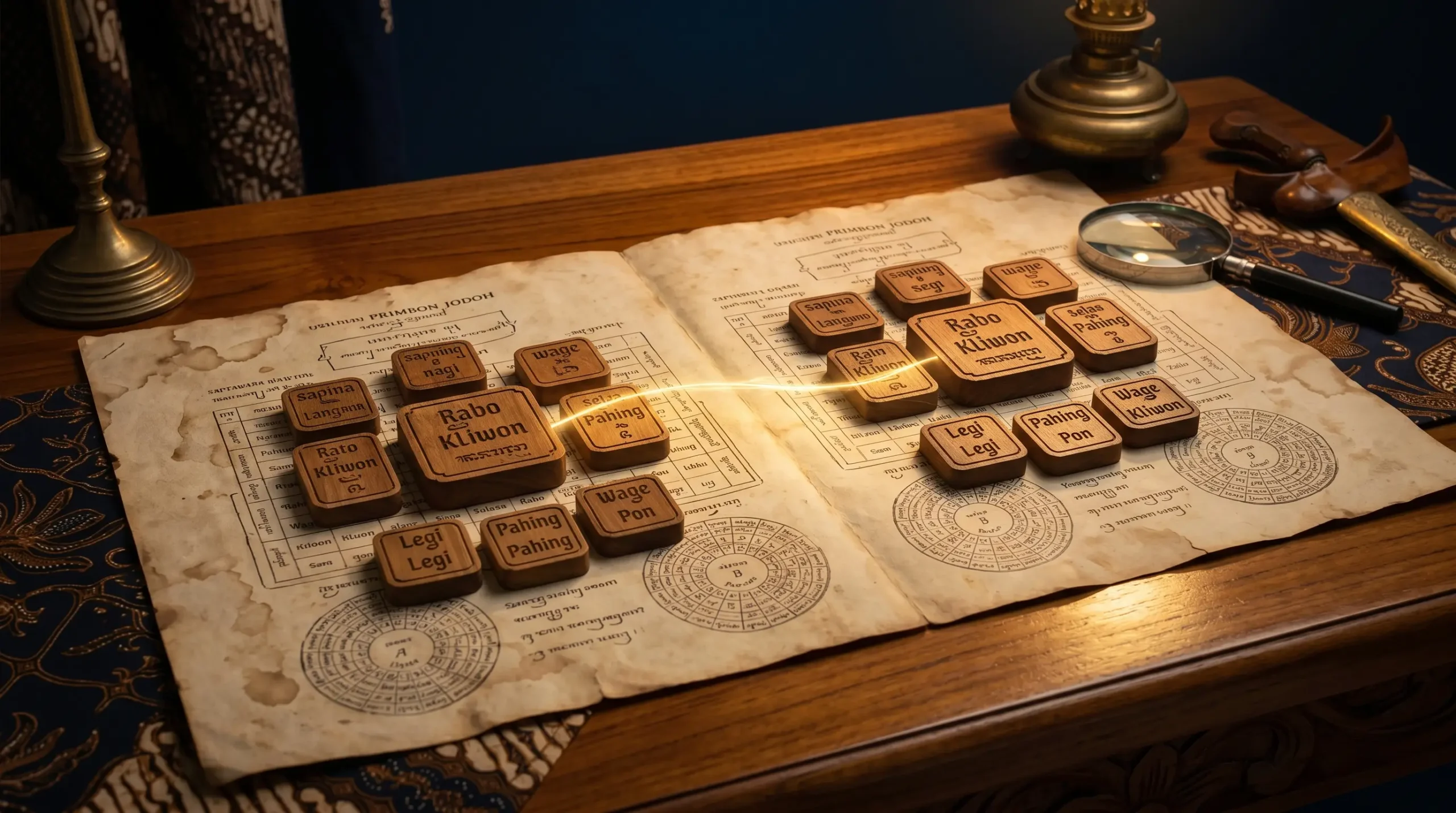
Imagine two people preparing for a more serious relationship. The family begins calculating weton, and the result is considered heavy. A calm situation suddenly turns uncertain. One person becomes afraid; the other feels blamed.
In this situation, Primbon Jodoh does not need to become a judge. A heavy result can be read as a reminder to be more careful: how does the couple handle conflict, how is family blessing discussed, how is trust maintained, and how is responsibility built?
What needs to be read is not only the neptu total, but also the real condition of the relationship. Numbers can open a conversation, but the decision still needs a clear heart and a responsible mind.
Ky Tutur’s reflection: Primbon is not a hammer for judging love. It is a mirror. If the reflection looks good, care for it. If it feels heavy, discuss it. Do not fear the number, but do not forget responsibility.
The Eight Primbon Jodoh Results and How to Read Them
In weton compatibility, several result terms are often searched: Pegat, Ratu, Jodoh, Topo, Tinari, Padu, Sujanan, and Pesthi. Each term carries a cultural meaning that needs to be read carefully.
| Result | Common Cultural Meaning | JavaSense Reading |
|---|---|---|
| Pegat | Often associated with distance, separation, or relationship strain. | A reminder to protect communication and commitment, not a verdict of separation. |
| Ratu | Often read as a respected or harmonious-looking relationship. | A reminder to keep dignity, humility, and mutual respect. |
| Jodoh | Often understood as a supportive compatibility result. | Compatibility still needs to be cared for through communication and responsibility. |
| Topo | Often linked with process, tests, restraint, or hardship. | A reminder to be patient, steady, and willing to strengthen each other. |
| Tinari | Often connected with sufficiency, livelihood, and calmness. | A reminder to keep working, stay grateful, and avoid carelessness. |
| Padu | Often associated with clashes of words or repeated arguments. | A reminder to guard speech, emotion, and the way problems are discussed. |
| Sujanan | Often linked with tests of trust, suspicion, or emotional distance. | A reminder to protect honesty, openness, and mutual trust. |
| Pesthi | Often read as calmness, stability, and continuity. | A reminder that peace still needs responsibility and daily care. |
Supportive Results Are Not Guarantees
Ratu, Jodoh, Tinari, and Pesthi are often treated as supportive results. Many people feel relieved when their Primbon Jodoh reading falls into one of these categories.
But a supportive result still needs good conduct. Ratu does not automatically make a relationship respected if the couple does not respect each other. Jodoh does not automatically create harmony if communication is ignored.
Tinari does not automatically create sufficiency if needs are not managed. Pesthi does not automatically bring peace if the couple stops caring for each other’s feelings. A supportive result is a cultural encouragement, not a guarantee.
Heavy Results Are Not Verdicts
Pegat, Topo, Padu, and Sujanan often make people anxious. But in the JavaSense reading, a heavy result should not be treated as punishment.
Pegat does not have to mean that a relationship will certainly end. Topo does not mean a relationship must suffer. Padu does not mean a couple will always argue. Sujanan should not be used as an accusation of disloyalty.
A heavy result is healthier when read as pepeling, a reminder: which part of the relationship needs more care? Communication, patience, trust, or the way conflict is resolved?
Primbon Jodoh and Marriage
In Javanese culture, Primbon Jodoh is sometimes read together with marriage discussions. After talking about compatibility, families may also consider a date that feels culturally aligned.
Still, a good day is not a guarantee of a good marriage. A healthy marriage needs emotional readiness, responsibility, family blessing, communication, honesty, and the willingness of two people to grow together.
When the discussion moves toward marriage, weton may be one cultural consideration beside practical readiness: family agreement, venue, budget, health, guest travel, and the couple’s ability to take responsibility for their shared life.
How Primbon Jodoh Relates to the Javanese Calendar
The Javanese calendar helps readers identify the weekday and pasaran of a birth date. That is why the Javanese calendar becomes an important foundation before reading weton compatibility.
To find each person’s weton, use the JavaSense tool to find your weton, pasaran, and neptu. To read compatibility directly, use the JavaSense tool to compare two weton values.
Myths and Safer Readings About Primbon Jodoh
Many readers approach Primbon Jodoh with worry. To keep the reading balanced, these myths and safer interpretations need to be separated.
| Myth | Safer Reading |
|---|---|
| Primbon Jodoh decides whether a relationship will succeed or fail. | No. Primbon Jodoh is better read as a cultural mirror, not an absolute decision. |
| A heavy result means the couple must separate. | No. A heavy result is safer when read as a reminder for care, reflection, and dialogue. |
| A supportive result guarantees a happy marriage. | No. A supportive result still needs communication, responsibility, loyalty, and daily care. |
| Neptu can measure whether someone is good or bad. | No. Neptu is a cultural symbol, not a measure of human worth. |
Common Mistakes When Reading Primbon Jodoh
The first mistake is treating the result as an absolute decision. This turns cultural reading into a burden.
The second mistake is using the result to blame a partner. A relationship needs two people who are willing to listen, not two people who use tradition to judge each other.
The third mistake is only looking at numbers while ignoring the real relationship. Communication, family blessing, shared values, emotional readiness, and responsibility cannot be left out.
The fourth mistake is reading traditional terms in a frightening way. In JavaSense, weton compatibility terms should be read carefully and should never be used to hurt someone.
Use Weton Compatibility with Care
JavaSense provides a weton compatibility tool to help readers explore relationship compatibility through weton more practically.
Use the result wisely. Do not turn it into a final decision. Treat it as a conversation starter, a cultural reflection, and a reminder to build a relationship with more awareness.
To find each person’s weton first, use the JavaSense weton calculator. To understand the wider cultural frame, read Javanese Primbon and Primbon Weton. To try other cultural tools, readers can also write in Javanese script.
To explore weton, the Javanese calendar, Primbon, wuku, Pawukon, and Javanese script in one place, visit JavaSense as a Javanese cultural platform.
For a more practical mobile experience, readers can download the JavaSense Android app through Google Play.
Cultural References on Primbon and Javanese Petungan
In Javanese tradition, Primbon Jodoh is related to Primbon, petungan, weton, pasaran, neptu, good days, and the cultural habit of reading relationships with caution.
For library context, readers can explore the Kitab Primbon Jawa Serbaguna collection in BintangPusnas. The Primbon catalog entry in the National Library of Indonesia also shows Primbon as part of a cultural literature tradition that discusses good days, character reading, and Javanese social customs.
JavaSense does not read Primbon as absolute prediction. In this article, Primbon Jodoh is understood as a cultural language that should be read together with reason, feeling, family dialogue, and the real condition of the couple.
Closing Reflection: A Relationship Is Not Finished by a Calculation
A relationship is not only a number. It is the meeting of two people, two families, two habits, two ways of seeing life, and two hearts learning to understand each other.
Primbon Jodoh can become a mirror. Weton can become a doorway. Neptu can become a cultural symbol. But the relationship still needs communication, responsibility, and compassion.
So read Primbon Jodoh calmly. Honor the tradition, understand its limits, and use it as a mirror for caring for a relationship, not as a hammer for judging people.
FAQ About Primbon Jodoh
What is Primbon Jodoh?
Primbon Jodoh is a Javanese relationship compatibility reading, usually based on the weton, pasaran, and neptu of two people.
Does Primbon Jodoh determine whether a relationship will succeed?
No. Primbon Jodoh does not determine relationship success. A relationship is still shaped by communication, maturity, family blessing, responsibility, and the shared values of two people.
How do you read weton compatibility?
The reading begins by finding each person’s weton, calculating the weekday and pasaran neptu, then reading the result as cultural reflection rather than a verdict on the relationship.
How is Primbon Jodoh related to neptu?
Neptu is the numerical value of the weekday and pasaran. In Primbon Jodoh, neptu is often used as one foundation for reading relationship compatibility.
What do Pegat, Ratu, Jodoh, Topo, Tinari, Padu, Sujanan, and Pesthi mean?
They are traditional result terms in weton compatibility. Their meanings should be read as cultural reminders for relationship care, not as certainty that a relationship will succeed or fail.
Does a difficult weton compatibility result mean a couple must separate?
No. A difficult result is safer when used as a reminder for reflection and dialogue, not as an immediate reason to separate.
Where can I check Primbon Jodoh online?
Readers can use the JavaSense weton compatibility tool to explore weton-based relationship reflection more practically.
Is Primbon Jodoh still relevant for modern couples?
It can still be relevant when read as cultural literacy and a space for dialogue, not as a verdict. Modern couples still need communication, honesty, family respect, and responsibility.