
Angger, my child…
There is laughter that passes only as entertainment. Yet there is also laughter that carries advice, corrects without wounding, and opens human eyes without humiliating them. In Javanese wayang, this kind of laughter lives through punakawan.
Ky Tutur Summary
- Punakawan are Javanese wayang figures who appear as companions, advisers, entertainers, and mirrors for the knights.
- The most widely known punakawan figures are Semar, Gareng, Petruk, and Bagong. Each carries a different lesson of conduct.
- Punakawan are not merely comic characters. They teach humility, social critique, honest speech, people’s wisdom, and the courage to correct power through laughter.
- In JavaSense, punakawan are read as cultural guidance and a mirror for life, not as figures that must be interpreted literally or dogmatically.
Ky Tutur Note: This article discusses punakawan as part of Javanese wayang, cultural teaching, and reflection on daily conduct. Stories of origin, symbols, and character meanings are read as cultural language, not absolute claims. Use them as mirrors for arranging rasa, speech, humor, humility, and the courage to speak truth with care.
Punakawan are often recognized as funny figures in Javanese wayang. When Semar, Gareng, Petruk, and Bagong appear, the atmosphere usually softens. The audience laughs, the tension of the story loosens, and the knights are given a pause from war, conflict, and heavy decisions.
Yet, my child, if punakawan are read only as clowns, the deeper teaching is lost. Behind their comic faces, unusual bodies, direct speech, and playful jokes, the punakawan carry a profound kind of wisdom. They teach that truth does not always need a tense face. Criticism does not always need to shout. Advice does not always need to sound like a lecture.
Punakawan are a Javanese way of teaching through laughter. They invite human beings to laugh at themselves, to see power more clearly, and to remember that ordinary people also carry voices that deserve to be heard. They remind us that life does not only need power, rank, learning, and heroic seriousness. It also needs humility, flexibility, courage, and the ability to keep wisdom close to everyday people.
What Are Punakawan in Javanese Wayang?
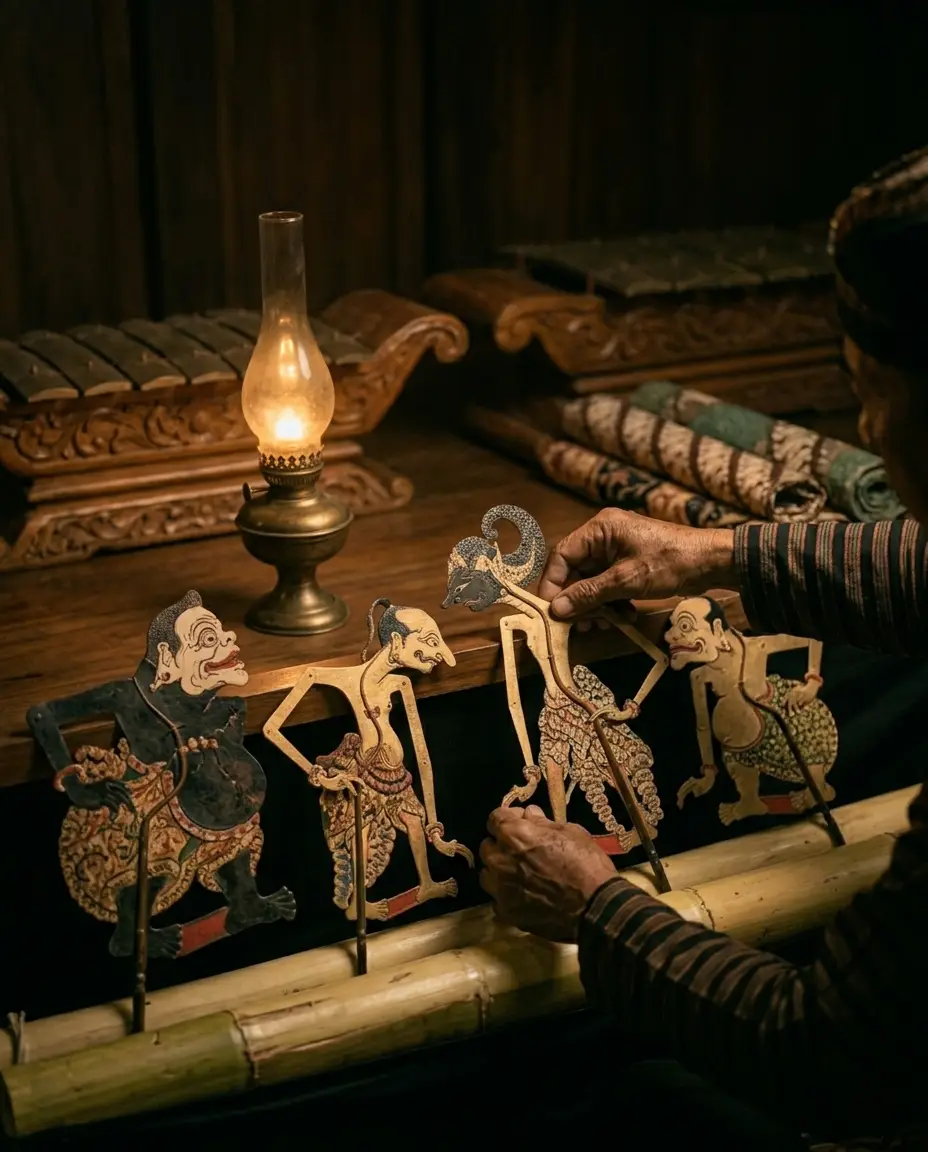
Punakawan are a group of figures in Javanese wayang who usually accompany the knights. They appear as servants, companions, advisers, balancing figures, and entertainers. In the most familiar Javanese tradition, the punakawan consist of Semar, Gareng, Petruk, and Bagong.
They do not merely walk behind the knights. They accompany the inner life of the story. They listen, advise, joke, criticize arrogance, and sometimes say what other characters cannot say directly.
This is the strength of punakawan. In social position, they seem lower than kings, gods, and noble warriors. Yet from that simple position, they often see life more clearly. They are not kings. They are not gods. They are not the central heroes. But precisely because they stand closer to ordinary life, they can speak truth with unusual freedom.
In cultural reading, punakawan teach that wisdom does not always come from the highest seat. Sometimes it comes from common people, from jokes, from the roadside conversation, from a servant’s honesty, and from laughter that seems light but touches the heart of the matter.
Punakawan Are More Than Comic Characters
One of the most common misunderstandings is seeing punakawan only as comic characters. It is true that they make people laugh. But their laughter is not empty. It is a doorway into advice.
In wayang performances, punakawan often appear when the story needs a pause. After heavy conflict, battle, or serious courtly conversation, they enter with the language of ordinary people. They make complicated matters easier to understand, pull lofty ideas back to earth, and return the story to daily human reality.
Here, humor becomes a way of educating rasa. Through laughter, advice becomes easier to receive. Through playfulness, criticism does not immediately feel like an attack. Through a simple sentence, a complicated problem can suddenly become clearer.
Punakawan teach that human beings do not need to be tense in order to become wise. Sometimes, when a person can laugh at themselves, the door of awareness begins to open. Those who cannot laugh at themselves are often easier to offend, easier to trap in pride, and harder to advise.
Semar: Pamomong, Humility, and People’s Wisdom
Semar is the center of the punakawan. In Javanese wayang, he is often read as a pamomong: a caretaker, guide, and guardian of the inner direction of the knights. His form is simple and does not look like a grand heroic figure. Yet behind that simplicity, Semar carries deep wisdom.
Stories about Semar’s origin are often connected with divine and symbolic worlds. In the JavaSense reading, such stories are best understood as cultural language. The point is not to force a literal claim, but to show that wisdom can choose the path of humility, service, and closeness to ordinary people.
Semar teaches that what is high does not always need to appear magnificent. The wise do not always need to show themselves. The strong do not always need to win with a loud voice. In Semar, there is a lesson about humility, protection, and the courage to correct power without losing rasa.
Semar’s value is important for leadership today. A leader who cannot listen will easily become distant. A person with knowledge who refuses correction will easily become proud. Semar reminds us that the higher one stands, the deeper one must learn to bow.
Gareng: Imperfection and Honest Humility
Gareng is often depicted with an imperfect body. Yet in wayang, this imperfection is not meant as humiliation. It becomes a symbol that human beings do not need to be physically perfect in order to carry value. Shortcomings do not automatically erase wisdom.
In cultural reflection, Gareng teaches honesty, simplicity, and humility. He reminds us that people are often too busy hiding weakness, while a weakness recognized honestly can become a doorway to more mature conduct.
Gareng also teaches that a stumbling step can still move toward goodness. Not everyone moves quickly. Not everyone appears graceful. Not everyone speaks brilliantly. Yet every person still has room to learn, to improve, and to take part.
In an age that often worships perfect appearance, Gareng feels deeply relevant. He invites human beings to stop measuring worth only by face, style, status, or outer achievement. What matters more is honest inner life, perseverance, and the courage to continue walking even when not everything is ideal.
Petruk: Clever Humor and Gentle Satire
Petruk is often associated with wit, verbal agility, and satirical humor. His long and flexible figure often appears with comments that make people laugh and think at the same time. Through him, laughter becomes a subtle blade for opening reality.
Petruk teaches that criticism does not have to be harsh. Truth can be delivered playfully, yet still remain sharp. In Javanese culture, indirect satire can sometimes work better than shouting, because it gives the one being criticized room to realize without being publicly humiliated.
Yet Petruk’s cleverness also has a yellow light. If not guided by rasa, verbal intelligence can become a game that wounds. Humor can turn into mockery. Criticism can become hidden arrogance.
Because of this, Petruk’s conduct needs tepa slira. Cleverness needs rasa. Jokes need responsibility. Criticism needs an intention to repair, not merely a desire to appear sharper than others.
Bagong: Plain Honesty and the Voice of the People
Bagong often appears blunt, direct, and brave. His words may feel rough, but inside them there is a kind of honesty that is difficult to cover. He represents the voice of ordinary people: not always polished in language, but often clear in sensing what is wrong.
In the structure of punakawan, Bagong reminds us that truth does not always come wrapped in refined language. Sometimes it comes from simple complaints, direct questions, or the courage to say that something is not right.
Bagong teaches courage. Not the courage to rebel without purpose, but the courage not to let injustice walk without a voice. He reminds us that harmony should never mean closing the mouth against truth.
Still, Bagong’s honesty also needs guidance. Bluntness without rasa can wound. Courage without wisdom can become noise. That is why, in daily conduct, Bagong needs Semar, Gareng, and Petruk beside him: courage needs care, honesty needs humility, and criticism needs intelligence.
Laughter as a Javanese Way of Teaching
The laughter of punakawan is not an escape from problems. It is a way to approach problems without closing the heart. When people feel attacked, they tend to defend themselves. But when they laugh and see themselves from a healthier distance, advice can enter more gently.
This is one of the strengths of Javanese cultural teaching. Not every lesson is delivered as a command. Not every criticism is wrapped in anger. Sometimes what remains in the heart is a joke that makes people silent after laughing.
In wayang performance, punakawan laughter also becomes breathing space. Audiences following a heavy conflict are invited to see life from a more human angle. Knights who are too serious are reminded that they are still human. Power that stands too high is pulled back toward the ground.
In this way, punakawan laughter becomes a practice of educating rasa. It allows people to learn without feeling lectured, to be corrected without being destroyed, and to be invited to change without losing dignity.
Punakawan as Social Critique
One of the most important dimensions of punakawan is social critique. In a wayang world filled with kings, gods, knights, and great figures, the punakawan arrive as a different voice. They can laugh at power, correct arrogance, and question the decisions of figures who appear noble.
Their criticism is not always direct. It is often wrapped in humor, satire, innocent questions, or casual conversation. Precisely because of this gentle form, the criticism can enter more deeply. The one being criticized does not immediately lose face, but is still invited to reflect.
Here, Javanese wisdom becomes visible: truth must be spoken, but the method needs care. If criticism is too harsh, people may close their ears. If criticism is too weak, truth may disappear. Punakawan choose a middle path: correcting through laughter, satirizing through jokes, and reminding through the language of ordinary people.
This value is close to aja dumeh. Do not feel that power makes listening unnecessary. Do not feel that intelligence makes correction unnecessary. Do not feel that honor makes ordinary people’s voices meaningless.
Punakawan in Modern Life
In modern life, punakawan remain relevant. We live in an age where many people want to look perfect, strong, and always correct. Social media makes it easy to build an image, but difficult to truly reflect. Criticism is often treated as an attack. Humor often becomes humiliation. Truth is often defeated by performance.
Punakawan invite us to return to simplicity. Dare to laugh at ourselves. Dare to admit shortcomings. Dare to listen to small voices that may not be popular. Dare to give criticism without lowering another person’s dignity.
In teamwork, the spirit of punakawan means giving room for people who seem ordinary to speak. In family life, it means correcting with care, not humiliation. In leadership, it means remaining close to the lower voices. In digital spaces, it means pausing before turning humor into a weapon for public embarrassment.
Punakawan also teach that wisdom does not always arrive with a serious face. There is advice in laughter. There is criticism in playful speech. There is courage in simplicity. There is nobility in humility.
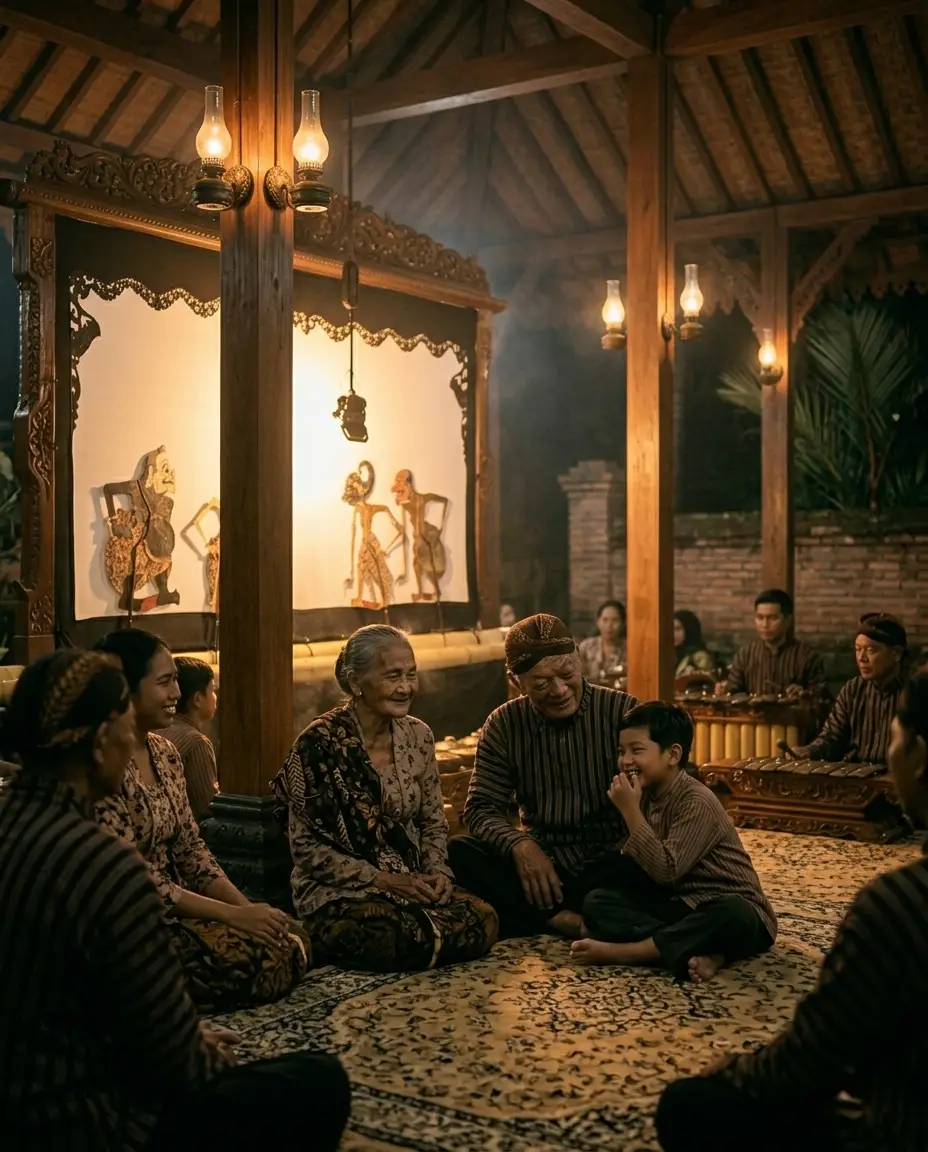
Punakawan, Wayang, and Javanese Pitutur
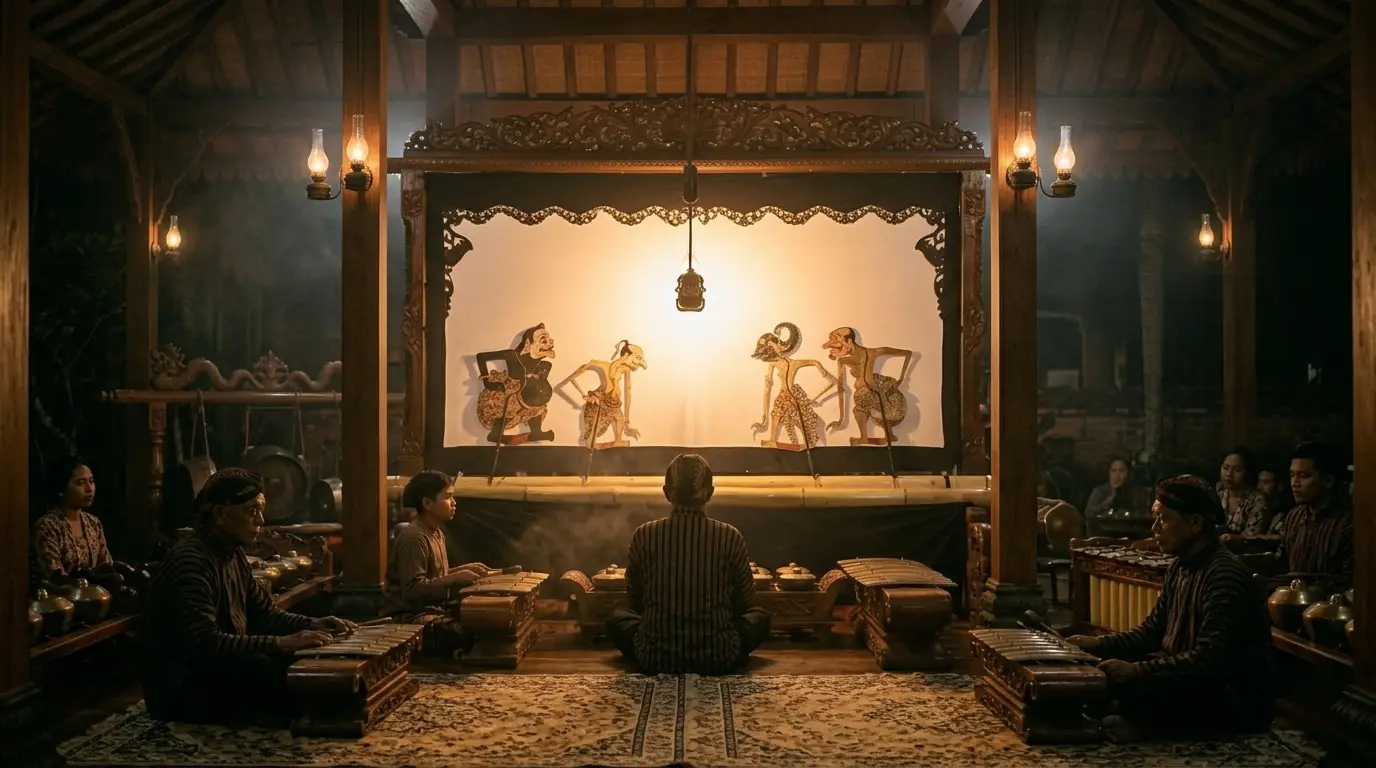
Punakawan do not stand alone. They live within Javanese wayang, a world full of symbols about life, conflict, choices, and the inner journey of human beings. If the gunungan marks openings, endings, and changes of scene, punakawan become the voice that reminds human beings not to lose rasa in the middle of the story.
Punakawan are also close to Javanese pitutur. They teach eling, humility, tepa slira, courage, and careful speech. These teachings do not float in the sky. They are brought down into jokes, conversations, and everyday moments.
This is why punakawan feel alive. They do not only speak to kings and knights. They speak to workers, families, leaders, students, creators, and anyone who must learn how to carry truth without cruelty.
If you want to explore Javanese letters and written heritage, use the JavaSense Javanese script tool. If you want to read Javanese dates, pasaran, and cultural rhythm, open the JavaSense Javanese calendar.
JavaSense and a Clearer Way to Read Punakawan
JavaSense reads punakawan as cultural heritage that should be cared for with common sense and refined rasa. Not merely as funny figures. Not as decorative wayang characters. Not as symbols forced into rigid dogma.
The value of punakawan is practical. Laugh without becoming cruel. Criticize without humiliating. Lead without becoming arrogant. Speak truth without losing tenderness. Listen to ordinary voices before a system becomes too proud to correct itself.
As a broader public cultural reference, readers may also visit the National Library of Indonesia. References like this help cultural reflection stay connected to learning and public knowledge.
In JavaSense, tradition is not used to make people afraid. Tradition becomes useful when it helps human beings become clearer, more humble, more courageous, and more able to care for shared life.
Closing Reflection: Laughter That Keeps Life Sane
In the end, punakawan teach that life does not always need to be read with a tense face. There are times when human beings need to laugh, not to run from problems, but to see problems with a wider heart. There are times when criticism must be spoken, not to destroy, but to remind. There are times when ordinary people must be heard, because honest voices often rise from there.
Angger, my child, carry the conduct of punakawan slowly. Be humble like Semar, honest in imperfection like Gareng, clever in delivering goodness like Petruk, and brave in speaking truth like Bagong. But remember, all of that needs rasa. Humility without courage can become silence. Courage without rasa can become roughness. Humor without responsibility can become a wound.
Punakawan are not only performance. They are guidance. They invite human beings to keep laughter from becoming empty, criticism from becoming cruel, and wisdom from drifting too far away from ordinary people.
To learn Javanese culture in a lighter and more modern way, you can download JavaSense on Google Play.
FAQ About Punakawan in Javanese Wayang
What are punakawan in Javanese wayang?
Punakawan are Javanese wayang figures who act as companions, advisers, entertainers, and balancing voices for the knights.
Who are the main punakawan figures?
The most widely known punakawan figures are Semar, Gareng, Petruk, and Bagong. Each carries a different symbolic lesson that complements the others.
What does Semar represent in punakawan?
Semar is often read as a pamomong, or caretaker figure, who represents humility, closeness to ordinary people, and wisdom carried through simplicity.
Why are punakawan humorous?
Punakawan are humorous because laughter becomes a Javanese way to deliver advice, criticism, and wisdom without making people feel directly attacked.
What is the function of punakawan in wayang stories?
Punakawan function as entertainers, advisers, voices of the people, moral reminders, and balancing figures for the main characters in wayang stories.
Are punakawan only comic characters?
No. Punakawan are entertaining, but they also carry life guidance, social critique, people’s wisdom, humility, and honest speech.
How are punakawan connected with social critique?
Punakawan often deliver criticism toward power or noble figures through laughter, gentle satire, and innocent questions so truth can be received more easily.
What life lesson can be learned from punakawan?
Punakawan teach humility, honest courage, acceptance of imperfection, criticism without humiliation, and laughter that still carries wisdom.
Learn Punakawan with Clearer Awareness
Punakawan are not merely funny figures in wayang. They are Javanese guidance about humility, social critique, people’s voices, and wisdom through laughter. To explore the Javanese calendar, script, weton, and daily heritage in a simpler way, open JavaSense on Google Play.