Angger, my child…
There are buildings that cannot be understood only as walls, gates, and halls. There are spaces that carry long memories of power, people, arts, manners, and the Javanese way of arranging life. That is keraton: not merely a palace, but a cultural center where history, symbols, and inner conduct meet.
Ky Tutur Summary
- Keraton is a Javanese palace and cultural center that contains symbols of power, space, arts, babad, tradition, and the relationship between ruler and people.
- Keraton should not be read only as a physical building, but also as a space of values where etiquette, refined speech, arts, and historical memory are preserved.
- In Javanese babad, keraton often appears as a center of story, legitimacy, conflict, transition, and cultural memory.
- In JavaSense, keraton is read as cultural heritage and a mirror for conduct, not as rigid doctrine, not as absolute mystical claim, and not as a tool for glorifying power without reflection.
Ky Tutur Note: This article discusses keraton as cultural heritage, historical memory, symbolic space, and reflective guidance. Mentions of royal authority, sacred symbols, spatial order, and inner meaning are read as cultural language, not absolute claims. Use them as a doorway into history and values, not as a rigid doctrine for judging the present.
Keraton is often imagined as the palace of a king, a residence of royal families, or a historic building that people visit as a cultural destination. That view is not wrong. Yet if we stop there, the meaning of keraton becomes too narrow. It appears only as an old building, while inside it lives a way of reading power, space, people, arts, language, and cultural values.
In Javanese tradition, keraton is a center. But center does not only mean the highest place of command. It also means a point of connection. From there, stories are arranged, ceremonies are performed, arts are preserved, language is refined, and historical memory is passed down.
So, my child, reading keraton is not only asking, “Who was the king?” or “How magnificent is the palace?” A deeper question is: what values were cared for there? How does its space teach conduct? Why do the alun-alun, pendopo, abdi dalem, wayang, gamelan, refined language, and the people all appear within one cultural ecosystem?
What Is Keraton Jawa?
In simple terms, keraton is the central residence of a ruler in the Javanese royal tradition. The word keraton is often connected with ratu, meaning king, queen, or ruler. From this basic meaning, keraton may be understood as the place where the ruler resides, where governance is arranged, and where symbolic authority is centered.
But keraton does not stop as a royal residence. In Javanese culture, it also becomes a center of customs, arts, knowledge, ceremonies, language, etiquette, and collective memory. Its order does not only organize space. It also teaches rasa: how people walk, speak, give respect, receive guests, perform ceremonies, and maintain social relationships.
Because of this, keraton can be read as a complete cultural space. It has a historical side, political side, aesthetic side, symbolic spiritual side, and social side. These sides are not always easy to separate, because in older traditions, power, arts, religion, manners, and the life of the people often touched one another.
This is why keraton must be read carefully. It is not enough to romanticize it. It is also not fair to dismiss it as only an old symbol of hierarchy. A clearer reading sees both beauty and complexity: the elegance of culture, the weight of history, the memory of power, and the living lessons that can still be carried today.
Keraton as a Center of Symbols and Space
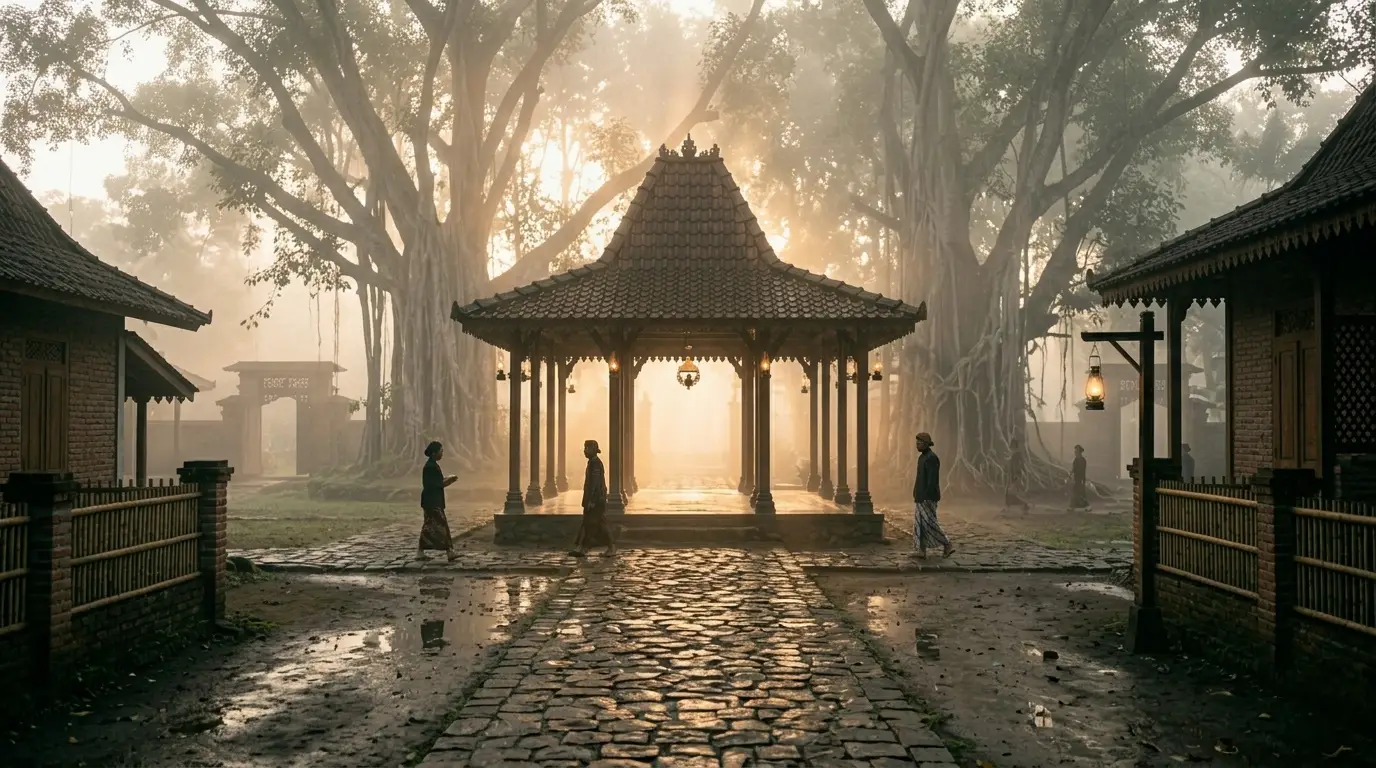
The spatial order of keraton is not arranged randomly. Many parts carry symbolic meaning. There are the alun-alun, pendopo, gates, mosque, paseban, kedhaton, and other spaces, each with function and cultural message.
The alun-alun, for example, is not merely an open field. It becomes a meeting space between keraton and the people. Ceremonies may happen there, public gatherings may take place, and the relationship between the center of authority and society becomes more visible.
The pendopo is not only a shaded building. It is a space of reception, discussion, performance, and etiquette. It teaches openness that still has order. It is physically open, yet culturally not without manners.
In symbolic reading, keraton may be understood as a small ordering of a larger world. This does not need to be turned into a rigid mystical claim. It is better understood as cultural language: a way Javanese society placed values into space, buildings, direction, movement, and ceremony.
The lesson is simple: space can educate human beings. The way a space is arranged can influence the way people behave. A room can invite silence, respect, openness, distance, or gathering. Keraton shows that architecture can become cultural teaching.
Alun-Alun, Banyan Trees, Mosque, and Pendopo
One of the most recognizable parts of keraton space is the alun-alun. In many Javanese cities, the alun-alun is an open public square near a center of authority, mosque, and important buildings. This arrangement shows that public space, power, worship, and the life of the people were once imagined as connected parts of a wider order.
The banyan tree often appears as a symbol of shade, strong roots, and protection. In cultural rasa, the banyan is not merely a large tree. It can be read as a sign of shelter. It gives shade, but does not need to speak loudly. It stands firm, while its roots go deep into the ground.
The mosque near the alun-alun reminds us that keraton life cannot be separated from spiritual, social, and communal rhythm. Yet again, this should be read carefully. The point is not to claim that every spatial detail has one fixed meaning. The point is that Javanese space often carries layers of memory and value.
The pendopo, meanwhile, teaches ordered openness. People may gather, speak, listen, perform arts, and receive guests. But entering such a space still asks for manners. A person does not only bring the body into the pendopo. They also bring speech, posture, intention, and awareness.
Keraton in Javanese Babad
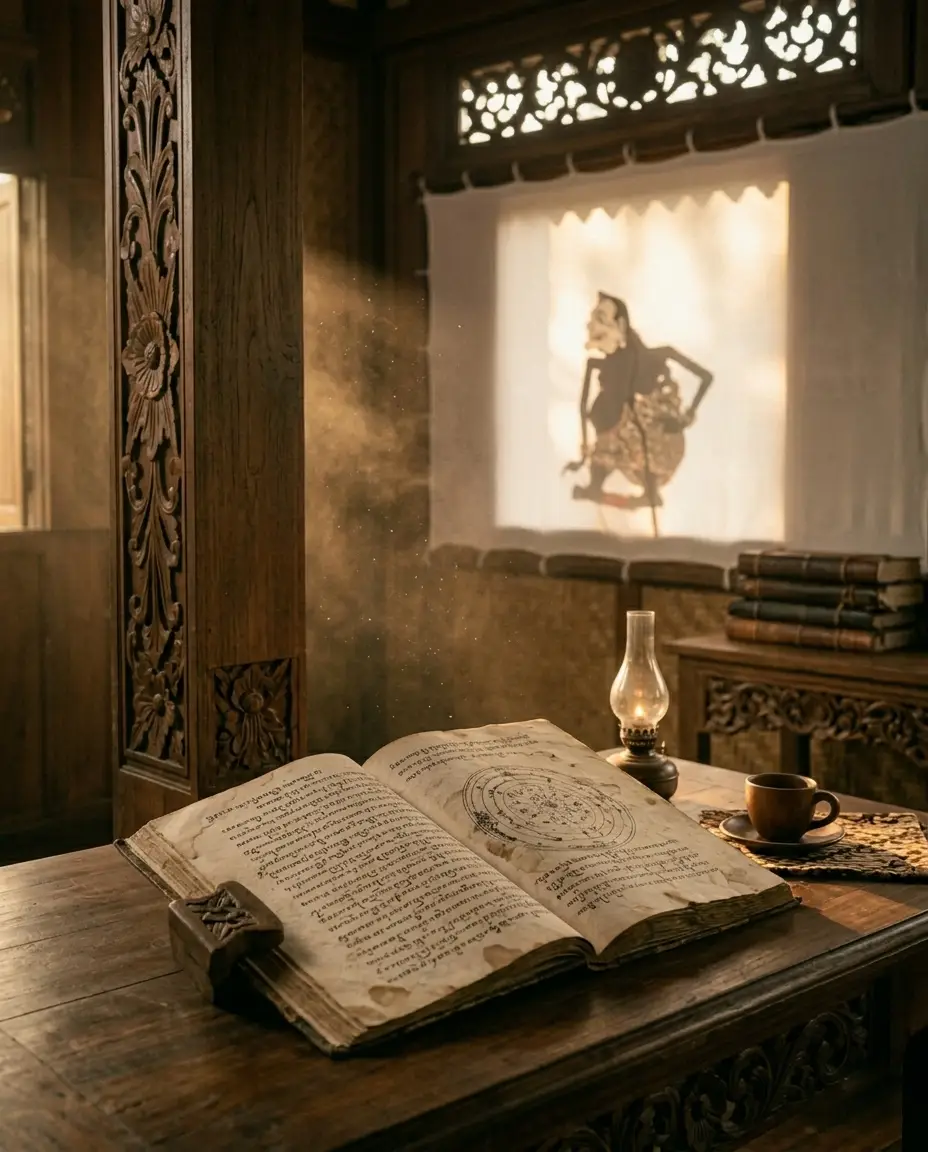
In Javanese babad, keraton often appears as the center of the story. Many accounts of the rise of kingdoms, movement of royal centers, family conflict, agreements, war, and the turning of eras are connected with keraton.
Babad is not always the same as modern historical writing that focuses only on dates, archives, and administrative evidence. Babad carries memory, symbols, legitimacy, and the way a community narrates its past. Because of that, when keraton appears in babad, it is not only the location of events. It becomes the stage where values, conflicts, ambitions, and historical wounds are spoken.
Reading keraton through babad helps us understand that a palace never stands alone. It is connected with the people, land, heirlooms, ancestors, diplomacy, war, and social change. Within it there is grandeur, but also tension. There is order, but also struggle. There is beauty, but also the weight of power.
Here, the reading must remain clear. Respecting keraton as cultural heritage does not mean closing our eyes to historical complexity. The more carefully we respect heritage, the more carefully we should ask: which part is symbol, which part is event, which part is pitutur, and which part becomes a lesson for today?
Keraton as People’s Space
Keraton is often imagined as distant from ordinary people, as if it belonged only to kings, noble families, and abdi dalem. Yet in many cultural practices, keraton is also connected with the people through the alun-alun, markets, ceremonies, arts, stories, and collective memory.
The people are not always passive spectators. They are part of the cultural ecosystem. Some come during ceremonies. Some preserve crafts. Some tell stories. Some keep traditions outside the palace walls. Others bring the influence of keraton into language, clothing, music, and daily etiquette.
Because of this, keraton may be read as a space of relationship. It connects center and edge, nobility and common people, written tradition and oral memory, formal ceremony and everyday practice. This relationship has never been perfectly simple. There are social distances, hierarchies, and histories of power. But precisely because of that, keraton needs to be read as a whole, not merely praised as splendor.
In the JavaSense reading, the keraton worth studying is not only keraton as a symbol of authority, but also keraton as shared cultural memory. From there, we can ask: which values still deserve care? Which parts need to be reread? How can culture remain alive without trapping people in empty nostalgia?
Abdi Dalem and the Practice of Caring for Tradition
One of the gentlest faces of keraton life is the abdi dalem. They are often understood as people who serve the palace. But more deeply, abdi dalem can also be seen as guardians of traditional rhythm. They help preserve procedure, language, clothing, ceremony, and the quiet conduct that keeps the keraton breathing as culture.
The practice of abdi dalem teaches patience. Many of their tasks may not appear grand. Some are repetitive, slow, and small. Yet many traditions survive precisely because of these small details. Not every heritage is preserved by great speeches. Much of it remains alive because there are people who faithfully care for details.
This value is close to ngemong: nurturing, guiding, and caring with rasa. A tradition needs this kind of conduct so it does not become merely a spectacle. It remains a space of learning.
Still, service must also be read with common sense. Honoring tradition should never erase human dignity. Serving does not mean losing voice. What needs to be cared for is balance: respect, awareness, humility, and humanity.
Arts, Wayang, Gamelan, and Refined Speech
Keraton Jawa is also known as a space where arts are cultivated. Dance, gamelan, wayang, clothing, tembang, literature, and refined speech have been preserved through the keraton environment. Here, art is not merely entertainment. It becomes education of rasa.
Javanese dance teaches bodily control, pause, refinement, and awareness of movement. Gamelan teaches harmony: no single instrument stands alone. Each sound finds its place within a larger arrangement. Wayang carries stories about human beings, power, loyalty, cunning, wisdom, and the choices of life.
Refined language also becomes important. Through unggah-ungguh basa, human beings learn that words carry rasa. The way one speaks to elders differs from the way one speaks with close friends. The way one receives a guest differs from casual speech. This is not merely a complicated rule. It is a cultural way of teaching sensitivity.
From keraton arts, we learn that refinement is not weakness. A soft movement can carry strength. A slow rhythm can carry depth. A gentle word can carry dignity. In a fast and loud age, this lesson becomes even more important.
Inner Keraton: Reading Symbols for Modern Life
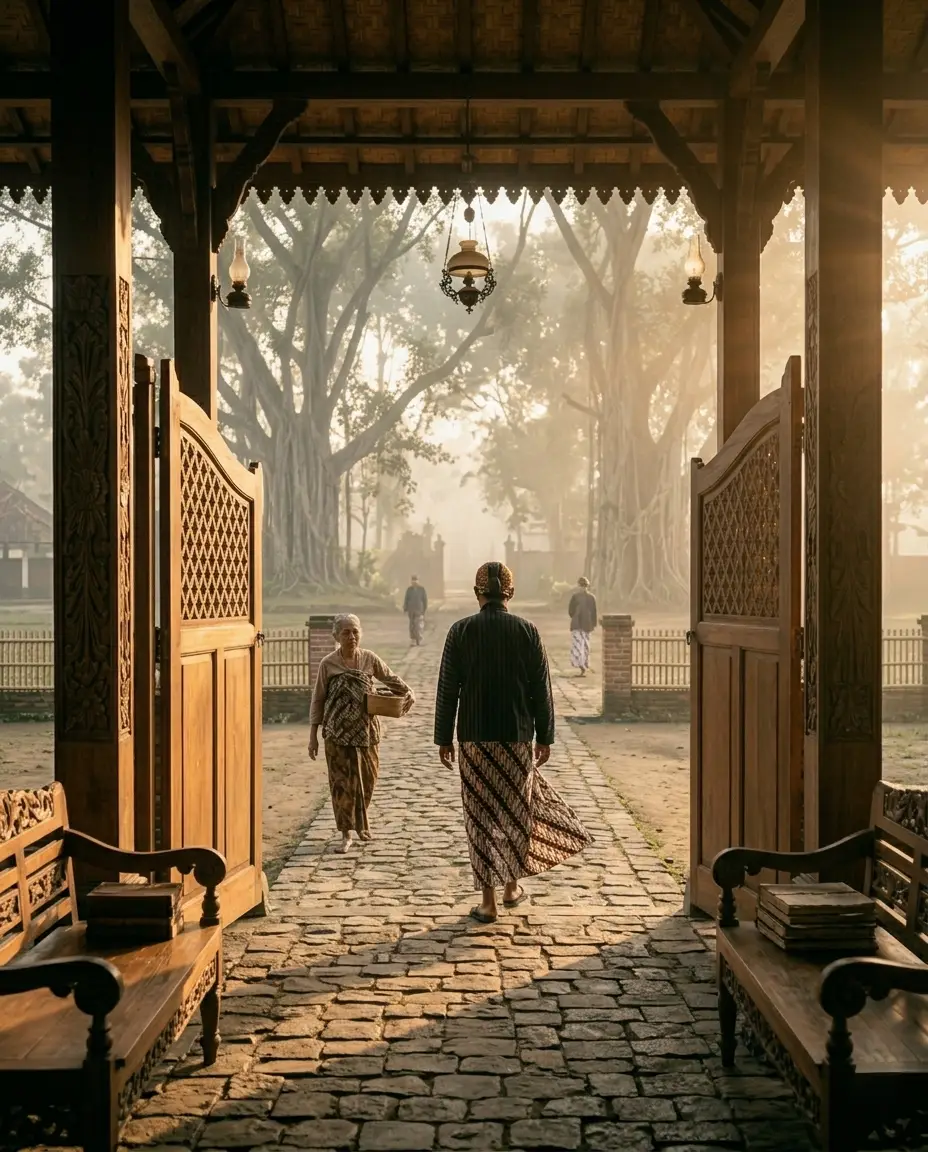
Keraton can also be read as an inner symbol. Inside every human being, there is a space that needs to be arranged. There are thoughts that need order. There is rasa that needs care. There is speech that needs refinement. There are decisions that need to return to a clear center.
This “inner keraton” is not meant to make life sound beautiful without substance. It is a simple reminder that human beings need a center. If the inner center is chaotic, speech easily wounds. If the inner center is filled with arrogance, knowledge can become a tool for lowering others. If the inner center is clearer, decisions become more able to bring benefit.
Today, many people live in a noisy digital alun-alun. Everyone speaks. Everyone judges. Everyone wants to be seen. In such a time, the symbol of keraton can remind us to build a quiet space within ourselves.
This value is close to hening, eling lan waspada, and sangkan paraning dumadi. All of them invite human beings not only to move outward, but also to return inward, arranging the place from which speech and action are born.
Keraton, Majapahit, and Historical Memory
A discussion of keraton cannot be separated from the wider memory of Javanese kingdoms, including Majapahit. For many Javanese people, Majapahit is not only the name of an old kingdom. It is also a symbol of political imagination, diplomacy, cultural memory, and inherited storytelling.
Later keraton traditions often lived with shadows of this historical memory. There were continuities, changes, and reinterpretations. Heirlooms, babad, genealogies, ceremonies, and symbols of authority were often used to connect the present with the past.
Yet historical memory needs to be read clearly. We may respect the greatness of the past, but we should not become trapped in empty pride. What matters more is the lesson: how power was exercised, how people were positioned, how arts were preserved, and how division could leave long wounds.
In this way, keraton is not only a building to admire. It becomes material for learning about leadership, public space, cultural responsibility, and the need to read history with both respect and caution.
JavaSense and a Clearer Way to Read Keraton
JavaSense reads keraton as cultural heritage that should be cared for with common sense. Not as doctrine that must be accepted without questions. Not as nostalgia that only praises the past. Not as an empty symbol used without understanding its context.
If you want to explore Javanese letters and written heritage, use the JavaSense Javanese script tool. If you want to read dates, pasaran, and the rhythm of Javanese time, open the JavaSense Javanese calendar.
As a broader public cultural reference, readers may also visit the National Library of Indonesia. References like this help cultural reading stay connected to learning and public knowledge.
The JavaSense path is simple: honor symbols, but do not lose common sense. Study history, but do not freeze in the past. Care for culture, but keep humanity at the center.
Closing Reflection: Keraton as Memory and Mirror
In the end, keraton teaches that culture does not only live in the past. It lives in the way human beings arrange space, guard speech, care for arts, respect people, and read history carefully. Keraton is a building, but also memory. It is a center of authority, but also a symbolic space. It holds beauty, but also invites us to read complexity.
Angger, my child, do not see keraton only as a distant place. Read it as a mirror. There are lessons there about center and edge, leader and people, arts and manners, history and living conduct.
If the outer keraton teaches spatial order, the inner keraton teaches the order of rasa. If the alun-alun becomes a meeting space for people, the human heart also needs a wide space to listen and weigh. If the pendopo teaches openness with manners, human speech also needs to be open without losing adab.
Carry this lesson slowly. Care for memory, but do not freeze in the past. Honor symbols, but do not abandon clear reason. Study history, but do not forget to bring its lesson into today’s conduct.
To learn Javanese culture in a lighter and more modern way, you can download JavaSense on Google Play.
FAQ About Keraton Jawa
What is Keraton Jawa?
Keraton Jawa is a Javanese royal palace and cultural center connected with rulers, space, arts, ceremonies, babad, etiquette, and the relationship between leadership, people, and tradition.
What does keraton mean in Javanese culture?
In Javanese culture, keraton means more than a palace. It is a symbolic center of values, historical memory, arts, refined speech, ceremonies, and cultural order.
How is keraton connected with Javanese babad?
In Javanese babad, keraton often becomes the center of stories about kingdoms, changes of power, conflict, legitimacy, historical memory, and cultural identity.
Why is the alun-alun important in keraton space?
The alun-alun is important because it connects the keraton with the people. It can be read as public space, ceremonial space, and a symbol of relationship between the center and society.
Is keraton only a royal residence?
No. Keraton is a royal residence, but it is also a center of customs, arts, language, ceremonies, education of rasa, and preservation of tradition.
What is the role of abdi dalem in keraton tradition?
Abdi dalem help preserve palace procedures, ceremonies, refined language, clothing, arts, and the rhythm of tradition so cultural heritage can continue across generations.
Why is keraton still relevant today?
Keraton remains relevant because it teaches lessons about spatial order, inner order, arts, historical memory, leadership, public space, and the relationship between people and culture.
How should keraton symbols be read clearly?
Keraton symbols should be read as cultural language and reflective guidance, not as rigid mystical certainty. This allows their historical and ethical value to remain alive without becoming dogma.
Learn Keraton Jawa with Clearer Awareness
Keraton is not merely an old palace. It is symbolic space, historical memory, people’s space, and a mirror for cultural conduct. To explore the Javanese calendar, script, weton, and daily heritage in a simpler way, open JavaSense on Google Play.