

Angger, my child…
There are names in Javanese history that cannot be read only as stories of war. Diponegoro is one of them. He opens a doorway into inner steadfastness, laku prihatin, dignity, tata rasa, and the courage to hold principle when the age itself feels unstable. To read him clearly is not to worship a figure, but to learn from history with a calmer heart.
Ky Tutur Summary
- Diponegoro is an important figure in Javanese and Indonesian history, especially through the Java War of 1825–1830.
- His story is not only about physical resistance, but also about inner steadfastness, laku prihatin, dignity, land, faith, and leadership guided by rasa.
- Babad Diponegoro remains an important cultural and historical source for understanding how he remembered life, struggle, exile, and Javanese historical memory.
- This article reads Diponegoro as a mirror of conduct, not as a cult figure, not as an empty heroic slogan, and not as an excessive mystical narrative.
Ky Tutur Note: This article discusses Diponegoro as a historical figure and Javanese cultural heritage. It is not a replacement for academic study, not a single final claim about history, and not an invitation to idolize a person. Read it as a doorway into values: steadfastness, restraint, awareness, dignity, and moral courage.
Diponegoro is often remembered as a war hero. In history lessons, his name is attached to the Java War, horses, white robes, turbans, spears, and courage against Dutch colonial power. That image is not wrong, but it is not complete.
If he is read only as a war figure, Diponegoro becomes distant from life today. He appears to stand only inside a museum of history, not as a mirror for arranging the inner life. Yet behind the battles, there was a deeper struggle: dignity, land, faith, leadership, self-control, and the courage to hold principle.
So, my child, reading Diponegoro clearly means not stopping at heroism. We need to see how his inner steadfastness was formed, how laku prihatin shaped his stance, how he read injustice, and how his legacy can still become guidance for a fast-moving age.
Diponegoro as a Mirror of Inner Steadfastness
Diponegoro can be read as a mirror of inner steadfastness. Steadfastness here does not mean being hard-headed. It means the ability to hold a principle after weighing the situation, seeing the risk, and realizing that the right path is not always the easy one.
In Javanese history, Diponegoro stood in the middle of a complicated age. The palace, colonialism, people’s land, political power, religion, and competing interests met in one difficult current. His story did not grow from a simple space. That is exactly why it remains powerful.
Diponegoro’s inner steadfastness was not visible only when war broke out. It could already be seen in his way of life, his choice of place, his laku prihatin, and his distance from palace luxury. He did not only resist colonialism outwardly. He also resisted the moral decline that he sensed around him.
This is where Javanese tata rasa becomes important. Steadfastness is not enough if it stands alone. It needs rasa, adab, awareness of limits, and sensitivity toward the suffering of others. Without rasa, firmness can become violence. With rasa, firmness becomes dignified conduct.
A Brief History of Diponegoro and the Java War
Diponegoro was born Raden Mas Mustahar and was also known as Raden Mas Antawirya. He was a son of Sultan Hamengkubuwono III. In history, he became known as Prince Diponegoro, the central figure of the Java War, which took place from 1825 to 1830.
The Java War was not a small conflict. It became one of the major wars that deeply drained Dutch colonial power in Java. The war was not caused by one single issue. It grew from court politics, colonial interference, land disputes, burdens on the people, taxation, and social wounds that had accumulated over time.
One trigger often mentioned is the placement of road markers through land in Tegalrejo, a place closely connected to Diponegoro’s life. But when seen more broadly, that event was like fire touching dry straw. The tension had already existed for a long time. The marker only made the sense of violation visible.
In many historical readings, Diponegoro’s struggle is not understood merely as a personal search for power. It is also connected to dignity, religion, land, and resistance to colonial injustice. Because of that, reading the Java War only as a rebellion narrows its meaning.
Tegalrejo, Laku Prihatin, and Inner Formation
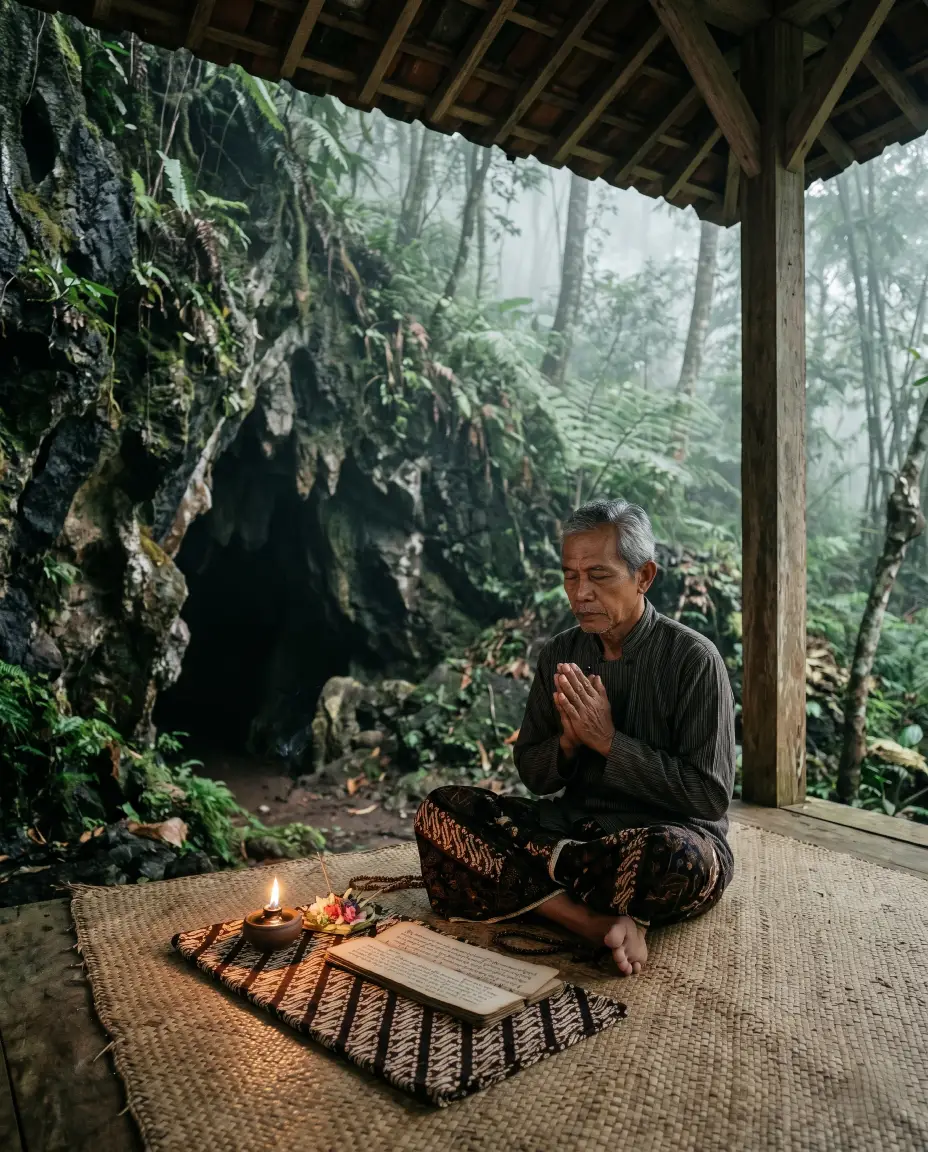
To understand Diponegoro, we need to look toward Tegalrejo. There, much of his inner life was shaped. He did not grow only inside the noise of the palace. He also lived in an environment closer to religious discipline, simplicity, reflection, and self-control.
Tegalrejo gave Diponegoro space to deepen religious learning, reflect, and practice laku prihatin. Laku prihatin is not merely eating less or withdrawing from crowds. In Javanese rasa, prihatin is a discipline for restraining desire, controlling the self, sharpening the inner life, and keeping a person from being enslaved by comfort.
Here, a careful boundary is needed. Diponegoro is often remembered as a deeply religious figure with a strong inner life. Yet this article does not need to lock readers into one spiritual claim. What matters here is the value of the conduct: discipline, simplicity, clarity of intention, and the courage to protect dignity.
Laku prihatin helps a person become less easily tempted. In Diponegoro’s story, this practice can be read as one reason he was not easily softened by comfort, office, or compromise that damaged dignity.
The Java War: Dignity, Land, and Injustice
The Java War cannot be separated from dignity and land. In Javanese life, land is not only an economic object. It is connected to home, ancestors, family, graves, fields, livelihood, and a deep sense of belonging. When land is disturbed, what is wounded is not only interest, but also dignity.
Colonial interference in court and community affairs deepened that wound. The people carried burdens. Nobles lived under political pressure. Older forms of order shifted. In this atmosphere, Diponegoro appeared as a figure who could gather the anxiety of many groups.
Still, history must be read carefully. It is never as simple as black and white. There are strategies, interests, beliefs, different choices, and complex human dynamics inside it. Diponegoro can be read as the center of a major movement, but that movement also involved many figures, followers, ordinary people, religious teachers, and social networks.
To understand the Java War is to understand a collective wound. It was not only a war of weapons, but also a war of meaning: who had the right to determine the direction of life, land, dignity, and social values.
Tata Rasa in Diponegoro’s Leadership
Tata rasa in Diponegoro’s leadership can be seen in the way his struggle did not rely only on physical strength. He carried belief, symbol, laku, and the trust of the people. This kind of leadership does not arise only from title. It arises from an inner life that people trust.
Tata rasa means the ability to read the atmosphere. A leader does not need courage alone. A leader must know when to move, when to restrain the self, when to listen, and when to make difficult decisions. In war, this ability becomes important because a leader’s decision involves many lives.
Diponegoro can also be read as an example that leadership should not be driven only by the desire for power. Dignified leadership carries burden. It understands the suffering of people, protects intention, and does not easily turn struggle into a stage for personal ego.
For modern life, this remains important. In offices, communities, families, or public life, leaders are often tested not only by the ability to speak, but by the steadiness to hold principle when shortcuts become tempting.
Babad Diponegoro and Javanese Historical Memory
One of Diponegoro’s important legacies is Babad Diponegoro. This text is often understood as an autobiographical chronicle written during exile. Its value does not lie only in historical information, but also in the way a figure recorded experience, struggle, loss, and the meaning he found in events.
Babad Diponegoro matters because it gives space to a voice from someone who lived through the history, not only the voice of colonial archives. It helps readers see how Diponegoro understood himself, his time, and the struggle he faced.
Yet reading a babad also requires care. A babad is not a dry modern report. Inside it are symbolic language, the feeling of its age, literary structure, belief, and cultural worldview. Because of that, it needs patience, not only a quick search for facts.
In the JavaSense view, Babad Diponegoro can be read as Javanese historical memory. It reminds us that history is not only dates and wars, but also the way human beings give meaning to wounds, choices, sacrifice, and exile.
Laku Prihatin: A Quiet Path Toward Strength
Laku prihatin is one key to reading Diponegoro. In Javanese culture, prihatin is not an escape from reality. It is a way to train the self so a person is not easily controlled by desire, luxury, anger, or the need to win.
A person who practices prihatin learns to reduce what is excessive. This reduction is not hatred of the world, but an attempt to keep the world from ruling the heart. A person learns restraint, examines intention, and asks which needs are true and which desires only make the heart hungrier.
In Diponegoro’s story, laku prihatin can be read as a foundation of steadfastness. A person accustomed to arranging the self becomes stronger under pressure. A person who cannot easily be bought by comfort is harder to shake with the temptation of power.
For life today, laku prihatin does not need to be copied in extreme forms. It can appear as simple discipline: not being easily provoked, not speaking wastefully, not allowing anger to lead decisions, and not selling principle just to appear safe.

Common Misunderstandings about Diponegoro
There are several misunderstandings about Diponegoro that need to be clarified.
First, Diponegoro is often read only as a war figure. Yet his story also contains inner conduct, religious discipline, leadership, the dignity of land, and a critique of injustice.
Second, Diponegoro is sometimes read too mystically. Such readings may be interesting, but they can blur the historical, social, and political dimensions that are real. It is safer to read his inner dimension as part of religious and cultural conduct, not as an excessive claim that is difficult to verify.
Third, Diponegoro is often turned into a slogan. A great name is easy to use for burning emotion, but harder to use for arranging the self. Yet the most important lesson may be found in inner discipline, honesty of intention, and the courage to protect dignity.
Fourth, Diponegoro’s history is sometimes made too simple. One side is good, another side is evil, and the story ends there. History is always more complex. Reading clearly means respecting complexity without losing the main values.
Diponegoro in Modern Life
What is the use of reading Diponegoro today? The point is not to make us live like people in the nineteenth century. The point is to learn from steadfastness, laku, and moral courage that remain relevant.
In modern life, people often face a different kind of pressure. Not always physical war, but inner war: pressure to follow the crowd, temptation to take shortcuts, the desire to appear successful, and fear of losing one’s place. In the middle of all this, steadfastness matters.
Diponegoro reminds us that principle needs to be guarded. Not with stubbornness, but with clarity. If something wounds dignity, a person needs the courage to say enough. If an environment begins to blur values, a person needs inner ground.
His story also reminds us that great change often begins with quiet discipline. Self-control, calmness, willingness to learn, and the courage to refuse what is not right are parts of struggle that are not always visible.
Practical Ways to Learn from Diponegoro
Learning from Diponegoro does not mean idolizing him. It means taking values that can be practiced in a healthy way.
First, train inner steadfastness. Do not change too easily because of praise, pressure, or the fear of not being accepted.
Second, care for laku prihatin. Reduce what is excessive. Guard the self from habits that make the heart dull.
Third, read injustice clearly. Do not stay silent only out of fear, but do not act from blind anger either.
Fourth, protect dignity in speech and action. A good struggle does not need to lose adab.
Fifth, understand history with humility. Do not take one figure only to justify your own opinion. Read from many sides, then take the value that guides conduct.
A Brief Javanese Glossary
- Laku: conduct, inner practice, or a disciplined way of living.
- Rasa: inner feeling, sensitivity, and refined awareness.
- Tata rasa: the arrangement of feeling, conduct, and social sensitivity.
- Laku prihatin: a practice of restraint, simplicity, and self-discipline to strengthen the inner life.
- Eling lan waspada: remembering one’s grounding while staying aware of what may disturb clarity.
- Adab: refined conduct, manners, and ethical restraint.
- Babad: a Javanese chronicle that often combines history, memory, literature, and cultural worldview.
JavaSense and a Clearer Way to Read Javanese History
JavaSense reads Javanese history as heritage that deserves to be cared for with rasa and clear understanding. A figure like Diponegoro does not need to become a statue made of words. He needs to be read as a historical human being living in the context of his age, whose values can still be reflected on today.
Diponegoro is most useful when he helps us ask better questions. How do we hold principle without becoming cruel? How do we resist injustice without losing adab? How do we practice discipline without turning it into pride? How do we remember history without simplifying it into a slogan?
As a general cultural reference, you may explore collections and literacy resources through the National Library of Indonesia and the Indonesian Ministry of Culture archive. References like these help cultural reflection stay connected to learning, not only memory.
To learn Javanese culture in a lighter and more modern way, open the JavaSense app on Google Play: download JavaSense on Google Play.
Closing Reflection: Steadfast Without Losing Rasa
In the end, Diponegoro is not enough to be remembered as a great name. He needs to be read as a mirror: how a person protects dignity, arranges the inner life, practices restraint, and remains steady when pressure comes from many directions.
Angger, my child, steadfastness does not mean hardness without rasa. Mature steadfastness still has adab. It cannot easily be bought, but it also does not wound carelessly. It dares to say no, while still protecting clarity of intention.
Diponegoro reminds us that history does not only live in the past. History can become a small flame that guides the inner life today. Not to burn anger, but to light the path: so that a person is not easily shaken, does not easily sell dignity, and does not lose tata rasa when the age changes.
FAQ about Diponegoro and Javanese Rasa
Who was Diponegoro in Javanese history?
Diponegoro was a Javanese prince from Yogyakarta, known as the central figure of the Java War of 1825–1830 and as an important symbol of resistance to Dutch colonial power.
What was Diponegoro’s role in the Java War?
Diponegoro led a major resistance known as the Java War. The conflict involved many factors, including colonial interference, land issues, burdens on the people, and court politics.
Why is Diponegoro important in Indonesian history?
Diponegoro is important because his struggle became one of the major resistances against colonial power in Java and left a lasting legacy of history, culture, dignity, and steadfastness.
What does laku prihatin mean in Diponegoro’s story?
Laku prihatin in Diponegoro’s story can be read as restraint, simplicity, self-discipline, clarity of intention, and inner steadiness under pressure.
What is Babad Diponegoro?
Babad Diponegoro is an important Javanese chronicle connected to Diponegoro’s life, struggle, reflection, and memory, especially in the context of the Java War and exile.
Should Diponegoro only be understood as a war figure?
No. Diponegoro can also be understood as a mirror of inner steadfastness, laku prihatin, leadership, tata rasa, dignity of land, and resistance to injustice.
What can Diponegoro teach modern readers?
Diponegoro can teach modern readers to protect principle, arrange the inner life, resist shortcuts, read injustice clearly, and act with dignity.
How should Diponegoro be understood safely?
Diponegoro should be understood with historical context, without oversimplifying events, idolizing the figure, or making excessive mystical claims that are difficult to verify.
Learning Diponegoro More Clearly
Diponegoro is not merely a name in a history book. He is a Javanese historical mirror of inner steadfastness, laku prihatin, tata rasa, and dignified struggle. To explore Javanese wisdom, script, weton, calendar, and cultural heritage more easily, open JavaSense on Google Play.