
Quick Answer: What Does Tinari Weton Mean?
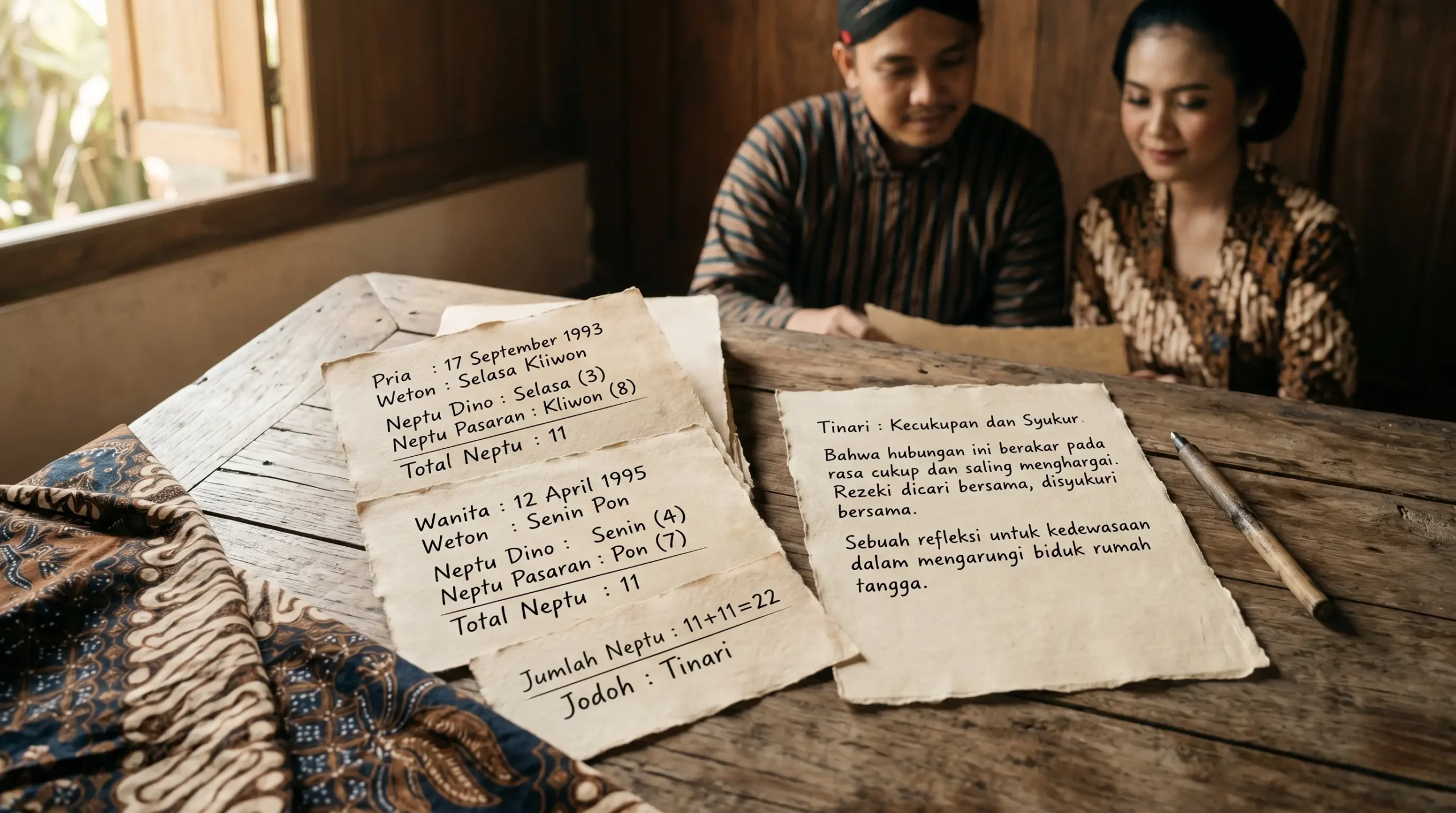
Tinari weton meaning refers to a Javanese compatibility result often linked with enoughness, livelihood, peace, and a more settled relationship. In traditional weton jodoh reading, Tinari is usually seen as a favorable result.
Still, Tinari should not be read as a guarantee that a couple will become rich, avoid hardship, or always live easily. In JavaSense’s approach, Tinari is better understood as a cultural reminder to keep working, stay grateful, manage needs wisely, and carry responsibility together.
If your weton compatibility result is Tinari, receive it with gratitude, but do not become careless. A good result still needs daily effort, honesty, and mature communication.
What Is Tinari in Javanese Weton Compatibility?
Tinari is one of the result categories in Javanese weton compatibility, often called weton jodoh in Indonesian and Javanese contexts. It comes from a traditional way of reading relationship patterns through birth day, pasaran, and neptu values.
In many popular readings, Tinari is associated with rezeki, enoughness, and a peaceful household atmosphere. The word rezeki is not only about money. It can also suggest livelihood, provision, sufficiency, and the feeling that life can be managed with steadiness.
This is why Tinari often feels comforting. Yet comfort should not become overconfidence. A relationship still needs communication, family dialogue, responsibility, and the ability to manage changing circumstances.
How Tinari Appears in Weton Compatibility Calculation
In one common Javanese weton compatibility method, the neptu values of two people are added together. The result is then read through a cycle of eight categories: Pegat, Ratu, Jodoh, Topo, Tinari, Padu, Sujanan, and Pesthi.
Tinari is usually understood as the category that carries a message of enoughness, provision, and calmness. It suggests that a couple may have a hopeful path for building a more orderly shared life, especially if both people are willing to work and care for the relationship together.
To understand the number behind weton, you can first read about neptu in the Javanese calendar. If you want to compare two weton values directly, use JavaSense to read weton compatibility with care.
Why Tinari Is Often Seen as a Good Sign
Tinari is often seen as a good sign because it is close to the idea of enoughness. A couple may imagine a life where needs are more manageable, the household feels calmer, and the relationship is not always trapped in a sense of lack.
In Javanese cultural feeling, enoughness is not always the same as abundance. Sometimes enoughness means knowing how to manage what is already present, being able to separate needs from desires, and not measuring life only by comparison with others.
That is the quieter meaning of Tinari. It points not only to what may come into the household, but also to how a couple receives, manages, and protects what they have.
Ky Tutur’s reflection: A good sign is not a place to fall asleep. It is a small invitation to stay grateful, keep working, and protect what has been entrusted to the relationship.
Tinari Is Not a Guarantee of Wealth
The most important caution is simple: Tinari is not a guarantee that a couple will become wealthy. It is not a promise that money will always flow smoothly or that the household will never face financial pressure.
A couple with a Tinari result still needs to work, plan, speak honestly about money, manage needs, and build trust. A peaceful household is not born from a calculation alone. It grows from repeated daily habits.
This is why JavaSense reads Tinari as reflection, not certainty. Even when a result feels good, it should not replace responsibility, clear thinking, and honest conversation.
Seven Safer Meanings Behind Tinari
To avoid reading Tinari too sweetly, it helps to understand the result as a good sign that still asks for responsibility. Here are seven safer meanings behind Tinari.
- Enoughness in life. Tinari may suggest sufficiency, but sufficiency still needs effort and wise management.
- Gratitude. The couple is reminded not only to seek more, but also to care for what is already present.
- Peace in the relationship. A calm household is built not only through income, but also through mutual care.
- Shared work. Livelihood in a relationship should not rest on one person alone; both people need responsibility.
- Managing needs wisely. A good result can still feel heavy if the couple cannot separate needs, desires, and priorities.
- A reminder not to become careless. Tinari is not a reason to wait for life to become easy by itself.
- Daily conduct. Enoughness is cared for through honesty, simplicity, work, gratitude, and healthy communication.

A Simple Case: When Tinari Makes a Couple Too Comfortable
Imagine a couple preparing for marriage. Their weton values are calculated, and the result is Tinari. The family feels relieved because the result is considered favorable. Slowly, the couple begins to believe that livelihood matters will be easy after marriage.
Relief can be helpful when it brings calm. But if it becomes overconfidence, important conversations may be skipped: spending, work, family obligations, savings, debt, and how to face difficult periods together.
In JavaSense’s reading, Tinari can be turned into better questions: can we discuss money without blaming each other? Can we manage priorities? Can we stay grateful without stopping our effort?
With that kind of reflection, Tinari becomes more than a pleasant label. It becomes a small mirror for seeing whether the couple is ready to care for enoughness in real life.
Tinari, Topo, and Pesthi: A Gentle Comparison
Tinari is often compared with Topo and Pesthi because each result carries a different tone. Topo is closer to patience and shared trials, Tinari to enoughness and livelihood, and Pesthi to stability and peaceful continuity.
| Result | Common Meaning | JavaSense Reading |
|---|---|---|
| Tinari | Often linked with enoughness, livelihood, and peace. | A reminder to keep working, stay grateful, and manage shared needs responsibly. |
| Topo | Often linked with trials, restraint, and shared struggle. | A reminder to build patience, resilience, and steady communication. |
| Pesthi | Often read as stability, peace, or a steadier relationship flow. | A reminder that peace still needs loyalty, care, and responsibility. |
If you want to understand a more serious result, you can also read about Topo in Javanese weton compatibility. Each result should be treated as reflection, not as a rigid label.
Myths and Safer Ways to Read Tinari
Because Tinari is often considered favorable, some people read it too sweetly. The table below helps separate common assumptions from a safer cultural reading.
| Myth | Safer Reading |
|---|---|
| Tinari means the couple will definitely become rich. | No. Tinari is better read as a reminder of enoughness that still needs effort and wise management. |
| If the result is Tinari, livelihood will always be smooth. | Livelihood still depends on work, responsibility, honesty, planning, and how the couple manages needs. |
| Tinari means the couple will never face financial problems. | Every couple still needs to discuss needs, priorities, decisions, and possible difficult seasons. |
| A Tinari result is more important than daily effort. | No. Daily conduct still matters: working, managing, giving thanks, and supporting each other. |
What Should You Do If the Result Is Tinari?
If your weton compatibility result is Tinari, the best response is gratitude without carelessness. A good result still needs to be cared for, so it does not stop as a moment of relief.
- Care for a sense of enoughness. Do not let the relationship be measured only by how much is owned.
- Keep working and making effort. A favorable result is not a reason to wait for life to improve by itself.
- Talk about shared needs. A couple needs openness about priorities, plans, and responsibilities.
- Protect honesty. Peaceful livelihood needs trust.
- Manage desires. Not everything wanted must be fulfilled immediately.
- Do not assume everything is safe. Enoughness still needs planning, discipline, and wisdom.
For a wider relationship reflection, you can check weton compatibility with care through JavaSense.
Is Tinari Good for Marriage?
Tinari is often considered a good result in Javanese weton compatibility because it is linked with enoughness and peace. But it should not become the only reason to continue or stop a marriage plan.
A mature marriage decision still needs to consider emotional readiness, family blessing, communication, responsibility, shared values, and the couple’s real circumstances. Tinari may become a calming cultural sign, but it is not a guarantee that married life will always be easy.
If you want to understand the date side of Javanese tradition, you can follow the Javanese calendar with pasaran and wuku. Cultural timing can support thoughtful dialogue, but it should not replace it.
Use JavaSense Weton Compatibility Carefully
JavaSense provides tools to help readers explore Javanese cultural systems more clearly. You can calculate your weton from a birth date or compare two weton values through the weton compatibility tool.
Still, a tool is only the beginning. The meaning of Tinari depends on how it is read. If it is read with greed, it becomes a promise people may chase. If it is read with gratitude and responsibility, it becomes a reminder to care for what life gives.
For a broader cultural path, you can explore JavaSense as a Javanese cultural platform, where weton, calendar, Primbon reflection, and Javanese script are presented as heritage and reflective guidance.
Cultural Notes on Primbon and Petungan Jawa
Tinari in weton compatibility belongs to a wider tradition of Primbon, petungan, pasaran, neptu, and Javanese ways of reading timing, conduct, and caution before important decisions.
For Indonesian readers who want to see library references, the National Library of Indonesia provides records related to Primbon, including Kitab Primbon Jawa Serbaguna and an OPAC record on Primbon.
JavaSense does not treat Primbon as a rigid book of fate. In this article, Tinari is read as a cultural language of enoughness, always balanced with reason, gratitude, family dialogue, and the real condition of the couple.
FAQ: Tinari Weton Meaning
What does Tinari mean in weton compatibility?
Tinari in weton compatibility is a Javanese relationship result often associated with enoughness, livelihood, peace, and a calmer shared life. In JavaSense’s approach, it is better read as a cultural reminder, not as a guarantee.
Does Tinari mean guaranteed wealth?
No. Tinari should not be understood as guaranteed wealth. It is safer to read it as a favorable sign about enoughness that still needs effort, honesty, planning, and wise management.
Is Tinari a good weton compatibility result?
Tinari is often considered a favorable result in Javanese weton compatibility because it is linked with enoughness and peace. Still, it should be treated as reflection, not as certainty.
Can a Tinari couple still face problems?
Yes. A Tinari result does not mean a couple will never face problems. Every relationship still needs communication, responsibility, family dialogue, financial honesty, and emotional maturity.
How should a couple respond to a Tinari result?
A couple should respond with gratitude and responsibility. Use Tinari as a reminder to keep working, manage needs, speak honestly, stay grateful, and avoid becoming careless.
What is the difference between Tinari and Topo?
Tinari is usually linked with enoughness, livelihood, and peace, while Topo is more often linked with trials, restraint, and shared endurance. Both should be read as cultural reflection, not as fixed fate.
Where can I check Tinari weton compatibility online?
You can use the JavaSense weton compatibility tool to compare two weton values and see whether the result is Tinari or another category. The result should be read with care and reflection.
Should Primbon relationship results be trusted completely?
No. Primbon relationship results should be understood as part of Javanese cultural reflection. A relationship still needs communication, responsibility, honesty, family dialogue, and mutual care.
Closing Reflection: Tinari as a Reminder of Enoughness
Tinari weton meaning is often received as a good sign, and there is nothing wrong with feeling grateful for that. But good does not mean finished. Tinari is safer when read as a reminder to care for enoughness through effort, gratitude, honesty, and shared responsibility.
If your result is Tinari, receive it with a quiet heart. Then keep working, keep speaking honestly, and keep managing life together. A relationship does not live from a favorable result alone, but from two people who continue to care for livelihood, trust, and each other every day.
Read the tradition with respect, but do not let it replace responsibility. In that balance, Tinari can become not a promise of an easy life, but a gentle reminder to live with gratitude and steadiness.