

Angger, my child…
There are days that do not arrive with a loud voice. They are like a small lamp in the inner room: not blinding, yet enough to help human beings see direction. On Wednesday Kliwon in Wuku Sinta, what needs care is not only the step, but also thought, speech, and the depth of rasa.
Ky Tutur Summary
- Wednesday Kliwon Weton Wuku Sinta 2026-04-08 can be read as a Javanese cultural reflection on intelligence, inner depth, firm principle, and the importance of guarding speech.
- Wednesday Kliwon has a neptu of 15, formed from Wednesday 7 and Kliwon 8, often used in traditional Javanese weton readings.
- Wuku Sinta is the first wuku in the Pawukon cycle, often understood as a symbol of beginning, foundation, order, and the arrangement of intention.
- This reading is not a fixed prophecy, not a guarantee of sustenance, not a personality verdict, and not a replacement for rational decisions. It is best used as a reflective mirror for conduct.
Ky Tutur Note: This article discusses weton, pasaran, neptu, and wuku as part of Javanese cultural heritage. It is not a fixed prediction, not a personal verdict, not a guarantee of fortune or relationship outcomes, and not a replacement for clear judgment. Read it as guidance for arranging conduct, not as a chain around life.
Wednesday Kliwon Weton Wuku Sinta 2026-04-08 brings together three layers of Javanese time: the weekday Wednesday, the pasaran Kliwon, and Wuku Sinta in the Pawukon cycle. These layers can be read as symbolic cultural language that invites reflection on thinking, communication, inner depth, and the way human beings begin something with clearer awareness.
In Javanese timekeeping, a day is not only a number on a calendar. It may also be read as atmosphere, symbolic reminder, and space for arranging intention. Because of this, weton and wuku are clearer when placed as cultural mirrors, not as absolute laws that close the possibility of life.
So, my child, this reading does not need to create fear. It does not say that a person must be this way or that way. It only invites us to see certain tendencies, then return them to effort, communication, prayer, practical work, and the ability to guard rasa.
Meaning of Wednesday Kliwon Weton Wuku Sinta 2026-04-08
The meaning of Wednesday Kliwon Weton Wuku Sinta 2026-04-08 can be approached through three cultural layers. The first layer is Wednesday in the seven-day week. The second is Kliwon in the five-day Javanese pasaran cycle. The third is Wuku Sinta in the thirty-wuku Pawukon cycle.
Wednesday is often read as a symbol of thought, communication, and the ability to weigh a matter. Kliwon is often understood as a pasaran with depth, quietness, and strong inner nuance. Wuku Sinta, as the first wuku, points toward beginning, foundation, order, and the need to arrange intention carefully.
When these three are read together, the message becomes clear: be intelligent without becoming slippery, firm without becoming rigid, and deep without closing yourself. Sharp thought needs a clear heart. Convincing speech needs refined rasa. Strong principle needs the flexibility to listen.
Neptu 15 and How to Read It Safely
In the commonly known Javanese weton calculation, Wednesday carries the value of 7, while Kliwon carries the value of 8. Together, Wednesday Kliwon forms a neptu of 15. This number is often used in several traditional readings, from symbolic character reflection to certain customary considerations.
But neptu should not be used as a number that locks life. It is not a formula that determines a person’s fate. A safer way to read neptu is to treat it as traditional language that helps people slow down and examine themselves.
In the JavaSense reading, neptu 15 in Wednesday Kliwon may be understood as an invitation to balance thought and rasa. There may be an ability to understand situations deeply, but this should not turn into excessive weighing that delays action. There may be inner depth, but it should not make a person difficult for others to reach.
If you want to calculate your own birth weton, you can use the JavaSense weton calculator. To see dates, pasaran, and broader Javanese timing context, open the Javanese calendar.
Wednesday Kliwon as a Mirror of Thought and Inner Depth
Wednesday Kliwon can be read as a mirror of intelligence that needs to be guided by a clear inner life. In daily life, this rhythm teaches that deep thinking is valuable, but a mind that keeps turning without direction can make a person lose the courage to act.
The strength of this rhythm is the ability to read situations. There is sensitivity to detail. There is skill in catching meanings that are not always spoken. There is an ability to process words and explain something convincingly. All of this can become strength when used with clean intention.
Yet every strength has a shadow. Depth can turn into distance. Principle can turn into stubbornness. Intelligence can turn into the feeling of knowing best if it is not guarded by humility.
That is why the main guidance of Wednesday Kliwon is to keep balance between inner center and openness. Do not store every rasa alone. Do not let every thought spin until it becomes tiring. Do not delay every decision only because you are waiting for perfect certainty.
Wuku Sinta in the Javanese Pawukon Cycle
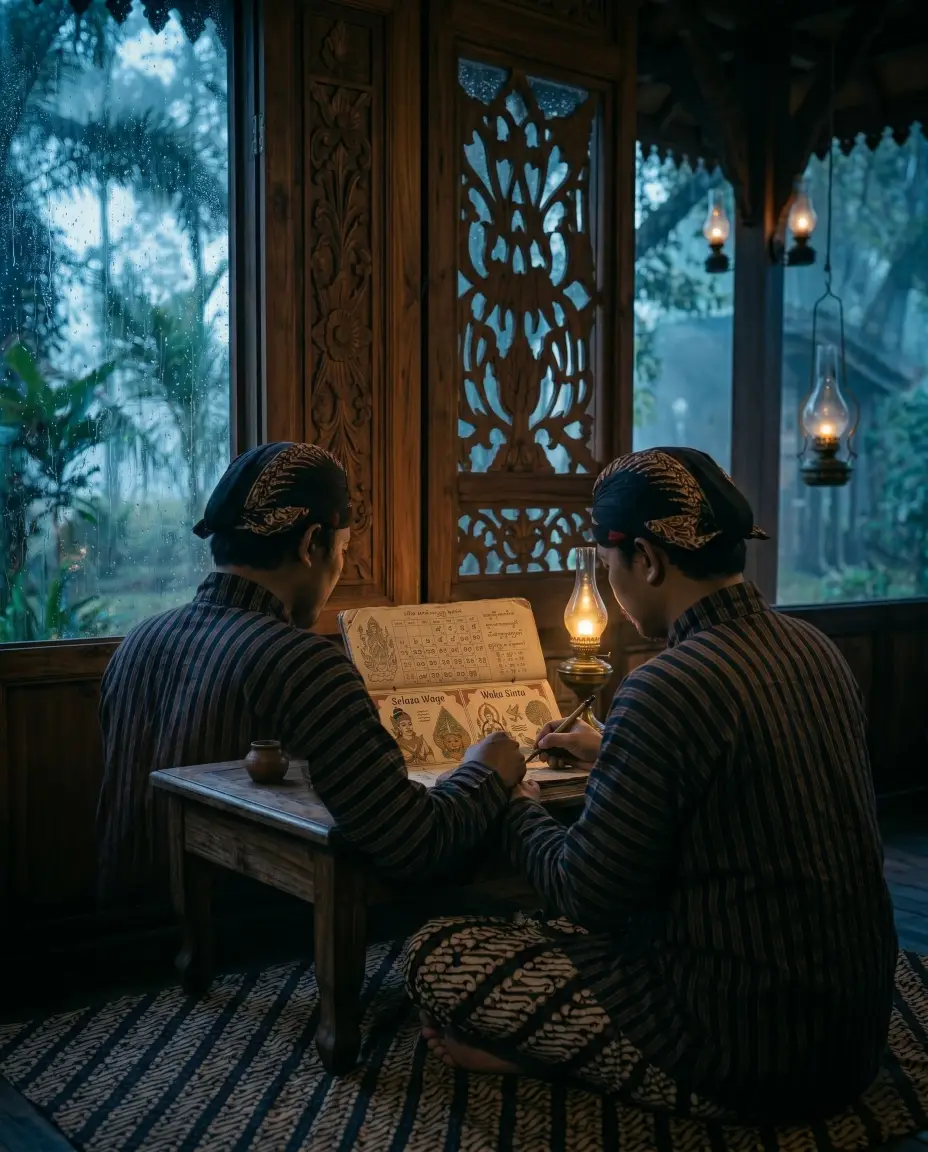
Wuku Sinta is the first wuku in the cycle of thirty wuku. Because it stands at the beginning, Sinta is often read as a symbol of first steps, new chapters, and the need to begin with a clean intention.
In Pawukon readings, Wuku Sinta is connected with several symbols. Some readings associate it with steadiness, loyalty, beginning, and the foundation of conduct. Other readings connect it with Batara Yamadipati as a symbolic reminder of justice, discipline, consequence, and responsibility.
These symbols should be read as cultural language, not rigid claims. The message is not that human beings are controlled by symbols. The message is that every beginning needs order, honesty, and the willingness to carry the consequence of one’s own choices.
Wuku Sinta reminds us that a beginning is not only about excitement. A beginning is also about foundation. What is planted carelessly may become difficult to care for later. What is begun with clearer intention has a better chance of growing with dignity.
Symbolic Character: Intelligent, Deep, and Needing Openness
When Wednesday Kliwon and Wuku Sinta are read together, they form a cultural reminder about depth that needs openness. There is intelligence for reading situations. There is firmness in holding principle. There is strong inner rasa. These can become strengths when directed clearly.
In daily life, this symbolic character may appear as the ability to think far ahead, not easily believe everything, and prefer to understand something down to its roots. A person with this rhythm may look calm outside, while carrying many considerations within.
Still, depth needs to be cared for so it does not become distance. If everything is thought through alone, other people may feel they are not invited to walk together. If decisions are held for too long, opportunities may pass. If someone is too certain about their own reading, useful input may be rejected too quickly.
The practice needed here is opening room for communication. Speaking does not mean losing depth. Listening does not mean losing principle. Changing a view after seeing a better reason does not mean defeat.
Sustenance as Trust and Knowledge, Not a Promise
In some traditional readings, Wednesday Kliwon and Wuku Sinta may be connected with intelligence, communication, trust, and the ability to build a foundation. JavaSense does not read this as a promise of guaranteed sustenance. Sustenance still depends on effort, skill, honesty, healthy relationships, and the way opportunities are managed.
For Wednesday Kliwon Wuku Sinta, sustenance is better understood as an invitation to protect knowledge and trust. If you are given the ability to think, use it to build a useful path. If you are given the ability to speak, use it to clarify, not to manipulate. If others place trust in you, protect that trust with adab.
Sustenance often grows from things that are not immediately visible: reputation, consistency, keeping promises, how one treats people, and the ability to guard speech. In Javanese pitutur, a good path is not only a path that produces quickly, but also one that does not damage the inner life, relationships, and honesty.
So, do not read this weton as a guarantee. Read it as a reminder to build the kind of conduct that makes trust easier to grow.
Relationships, Tepa Slira, and Clear Communication
In relationships, Wednesday Kliwon can be read as an invitation to keep communication clear. People who think deeply may sometimes assume others should understand without explanation. Yet relationships need language. Good rasa still needs to be expressed. Good intention still needs to be explained.
Many relationships are damaged not because there is no care, but because too many things are stored silently. There is discomfort that is never spoken. There is disappointment that is buried. There is hope that is never explained, then slowly turns into silent demand.
This is where tepa slira becomes important. Tepa slira teaches people to consider another person’s rasa. If we do not like being left to guess, we should not make others keep guessing. If we want to be understood, we also need to learn how to explain.
This guidance is also close to eling lan waspada. Eling keeps a person from forgetting the self. Waspada keeps speech and decisions from being born out of assumptions that move too quickly.
Obstacles as Yellow Lights, Not Fear
In Javanese tradition, obstacles may be understood as things that need awareness. But they should not be read as threats that make people afraid. A better image is a yellow light.
For Wednesday Kliwon Wuku Sinta, the yellow lights are overthinking until action is delayed, being too closed in communication, and holding personal opinions too rigidly. If not arranged, intelligence can become a burden. Depth can become distance. Principle can become a wall.
A yellow light does not forbid us to move. It only asks us to slow down. Look again. Weigh again. Arrange the breath before choosing the next step.
The simplest practice is opening room for dialogue. If something feels stuck, speak calmly. If there is a major decision, do not keep it only inside your own head. If criticism arrives, listen first before rejecting. Sometimes a step becomes lighter not because the problem disappears, but because the heart is no longer carrying it alone.
Daily Guidance for April 8, 2026
The daily guidance for April 8, 2026, is to keep depth open. If you want to begin something today, begin with a clear plan. If you want to make a decision, make sure it is not born from suspicion or excessive assumptions. If you want to speak, choose words that calm without blurring the truth.
There are several simple practices to carry.
First, write down one decision that has been delayed for too long. Not everything can wait until it becomes perfect. Sometimes what is needed is a small but ordered step.
Second, express one thing that has only been stored inside. Choose gentle words, but do not erase the core message that needs to be spoken.
Third, listen to advice without immediately feeling attacked. Sometimes good input arrives in a way that is not always comfortable.
Fourth, guard knowledge so it does not become arrogance. If today you feel you understand more, use that understanding to guide, not to belittle.
Fifth, close the day with eling. Ask yourself: was I too closed today? Is there someone waiting for clarity from me? Has my thought become light, or has it turned into a tiring labyrinth?

Reading Weton Without Turning It into Fate
It is important to remember that weton is not a fixed prophecy. Weton is part of a traditional way of reading time, neptu, pasaran, and conduct. It can help human beings reflect, but it should not replace clear thinking, real work, communication, prayer, and personal responsibility.
This kind of reading should not make anyone feel locked by a date. It should not create fear around a label. It should not make anyone believe that life will move automatically just because a reading sounds favorable.
In the JavaSense approach, there is no weton that should be used to lower a human being. Every reading should become material for improving conduct. If a reading speaks about intelligence, the practice is to keep humility. If it speaks about depth, the practice is to keep openness. If it speaks about beginning, the practice is to build a foundation carefully.
That is how weton stays cultural, not superstitious. Symbols are read, reflected on, and then returned to concrete action.
JavaSense and a Clearer Way to Read Javanese Time
JavaSense reads Javanese culture as heritage that deserves to be cared for with common sense. Weton, wuku, pawukon, pasaran, and the Javanese calendar should not be used to frighten people. They are better used as doors of learning: to know the roots, arrange the inner life, and refine relationships with others.
If you want to read dates, pasaran, and Javanese timing more easily, open the JavaSense Javanese calendar. If you want to calculate your birth weton, use the weton calculator. If your interest also reaches manuscripts, letters, and cultural writing, you can explore the JavaSense Javanese script tool.
As a broader public cultural reference, readers may also visit the National Library of Indonesia. References like this help cultural reading stay connected to learning, not merely to scattered claims without direction.
Closing Reflection: Deep Within, Clear in Speech
So, my child, do not hold Wednesday Kliwon Weton Wuku Sinta 2026-04-08 as a punishment or a guarantee. Hold it as a reminder. If your thoughts are deep, open space to explain. If your principle is strong, still give room for input. If your speech is sharp, soften it so it does not wound.
Wednesday Kliwon teaches intelligence and depth. Wuku Sinta reminds us of beginning. Together, they offer a simple piece of guidance: think clearly, speak with rasa, and begin a new step without losing eling.
Life is not completed by one date. Yet one date can become a small room for pausing and refining the next step. That is where culture becomes useful: not by binding human beings, but by reminding human beings not to lose rasa.
To learn Javanese culture in a lighter and more modern way, you can download JavaSense on Google Play.
FAQ About Wednesday Kliwon Weton Wuku Sinta 2026-04-08
What does Wednesday Kliwon Weton Wuku Sinta 2026-04-08 mean?
Wednesday Kliwon Weton Wuku Sinta 2026-04-08 is a Javanese date reading that combines Wednesday, the pasaran Kliwon, and Wuku Sinta as a cultural mirror for conduct, not as a fixed prophecy.
What is the neptu of Wednesday Kliwon?
The neptu of Wednesday Kliwon is 15, formed from Wednesday 7 and Kliwon 8. In Javanese tradition, this number is used as part of a broader weton reading.
What does Wuku Sinta mean in the Javanese Pawukon cycle?
Wuku Sinta is the first wuku in the Pawukon cycle. It is often read symbolically as a beginning, foundation, order, and the arrangement of intention.
Does Wednesday Kliwon Wuku Sinta determine sustenance?
No. Wednesday Kliwon Wuku Sinta does not determine sustenance in a fixed way. This reading is better understood as a reminder to care for knowledge, trust, communication, and real work.
How should Wednesday Kliwon character be read safely?
Wednesday Kliwon character should be read as a symbolic reflection on intelligence, inner depth, and firm principle that need openness, not as a fixed label placed on a person.
What is the daily guidance for Wednesday Kliwon Wuku Sinta?
The daily guidance is to keep inner depth open. Think clearly, speak with rasa, listen to input, and do not let principle turn into stubbornness.
Can this weton reading be used for important decisions?
It can be used as cultural reflection, but important decisions still need facts, readiness, communication, risk awareness, and relevant advice.
Where can I check my weton and the Javanese calendar?
You can use JavaSense tools to calculate your weton and read the Javanese calendar, including pasaran and broader date context.
Learn Weton with Clearer Awareness
Wednesday Kliwon Weton Wuku Sinta 2026-04-08 is not a fate verdict. It is a cultural mirror for thought, speech, inner depth, and daily conduct. To explore weton, the Javanese calendar, pawukon, and Javanese script more easily, open JavaSense on Google Play.