

Angger, my child…
There are days that teach human beings not to speak too quickly. Saturday Wage in Wuku Dukut on March 28, 2026, can be read as a cultural mirror: there is steadiness to be guarded, suspicion to be clarified, and responsibility that does not always need to be carried alone.
Ky Tutur Summary
- Saturday Wage Weton Wuku Dukut 2026-03-28 is best read as a map of reflection, not a fixed verdict of fate.
- Saturday can be understood as a symbol of responsibility, steadiness, deep thought, and the tendency to hold rasa inside.
- Wage is often read as grounded inner strength, endurance, and the ability to carry burdens, but it needs openness so it does not become too rigid.
- Wuku Dukut invites human beings to review old burdens, clear intention, and walk with a calmer and more measured heart.
Ky Tutur Note: This article discusses weton, pasaran, neptu, and wuku as Javanese cultural literacy and reflective guidance. It is not a fixed prophecy, not a guarantee of sustenance, not a relationship verdict, and not a replacement for clear judgment. Use it as a mirror for arranging conduct, not as a tool for frightening yourself or others.
Saturday Wage Weton Wuku Dukut 2026-03-28 can be read as a meeting between steadiness, responsibility, and the invitation to tidy the inner life. In Javanese tradition, weton and wuku should not be used as absolute certainty about fate. They are healthier when read as maps of possibility: signs that help a person become more aware, more careful, and more ordered in daily conduct.
My child, do not read weton as a stamp placed forever on a human forehead. Read it like a small lamp on the road. It does not decide where you must go, but it can help you see a small stone that might make your step stumble.
Because of that, this reading follows the JavaSense principle: weton is not a rigid prophecy. It is a cultural mirror for recognizing tendencies and arranging conduct with more clarity.
Meaning of Saturday Wage Weton Wuku Dukut 2026-03-28
The meaning of Saturday Wage Weton Wuku Dukut 2026-03-28 can be approached through three layers: the weekday Saturday, the pasaran Wage, and Wuku Dukut in the Javanese Pawukon cycle.
Saturday gives the tone of depth, seriousness, responsibility, and inner steadiness. Wage gives the tone of grounded endurance, quiet strength, and the ability to remain firm under pressure. Dukut brings a message of introspection, clearing old burdens, and arranging intention before walking further.
So the message of this day is simple: be strong, but do not harden. Be steady, but do not close the door to good advice. Carry responsibility, but do not assume that every burden must be carried alone.
This reading is not meant to make anyone afraid. It invites a more ordered life: do not keep problems too long, do not let suspicion grow too quickly, do not allow steadiness to become rigidity, and do not delay a conversation that actually needs to be clarified.
Neptu 13 and How to Read It Safely
In the commonly known Javanese weton calculation, Saturday carries the value of 9, while Wage carries the value of 4. Together, Saturday Wage forms a neptu of 13.
This number may be used in traditional readings, but it should not be treated as a chain around life. Neptu is better understood as cultural language, not a final decision about a person’s future.
In the JavaSense reading, neptu 13 can be reflected as steadiness, endurance, and the ability to carry responsibility. Yet every strength has a shadow. Steadiness may become stubbornness. Endurance may become silence that is too heavy. Responsibility may become the habit of refusing help.
The safe way to read neptu is to ask: what conduct should I guard today? Which side of myself needs to be softened? Which responsibility needs to be carried clearly, and which burden needs to be shared, discussed, or released?
If you want to calculate your own birth weton, you can use the JavaSense weton calculator. To see dates, pasaran, and broader Javanese timing context, open the Javanese calendar.
Saturday Wage in the Javanese Calendar
In the reading of day and pasaran, Saturday Wage is often understood as a combination that carries strength, independence, and endurance under pressure. Saturday brings a serious and responsible tone, while Wage adds grounded resilience and the ability not to give up easily.
The good side of this combination is diligence. It can invite a person to keep trust, finish tasks carefully, and remain steady when outer noise becomes distracting. This is the strength of someone who does not easily collapse just because the day becomes difficult.
Yet the side that needs attention is the tendency to close the heart. When too much is kept inside, the inner life becomes heavy. When a person is too certain of their own judgment, good advice may become difficult to receive.
Saturday Wage teaches that quiet strength still needs communication. A strong person does not always need to appear unshaken. Sometimes the true sign of strength is the courage to say, “I need to speak,” “I need help,” or “I may need to look at this again.”
Wuku Dukut and the Practice of Clearing Old Burdens
Wuku Dukut can be read as a time to look again at things that have been carried for too long. Some responsibilities truly need to be completed. But there are also inner burdens that no longer bring benefit.
In this reading, Dukut does not need to be understood as a bad sign. It is better read as an invitation to reorder. Which task is truly yours? Which burden comes from pride? Which matter needs to be discussed? Which old rasa is ready to be placed down?
The message of Dukut is clear: before walking further, lighten what does not need to be carried. Before judging others, check whether the heart is clear. Before making a decision, make sure it is born from wisdom, not from an old wound quietly asking for revenge.
Dukut invites the heart to become more spacious. Not empty, but cleaner. Not careless, but more ready to walk.
Symbolic Character: Steady, Independent, but Needing Openness
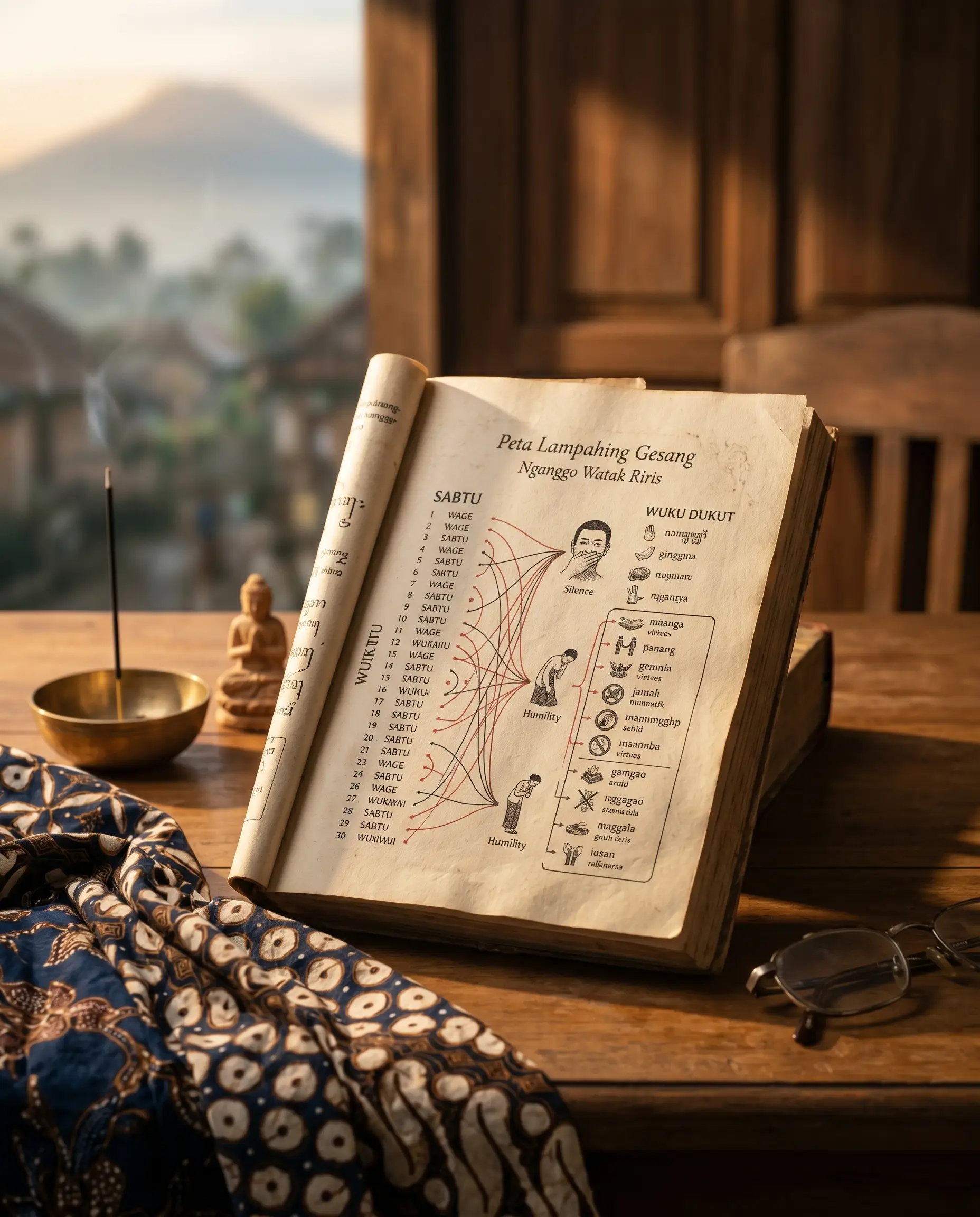
Symbolically, Saturday Wage Wuku Dukut describes an inner atmosphere that is steady, independent, and able to hold deep strength. There is endurance. There is the ability to complete work. There is seriousness in keeping responsibility.
These qualities can become powerful when directed toward ordered work, mature decisions, and clear commitments. A person with this rhythm may not speak often, but their actions can show reliability. They may not seek attention, but they can become someone others trust.
Still, every strength carries a shadow. Steadiness can become stubbornness. Independence can become reluctance to ask for help. Responsibility can become the habit of carrying everything alone.
So the message here is not “you must be this way.” The message is “this part needs to be guarded.” If today you feel too closed, find a gentle way to speak. If you feel it is difficult to accept advice, make room to listen. If you feel everything must be solved alone, remember that asking for help is not defeat.
Sustenance as Effort and Consistency, Not a Promise
In weton readings, sustenance should not be understood as a promise that arrives automatically. It is safer to read sustenance as a direction for effort: which habits need to be arranged, which skills need to be sharpened, and which responsibilities need to be carried more clearly.
Saturday Wage Wuku Dukut gives a message that sustenance is better approached through consistency, patience, and the ability to finish what has been started. The steadiness of Saturday Wage can become a good foundation, but it still needs flexibility so opportunity is not rejected only because it appears in an unexpected form.
If you are considering work, business, or financial decisions, do not rely only on a weton reading. Check real conditions, risks, personal capacity, timing, and family needs. Weton may be a mirror, but decisions still need common sense, data, communication, and responsibility.
The healthiest reading is this: do not wait for fortune without effort, and do not force effort without wisdom.
Relationships, Trust, and Clear Communication
In relationships, Saturday Wage Wuku Dukut teaches about trust, loyalty, and openness. There may be a tendency to take relationships seriously. But if the heart is too closed, others may struggle to understand what is actually being felt.
My child, not every feeling needs to be buried just to look strong. Not every suspicion should be stored until it becomes distance. Sometimes a relationship becomes healthier when something is spoken clearly, calmly, and without cornering one another.
This is where tepa slira becomes a counterweight. Tepa slira helps a person weigh another person’s rasa. But do not forget: your own rasa also needs to be cared for. Healthy empathy does not erase personal boundaries.
If there is conflict, begin with clarification. If there is discomfort, do not immediately assume bad intention. If there is a heavy feeling, find language that keeps dignity without hiding the truth.
Obstacles as Yellow Lights, Not Fear
The obstacles in this reading are safest when understood as yellow lights, not disasters. The vulnerable points of Saturday Wage Wuku Dukut are suspicion that grows too quickly, rigidity when feeling right, and the habit of carrying burdens without speaking.
If there is conflict, do not immediately conclude. If there is criticism, do not defend too quickly. If someone offers help, do not automatically feel that it lowers you. Perhaps today is the time to learn that human beings do not need to be strong alone.
A yellow light does not tell you to stop forever. It only says: slow down, clear the rasa, and do not make decisions while the heart is still clouded.
This is the function of a cultural reading when used well. It does not frighten. It gives warning gently so the next step can be more aware.
Daily Guidance for March 28, 2026
The main daily guidance for this weton is to keep steadiness calm. Steadiness is good, but steadiness that refuses to listen can become hard. Responsibility is noble, but responsibility that is never shared can make the inner life tired.
First, pause before judging. If someone’s words feel uncomfortable, do not immediately conclude that their intention is bad. Ask, listen, then understand the context.
Second, practice eling lan waspada. Be aware of your own condition. Be careful with the effect of words. Many relationships do not become distant because of one large event, but because of small conclusions that were never clarified.
Third, use the message of Dukut to clear one old burden. Choose one matter that needs to be completed today. Not everything. Just one. Close a hanging task, tidy a small promise, or speak one sentence that has been held back too long.
Fourth, care for the inner life gently. A person who cares for their inner world can become strong without becoming hard. They can be steady without becoming distant.

Reading This Weton Without Turning It into Fate
There are three boundaries to keep when reading any daily weton. First, do not turn it into a verdict. If there are words such as character, sustenance, relationship, or obstacle, read them as symbolic tendencies, not certainty.
Second, do not use it to judge other people. Weton is not a tool for stamping someone with a bad label. If you read a personal weton, use it for self-reflection. If you read a relationship, use it for dialogue, not for lowering another person.
Third, return everything to effort. Human life is shaped by decisions, habits, environment, knowledge, communication, prayer, and responsibility. Weton can remind, but it does not replace all of that.
This is how Javanese culture stays alive without becoming frightening. Symbols are read, reflected on, and then returned to concrete action.
JavaSense and a Clearer Way to Read Javanese Time
JavaSense reads weton as culture and reflection, not as a tool for declaring fate. Every daily weton reading should help a reader ask: what should I guard today? What should I speak about? What should I tidy? What should I soften in my attitude?
If you want to read dates, pasaran, and Javanese timing more easily, open the JavaSense Javanese calendar. If you want to calculate your birth weton, use the weton calculator. If your interest also reaches manuscripts, letters, and cultural writing, you can explore the JavaSense Javanese script tool.
As a broader public cultural reference, readers may also visit the National Library of Indonesia. References like this help cultural reading stay connected to learning, not merely to scattered claims without direction.
The JavaSense path is simple: honor tradition, but do not lose clear reason. Read symbols, but do not turn them into fear. Carry pitutur into conduct, so culture becomes useful.
Closing Reflection: Strong Without Hardening
So, my child, Saturday Wage Wuku Dukut on March 28, 2026, does not need to be read with fear. It is not a day that brings a final decision. It is a small mirror for arranging responsibility, lowering suspicion, and clearing old inner burdens.
If there is steadiness, keep it from becoming stubbornness. If there is responsibility, carry it with order without assuming everything must be carried alone. If there is suspicion, clarify it before it becomes distance. If there is good advice, listen before rejecting it.
Weton does not live life on behalf of human beings. It only reminds. The one who walks is still you: with effort, adab, prayer, responsibility, and the courage to improve yourself.
So keep this reading as pitutur, not verdict. Carry it as a small lamp: enough to see the next step, not something used to frighten the whole journey.
To learn Javanese culture in a lighter and more modern way, you can download JavaSense on Google Play.
FAQ About Saturday Wage Weton Wuku Dukut
What does Saturday Wage Weton Wuku Dukut 2026-03-28 mean?
Saturday Wage Weton Wuku Dukut 2026-03-28 can be read as a map of conduct about steadiness, responsibility, introspection, and clearing inner burdens with more clarity.
What is the neptu of Saturday Wage?
The neptu of Saturday Wage is 13, formed from Saturday 9 and Wage 4. In Javanese tradition, this number is used as part of a broader weton reading.
What does Wuku Dukut mean in this reading?
Wuku Dukut can be read as an invitation to review old burdens, separate what still needs care from what should be released, and move with a clearer heart.
Does Saturday Wage Wuku Dukut determine sustenance?
No. This weton reading does not determine sustenance in a fixed way. It is better used as reflection on effort, consistency, habits, knowledge, and responsibility.
How should Saturday Wage character be read safely?
Read Saturday Wage as a symbolic tendency, not as a fixed label. Its steadiness and independence can be strengths, but they need openness and communication.
What are the yellow lights in this weton reading?
The yellow lights are suspicion, rigidity, and the habit of carrying burdens alone. They are not disasters, but reminders to slow down and clarify rasa.
Can this weton reading be used for important decisions?
It can be used as cultural reflection, but important decisions still need facts, readiness, communication, risk awareness, prayer, and practical consideration.
Where can I check my weton and the Javanese calendar?
You can use JavaSense tools to calculate your weton and read the Javanese calendar, including pasaran and broader date context.
Learn Weton with Clearer Awareness
Saturday Wage Weton Wuku Dukut is not a fate verdict. It is a map of conduct for reading steadiness, responsibility, pause, and inner direction with more awareness. To explore weton, the Javanese calendar, pawukon, and Javanese script more easily, open JavaSense on Google Play.