
LIBRARY • WETON • JAVANESE CALENDAR • SCRIPT

JavaSense Library

The JavaSense Library is a curated reading space for weton, pasaran, neptu, wuku, pawukon, pranata mangsa, the Javanese calendar, good-day notes, Javanese script, reflective primbon, and modern Javanese culture.

Javanese Pawukon: 30 Wuku and the 210-Day Cycle

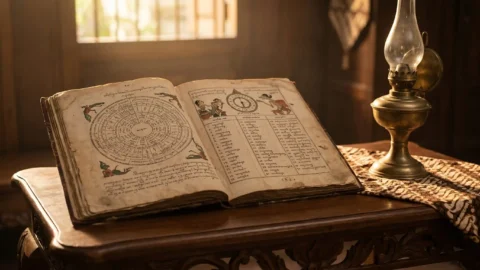
Pawukon reads Javanese time through 30 wuku and a 210-day cycle, as a cultural mirror for understanding rhythm and reflection. Written by Ky Tutur — JavaSense’s editorial persona for reflective Javanese cultural reading. Reviewed and managed by JavaSense Editorial. Last updated: June 1, 2026. Time is not always felt as a straight line. In Javanese […]

OPEN →

Ewuh Pakewuh Meaning in Javanese Culture: Respect, Boundaries, and Clear Communication

Ewuh pakewuh can preserve respect and harmony, but it needs healthy boundaries so the voice does not disappear. Angger, my child… Not every truth needs to be spoken harshly. But not every silence is wisdom either. Between those two paths, Javanese culture knows a subtle and sometimes complicated feeling called ewuh pakewuh. Ky Tutur Summary […]

OPEN →
Gunungan Wayang Meaning in Javanese Culture: Kayon, Cosmos, and Life Reflection

Gunungan, also called kayon, marks the gate of a lakon and invites reflection on order, transition, and life. Angger, my child… Before the heroes speak, before the gamelan opens the air, before the dalang carries the story across the kelir, there is one form that stands quietly in the middle of the stage. It is […]

OPEN →
Bad Weton Myth Explained: Read Weton Without Fear

Written by Ky Tutur — JavaSense’s editorial persona for reflective Javanese cultural reading. Reviewed and managed by JavaSense Editorial. Last updated: May 31, 2026. The bad weton myth is safer when read calmly: as cultural reflection, not as a negative label on someone’s life. Some people discover their weton and return home with a heavy […]

OPEN →
Weton Is Not Fortune Telling: A Javanese View

Written by Ky Tutur — JavaSense’s editorial persona for reflective Javanese cultural reading. Reviewed and managed by JavaSense Editorial. Last updated: May 31, 2026. Javanese weton is safer when read as a cultural mirror, not as an absolute prediction of fate. Some people first meet weton through worry: “If my weton is like this, does […]

OPEN →
Eling lan Waspada in Javanese Wisdom: Awareness, Caution, and Emotional Clarity

Eling lan waspada teaches awareness, careful action, and the ability to pause before emotion becomes harm. Angger, my child… There are moments when a person is not defeated by a large problem, but by a small explosion inside the chest. One comment makes the heart hot. One message pulls the mind into fear. One mistake […]

OPEN →
Javanese Weton: Birth Day, Pasaran, and Neptu

Written by Ky Tutur — JavaSense’s editorial persona for reflective Javanese cultural reading. Reviewed and managed by JavaSense Editorial. Last updated: May 31, 2026. Javanese weton is born from the meeting of weekday, pasaran, neptu, and the felt rhythm of time in Javanese tradition. In many Javanese families, one simple question can open a long […]

OPEN →
LIBRARY FAQ

Questions about the JavaSense Library

Short answers about weton articles, the Javanese calendar, wuku, pawukon, pranata mangsa, Javanese script, and reflective primbon.

What is inside the JavaSense Library?

The JavaSense Library contains articles on weton, pasaran, neptu, wuku, pawukon, pranata mangsa, the Javanese calendar, Javanese script, reflective primbon, history, classical texts, and modern Javanese culture.

What is the difference between Library and Tools?

The Library is the reading space for articles and cultural knowledge. Tools are the practical JavaSense features, such as the weton calculator, weton compatibility, today's Javanese calendar, and Javanese script writer.

Does the Library cover weton, neptu, wuku, and pawukon?

Yes. The Library covers weton meanings, neptu numbers, pasaran, wuku, pawukon, traditional character notes, and cultural ways of reading those calculations as reflection.

Does JavaSense discuss good days and pranata mangsa?

Yes. JavaSense discusses the Javanese calendar, pranata mangsa, good days, neutral days, and less favorable days as cultural time-reading traditions, not as absolute rules.

Is primbon in JavaSense fortune-telling?

No. Primbon in JavaSense is presented as cultural reflection. Weton, neptu, wuku, and good-day notes are not used as fixed predictions or final decisions.