
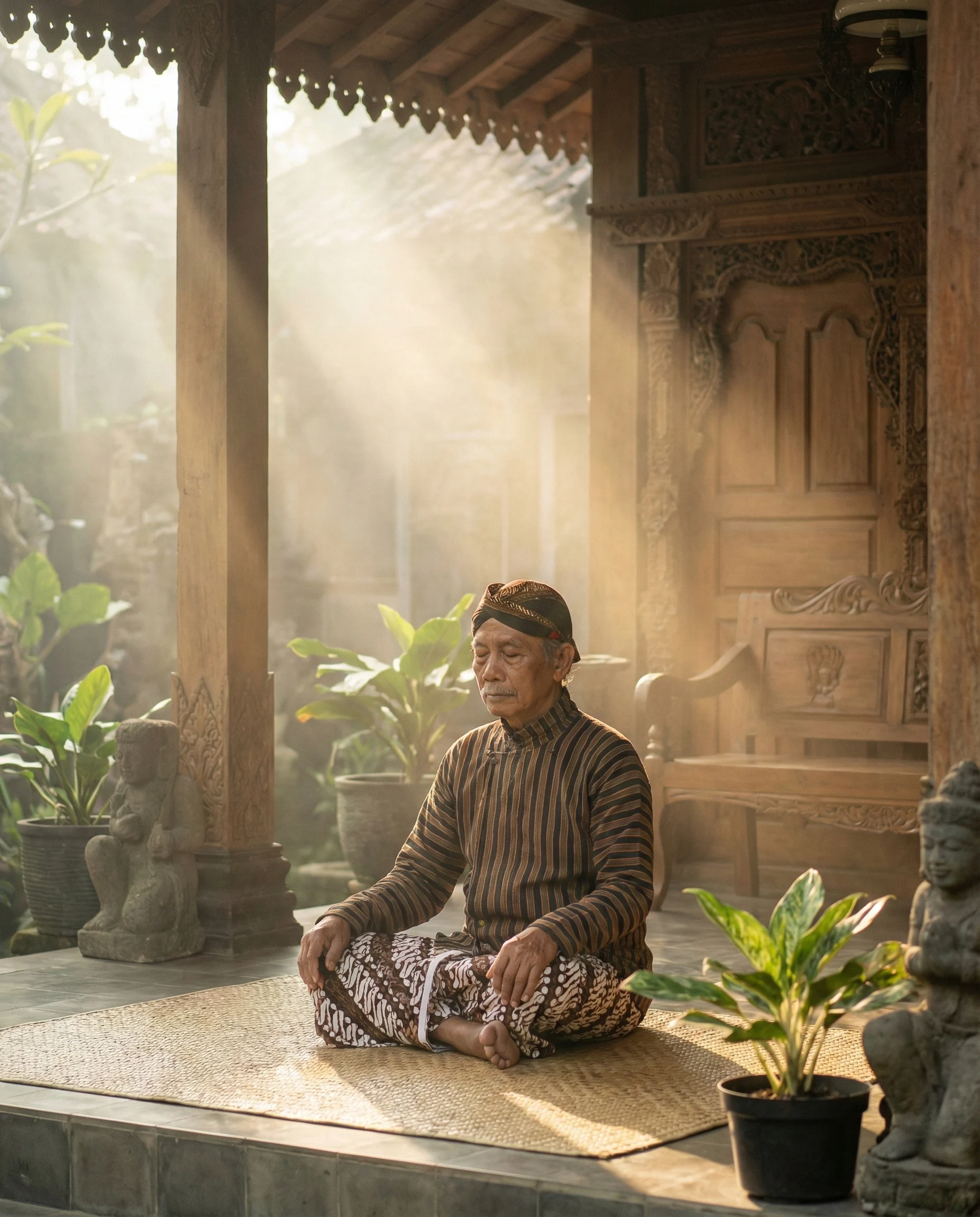
Angger, my child… Please, sit here on the mat of this pendopo. Take a deep breath, release it slowly, and let the chaotic noise of the outside world remain at the threshold. Uncle sees the subtle lines of exhaustion hiding behind your eyes. I understand it perfectly. In this fast-paced era, emotions ignite so easily. Anger explodes in traffic, frustration piles up in the workplace, and anxiety frequently hijacks our sanity in the dead of night.
The modern Western world has introduced concepts like mindfulness and mental resilience (stoicism) as the ultimate remedies for the diseases of our time. However, did you know that centuries ago, long before these terms became popular in psychology books, our ancestors in the land of Java bequeathed a spiritual technology that is far more grounded? That invisible heirloom is called eling lan waspada.
Many among the younger generation today assume that eling lan waspada is merely an ancient mantra or outdated advice from grandparents that has lost its edge in the digital age. Yet, if you brush off the dust and dissect it with the blade of rationality, it reveals a highly sophisticated and systematic psychological framework. It is not a teaching about suppressing emotions until you become a wooden statue devoid of feeling; rather, it is about how to become the sovereign master of your own inner house.
Today, we will not merely indulge in romantic nostalgia. We will dissect the architecture of this soul together, layer by layer, and uncover the 7 best and most realistic ways to apply the grand teaching of eling lan waspada when emotional storms ravage your life.
The Anatomy of the Soul: Dissecting the Meaning of Eling lan Waspada
Before we delve into the tactics and techniques of emotional mastery, you must understand the anatomy of this philosophy. The ancestors of Nusantara never combined two words into a phrase without meticulous architectural calculation. This phrase consists of two pillars that support human consciousness.
The First Pillar: Eling (The Anchor of Consciousness)
The word Eling literally translates to “remember” or “be aware.” But in the context of Javanese psychology, it carries multifaceted depths. Eling means returning to pure consciousness. It is the act of remembering who you are entirely, remembering your small position amidst the vast universe, and above all: remembering the Creator (Sangkan Paraning Dumadi—the origin and destination of all that exists).
When negative emotions like wrath or greed rise to the surface, humans often experience a “loss of self” (kalap). It is at this point that the ego seizes control of your nervous system. Blood boils, muscles tense, and harsh words slip out unfiltered. In this state, Eling functions as a heavy iron anchor. It is dropped to the bottom of your inner ocean to prevent the ship of your consciousness from being dragged and shattered by the temporary currents of anger. Eling pulls you away from the projections of the past (grudges) and the future (anxiety), grounding you fully in the present moment.
The Second Pillar: Waspada (The Radar of Sensitivity)
If Eling is the anchor that dives inward (internal), then Waspada (Alert / Anticipatory) is the radar that spins outward (external and mental). Waspada does not mean you live in fear and paranoia towards others. Waspada here means possessing a high-level sensitivity to read the situations outside yourself as well as those brewing within your own mind.
Practicing waspada means you are able to distance yourself from your thoughts and act as the observer. When an emotion arrives, your waspada radar will sound and say: “Oh, I am being provoked,” or “Oh, my ego is hurt by this person’s words,” without you having to let that hurt manifest into destructive action. Waspada is the ability to read the emotional weather before the storm actually breaks.
The complete combination of eling lan waspada gives birth to an emotionally sovereign human being. They are fully aware of their footing, while simultaneously being highly sensitive to the deceptions of their own ego. This is the pinnacle of human dignity.
Javanese Psychology Context: Controlling the Army of Emotions
To understand why eling lan waspada is so crucial, Uncle must introduce you to the ancient Javanese psychological concept regarding emotional drives. Our ancestors understood that within humans reside four basic lusts or drives (often metaphorically linked to Anger, Greed, Worldly Desire, and Goodness). These four drives are like four wild horses pulling the golden carriage of your life.
If you do not hold the reins, these horses will bolt in different directions and tear your soul’s carriage apart. Who is the coachman that must hold those reins? The coachman is the Pancer, the center of consciousness, the sacred spirit within you. And the primary tool used by the coachman to control those four wild horses is none other than the whip and reins called eling lan waspada.
Analytical Table: Comparing Eling and Waspada
To help your modern rationality digest this noble knowledge, Uncle has mapped the two elements of eling lan waspada like a data analysis framework:
| Distinguishing Aspect | Eling (Spiritual & Mental Awareness) | Waspada (Observational Sensitivity) |
|---|---|---|
| Spatial Focus | Internal (Inward to the soul, spiritual footing, and the Creator). | External & Mental (Reading the environment and the emergence of ego). |
| Primary Function | Anchoring the soul to prevent being swept away by temporary emotions. | Detecting the embryo of an emotion before it explodes into physical action. |
| Modern Analogy | The solid foundation of a building / Grounding techniques in psychology. | A smoke detector that sounds the alarm before a massive fire breaks out. |
| Reflective Question | “Who am I truly? Does this dirty anger deserve to define my dignity?” | “Where does this anger come from? What is the external trigger? What is the ego’s hidden motive?” |
| Ultimate Result | Tranquility (Tentrem), inner stability amidst the storm of crisis. | Precision in action (Pener), non-reactive, yet intelligently responsive. |
7 Best and Realistic Ways to Apply Eling lan Waspada
Angger, knowledge without practice is like a lush tree that never bears fruit. When your blood boils, your face turns red, and your heart pounds with rage, you will not have time to recall complex theories. You need concrete, tactical steps.
Here are the 7 best, most realistic, and instantly applicable ways to practice eling lan waspada amidst the chaos of the modern world.
1. Mungguh (Natural Grounding to Mother Earth)
The first and most physical secret of eling lan waspada is returning your body’s awareness to the earth (Mother Earth). When you are angry or panicking, the body’s energy and blood flow rush rapidly to the head and chest. Breathing becomes shallow. To neutralize this, you must consciously lower that energy.
If possible, take off your footwear. Feel the texture of the floor, wood, or soil you are stepping on. Realize that there is a gravitational force embracing and pulling your body down so you do not float away. Feel the weight of your body on the soles of your feet. In modern psychology, this is called the grounding technique. By focusing on the physical sensation in the soles of your feet, you are sending a signal to your brain to exit the sympathetic nervous system’s “fight or flight” mode and summon back your logical awareness.
2. Ngaso (The 3-Second Rescue Breath Pause)
Javanese ancestors highly revered silence and the pause. The golden rule is: Never respond to anything while the fire is blazing in your chest. Take a pause. Inhale slowly through your nose for three seconds until your stomach expands, hold it for a moment, then exhale slowly through your mouth.
Do this three times. In neuroscience, this breathing pause prevents what is known as an “amygdala hijack”. This pause provides crucial time for your rational brain layer (neocortex) to reclaim control from the primitive brain (reptilian brain) that is forcing you to act aggressively. This is the biological embodiment of practicing eling.
3. Ndelik / Observing (Welcoming the Guest in the Soul’s Pendopo)
The core of the waspada practice is the ability to observe without judgment. When negative emotions (anger, envy, sadness) come crashing in, do not fight them to the death, and do not drown in them or justify them. Imagine your emotion is an uninvited guest stopping by your inner pendopo.
Welcome it with inner observation: “Ah, the feeling of anger is visiting my chest. My heart is beating faster.” By saying this (in your heart), you instantly detach your identity from your emotion. You realize that you are not “The Anger.” You are the vast, limitless space (Suwung) that the anger is currently visiting. The guest, eventually, will surely leave the pendopo if you do not entertain them with an argument.

4. Reading the Self Map (Aligning Innate Emotions)
Often, our emotional outbursts happen not purely because the problem is massive, but because we do not recognize the innate “map” of our own selves. There are individuals created with a dominant fire element, easily ignited but quick to subside. Others have a water element, calm on the outside but capable of washing everything away if their boundaries are crossed.
The philosophy of eling lan waspada teaches us to be sensitive to the fundamental design of our soul. You can dissect your character tendencies and natural rhythms through the Weton Calculator method. Understanding weton is not an occult act to predict absolute destiny, but rather a psychological profiling instrument (like the ancestral version of MBTI). By recognizing your innate traits, you can be more waspada in managing your emotional weak points, especially when you must interact intimately with others, whose energy compatibility can be analyzed via Weton Compatibility.
5. Synchronizing with the Cosmic Calendar
Just as the moon’s gravitational pull can create the ebb and flow of the world’s oceans, the cosmic rotation of time also influences the ocean of human emotions. Practicing eling lan waspada holistically means you realize that you (the microcosm) are directly connected to the universe (the macrocosm).
The poets and astrologers of the past read these movements through pranata mangsa. In the modern era, you can monitor the rotation of days, wuku, and pasaran through the Javanese Calendar. If you know that you are entering a day with clashing elemental energy (a “hot” day by calculation), you have already activated your waspada radar since you woke up. You prepare a shield of patience twice as thick as a normal day. This is what it means to win the war before the war even begins.
6. Nulis (Channeling Negative Energy into Harmony)
Energy, including the energy of anger or disappointment, can never be destroyed. If it is merely buried in the chest, it will rot and turn into a physical illness (psychosomatic). It must be channeled and transformed (canalization).
In the past, the royal nobles used the art of batik making, playing the gamelan, and writing literature to calm their inner turmoil. When your emotions peak and words feel like they want to explode, channel that excess energy through kinetic actions that demand focus. You can try exploring the Javanese Script. Carving the Hanacaraka strokes is not something that can be done with explosive emotions. It requires care, precision, and a steady breathing rhythm. This process will mechanically slow down your brainwaves, transforming the poison of anger into a work of aesthetics that centers the soul.
7. Nrimo ing Pandum (Radical Acceptance a la Javanese Stoicism)
This is the final secret and the highest stratum of the eling lan waspada practice. The concept of Nrimo ing Pandum is often misinterpreted as a passive attitude, surrendering to fate, or laziness. That is a flawed understanding that damages one’s dignity.
Nrimo ing Pandum is radical acceptance. Many negative emotions (like chronic stress and anger) arise due to our stubborn refusal of a reality that does not run according to our ego’s expectations. Nrimo means you bravely acknowledge reality as it is, without the filter of delusion. Realize that other people’s actions, traffic jams, or the global economy are far beyond your control. Your absolute control lies in only one thing: how you respond to the situation.
When you accept reality with sincerity, the fire of anger is extinguished instantly because you have removed its fuel source (which is the ego demanding the world to bow down to you).
Case Studies: Eling lan Waspada in the Modern World
So that this teaching does not merely float in the clouds, let us pull it down to the asphalt roads where you live your life, Angger.
Scenario 1: On the Highway
You are driving home after an exhausting day. Suddenly, a car cuts into your lane recklessly, almost causing an accident. Your blood boils, and your hand automatically presses a long honk. You want to chase them and shout obscenities.
The Act of Eling lan Waspada: The second your hand tightly grips the steering wheel, the waspada radar sounds: “I am angry. My ego feels violated on the highway.” You then take a deep breath (ngaso) and feel your back touching the car seat (mungguh). You return to being eling of your primary goal: returning home safely to meet your family. You let go of the reckless driver (nrimo ing pandum). You choose safety, not serving a wounded ego. You win.
Scenario 2: In the Workplace
Your coworker sends an email cornering you with a condescending tone. You feel attacked, and instantly your fingers are ready to type a sharp, defensive, and emotional reply email.
The Act of Eling lan Waspada: The waspada radar detects your heart beating faster. You take your hands off the keyboard (the pause). You observe that offended feeling without judging it (ndelik). After stepping away from your desk for 10 minutes to realign your energy, you reply to the email with a cool head, professionally, and based on facts, without a single drop of emotional poison. Once again, your dignity remains intact. You win.
Preserving the Heirloom in Your Inner Home
Angger, my child…
Uncle wants you to remember this well: The practice of eling lan waspada is not an instant miracle that will transform you into a flawless saint overnight. It is a process of practice that must be done for a lifetime (lakuning urip).
As a human of flesh and blood, you will still feel angry, you will still feel sad, disappointed, and exhausted. That is natural. However, by continuously sharpening and preserving this heirloom within your inner home, one thing is certain: you will never again be a slave to those emotions. You are the one holding the reins.
If, in the middle of your journey, you feel tired, lose your way, or need a tool to continue practicing your sensitivity and harmony with the universe’s algorithm, know that the doors of our pendopo are always open for you. Stop by for a moment and explore the various instruments of local wisdom that Uncle has prepared on the JavaSense Tools page.
Now, stand tall. Return to your breath. Be the wise master of yourself. Remain eling to the nobility of your origins, and remain waspada to every movement of your hidden ego.
Mugi Rahayu Sagung Dumadi. (May safety, peace, and prosperity always encompass the entire universe, including within your soul).