
Weton Calculator Online (2026)
Today: Tuesday Wage (7), Wuku Wugu, March 3, 2026 — Time zone: Asia/Jakarta
Use this online weton calculator to view a birth weton profile: weekday & pasaran, total neptu, wuku in the pawukon cycle, pranata mangsa, hastawara/padewan, sadwara (Wurukung), sangawara/padangon, saptawara/Pancasuda, rakam, and paarasan. This is a Javanese cultural calculation for cultural education and reflection—not fortune-telling. The result can be used as an initial reference for auspicious timing, personality reflection in Javanese primbon, and early compatibility/career direction reflection.
Cultural note: In Javanese tradition, the day changes after Maghrib (sunset prayer), not at 00:00. A birth before Maghrib is counted as the previous day in Javanese calendar reckoning.

How to Use the Weton Calculator
- Enter your birth date (format
YYYY-MM-DD). - Click Check now.
- View the full result: weekday, pasaran, total neptu, wuku/pawukon, and other wariga components.
Privacy: your birth date is used only for calculation; we do not store it without your consent.
What the Calculator Shows
- Birth weekday (Saptawara) and its value.
- Pasaran (Pancawara) (Wikipedia) — Legi, Pahing, Pon, Wage, Kliwon and their values.
- Total neptu = weekday value + pasaran value.
- Birth wuku (30 wuku in the pawukon cycle) + a short character summary based on wuku.
- Pranata mangsa (Wikipedia) (traditional Javanese seasonal position at birth).
- Hastawara/Padewan (8), Sadwara/Wurukung (6), Sangawara/Padangon (9), Saptawara/Pancasuda (7).
- Rakam and Paarasan (traditional day influence/ray).
- (Optional, when available) Javanese and Hijri dates, plus warsa.
Pawukon (Wuku) as the Main Analysis Axis
Unlike many sites that only show weekday, pasaran, and total neptu, this page uses wuku in the pawukon cycle as a central axis to read character tendencies. Each wuku has a name, symbolic meaning, and traditional interpretation in Javanese primbon. This makes the weton calculator richer in cultural context and more useful as an early reference when considering auspicious timing together with rakam, paarasan, and pranata mangsa.
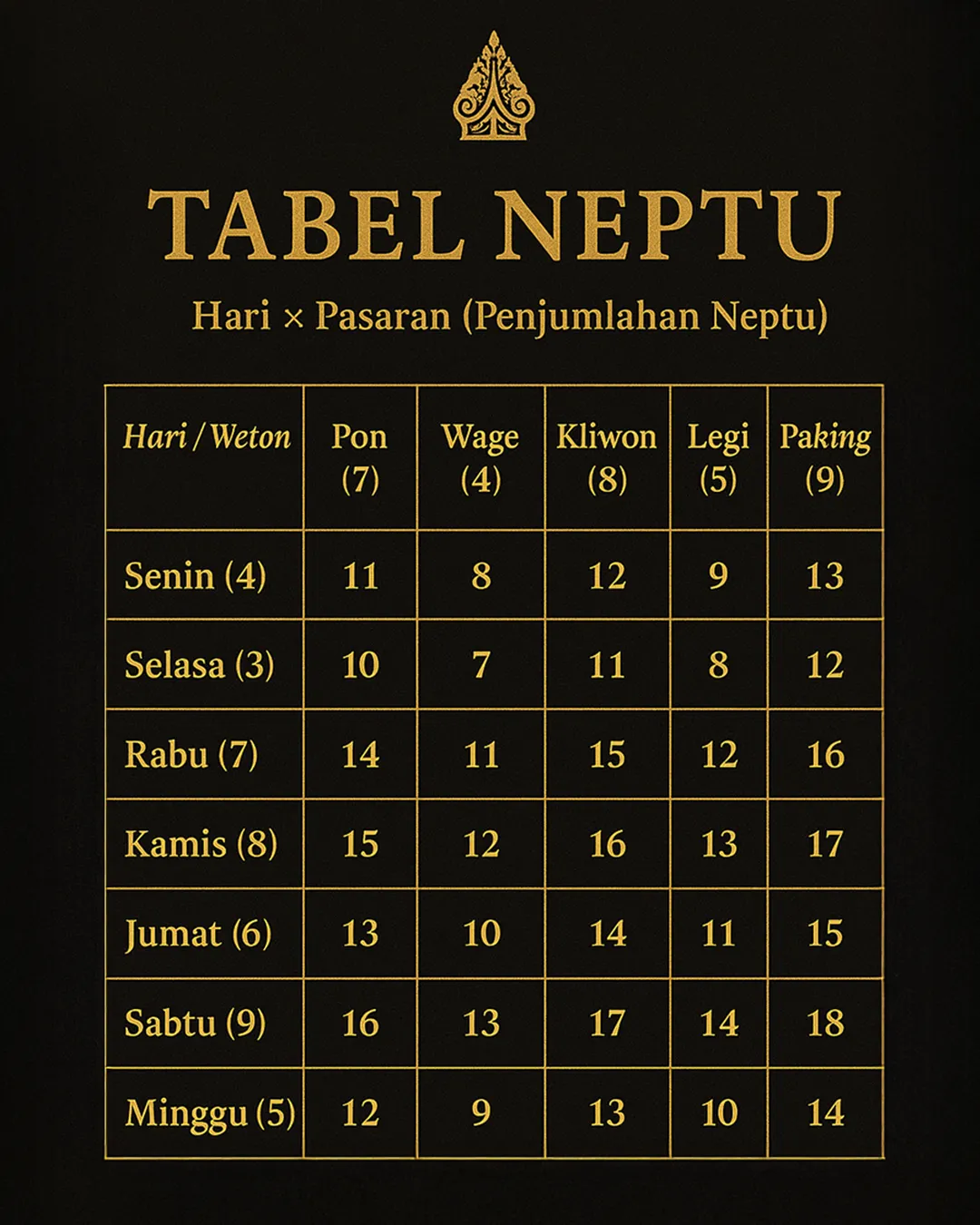
Neptu Table (Short and Easy to Read)
Common weekday values: Sunday 5, Monday 4, Tuesday 3, Wednesday 7, Thursday 8, Friday 6, Saturday 9.
Common pasaran values: Legi 5, Pahing 9, Pon 7, Wage 4, Kliwon 8.
Example: Sunday Pahing → 5 + 9 = 14. (Values may vary across sources; we follow widely used references.)
What Is It Used For? (Use Wisely)
- Choosing an auspicious day as an early cultural reference with the Javanese calendar & pranata mangsa. → Javanese Calendar
- Reflecting on personality tendencies through weton and wuku. → Weton Calculator
- Early compatibility (jodoh) reflection for couples in Javanese primbon context. → Weton Compatibility
- Career/work direction reflection as a cultural perspective on potential.
Calculation Method (Short & Transparent)
- Convert the Gregorian date into Javanese calendar elements: saptawara (weekday), pancawara (pasaran), wuku/pawukon, and optionally Javanese/Hijri date plus warsa.
- Total neptu = weekday value + pasaran value.
- Wuku is taken from the 30-cycle pawukon system and used for a brief character summary.
- Day change follows Javanese tradition (after Maghrib), and calculations use local time (Asia/Jakarta by default).
FAQ — Weton Calculator
Does this online weton calculator predict fate?
When does the day change in the Javanese calendar?
What is neptu and how is it calculated?
What is the difference between weton and wuku (pawukon)?
Can it be used to choose an auspicious day?
Can it be used for compatibility (jodoh)?
What about work/career/fortune?
Why can results differ across websites?
Does it show Javanese and Hijri dates?
Is my birth date stored?
Last updated: March 3, 2026