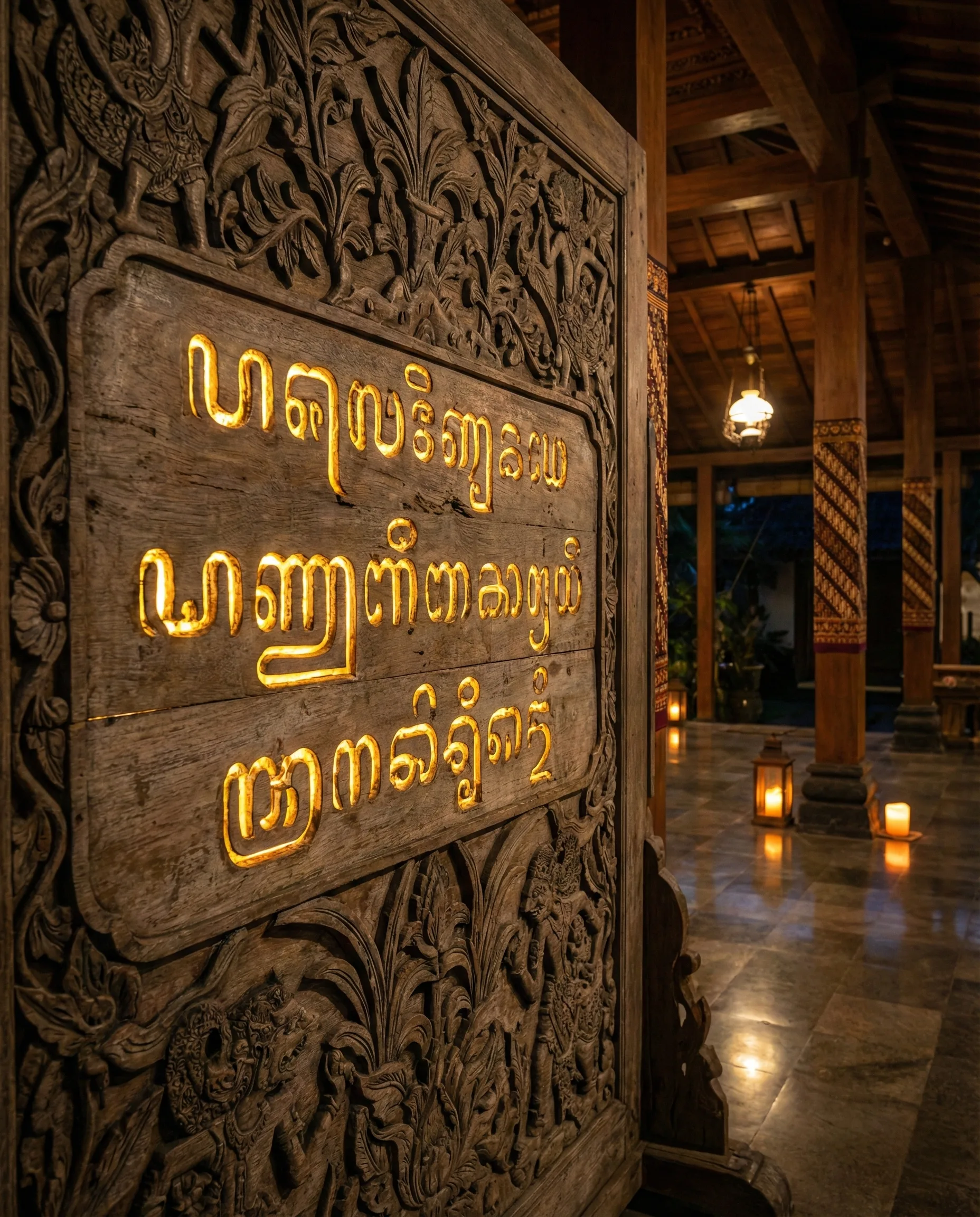
Angger, my child… Please, step inside the pendopo (traditional pavilion). The evening breeze is blowing gently, carrying the faint scent of jasmine and aged teakwood. Today, Uncle invites you to sit and reflect a little longer to unravel the mystery of pasangan vs pangkon aksara jawa. We are not merely learning to spell; we are diving into the 7 best secrets left by our ancestors through a script that is slowly becoming quiet in its own home.
To the modern eye, the flowing letters of Hanacaraka often appear merely as complex, aesthetic carvings. Our understanding frequently stops at its visual beauty, neglecting its underlying logic. Yet, if you peel back the layers one by one, the dynamics of pasangan vs pangkon aksara jawa reveal themselves as a blueprint for etiquette, empathy, and the natural harmony of the Nusantara (Indonesian archipelago) people.
One of the most confusing crossroads for modern seekers when taking their first steps on the Javanese Script page is understanding how to “kill” a vowel. In the Latin alphabet, a dead consonant stands alone without burden. However, in Hanacaraka, this is exactly where the profound knowledge of pasangan vs pangkon aksara jawa comes into play.
Both of these elements carry the heavy task of “silencing” the inherent vowel attached to a basic character. However, they possess opposing destinies, placements, and spiritual philosophies. Let us thoroughly dissect the 7 best secrets of pasangan vs pangkon aksara jawa so you may truly grasp its depth.
1. Syllabic Architecture: The Root of Pasangan vs Pangkon Aksara Jawa
Before we contrast the rules of pasangan vs pangkon aksara jawa, we must sit together and understand the anatomy of this script. This is the first secret. The Javanese script rests upon 20 basic characters known as Aksara Legena (Ha, Na, Ca, Ra, Ka, Da, Ta, Sa, Wa, La, Pa, Dha, Ja, Ya, Nya, Ma, Ga, Ba, Tha, Nga).
The word legena means “naked”—meaning it has not yet been dressed with punctuation marks (vowel symbols). Uniquely, each of these characters inherently contains a full “a” vowel sound. So, when you write the symbol “Ka”, you are directly pronouncing the syllable “Ka”. But what if we want to write a word that requires a dead letter (pure consonant), such as “Mangan” (To eat) or “Kembang” (Flower)?
To conquer this challenge, the master linguists of the past formulated a text-flow system that birthed the rule of pasangan vs pangkon aksara jawa. It is a system that goes beyond grammar; it serves as a reminder that in life, there is a time to halt, and a time to bridge connections.
2. Pangkon: The Guardian of the Boundary and the Point of Rest
Let us step into the second secret in our study of pasangan vs pangkon aksara jawa: the Pangkon element. Imagine Pangkon as a resting gate at the edge of a village. Visually, the pangkon symbol (꧀) is written behind a character, as if cradling it to sleep.
The Technical Function of Pangkon
The sole function of pangkon is to strip away the inherent vowel sound (“a”) from an legena character, turning it into a pure consonant. If the character “Na” is given a pangkon, it falls silent, leaving only the humming consonant sound of “n”.
The Strict Rule (Paugeran) of Pangkon
This is the iron law that distinguishes pasangan vs pangkon aksara jawa: Pangkon is strictly only permitted at the very end of a standalone word or at the absolute end of a sentence. Pangkon is the ultimate brake; it is the point where the reader’s breath comes to a peaceful halt.
3. The Secret Philosophy of “Pangku”: Silencing the Ego in Tranquility
Angger, our ancestors did not name things by coincidence. The word “pangkon” derives from “pangku”, which means to hold in one’s lap. This is the third secret of pasangan vs pangkon aksara jawa. In the cycle of lakuning urip (the journey of life), there is no movement without pause. Every long journey requires a resting place.
The concept of “pangku” at the end of a sentence teaches us about Suwung (meaningful emptiness) and ultimate peace. When a letter is placed in the lap (dipangku), it is not destroyed; it is laid to rest. It finds its tranquility at the end of the road, much like a human reaching the end of their journey with graceful acceptance.
4. Pasangan: The Bridge of Harmony Amidst the Current
Then what happens if the “death” of a letter must occur in the middle of a sentence’s journey? This is where the balance of pasangan vs pangkon aksara jawa is tested. In a phrase like “Bapak Sare” (Father sleeps), the dead “K” character crashes directly into the “S” of the syllable “Sa”.
A rushed modern mind might think: “Just use a pangkon in the middle of the sentence.” However, in the civilization of Nusantara, using a pangkon mid-sentence is akin to abruptly slamming the brakes on your horse-drawn carriage, sending your passengers tumbling. It destroys the rhythm. The law demands that we use the balancing element of pasangan vs pangkon aksara jawa, which is: Pasangan (The Counterpart).
Function and Placement of Pasangan
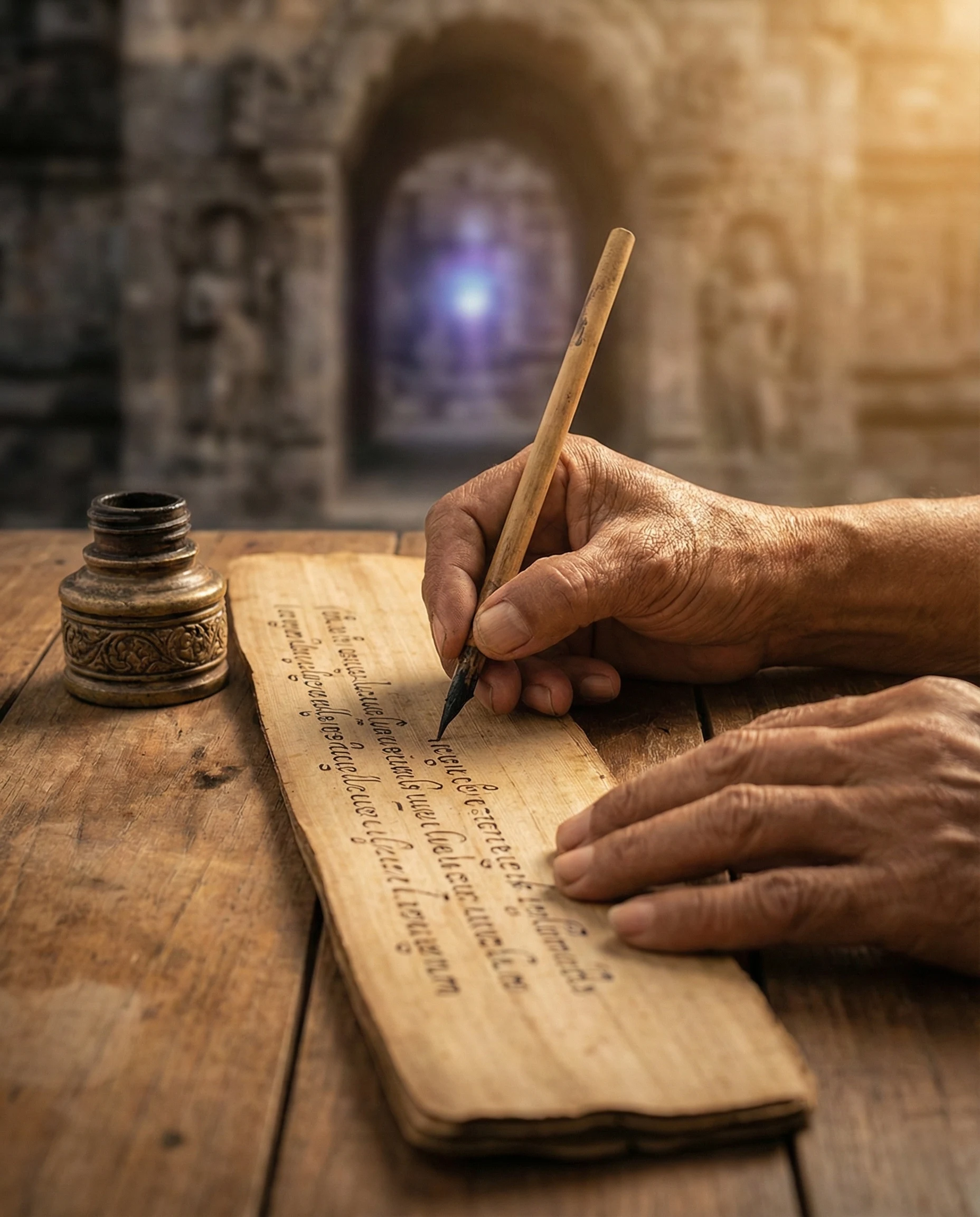
Pasangan functions to silence the vowel of the character that precedes it. It does this beautifully: the second character voluntarily alters its original form (usually written smaller underneath or to the side), and its presence automatically absorbs the life (vowel) of the first character so the sentence can continue to flow. This is the technical core of the pasangan vs pangkon aksara jawa puzzle.
5. Tepa Selira: The Hidden Message Behind Pasangan
The fifth secret from the study of pasangan vs pangkon aksara jawa is a grand manifesto on Tepa Selira (empathy and tolerance) and Sambung Rasa (emotional connection).
Observe this dynamic closely: to prevent the flow of the sentence from breaking, the second character is willing to “lower its status” and alter its shape to embrace the first character that has died on the path. The harmony of life is not achieved through abrupt isolation or severing (Pangkon), but through sacrifice and form adaptation for the sake of communal survival (Pasangan). Is this not the reflection of an ideal, harmonious society?
6. Ancestral Big Data: The Table of Pasangan vs Pangkon Aksara Jawa
To accommodate your rational mind, Uncle has summarized this comparative matrix of pasangan vs pangkon aksara jawa like modern digital data:
| Distinguishing Aspect | Pangkon (꧀) | Pasangan (20 Forms) |
|---|---|---|
| Primary Function | Kills the pure vowel at the end of a breath/sentence. | Kills the preceding character mid-sentence to bridge words. |
| Writing Position | Always at the absolute end (of a word/sentence). | Fluidly positioned in the middle, bridging words. |
| Form Characteristics | One standard shape resembling folded wings. | 20 adaptive variations depending on the origin character. |
| Impact on Reading Flow | Halts the breath. Provides an absolute pause. | Flows the breath. Ensures no abrupt breaks in pronunciation. |
| Philosophical Metaphor | Ultimate peace, acceptance, the end of a journey. | Tolerance, supporting one another, maintaining bonds. |
7. Weaving the Practice: Sentence Architecture Case Study
The seventh and final secret to mastering pasangan vs pangkon aksara jawa is not allowing this knowledge to turn to stone. We must practice it. Let us dissect a simple sentence to see it in action.
Case: Writing the sentence “BAPAK TINDAK” (Father Goes)
- The word “Bapak” ends with the dead consonant “K”. However, because it is directly followed by the word “Tindak” (starting with T), the letter K in Bapak is strictly forbidden from using a Pangkon.
- The Solution: We place the Pasangan Ta beneath the “Ka” character in the word Bapak. Pasangan Ta silences the “Ka” vowel, weaving it smoothly into “K-Ti”.
- Then, at the end of the word “Tindak” (which also ends in K), because this is the end of the sentence’s breath, the peacemaker takes its role: the final “Ka” character is peacefully embraced by a Pangkon.
This profound knowledge is also neatly documented in the authoritative history of Javanese Script on Wikipedia, where the strict Sriwedari writing guidelines have upheld this rule for generations to protect the integrity of Javanese literature.
Preserving the Heritage of Harmony in the Digital Era
Angger, my child…
Studying the structure of pasangan vs pangkon aksara jawa is by no means a romantic escape to the past. This grammatical rule, with its precise if-then statement logic, is remarkably similar to how a modern developer writes computer code.
It is this structural wisdom that makes JavaSense (Javanese Wisdom) so noble. The way our ancestors viewed cyclical time through the Javanese Calendar, or their methods for reading human rhythms via Weton Compatibility and the Weton Calculator framework—all are rooted in the awareness that everything in this world is interconnected.
Utilize the wisdom of pasangan vs pangkon aksara jawa that we have unveiled today. Stop by our JavaSense Tools page to simulate this knowledge on your smart screens.
Be the mediating bridge (pasangan) for those struggling around you, and be the ultimate peace (pangkon) for the anxieties of this world.
Mugi Rahayu Sagung Dumadi. (May safety and prosperity encompass the universe).